
Case Background
The case arose from village Jhouwari, under Banmankhi Police Station in Purnea district, Bihar. The appellant and the informant’s family lived in houses facing each other in the same village.
The informant’s daughter, Maharani Devi, and the appellant developed a love relationship. In 2006, they married. According to the prosecution, tensions existed in the marriage, and the appellant used to beat Maharani Devi.
It was stated that in 2009, there was an incident of beating which led to a Panchayat meeting. The prosecution claimed the appellant became angry because of this Panchayat.
Out of the marriage, a daughter, Madhu Kumari, was born. At the time of the incident in August 2011, she was about three years old.
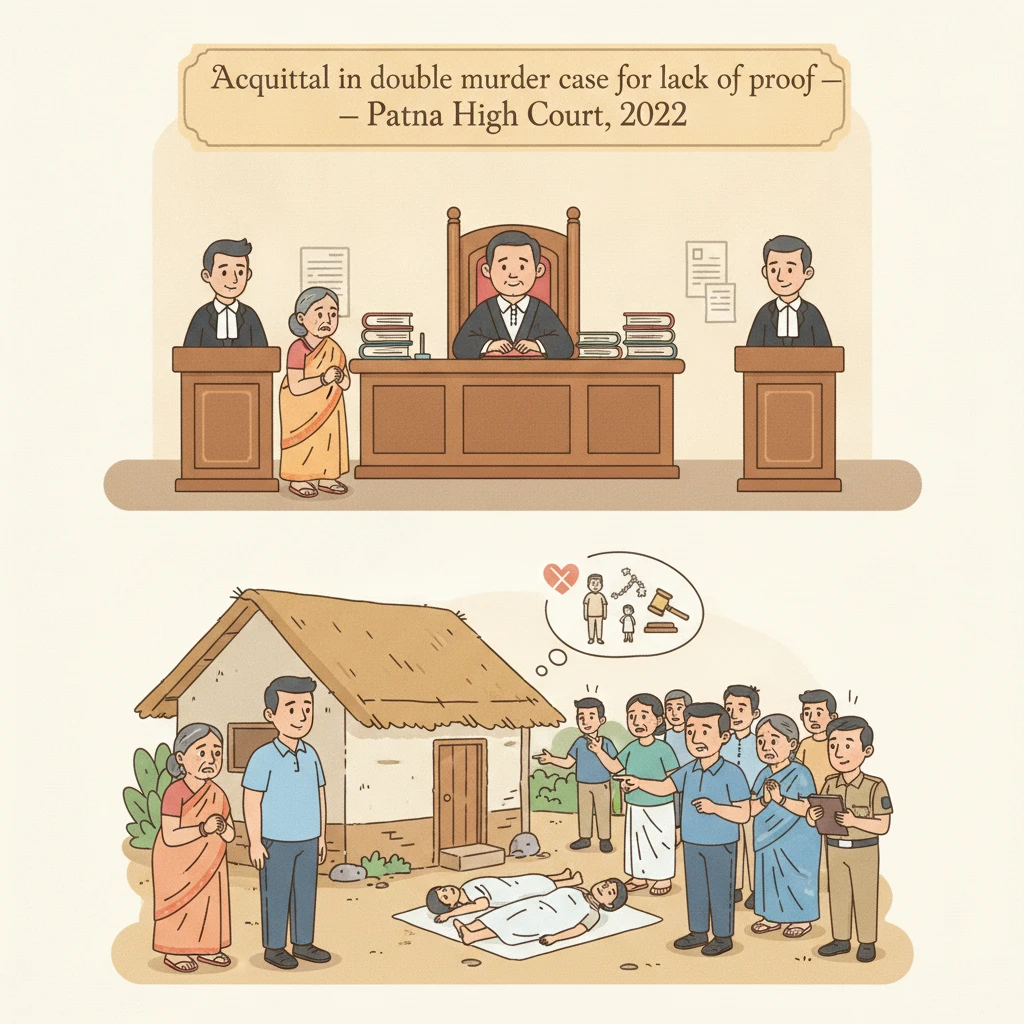
On 31.08.2011, around 3:00 p.m., both Maharani Devi and her child Madhu Kumari died. The prosecution case was that the appellant killed both by throttling. Many villagers allegedly rushed to the informant and told her that her daughter and granddaughter had been murdered.
The informant, P.W.11, then went to the appellant’s house. She saw the dead bodies of Maharani Devi and Madhu Kumari lying in the front yard of the appellant’s house. She noticed injuries on the neck of both bodies. On the same day, she lodged a First Information Report at Banmankhi Police Station, leading to registration of Case No.130 of 2011 under Section 302 of the Indian Penal Code.
During investigation, the Investigating Officer, P.W.13, prepared inquest reports and sent the bodies for post-mortem at Sadar Hospital, Purnea. Dr. Umesh Kumar (P.W.10) conducted the autopsy.
On completion of investigation, the police filed a charge-sheet against the appellant for murder under Section 302 IPC. The case was committed to the Sessions Court as Sessions Trial No.320 of 2012.
The Adhoc Additional Sessions Judge-V, Purnea framed charge under Section 302 IPC. The appellant pleaded not guilty, claimed trial, and took the defence of complete denial. The defence examined four witnesses in support.
After trial, the Sessions Court held that the appellant had murdered his wife and daughter, convicted him under Section 302 IPC, sentenced him to rigorous imprisonment for life, and imposed a fine of Rs.10,000/-, with two months’ simple imprisonment in default.
Aggrieved, the appellant filed Criminal Appeal (DB) No.87 of 2014 before the Patna High Court challenging both conviction and sentence.
What the Court Examined and Decided
The Division Bench of the Patna High Court, consisting of Hon’ble Mr. Justice A. M. Badar and Hon’ble Mr. Justice Sunil Kumar Panwar, heard the appeal. The judgment was authored by Hon’ble Mr. Justice A. M. Badar.
On behalf of the appellant, it was argued that there was no reliable evidence connecting him with the deaths. It was submitted that the key witness, the informant P.W.11, was unreliable and had changed her version.
The State relied on Section 106 of the Indian Evidence Act. The prosecution argued that since the wife and daughter died inside the appellant’s house, it was for him to explain how they died. As he did not explain, an adverse inference should be drawn and the conviction should be upheld.
The Court first examined whether the deaths were homicidal. P.W.11, the mother of the deceased woman, clearly stated that her daughter and granddaughter died in the incident. The defence did not dispute the fact of death but claimed that they were suicidal deaths.
P.W.13, the Investigating Officer, confirmed that he sent the dead bodies for autopsy. P.W.10, Dr. Umesh Kumar, conducted the post-mortem examinations. He found ligature marks around the necks of both deceased. He also noted fractures of the hyoid bone, thyroid cartilage, and tracheal rings. There was laceration around the ligature marks.
Based on these findings, P.W.10 concluded that both had died due to asphyxia caused by strangulation. On this medical evidence, the Court accepted that death was by strangulation, but the key question remained: who caused it, and was it proven to be murder committed by the appellant.
The Court then examined the oral evidence. The prosecution had examined 13 witnesses, most of them co-villagers.
P.W.3, P.W.4, P.W.5, P.W.6, P.W.7, P.W.8, and P.W.9, all co-villagers, turned hostile. They did not support the prosecution case and said nothing incriminating the appellant. They only confirmed the fact of love marriage between the appellant and Maharani Devi.
P.W.1 and P.W.2, also co-villagers, spoke of quarrels between the couple on account of financial problems after the love marriage. However, both of them stated that the deaths were suicidal and that the appellant had not murdered Maharani Devi and Madhu Kumari.
P.W.1 stated that Maharani Devi died a suicidal death after her mother, P.W.11, had told her that after her third cesarean she would not be able to give birth to another child. P.W.2 supported the suicidal theory and added that after the incident P.W.11 cursed the appellant, saying that he should die and that he would not get bail.
P.W.12 expressed ignorance about the incident and did not support either side in any meaningful way.
The Investigating Officer, P.W.13, deposed about recording the FIR and the course of investigation. His cross-examination turned out to be important. He stated that the dead bodies were found inside a mud house which had no door or window, making it accessible to all. The prosecution did not bring on record any detail of the rope or noose used for strangulation. Nor did it clarify the exact manner or place where the bodies were hanging, despite the medical evidence of ligature marks.
Thus, the investigation and prosecution evidence did not clearly reveal how the offence took place or tie the act of strangulation to the appellant.
The crucial witness for the prosecution was P.W.11, the informant and mother of the deceased woman. In the FIR she lodged promptly on 31.08.2011, she had not claimed to be an eye-witness. She wrote that at about 3:00 p.m., many villagers came to her and told her about the murders, and then she went and saw the dead bodies in the appellant’s front yard.
However, when she gave evidence in Court, she made a major change. She claimed she had personally seen the appellant throttling her daughter and granddaughter and that the murders were because a Panchayat had been convened earlier over the appellant’s beating of Maharani Devi.
The High Court treated this as a material improvement. It held that P.W.11 had changed her version to show herself as an eye-witness, which she was not according to her own FIR. The Court noted that her version of “throttling by hand” (constricting the neck) was also contrary to the medical evidence of ligature marks and laceration caused by a ligature like rope. The Court described her as an interested witness who had modulated her version to fit the prosecution case, and concluded that she was not a witness of truth. Therefore, her testimony could not be safely relied upon.
After rejecting P.W.11’s improved version, the Court noted that there was no other evidence placing the appellant at the scene at or around the time of the incident. The prosecution had not shown that he was seen before, during, or immediately after the occurrence inside the house.
The house itself, being a mud structure without doors or windows, was open to anyone. There was no evidence about any specific weapon or material used for strangulation recovered at his instance or otherwise.
In these circumstances, the Court turned to the State’s reliance on Section 106 of the Evidence Act. It reiterated the settled principle that the prosecution must first discharge its initial burden of establishing, at least prima facie, that the accused is connected to the crime. Only then does Section 106, which deals with facts especially within the knowledge of a person, come into play.
Here, the prosecution had failed to prove basic facts linking the appellant to the act of killing. There was no reliable eye-witness evidence, no circumstantial chain, and no proof of his presence at the crucial time. Therefore, Section 106 could not be used to shift the burden onto the appellant.
Although the Court found it unnecessary to rely on the defence evidence, it still examined it. The defence had produced four co-villagers as D.W.1 to D.W.4.
D.W.1, an agriculturist with a field next to that of the appellant, deposed that at around 3:00 p.m. on the day of the incident, he saw the appellant in his field cutting grass. Then a message came about the death of the appellant’s wife and daughter. D.W.1 said that he and another villager, P.W.2, accompanied the appellant back to his house and saw the dead bodies there. His cross-examination did not shake his version.
D.W.2, a neighbour of the appellant, stated that he rushed to the house on hearing the shouts of P.W.11. He saw the dead bodies of Maharani Devi and Madhu Kumari hanging from a noose. The appellant was not present in the house then. D.W.2 said he opened the noose and lowered the bodies to the ground. Only after that did the appellant arrive and start weeping. The prosecution could not discredit D.W.2 in cross-examination.
D.W.3 and D.W.4 stated that they had seen the dead bodies lying on the ground at the appellant’s house. The rest of their testimony was based on what they heard from others.
From the overall evidence, the High Court concluded that the prosecution case was weak, incomplete, and doubtful. It was not safe to uphold a conviction for murder based on such material.
The Bench held that the prosecution had failed to prove beyond reasonable doubt that the appellant had murdered his wife and daughter by throttling. Consequently, it set aside the trial court’s judgment and order dated 29.11.2013 and 30.11.2013 in Sessions Trial No.320 of 2012.
The appeal was allowed. The appellant was acquitted of the charge under Section 302 IPC and ordered to be released forthwith, if not required in any other case. Any fine paid was directed to be refunded.
Why This Judgment Matters
This judgment of the Patna High Court has practical importance for criminal cases based mainly on suspicion and weak evidence. It shows that even in serious offences like double murder within the family, courts will not uphold a conviction unless the evidence is clear, consistent, and trustworthy.
For villagers and families, the case highlights how initial statements given in the FIR are very important. If a person later changes their story in court in a major way, the court may not trust their testimony.
The decision also underlines that the police must thoroughly investigate how a death took place. They must collect and present concrete proof linking the accused to the act, not just assume guilt because the deaths occurred in his house.
Finally, the ruling clarifies that Section 106 of the Evidence Act cannot be used to shift the entire burden of proof onto the accused when the prosecution has not first shown a basic connection between the accused and the crime.
Legal Issues and Answers
-
Issue: Did the prosecution prove beyond reasonable doubt that the appellant murdered his wife and minor daughter by throttling them?
Answer: No. The Patna High Court found the prosecution evidence unreliable, incomplete, and insufficient to connect the appellant to the act of killing. -
Issue: Could Section 106 of the Indian Evidence Act be applied to presume that the appellant, as head of the house, committed the murders when he did not explain the deaths?
Answer: No. The Court held that Section 106 applies only after the prosecution first establishes a prima facie case. As the prosecution failed to prove the appellant’s presence or role, Section 106 could not be invoked. -
Issue: Was the sole testimony of the informant, who materially improved her version from the FIR to her court evidence, sufficient for conviction?
Answer: No. The Court held that her improved testimony was inconsistent with her FIR and with the medical evidence, and she was an interested witness whose evidence could not safely be relied upon.
Cases Cited by the Court
- The text of the judgment provided does not mention or discuss any other specific decided cases. No prior judgments have been cited or relied upon in the extracted content.
Case Details
Case Number: Criminal Appeal (DB) No.87 of 2014; arising out of P.S. Case No.130 of 2011, Banmankhi Police Station, District Purnea.
Case Title: Birendra Yadav v. The State of Bihar.
Citation: 2022(2) PLJR 16.
Court: High Court of Judicature at Patna.
Coram: Hon’ble Mr. Justice A. M. Badar and Hon’ble Mr. Justice Sunil Kumar Panwar.
Date of Judgment: 10.03.2022 (CAV judgment; CAV date 08.03.2022).
Advocates: For the appellant: Mr. Praveen Kumar Agrawal, Advocate. For the State: Mr. S. N. Prasad, A.P.P.
Nature of the Case: Criminal appeal (Division Bench) against conviction and sentence under Section 302 of the Indian Penal Code, arising from Sessions Trial No.320 of 2012 decided by the Adhoc Additional Sessions Judge-V, Purnea.
Final Outcome: Appeal allowed; conviction and sentence under Section 302 IPC set aside; appellant acquitted and to be released if not required in any other case; fine, if paid, to be refunded.
If you found this explanation helpful and wish to stay informed about how legal developments may affect your rights in Bihar, you may consider following Samvida Law Associates for more updates.







