

Case Background
The petitioner was working as a police constable in Bihar. A dispute arose between him and a colleague, one Ajay Singh, over a friendly loan of Rs. 2,000. It was alleged that the petitioner had borrowed this amount and not returned it, leading to a physical quarrel between them.
On this basis, the official respondents initiated two separate actions. One was a criminal case, and the other was a departmental disciplinary proceeding. Thus, the petitioner faced parallel proceedings arising out of the same incident.
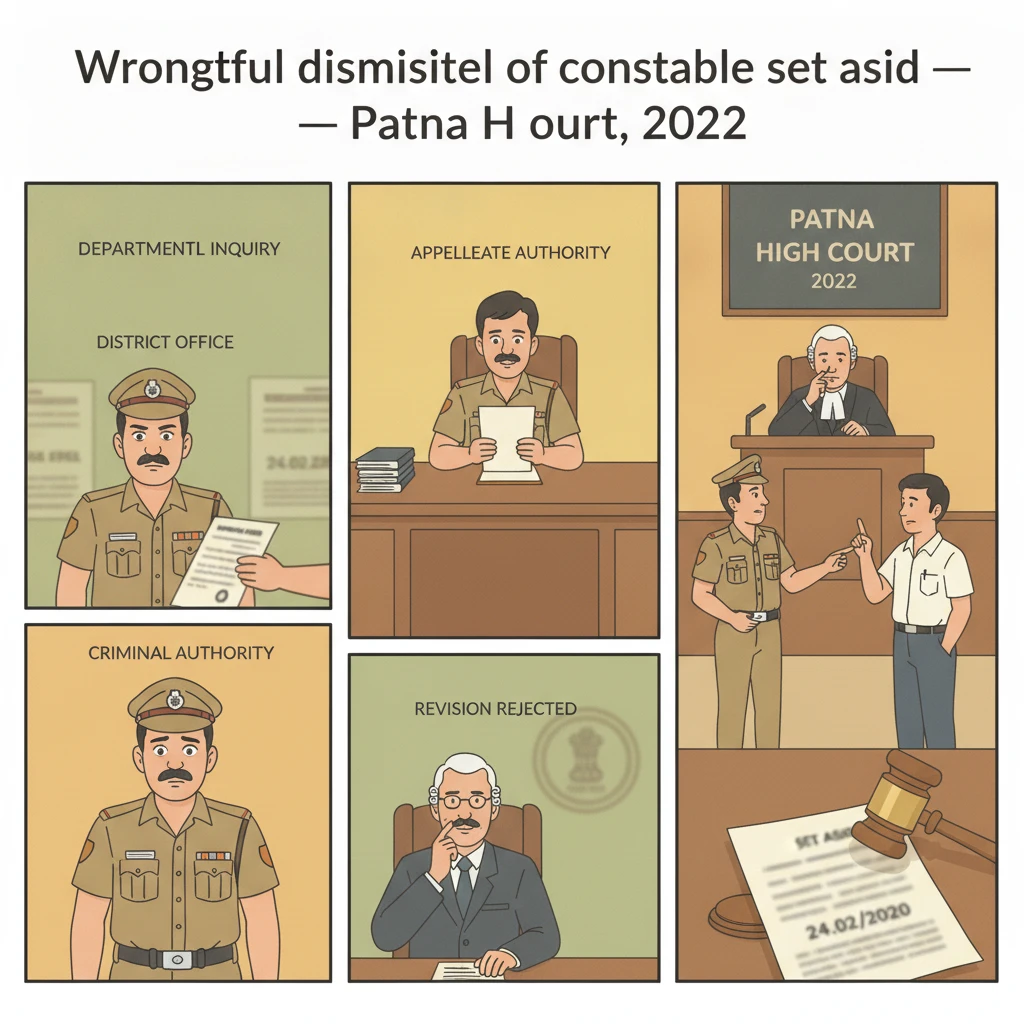
In the criminal case, the petitioner was later acquitted on 24.02.2020. However, long before this acquittal, the departmental side had already moved ahead and imposed the harshest service penalty.
In the disciplinary proceeding, the authorities framed articles of charge against the petitioner on 25.11.2011. The inquiry officer conducted hearings on 10.02.2012 and 27.02.2012. According to the record as read by the High Court, the petitioner did not participate in this inquiry, and it proceeded ex parte.
After the inquiry officer submitted his report, the disciplinary authority issued a show-cause notice on 07.03.2012 along with a copy of the report. The petitioner submitted his explanation to this notice.
Despite his explanation, the Superintendent of Police, Purnea, acting as disciplinary authority, dismissed the petitioner from service by order dated 06.04.2012. The petitioner then filed a departmental appeal before the Deputy Inspector General, Purnea, which was rejected on 18.07.2012. Still aggrieved, he preferred a revision before the Director General of Police, Bihar, which too was dismissed by order dated 30.04.2013.
Having failed at all departmental levels, the petitioner approached the Patna High Court under its writ jurisdiction in Civil Writ Jurisdiction Case No. 15166 of 2013. He asked the Court to quash the dismissal order, the appellate order, and the revisional order, and to direct his reinstatement with all consequential benefits.
What the Court Examined and Decided
The core question before the Patna High Court was whether the departmental inquiry that led to the constable’s dismissal had been conducted according to law and principles of natural justice.
The petitioner’s counsel argued that the entire inquiry was ex parte and that key procedural safeguards were ignored. He pointed out that on the dates of inquiry, 10.02.2012 and 27.02.2012, the presenting officer was not present before the inquiry officer. He submitted that under the rules of disciplinary proceedings, the presenting officer is appointed to represent the department, lead evidence, and prove the charges. If the presenting officer does not participate, the inquiry cannot be said to be properly conducted.
The petitioner also asserted that because of these lapses, the inquiry officer ended up playing a dual role—both as judge and as prosecutor—by examining the material himself and then holding the charges to be proved. This, it was argued, was contrary to the disciplinary procedure and violated natural justice.
On the other side, the State’s counsel, on instructions, disputed the claim that the inquiry was ex parte. He submitted that the petitioner had actually appeared before the inquiry officer on 10.02.2012 and 27.02.2012. Therefore, according to the State, the inquiry could not be termed ex parte.
The State also argued that the charge of physical quarrel with a colleague was very serious, especially because the petitioner was a member of the Police Department and was expected to be a model to the general public. On this basis, the State maintained that the penalty of dismissal was justified.
As to the later criminal acquittal dated 24.02.2020, the State submitted that it had no bearing on the departmental punishment. The State emphasized that criminal cases relate to offences under criminal law, while departmental proceedings deal with misconduct under service rules. Therefore, according to the State, an acquittal in the criminal case could not affect the penalty already imposed under the disciplinary rules.
After hearing both sides, the Patna High Court examined the record of the departmental proceedings. The Court first noted certain undisputed facts. The petitioner had indeed faced both criminal and departmental proceedings arising out of the same incident. The disciplinary proceeding had ended with the dismissal order dated 06.04.2012, which was later affirmed by the appellate authority on 18.07.2012 and by the revisional authority on 30.04.2013.
On scrutiny of the record, the Court found that the inquiry had in fact proceeded ex parte and that the presenting officer had not presented the departmental case before the inquiry officer. In other words, the Court found that the inquiry officer had effectively acted both as inquiry officer and presenting officer.
The Court held that such a procedure was contrary to the provisions of the disciplinary rules. The role of a presenting officer is to appear on behalf of the department, produce witnesses, and prove documents. When the same person also acts as the decision-maker in the inquiry, the basic separation between prosecution and adjudication breaks down.
The Court went further and discussed the recording of the petitioner’s presence. It observed that if in fact the petitioner had appeared on 10.02.2012 and 27.02.2012, as claimed by the State, then it was the bounden duty of the inquiry officer to record his presence in the day-to-day proceedings and to obtain his signature at the close of each day’s proceedings.
The Court found that this had not been done. Therefore, even if the petitioner had appeared on those dates, the inquiry officer’s failure to record his presence and obtain his signature was a serious procedural lapse. From this omission, the Court drew the inference that the petitioner had remained ex parte in the inquiry.
In light of these findings, the Court rejected the State’s contention that the inquiry was properly conducted. It held that there was a serious lacuna in the inquiry itself, mainly because the presenting officer did not present the department’s case, and the alleged charge was never proved by leading oral or documentary evidence before the inquiry officer.
The Court noted that on this issue alone, the petitioner had made out a strong prima facie case warranting interference with the orders of dismissal, the appellate order, and the revisional order. Since the foundation of the punishment—the departmental inquiry—was legally defective, the High Court concluded that the dismissal could not stand.
Accordingly, the Patna High Court set aside the dismissal order dated 06.04.2012, the appellate order dated 18.07.2012, and the revisional order dated 30.04.2013.
Having quashed these orders, the Court then issued positive directions to the authorities. It directed the concerned official respondents to reinstate the petitioner in service within one month from the date of receipt of the Court’s order.
The Court further held that the petitioner was entitled to all service benefits, including monetary benefits, as if he had not been dismissed. It ordered that these benefits be calculated and disbursed in favour of the petitioner within two months from the date of receipt of the order.
In effect, the High Court not only invalidated the dismissal but also restored the petitioner’s service and his financial entitlements for the period he had remained out of employment due to the illegal disciplinary action.
Why This Judgment Matters
This judgment is important for government employees and especially for members of disciplined forces like the police. It shows that even where allegations appear serious, the department must still follow proper procedure while holding disciplinary inquiries.
The Patna High Court has made it clear that an inquiry cannot be treated as valid if it is conducted ex parte without proper reasons, or if the presenting officer does not participate and the inquiry officer ends up playing both roles. Departments must lead evidence, record daily proceedings, and obtain signatures of the charged employee when he appears.
The case also demonstrates that employees can challenge illegal inquiries even many years later, and that courts can order reinstatement with full benefits when the basic process is flawed. For employees dismissed after one-sided inquiries, this judgment offers a concrete example of how courts examine the fairness of the process, not just the nature of the allegation.
At the same time, the judgment clarifies that criminal acquittal and departmental proceedings are distinct. The High Court did not base its decision on the later acquittal but on procedural defects in the departmental inquiry itself. Thus, the key lesson is the central role of due process in disciplinary matters.
Legal Issues and Answers
Issue: Whether the departmental inquiry against the police constable, leading to his dismissal, was conducted in accordance with disciplinary rules and principles of natural justice.
Answer: No. The Patna High Court held that the inquiry was vitiated because it effectively proceeded ex parte, the presenting officer did not present the departmental case, the inquiry officer acted in a dual role, and the petitioner’s presence was not properly recorded with his signatures.
Issue: Whether the dismissal order and the subsequent appellate and revisional orders could stand on the basis of such an inquiry.
Answer: No. Finding serious procedural lapses, the Court set aside the dismissal, appellate, and revisional orders and directed reinstatement with all consequential service and monetary benefits.
Issue: Whether the petitioner’s later acquittal in the criminal case automatically invalidated the dismissal.
Answer: The Court noted the acquittal but did not treat it as the basis for relief. Instead, it held that criminal proceedings and disciplinary proceedings are distinct, and interfered with the dismissal due to defects in the inquiry process.
Cases Cited by the Court
- The judgment text does not mention or rely upon any specific earlier case law. No prior cases are cited.
Case Details
Case Number: Civil Writ Jurisdiction Case No. 15166 of 2013
Case Title: Pankaj Kumar Paswan v. The State of Bihar and Others
Citation: 2022 (3) PLJR 273
Court: High Court of Judicature at Patna
Coram: Hon’ble Mr. Justice P. B. Bajanthri
Date of Judgment: 12.05.2022
Advocates:
- For the Petitioner: Mr. Abdul Mannan Khan, Advocate; Mr. Binay Kumar, Advocate
- For the Respondents: Mr. Tej Bahadur Singh, Advocate
Nature of the Case: Writ petition under Article 226 of the Constitution challenging dismissal from service and related appellate and revisional orders in a departmental proceeding.
Key Orders Challenged:
- Dismissal order dated 06.04.2012 passed by the Superintendent of Police, Purnea.
- Appellate order dated 18.07.2012 passed by the Deputy Inspector General, Purnea Range.
- Revisional order dated 30.04.2013 passed by the Director General of Police, Bihar, Patna.
Final Outcome: Writ petition allowed; all three orders set aside; directions issued for reinstatement with full service and monetary benefits.
Link to Judgment: Patna High Court Judgment in CWJC No. 15166 of 2013
If you found this explanation helpful and wish to stay informed about
how legal developments may affect your rights in Bihar,
you may consider following Samvida Law Associates for more updates.







