
Case Background
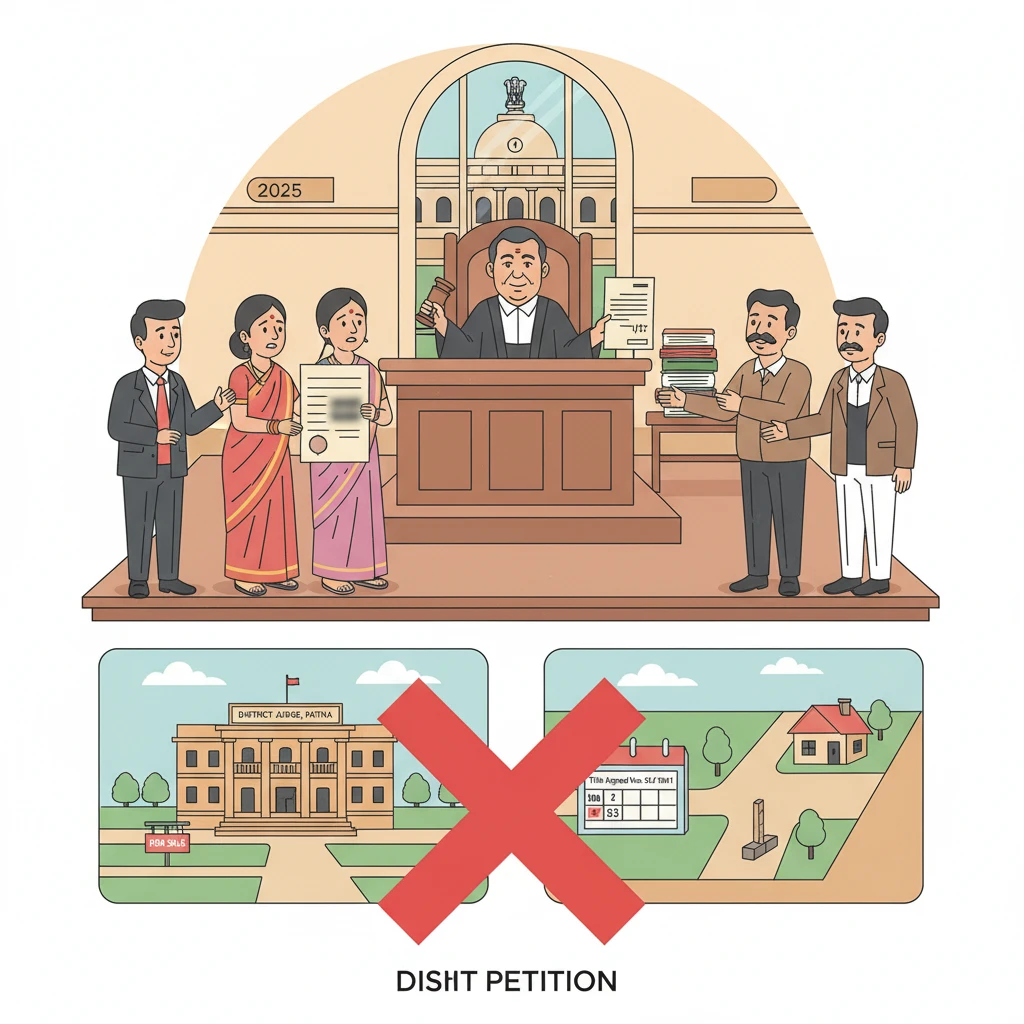
The petitioners are two women residing in Rajendra Nagar, Patna. They claimed to be joint purchasers and long-time peaceful possessors of a piece of raiyati land in Mauza Shahbudin Pakari (Dusadhi Pakari), under Survey Thana No. 25, Phulwari Sarif, District Patna. The land is recorded as Plot No. 246, Khata No. 74, Tauji No. 173 C.
According to the petitioners, they had acquired this land through a registered sale deed in the year 1976. Later, a civil dispute arose about the title over this property. A title suit being Title Suit No. 74 of 1996 was filed in the Court of the Sub Judge, Patna. That suit related to the same land now in dispute in this criminal writ.
The civil court decided Title Suit No. 74 of 1996 on 16.03.2011. The petitioners stated that this judgment and decree confirmed their right, title and possession over the land. They also stated that during the pendency of that suit, one Maheshwar Singh executed a sale deed in favour of respondent no. 8, Umesh Kumar Yadav, on 24.12.2002.
The petitioners’ stand was that Maheshwar Singh had no valid title to the land, and therefore could not pass any title to respondent no. 8. They alleged that despite this, respondent no. 8 was disturbing their possession and trying to take forceful possession of the land and undertake illegal construction.
Before the Patna High Court, the petitioners approached the criminal writ jurisdiction in Criminal Writ Jurisdiction Case No. 2829 of 2017. They claimed they were in peaceful possession for the last 38 years and sought police protection and preventive action against respondent no. 8.
What the Court Examined and Decided
The petitioners asked for four broad reliefs. First, a mandamus directing the State authorities to take legal action against respondent no. 8 and to restrain him from forcibly dispossessing them or making illegal construction on their raiyati land. Second, a direction to the Officer-in-Charge, Kankarbagh Police Station (respondent no. 7) to recommend initiation of proceedings under Section 144 of the Code of Criminal Procedure over the land, so that both sides could be restrained from quarrelling and peace could be maintained.
Third, they sought a direction to the authorities to provide them protection so that their alleged right, title and possession, as per the civil court judgment dated 16.03.2011, could be safeguarded from alleged illegal dispossession by respondent no. 8. Fourth, they prayed for any other relief the Court found fit.
On facts, the petitioners repeatedly stressed that they were fully protected by the civil court judgment dated 16.03.2011 in Title Suit No. 74 of 1996, and that respondent no. 8, being only a purchaser during pendency of that suit, had no right, title or interest in the property. Their “limited grievance” before the writ court, as recorded, was that respondent no. 8 be restrained from forceful dispossession.
On the other side, learned counsel for respondent no. 8 and the learned counsel for the State brought an important fact to the Court’s notice. They submitted that both sides had admitted that the land in question is the same as the subject matter of the civil suit decided on 16.03.2011, and that this judgment and decree have already been challenged in appeal before the District Judge, Patna.
That appeal is registered as Title Appeal No. 53 of 2011, and it is pending over the very same land. Counsel for the State specifically argued that since the matter of title over the property is already before the competent civil appellate court, the present writ petition is not maintainable.
This led the Patna High Court to frame the central question for consideration:
“If the dispute with regard to title over the land in question is pending before the Competent Court, whether writ court has jurisdiction to pass any order?”
The Court noted that the petitioners themselves admitted that the dispute over title is pending in appeal. The petitioners tried to distinguish respondent no. 8 by arguing that he is not a party to the title appeal and that his purchase was during the pendency of the original suit in 2002. They claimed that his vendor has already lost the suit in 2011 and therefore respondent no. 8’s right is a nullity.
However, the Court focused on the nature of its writ jurisdiction under Article 226 of the Constitution and on the existence of parallel civil proceedings. The Court observed that the petitioners themselves admit that the question of right, title and possession over the land is sub judice in Title Appeal No. 53 of 2011, which has not been finally decided.
The Court held that when the title over the land has not yet been finally decided by the appropriate civil court, the writ court cannot use a summary procedure to decide to whom title vests. In essence, the High Court refused to convert writ proceedings into a forum for deciding contested property rights and title disputes.
To support this approach, the Court referred to settled Supreme Court law. It noted that in a catena of judgments, the Supreme Court has held that a regular civil suit is the appropriate remedy for disputes about property rights between private persons. The remedy under Article 226 is generally not available in such cases unless there is an allegation of violation of some statutory duty by a statutory authority.
The Court emphasized that the High Court cannot allow its constitutional writ jurisdiction to be used for deciding disputes where ordinary civil or criminal law remedies are available. It also reiterated that jurisdiction under Article 226 is special and extraordinary, and should not be exercised casually or lightly at the mere asking of a litigant.
For this proposition, the Court specifically relied on two Supreme Court decisions:
First, Sohan Lal v. Union of India & Anr., reported in AIR 1957 SC 529. The Patna High Court quoted the Supreme Court’s observation that questions of fact and law relating to rival claims of title over property are more appropriate for a civil court in a properly constituted suit, rather than a court exercising writ jurisdiction. The Supreme Court had cautioned that declaring title and ordering restoration of property in writ proceedings would effectively be like passing a civil decree, something not usually done under Article 226.
Second, Radhey Shyam & Anr. v. Chhabi Nath and Ors., reported in (2015) SCC 423. In paragraphs 64 and 65, the Supreme Court criticized the trend of High Courts entertaining writ petitions in pure property disputes – such as partition suits, execution matters, landlord-tenant disputes, and money decrees – and clearly stated that writ courts should not interfere in disputes of property rights between private individuals unless there is infraction of a statute or collusion with a statutory authority.
Relying on this binding precedent, the Patna High Court held that the dispute about title over the land in question, and the corresponding reliefs sought, cannot be decided in writ jurisdiction. The Court concluded that in the facts and circumstances of this case, the proper remedy is before the civil court where the title appeal is already pending.
On that reasoning, the Court dismissed the writ petition. No directions were issued to start Section 144 CrPC proceedings, and no order for police protection or restraint against respondent no. 8 was passed under Article 226. The petitioners were left to pursue their remedies before the civil appellate court.
Why This Judgment Matters
This judgment from the Patna High Court sends a clear signal to litigants involved in land and property disputes. When there is already a civil suit or appeal pending on the same land, parties cannot use writ petitions as a shortcut to get interim protection or to indirectly secure a finding on title.
For ordinary landowners, this means that if your title is under challenge or appeal in a civil court, you must pursue your case there, including any interim relief available under civil procedure. The High Court will not generally step in under writ jurisdiction to decide who is the rightful owner or to grant police protection simply on the basis of disputed ownership claims.
For lawyers and litigants, the judgment reinforces that Article 226 is not a substitute for a civil suit or appeal. It also shows that the Patna High Court is following the Supreme Court’s caution against using writ or supervisory jurisdiction for routine property disputes between private parties.
Legal Issues and Answers
- Issue: Can the Patna High Court, in writ jurisdiction, grant protection and restrain a private respondent from interfering with land when the question of title over that land is already pending in a civil title appeal?
Answer: No. The Court held that disputes regarding title and property rights between private persons must be decided by the competent civil court, especially when a title appeal is pending. The writ court cannot, through summary procedure, decide to whom title vests or issue such directions in this situation.
Cases Cited by the Court
- Sohan Lal v. Union of India & Anr., AIR 1957 SC 529
- Radhey Shyam & Anr. v. Chhabi Nath and Ors., (2015) SCC 423
Case Details
Case Number: Criminal Writ Jurisdiction Case No. 2829 of 2017
Case Title: Joytirmayee Samta Singh & Anr. v. The State of Bihar & Ors.
Coram: Hon’ble Mr. Justice Alok Kumar Pandey
Citation: 2025 (4) PLJR 493
Nature of the Case: Criminal writ petition under Article 226 of the Constitution seeking directions for police action, preventive proceedings under Section 144 CrPC, and protection in relation to an alleged land dispute.
Advocates:
- For the Petitioners: Mr. Ajay Kumar Singh, Advocate
- For the State/Respondents: Mr. Sheo Shankar Prasad, APP
- For Respondent No. 8: Mr. J.K. Verma, Advocate; Mr. Anjani Kumar, Advocate; Mr. Ravi Raj, Advocate; Mr. Abhishek Kumar Srivastava, Advocate; Mr. Achyut Kumar, Advocate
Link to Judgment: Patna High Court Judgment
If you found this explanation helpful and wish to stay informed about
how legal developments may affect your rights in Bihar,
you may consider following Samvida Law Associates for more updates.







