
Case Background
The dispute arose out of a recruitment process for Class-IV posts (peons) in the Civil Court at Chapra, in the Judgeship of Saran, Bihar.
On 22.05.2010, the District and Sessions Judge, Saran at Chapra informed the Patna High Court, on its administrative side, about vacancies in Class-IV posts in that Judgeship. In response, by Letter No. 11580 dated 09.09.2010, the Patna High Court permitted the District and Sessions Judge to fill up 25 sanctioned Class-IV posts.
In compliance, Employment Notice No. 03/2011 dated 28.04.2011 was issued for 25 temporary Class‑IV posts, with reservation details clearly mentioned. The petitioner, belonging to backward class category, applied for the post of peon.
After scrutiny of applications, the appointing authority issued an interview letter dated 22.03.2013, fixing the interview for 05.04.2013. The petitioner appeared on the scheduled date and time. The result was later published in the daily newspaper “Hindustan” on 18.07.2013, listing 25 selected candidates.
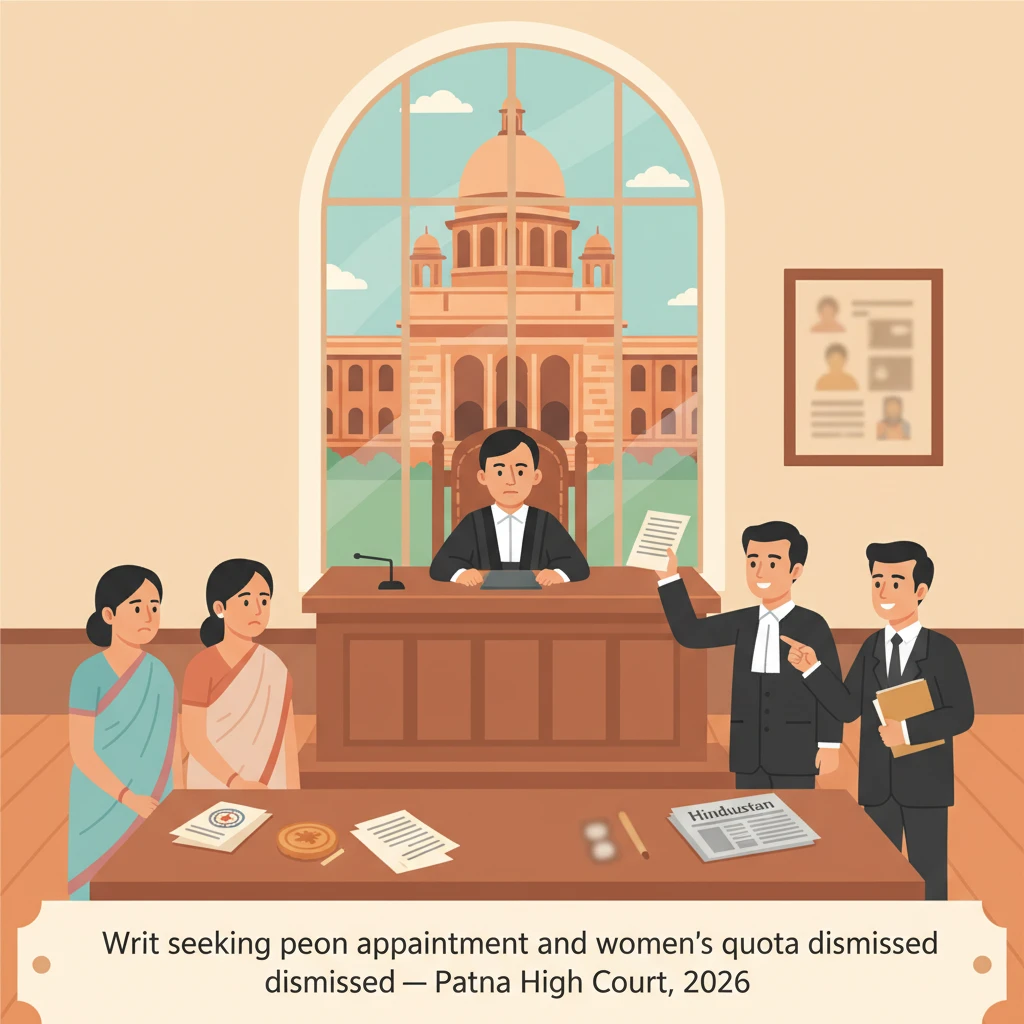
No female candidate was shown as selected. Feeling aggrieved, the petitioner approached the Patna High Court under its civil writ jurisdiction in 2013. She sought a direction for her own selection and appointment as peon in the District Court, Saran at Chapra, and a stay on the appointment process of the already selected candidates.
Importantly, the petitioner did not challenge the recruitment advertisement itself, nor the selection notification as such. Her prayer was confined to getting herself appointed and stopping appointments of others.
What the Court Examined and Decided
Hon’ble Justice Smt. G. Anupama Chakravarthy examined the pleadings, including a counter affidavit filed on behalf of the District and Sessions Judge, Saran at Chapra (respondent no. 2).
The counter affidavit laid out in detail how the recruitment process was conducted. First, it confirmed the administrative approval of the Patna High Court to fill 25 Class‑IV vacancies. Then, it described the publication of Employment Notice No. 03/2011 dated 28.04.2011, inviting applications for 25 Class‑IV posts and specifying reservation.
The selection process was carried out under the Bihar Civil Court Staff (Class III and IV) Rules, 2009. Eligible candidates, including the petitioner, were interviewed by a selection committee constituted in the Saran Judgeship at Chapra. Marks were awarded based on performance in the interview.
After interviews, a category‑wise merit list and a waiting list were prepared on the basis of marks secured by each candidate. This list was then sent to the Patna High Court for approval by Letter No. 2777 dated 05.07.2013. It was specifically informed that the State reservation policy, including the roster system, had been followed while preparing the merit list.
The Patna High Court, on its administrative side, approved the merit‑cum‑selection list of 25 candidates by Letter No. 9603 dated 11.07.2013 and also directed that a waiting list of 13 candidates be prepared as per rules. A revised waiting list of 13 candidates was accordingly sent for approval by Letter No. 3184 dated 03.08.2013. This waiting list was approved and communicated through Letter No. 11016 dated 23.08.2013.
Following approval, the final list of 25 successful candidates was published through notice dated 15.07.2013. Those selected candidates were then duly appointed on the post of peon in the Saran Judgeship.
A key contention in the writ petition was that no female candidate had been selected, and that this violated the reservation policy and principles of natural justice and fundamental rights. The petitioner, a backward class female, essentially argued that there ought to have been a reserved post for “Backward Class female” and that she should have been appointed.
The counter affidavit answered this point by explaining the working of the reservation roster. Under the State Government reservation rules, 3% posts are reserved for Backward Class female candidates. However, only 25 posts of peon had been advertised. Three percent of 25 posts works out to less than one post. Because the reserved share for that category did not reach a full post, no separate post could be earmarked in that recruitment cycle for Backward Class female candidates.
Thus, as per the counter affidavit, there was no scope to reserve even a single post for Backward Class female candidates within that batch of 25 posts. A waiting list of 13 candidates was prepared strictly on merit and reservation norms as per rules.
The counter affidavit further stated that there was no irregularity in the entire selection exercise. It also pointed out an important procedural flaw in the writ petition: the selected candidates, whose appointments would be directly affected if the Court interfered, had not been made parties to the case.
The Court heard counsel for both sides and perused the records. After considering the material, the Court recorded that it found no illegality in the selection process. The reservation policy, including the roster, was held to have been followed correctly. Specifically, the Court accepted that no reserved seat for Backward Class female candidates was available within the 3% limit when only 25 posts were under recruitment.
Further, the Court noted that only two respondents had been made parties: the State of Bihar and the District and Sessions Judge, Saran at Chapra. The already selected candidates, who had been appointed on 15.07.2013 itself, were not impleaded as respondents. The counter affidavit had highlighted that these selected persons were necessary parties, because the relief sought by the petitioner would directly affect their appointments.
In such situations, courts generally insist that persons whose rights are likely to be taken away must be given an opportunity of hearing. Since the petitioner had not joined them as respondents, and appointments had already been made, the writ petition suffered from this serious defect.
In paragraph 14 of the judgment, the Court concluded that, in the absence of any irregularity in the selection process, the writ petition was devoid of merit in limine—that is, it had no merit from the very outset. Consequently, in paragraph 15, the Court dismissed the writ petition.
As a result, the selection and appointment of the 25 peons in the Saran Judgeship, based on Employment Notice No. 03/2011 and the subsequent merit list, remained undisturbed. The petitioner did not receive any direction in her favour for appointment or for staying the process.
Why This Judgment Matters
This judgment is significant for candidates who participate in government or court recruitment processes in Bihar, especially for Class‑IV posts.
First, it shows that courts will usually not interfere with a recruitment process if it has strictly followed the rules and the State’s reservation policy. Even if no candidate from a particular reserved sub‑category is selected, the Court will see whether a reserved seat actually existed under the roster, rather than going by feelings of unfairness.
Second, the decision explains in simple terms how small numbers of vacancies interact with percentage‑based reservation. When only a few posts are advertised, the percentage for some reserved categories may work out to less than one post. In such cases, no separate reserved seat arises for that category in that particular recruitment, and candidates cannot claim a right to that non‑existent seat.
Third, the judgment underlines the importance of making all necessary parties join the case. When appointments have already been made, and a candidate challenges the process, the selected candidates are necessary parties. Without hearing them, courts are reluctant to cancel appointments or re‑do selections.
For job seekers, the message is clear: if you feel aggrieved by a selection, you must check whether there is a real reserved vacancy for your category in that recruitment, and you must implead the selected candidates whose appointments you seek to challenge.
Legal Issues and Answers
Issue: Was the selection of 25 peons in the Saran Judgeship, without selecting any Backward Class female candidate, illegal or contrary to the reservation roster?
Answer: No. The Patna High Court held that the State reservation policy and roster were properly followed. Since only 25 posts were advertised, the 3% quota for Backward Class female candidates came to less than one post, so no seat could be reserved for that category.
Issue: Could the Court grant the petitioner a direction to be appointed as peon and stall the appointments of already selected candidates, when those selected candidates were not made parties?
Answer: No. The Court noted that the selected candidates, who had been appointed on 15.07.2013, were necessary parties. In their absence, and in the absence of any proven irregularity, the writ petition was found devoid of merit and dismissed.
Cases Cited by the Court
- No earlier judicial precedents are cited or relied upon in the text of this judgment.
Case Details
Case Number: Civil Writ Jurisdiction Case No. 16441 of 2013
Case Title: Ragini Kumari v. The State of Bihar & Anr.
Coram: Hon’ble Justice Smt. G. Anupama Chakravarthy
Citation: 2026 (1) PLJR 616
Advocates:
- For the petitioner: Mr. Basant Kumar Singh, Advocate; Mr. Vishesh Kumar Singh, Advocate
- For the respondents: Mr. Arvind Ujjwal, Advocate; Mr. Piyush Lall, Advocate
Nature of the case: Writ petition under civil writ jurisdiction seeking direction for appointment on Class‑IV post (peon) and to stay appointments of selected candidates.
Link to judgment: Click here to read the full judgment on the Patna High Court website
If you found this explanation helpful and wish to stay informed about
how legal developments may affect your rights in Bihar,
you may consider following Samvida Law Associates for more updates.







