
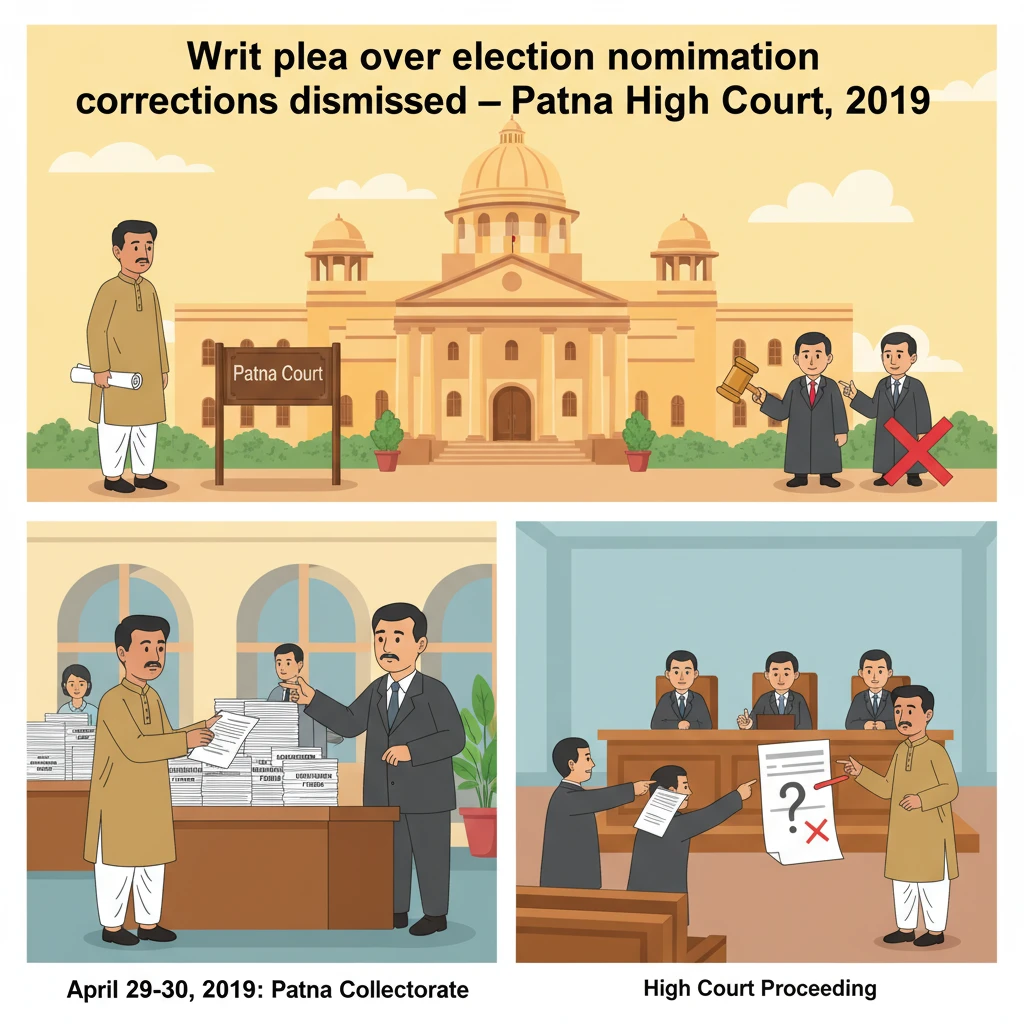
Case Background
The petitioner filed a writ case before the Patna High Court challenging actions of election authorities during the 2019 Parliamentary Elections for the Patna Sahib Constituency in Bihar.
He stated that he had submitted his nomination paper on 29 April 2019 to contest the Parliamentary election from Patna Sahib. According to him, he later realised that some “minor corrections” were needed in the nomination form.
These corrections were described as insertion of comma, full stop, and answering “yes or no” in certain columns. The petitioner claimed that he wanted to make these formal corrections so that his nomination form accurately reflected the required details.
The petitioner said that he appeared before the Returning Officer the next day, on 30 April 2019, and also filed a written representation (Annexure-1 to his writ petition). In this representation, he requested permission to carry out the corrections in his nomination paper.
He further asserted that, on that very day, other candidates who were present in the Returning Officer’s office were allowed to correct their nomination papers. However, he claimed that his own request for corrections was not accepted.
Feeling aggrieved, he moved the High Court under its writ jurisdiction. He sought a direction to the election authorities to permit him to make those minor corrections and to protect his fundamental right to contest the election.
What the Court Examined and Decided
The case came up before Hon’ble Mr. Justice Vikash Jain on 9 May 2019. The central question was whether, at that stage of the Parliamentary election, the High Court could direct election officials to allow corrections in the petitioner’s nomination paper through a writ petition.
The petitioner’s side argued that he was entitled to an opportunity to make formal corrections in his nomination. His counsel submitted that he had followed up promptly by appearing the next day and giving a representation. Despite this, he was allegedly denied the chance to correct small formal errors, even while other candidates were allowed to do so.
On the other hand, counsel for the Union of India and the Election Commission opposed the writ petition. They questioned not only the maintainability of the petition but also its basic facts.
The Additional Solicitor General appearing for the Union of India, along with counsel for the Election Commission of India, pointed out that the writ petition was vague. According to them, it did not even contain the minimum particulars necessary to support the petitioner’s allegations.
A key point they raised was that the petitioner had not enclosed a copy of his nomination paper along with the writ petition. Without the nomination form, the Court could not see what defects were in it or what exactly needed to be corrected.
They also drew attention to paragraph 6 of the writ petition itself. There, the petitioner had admitted that the Returning Officer had already communicated to him the defects in his nomination paper and had allowed him to make necessary corrections within the stipulated period.
In this backdrop, the respondents’ counsel argued that it was highly unlikely that the petitioner was prevented from making corrections, once he had been duly notified and given an opportunity. On the face of his own pleadings, it appeared that he had already been afforded a chance to cure defects.
Further, counsel for the Election Commission raised a strong objection based on Article 329(b) of the Constitution of India. This Article bars courts from questioning elections to either House of Parliament or a State Legislature, except by way of an election petition.
It was submitted that the election process for the Patna Sahib Constituency was already at an advanced stage. The Court was informed of the following facts:
(i) Symbols had already been allotted to all candidates.
(ii) Ballot papers had already been printed.
(iii) Postal ballots were in the process of distribution to personnel on election duty.
(iv) Ballot papers had been uploaded on the Electronically Transmitted Postal Ballot System (ETPBS).
(v) Polling was scheduled on 19 May 2019, less than two weeks from the date of hearing.
On these facts, the Election Commission’s counsel argued that no relief should be granted at such a belated stage. Any intervention would disrupt the ongoing election process, which Article 329(b) protects from interference by regular court proceedings.
After hearing both sides and examining the material on record, the Patna High Court declined to interfere.
First, the Court observed that the petitioner’s complaint about not being given an opportunity to correct his nomination was a pure question of fact. Such a claim would have to be proved by evidence. At the writ stage, with only bare assertions and no nomination paper on record, the Court found it difficult to accept the petitioner’s version.
The Court noted that paragraph 6 of the writ petition itself showed that the petitioner had been informed about the defects and was allowed to make corrections within the prescribed time. In these circumstances, it did not seem probable that he would have been denied the opportunity to correct his form if he had acted within the communicated time.
Secondly, and more importantly, the Court focused on the constitutional bar in Article 329(b). It held that once an election has been notified, this Article comes into operation. As a result, the proper way to challenge any issue which may affect the validity of an election, such as rejection or improper handling of a nomination, is through an election petition filed after the election, not a writ petition during the election process.
To support this reasoning, the Court relied on the landmark Supreme Court decision in N.P. Ponnuswami v. The Returning Officer, Namakkal Constituency, Namakkal, Salem District and Others, A.I.R. (39) 1952 SC 64.
In that case, the Supreme Court clarified the scheme of election law in India. It held that matters which can be grounds to call an election into question should be raised only at the appropriate stage, in an appropriate manner, before a special tribunal set up for election disputes. They should not be brought before the High Court at an intermediate stage under Article 226.
The Supreme Court explained that the rejection of a nomination paper gains legal significance mainly because it can be used as a ground to challenge the election result. Article 329(b) was enacted to lay down when and how such grounds could be raised—namely, only through an election petition after the election process is over.
If courts were to allow challenges to nomination issues while the election was still underway, it would defeat the very scheme of Article 329(b). It might lead to conflicting views between the High Court at the pre-poll stage and the election tribunal later, causing anomalies that the Constitution did not intend.
Relying on this binding precedent, the Patna High Court held that it could not entertain the petitioner’s grievance in a writ petition when the election process was already in progress and at an advanced stage.
The Court therefore concluded that the petitioner’s remedy, if he believed that denial of corrections had affected his right to contest, would be to file an election petition at the appropriate time after the election, not to seek writ relief at that stage.
Accordingly, the writ petition was dismissed.
Why This Judgment Matters
This judgment is significant for anyone thinking of contesting elections, especially in Bihar, because it clearly shows the limits of what the High Court can do once an election process has started.
The Court made it clear that complaints about nomination forms, alleged refusal to allow corrections, or similar issues cannot be brought before the High Court under writ jurisdiction while the election is underway and has advanced.
Instead, such grievances must be taken up through an election petition after the election is over. This keeps the election process smooth and uninterrupted and follows the constitutional design under Article 329(b).
For candidates, the decision underlines the importance of carefully filling nomination forms, responding promptly to any defect notices from the Returning Officer, and keeping documents like the nomination paper and communications safely if they later wish to challenge anything through an election petition.
Legal Issues and Answers
- Issue: Can the Patna High Court, in a writ petition, direct election authorities to allow corrections in a candidate’s nomination paper when the Parliamentary election process is already at an advanced stage?
Answer: No. The Court held that such disputes involve questions of fact and, once the election is notified and underway, are barred from writ interference by Article 329(b) of the Constitution. The proper remedy is an election petition after the election. - Issue: Did the petitioner establish, on the face of the record, that he was denied an opportunity to correct his nomination form?
Answer: No. Based on the petitioner’s own pleadings showing that defects were communicated and corrections permitted within a time frame, the Court found it improbable that he had been refused the chance to make corrections.
Cases Cited by the Court
- N.P. Ponnuswami v. The Returning Officer, Namakkal Constituency, Namakkal, Salem District and Others; A.I.R. (39) 1952 SC 64.
Case Details
Case Number: Civil Writ Jurisdiction Case No. 10566 of 2019
Case Title: Gopal Prasad Malakar v. The Union of India & Others
Coram: Hon’ble Mr. Justice Vikash Jain
Citation: 2019 (3) PLJR 407
Date of Judgment: 09-05-2019
Advocates:
For the Petitioner: Mr. Kameshwar Prasad Sinha, Advocate.
For the Union of India: Mr. S.D. Sanjay, Additional Solicitor General; Mr. Rajesh Kumar Verma, Advocate.
For the Election Commission of India: Mr. Siddhartha Prasad, Advocate; Mr. Om Prakash Kumar, Advocate.
Nature of the Case: Writ petition (civil) seeking mandamus regarding correction of election nomination paper.
Link to Judgment: Click here to view the full Patna High Court judgment
If you found this explanation helpful and wish to stay informed about
how legal developments may affect your rights in Bihar,
you may consider following Samvida Law Associates for more updates.







