
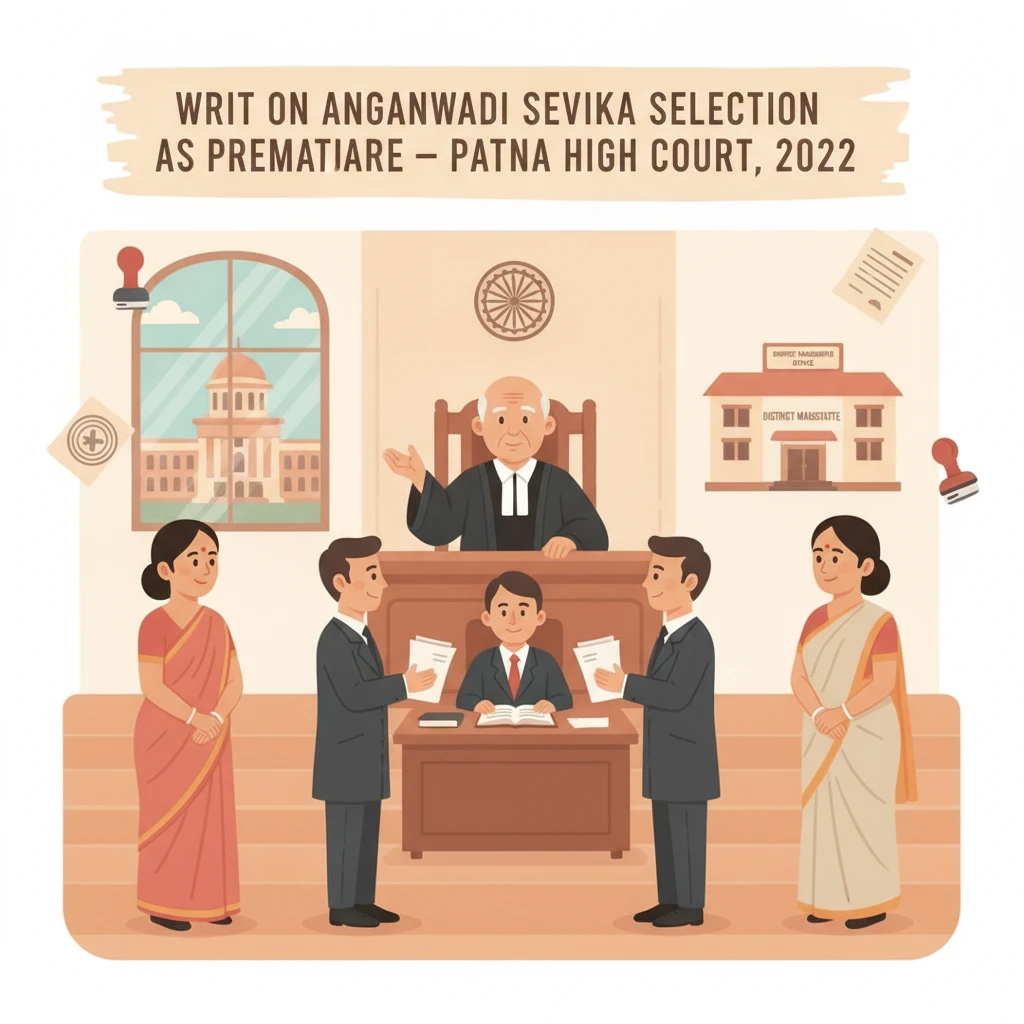
Case Background
The case arose from the selection of an Anganwadi Sevika for Ward No. 12, Centre No. 219, Bhutahi Panchayat, Block Sonbarsa in the district of Sitamarhi, Bihar.
A woman from the village, the petitioner, claimed that she was entitled to be selected as Sevika. However, the Selection Committee, functioning through its Chairman, chose another woman, who has been arrayed in the case as respondent no. 6.
The decision of the Selection Committee is dated 13.09.2018. Soon after, on 14.09.2018, a selection letter was issued to respondent no. 6 under the signature of the Lady Supervisor, Sonbarsa, countersigned by the Chairman of the Selection Committee.
Feeling aggrieved, the petitioner approached the Patna High Court directly under its writ jurisdiction. She did so without first filing an appeal before the District Magistrate, who is the appellate authority in such Anganwadi selection disputes.
In her writ petition, she asked the Court to quash both the selection decision and the selection letter issued to respondent no. 6. She also requested a mandamus directing the authorities to select her as Anganwadi Sevika for Ward No. 12, Centre No. 219. She further sought any other relief that the Court might find suitable in the circumstances.
What the Court Examined and Decided
The Patna High Court, through Hon’ble Mr. Justice P. B. Bajanthri, heard the parties on 10.03.2022.
On the date of hearing, counsel for the State accepted notice for respondent nos. 1 to 5, who are the State of Bihar through the Principal Secretary, the District Magistrate, the District Programme Officer (Establishment), the Child Development Project Officer, and the Selection Committee through its Chairman.
The Court noted that no adverse order was being passed against respondent no. 6 (the selected candidate) in the writ petition. Therefore, service of notice on her was dispensed with for the purpose of this order.
The core question before the Court was not whether the petitioner’s claim on merits was better than that of respondent no. 6. Instead, the Court first examined whether the writ petition was maintainable at all when a statutory appeal remedy existed but had not been used by the petitioner.
The Court recorded that the petitioner had approached the High Court “without exhausting statutory remedy of appeal”. It pointed out that this raised a serious question of maintainability of the writ petition.
To answer this, the Court relied on the decision of the Supreme Court in State of Jammu and Kashmir vs. R.K. Zalpuri and others, reported in AIR 2016 SC 3006. Paragraph 20 of that judgment refers to an earlier Supreme Court decision in City and Industrial Development Corporation vs. Dosu Aardeshir Bhiwandiwala and others, (2009) 1 SCC 168.
The Supreme Court in City and Industrial Development Corporation had explained the limits of High Court interference under Article 226 of the Constitution. The Patna High Court quoted this guidance at length.
The Supreme Court had said that, while exercising jurisdiction under Article 226, the High Court is duty-bound to consider several factors, including:
(a) whether dealing with the writ involves complex and disputed questions of fact, and whether these can be satisfactorily resolved in writ jurisdiction;
(b) whether all material facts have been disclosed in the petition;
(c) whether the petitioner has any alternative or effective remedy for resolution of the dispute;
(d) whether the person invoking jurisdiction is guilty of unexplained delay and laches;
(e) whether the claim appears barred by any law of limitation; and
(f) whether granting relief would be against public policy or barred by any valid law, among other possible factors.
By relying on this Supreme Court guidance, the Patna High Court emphasised that the availability of an alternative and effective statutory remedy is a key consideration. If such a remedy exists, the High Court normally expects the aggrieved person to use that remedy first, instead of coming directly to the High Court.
In the present case, the Court observed that an appeal lay before the District Magistrate, Sitamarhi, who is the appellate authority in Anganwadi Sevika selections within that district. The petitioner had not filed such an appeal before coming to the High Court.
In that background, the Court held that the writ petition could not be entertained and was premature. The Court did not go into the comparative merits of the petitioner and respondent no. 6, nor did it discuss the correctness of the marks, eligibility, or procedure adopted in the selection. All such issues were left open to be considered by the appellate authority.
Instead of rejecting the petition outright without any further direction, the Court gave the petitioner a clear route to challenge the selection properly.
The Court granted liberty to the petitioner to prefer an appeal before respondent no. 2, the District Magistrate, Sitamarhi, described as the Appellate Authority. It fixed a time limit: the appeal must be filed within eight weeks from the date the petitioner receives a copy of this High Court order.
To ensure that the appeal is not kept pending indefinitely, the Court also placed an obligation on the District Magistrate. It directed that, if the petitioner files such an appeal within the prescribed period, the appellate authority must decide the appeal after giving “ample opportunity of hearing” to both the petitioner and respondent no. 6, the selected candidate.
The Court further specified a time frame for this decision. The appellate authority must complete the exercise and pass an order on the appeal within four months from the date of receipt of the appeal.
By doing so, the Patna High Court made it clear that the correct forum to examine the factual and procedural issues relating to the Anganwadi Sevika selection is the statutory appellate authority, not the High Court at the first instance.
Finally, on this reasoning, the Court disposed of the writ petition. No costs or other directions were recorded against any party, apart from the direction regarding the appeal procedure and timelines.
Why This Judgment Matters
This judgment is important for Anganwadi Sevika and similar local appointments across Bihar and beyond.
First, it reinforces that candidates who are aggrieved by a selection decision cannot rush directly to the Patna High Court. If a statutory appeal is available, they must use that channel first.
Second, the order brings clarity to the role of the District Magistrate as an appellate authority in Anganwadi Sevika selections within the district. Candidates who feel wrongly denied selection should file a timely appeal before the District Magistrate rather than immediately resorting to writ proceedings.
Third, the Court balanced this requirement with a protection for the petitioner. It fixed a clear deadline for the District Magistrate to hear and decide the appeal—within four months from receipt—after giving ample opportunity of hearing to both sides. This helps prevent delays at the district level.
For laypersons and local candidates, the message is simple: if you are unhappy with an Anganwadi Sevika selection, first check the rules, file your appeal before the designated authority within time, and only then think of approaching the High Court if you remain aggrieved after the appeal decision.
Legal Issues and Answers
-
Issue: Can an aggrieved Anganwadi Sevika aspirant directly file a writ petition in the Patna High Court against the selection of another candidate without first filing a statutory appeal before the District Magistrate?
Answer: No. The Patna High Court held that the writ petition was premature and not maintainable because the petitioner had not exhausted the statutory remedy of appeal before the District Magistrate, who is the appellate authority.
Cases Cited by the Court
- State of Jammu and Kashmir vs. R.K. Zalpuri and others, AIR 2016 SC 3006
- City and Industrial Development Corporation vs. Dosu Aardeshir Bhiwandiwala and others, (2009) 1 SCC 168
Case Details
Case Number: Civil Writ Jurisdiction Case No. 7420 of 2021
Case Title: Sarita Kumari @ Sarita Devi vs. The State of Bihar & Ors.
Coram: Hon’ble Mr. Justice P. B. Bajanthri
Citation: 2022(2) PLJR 107
Advocates: Mr. Amit Narayan, Advocate for the petitioner; Mr. Lalit Kishore, Advocate General, for the respondents
Nature of the Case: Writ petition (civil) challenging Anganwadi Sevika selection and appointment letter
Date of Judgment: 10.03.2022
Court: High Court of Judicature at Patna
Final Outcome: Writ petition disposed of as premature; liberty granted to file appeal before District Magistrate, Sitamarhi, within eight weeks; appellate authority directed to decide the appeal within four months of its receipt after hearing both sides.
If you found this explanation helpful and wish to stay informed about
how legal developments may affect your rights in Bihar,
you may consider following Samvida Law Associates for more updates.







