

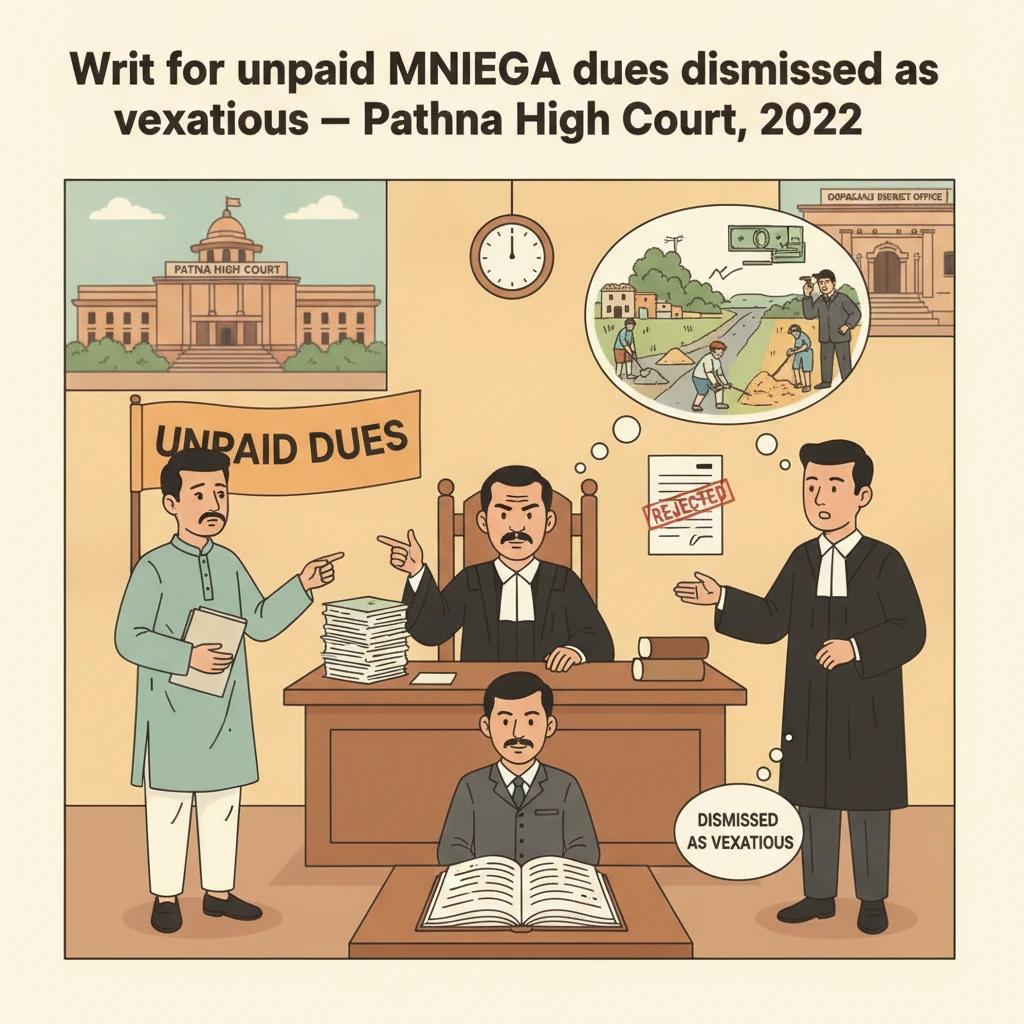
Case Background
The petitioner said he was an elected member of the Panchayat Samiti of Kathagharwa Block in Gopalganj district from 2006 to 2011. In that role, he claimed he functioned as a Block Development Coordinator to execute development plans by giving employment to unskilled rural workers under schemes framed under the Mahatma Gandhi National Rural Employment Guarantee Act, 2005 (MGNREGA).
According to him, different schemes under MGNREGA were completed in the years 2009-10, 2010-11, 2011-12 and 2012-13 for rural development. He alleged that, despite completion of these works, payments were not made in various districts in Bihar.
The petitioner asserted that four schemes were allotted to him in his block under MGNREGA, bearing Plan Nos. 52/2010-11, 66/2010-11, 69/2010-11 and 73/2010-11. For work No. 52/2010-11, he stated that out of the estimated cost of Rs. 4,26,700/-, an amount of Rs. 1,69,250/- remained unpaid despite completion of work as per the measurement book. At the same time, he also claimed that against “work No. 54/2010-11” the total dues were Rs. 3,02,006/-.
Earlier, the petitioner had moved the Patna High Court by filing C.W.J.C. No. 4310 of 2015. On 29.04.2015, that writ petition was disposed of. The High Court at that time did not itself assess the dues but directed the petitioner to approach the District Magistrate, Gopalganj, by filing a representation with all relevant documents.
The Court in 2015 had ordered the District Magistrate to examine the matter and decide in accordance with law. If any amount was found admittedly due, payment was to be made preferably within eight weeks. If no amount was found due, the District Magistrate was required to pass a reasoned order and communicate it to the petitioner. The Court also said that if any amount was found due and still not paid within the specified period, it would carry simple interest at 10% per annum from the date it became due till final payment.
In compliance with that order, the Deputy Development Commissioner, Gopalganj, passed an order on 28.12.2015. In that order, he recorded that there is no role of any contractor or intermediary in execution of MGNREGA schemes. Wages for work done are directly credited to the labourers’ accounts, and vendors are also paid directly. He further stated that the petitioner’s role was only to supervise the quality of work under the scheme.
The petitioner did not challenge the order dated 28.12.2015. Instead, he filed a contempt application, M.J.C. No. 3361 of 2015, alleging disobedience of the High Court’s earlier order dated 29.04.2015.
On 23.01.2019, taking note of the Deputy Development Commissioner’s order of 28.12.2015, the High Court disposed of the contempt application. The Court, however, left liberty to the petitioner to raise a claim that the respondents were under legal and moral obligation to extend benefits to the labourers.
More than two years after this, the petitioner again approached the High Court by filing the present writ petition, C.W.J.C. No. 6482 of 2021.
What the Court Examined and Decided
In the current writ petition, the petitioner sought a direction to the State authorities to pay “admitted dues” of Rs. 9,93,810/- against the works he referred to. He also took an alternative stand that if payment could not be made to him, it should be made to the labourers who, according to him, had worked under the MGNREGA schemes but had not been paid their wages. A list of labourers’ names was filed as Annexure-1.
During the hearing, the Patna High Court examined internal inconsistencies in the petitioner’s own claim. The Court asked about the variation in the amount claimed as dues. On one hand, the petitioner said that according to the measurement book, Rs. 1,69,250/- was payable against work No. 52/2010-11. On the other hand, he claimed total dues of Rs. 3,02,006/- against “work No. 54/2010-11.”
In response to the Court’s query, learned counsel for the petitioner stated that the “actual” dues against work No. 54/2010-11 were Rs. 3,02,006/-, but as per the measurement book only Rs. 1,69,250/- was shown as payable. He also accepted that a similar situation existed for the other works mentioned in paragraph 8 of the writ application.
This discrepancy raised serious doubt about the petitioner’s exact entitlement and the basis of his calculations. The Court noted that the claim for dues was not aligned with the figures recorded in the official measurement book, which is the primary record for MGNREGA work.
The Court then looked at the history of the case. In 2015, it had already directed the District Magistrate to decide whether any amount was “admittedly due” to the petitioner, and had provided even for interest if such admitted dues remained unpaid. Following this direction, the Deputy Development Commissioner’s order of 28.12.2015 had clearly stated that under MGNREGA there is no role for intermediaries like contractors, and that labourers and vendors are paid directly.
That order also limited the petitioner’s role to supervision of work quality. It did not accept any claim of monetary dues payable to him in respect of the schemes. Importantly, the petitioner never challenged or appealed against that order. It therefore stood as the final decision of the competent authority on his monetary claim.
Despite this, the petitioner first filed a contempt case, which was disposed of in 2019, and then, after more than two years, filed the present writ petition demanding nearly Rs. 10 lakh in alleged dues.
The Court also examined his new plea that the writ petition was being pursued for the benefit of labourers. When asked specifically whether he was individually entitled to receive any amount out of the claimed dues, his counsel submitted that the petition had been filed in the interest of the labourers who had worked but had not been paid their wages.
The Bench found this assertion unconvincing. It pointed out that there was no statement in the writ petition that it had been filed in a representative capacity on behalf of the labourers. No steps had been taken to show that the case was genuinely a public or representative action. In this background, the Court felt that the attempt to portray the petition as being for labourers’ welfare lacked sincerity.
In paragraph 9 of the judgment, the Division Bench recorded its clear view that the application was “vexatious, frivolous and lacks bonafide.” The Court noted that the Deputy Development Commissioner’s order dated 28.12.2015 had already dealt in detail with the facts and had rejected the petitioner’s claim. Instead of challenging that order in the correct legal manner, the petitioner kept approaching the Court through multiple proceedings.
Thus, the Court refused to direct any payment either to the petitioner or, on his petition, to the labourers. However, the judges remained conscious of the possibility that some labourers might genuinely have remained unpaid under the schemes.
Therefore, while dismissing the writ petition, the Court did two important things. First, it imposed a cost of Rs. 10,000/- on the petitioner, to be deposited in the account of the Bihar State Legal Services Authority. This was a clear signal that misuse of writ jurisdiction and repeated, non-bonafide litigation would not be encouraged.
Second, in paragraph 11, the Court requested the Member Secretary of the Bihar Legal Services Authority to take such steps as might be deemed fit and proper so that the cause of the labourers, who had allegedly remained unpaid, is duly addressed at the appropriate level. The Court expressed its expectation that the State Legal Services Authority would take all possible measures required to protect the interests of such labourers, if any.
In essence, while the Court found the petitioner’s own litigation to be lacking in good faith, it did not ignore the underlying concern about MNREGA workers’ wages. Instead of acting on a doubtful private claim, it shifted attention to an institutional body (the Legal Services Authority) better suited to independently verify and safeguard labourers’ rights.
Why This Judgment Matters
This judgment is important for anyone connected with MGNREGA works, especially in Bihar. It shows that a person who only supervises or coordinates schemes cannot, without clear legal basis, claim large sums as “dues” when the scheme design itself says wages and payments go directly to labourers and vendors.
The Patna High Court has underlined that once a competent authority examines a claim and passes a detailed order, the proper way to challenge that order is through appropriate legal channels, not by filing repeated writ and contempt petitions on the same issue.
The ruling also sends a message that courts will not entertain vague or inconsistent monetary claims, especially where figures do not match official records like measurement books. Litigants must present accurate, document-backed claims.
At the same time, the Court has kept the focus on the real beneficiaries under MGNREGA: rural labourers. By involving the Bihar State Legal Services Authority, it has tried to ensure that, if any labourers are genuinely unpaid, their grievances are checked and addressed without them having to depend on intermediaries.
Legal Issues and Answers
Issue: Whether the petitioner, a former Panchayat Samiti member and supervising functionary under MGNREGA, was entitled to nearly Rs. 10 lakh as unpaid dues for completed schemes, or could seek directions for payment to labourers through this writ petition.
Answer: The Court held that, in light of the Deputy Development Commissioner’s unchallenged order stating there is no role for intermediaries in MGNREGA payments and that the petitioner’s role was only supervisory, and given the inconsistencies and lack of bona fides in his claim, no such direction could be issued. The writ petition was dismissed with costs.
Issue: Whether the writ petition could be treated as a genuine action filed in the interest of unpaid labourers under MGNREGA schemes.
Answer: The Court found no statement in the writ petition that it was filed in a representative capacity and held that the petitioner’s claim of acting for labourers’ welfare was not genuine. Instead, the Court requested the Bihar State Legal Services Authority to independently take steps to protect labourers’ interests, if any.
Cases Cited by the Court
- No earlier judicial precedents or case law have been cited in this judgment. The Court proceeded on the facts of the case and previous orders in the same matter.
Case Details
Case Number: Civil Writ Jurisdiction Case No. 6482 of 2021
Case Title: Bangali Prasad v. The State of Bihar & Ors.
Citation: 2022 (1) PLJR 674
Court: High Court of Judicature at Patna
Coram: Hon’ble Mr. Justice Chakradhari Sharan Singh and Hon’ble Mr. Justice Madhuresh Prasad
Date of Judgment: 01-02-2022
Advocates: Mr. Lokesh Kumar Singh, Advocate for the petitioner; Mr. Vinay Kirti Singh (GA-2) for the respondents
Nature of the Case: Writ petition under civil writ jurisdiction seeking directions for payment of alleged dues under MGNREGA schemes and, in the alternative, for payment of wages to labourers.
Link to Judgment: Click here to read the full judgment on the Patna High Court website
If you found this explanation helpful and wish to stay informed about
how legal developments may affect your rights in Bihar,
you may consider following Samvida Law Associates for more updates.







