
Case Background
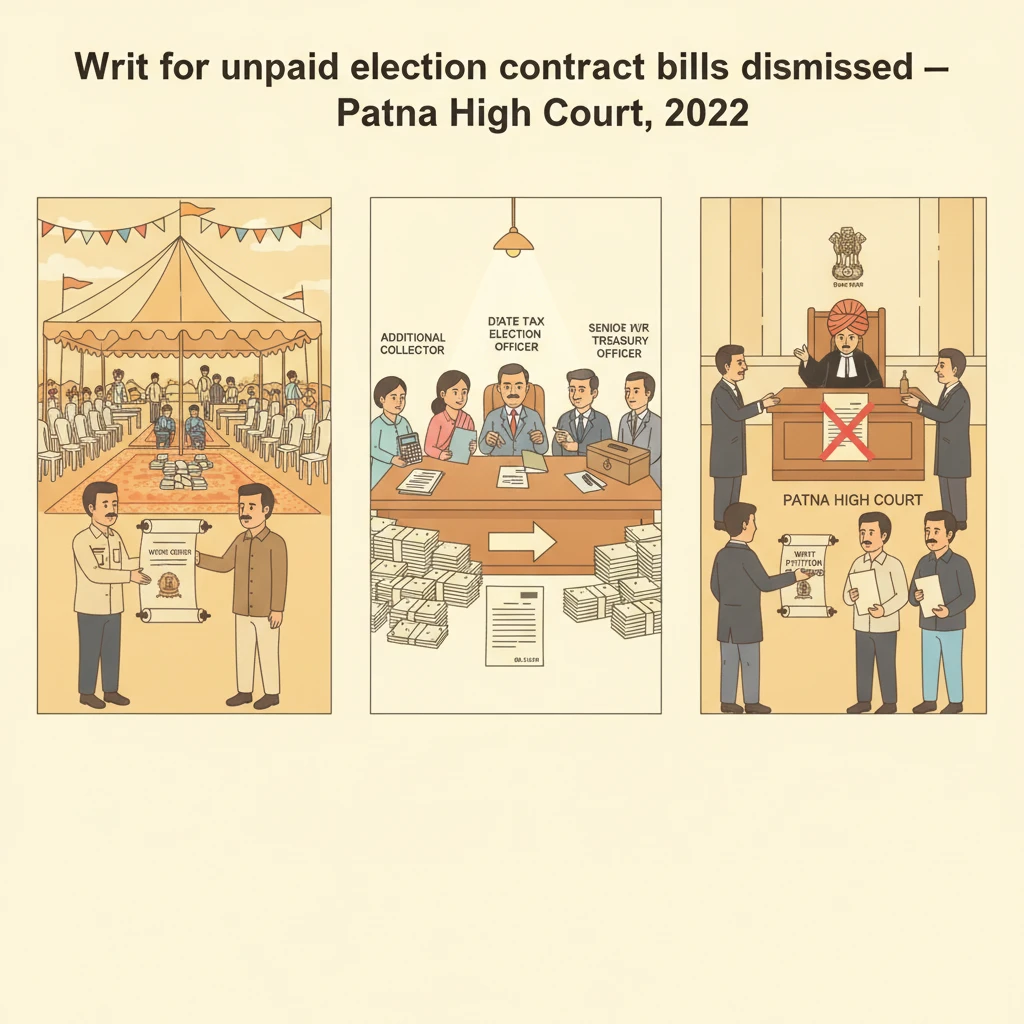
The dispute arises from work done during the 2019 Lok Sabha elections in Supaul district, Bihar. For this purpose, a tender was issued for supply of tent shamiyana, pipe pandal, chairs, tables, carpets and similar items for election work.
The petitioner firm, a tent contractor based in Patna, participated in this tender. According to the writ petition, the petitioners’ technical bid was opened and found successful. Thereafter, their financial bid was also opened.
The petitioners say that they were the lowest bidder among all tenderers. On that basis, the work was awarded to them and a work order was issued under the signature of the District Election Officer-cum-District Magistrate, Supaul.
During the election period, the petitioners claim to have supplied materials and services as directed by the authorities from time to time. On completion of the election work, the petitioners submitted their bills. They claimed a total amount of Rs.1,99,16,043.57 for the work executed.
However, a five-member committee later examined the bills of all agencies. On the basis of this committee’s report dated 06.11.2019, only Rs.20,66,161.00 was found payable to the petitioners and this amount was released to them. The petitioners accepted this payment but did so with objections.
Feeling aggrieved by the huge reduction in the claimed amount, the petitioners approached the Patna High Court by way of this civil writ petition.
What the Court Examined and Decided
The core grievance in the writ petition was against the report dated 06.11.2019 prepared by the five-member committee. This committee had been constituted on the orders of the District Election Officer-cum-District Magistrate, Supaul, to verify and examine the bills submitted by different tent agencies that had supplied materials for the Lok Sabha elections.
As per the counter affidavit of the State, other agencies had submitted significantly lower bills. One agency from Samastipur submitted a bill of Rs.25,64,844.00, and another agency from Saharsa submitted a bill of Rs.8,67,024.00. In contrast, the petitioners submitted a bill of Rs.1,99,16,043.57.
The State authorities felt that the bills appeared to be excessive. Therefore, by memo dated 06.07.2019, the Additional Collector, Supaul, constituted a five-member committee consisting of the Additional Collector, the Deputy Election Officer, the State Tax Commissioner, the Executive Engineer (Building Division) and the Senior Treasury Officer, all from Supaul.
All bills submitted by the agencies were forwarded to this committee for verification and examination. After scrutiny, the committee recommended that only Rs.20,66,161.00 was payable to the petitioners against their claim of nearly two crores. This recommendation was accepted and payment was made accordingly.
The petitioners challenged this committee report, arguing that it had been prepared without giving them any opportunity of hearing. Their counsel requested the High Court, under Article 226 of the Constitution, to quash the report dated 06.11.2019 and direct the authorities to reconsider their bills and pay the remaining amount of Rs.1,78,49,882.00.
The Division Bench examined whether such a dispute could properly be taken up in writ jurisdiction. The Court first looked at the nature of the committee’s report. It held that the report could not be treated as a decision by any quasi-judicial authority. It was only an internal determination of how much money was payable to each contractor.
Because it was not a quasi-judicial adjudication, the Court found that there was no requirement to grant the petitioners a formal hearing before the committee reduced the bills. The petitioners were essentially challenging the amount fixed as payable to them, not any violation of a public law duty or statutory right.
The Court noted that the petitioners were raising a money claim arising out of a contract between them and the State authorities. The State, through its counter affidavit and the committee report, had disputed the petitioners’ claim. Therefore, this was not a simple or admitted payment dispute; it was a contested contractual claim.
To decide such a dispute, evidence on the quantity and quality of work done, the rates applicable, and compliance with the work order would likely be required. That kind of detailed factual inquiry, possibly involving oral and documentary evidence, is normally done in a civil suit or similar proceeding, not in a writ petition.
The Court then referred to several Supreme Court decisions that set out when High Courts should exercise their writ powers in contractual and money claim matters.
It relied on the judgment in Joshi Technologies International Inc. v. Union of India, (2015) 7 SCC 728. In that case, the Supreme Court held that in pure contractual matters, the extraordinary remedy under Article 226 or 32 is generally not available, unless there is a clear public law element. The Supreme Court further observed that monetary claims arising from contracts are normally not to be entertained in writ proceedings, except in exceptional circumstances.
The Bench also cited Thansingh Nathmal v. Superintendent of Taxes, AIR 1964 SC 1419. There, the Supreme Court said that although Article 226 gives High Courts wide powers, those powers are discretionary and should not be used as an alternative to ordinary remedies like suits. The High Court should avoid deciding matters which require elaborate examination of evidence.
The Court referred to Suganmal v. State of M.P., AIR 1965 SC 1740, where the Supreme Court held that writ petitions seeking only a direction to refund money are not ordinarily maintainable, since such refund can be claimed by filing a suit.
Similarly, in Smt. Gunwant Kaur v. Municipal Committee, Bhatinda, (1969) 3 SCC 769, the Supreme Court stressed that when a petition involves complex questions of fact requiring oral evidence, the High Court may decline to entertain it under Article 226. The Court may dismiss such petitions at the threshold if it finds that writ jurisdiction is not appropriate.
The Bench further took support from Babubhai Muljibhai Patel v. Nandlal Khodidas Barot, (1974) 2 SCC 706, where the Supreme Court repeated that complex factual disputes are unsuitable for writ proceedings.
In the present case, after examining the pleadings and arguments, the Patna High Court concluded that the dispute was purely a contractual money claim. The petitioners were challenging the reduced amount recommended by the committee and accepted by the authorities. There was no allegation of violation of a fundamental right, no statutory provision shown to have been breached, and no element of public law that would justify interference under Article 226.
The Court found that the petitioners’ claim would likely require oral and documentary evidence regarding the work done and the correctness of the bills. Such a detailed enquiry could not be conveniently undertaken in writ jurisdiction.
On this reasoning, the Bench held that the writ petition was not maintainable. It refused to interfere with the committee report dated 06.11.2019 or to issue any mandamus for payment of the remaining amount claimed by the petitioners.
Accordingly, the Court dismissed the writ petition. At the same time, it made it clear that it was not going into the merits of the contractor’s monetary claim. The petitioners were given liberty to pursue their demand before the appropriate forum or court. No order as to costs was made.
Why This Judgment Matters
This judgment is important for contractors and suppliers who work with government departments, especially during elections and other large public events.
It makes clear that if there is a dispute about payment under a contract, and the government disputes the amount, the contractor generally cannot expect relief under Article 226 of the Constitution. The High Court will usually not act as a recovery court for such contested bills.
Instead, contractors must be prepared to use regular legal routes such as civil suits, arbitration or other agreed mechanisms to prove their claim. This may involve producing detailed records, bills, work orders, and witnesses.
For public authorities, the decision shows that they can verify and scrutinise contractor bills through internal committees. Such scrutiny, when it merely determines how much is payable under a contract, is not treated as a quasi-judicial proceeding that must follow the full principles of natural justice like personal hearings, unless some statute requires it.
For ordinary readers, the message is that writ petitions are mainly for violation of legal or constitutional rights, not for settling disputed money claims from contracts.
Legal Issues and Answers
-
Issue: Can a contractor use a writ petition under Article 226 to challenge an internal committee report that drastically reduces its contractual bills and seek payment of the balance amount?
Answer: No. The Patna High Court held that such a claim is a pure contractual money dispute involving contested facts and is not fit for writ jurisdiction. The contractor must approach the appropriate civil forum instead. -
Issue: Was the five-member committee’s report dated 06.11.2019 invalid because it was prepared without giving the contractor an opportunity of hearing?
Answer: No. The Court held that the committee was not acting as a quasi-judicial authority but only determining payable amounts under contracts. Hence, a prior hearing to the contractor was not required for the validity of the report in writ proceedings.
Cases Cited by the Court
- Joshi Technologies International Inc. v. Union of India, (2015) 7 SCC 728
- Thansingh Nathmal v. Superintendent of Taxes, AIR 1964 SC 1419
- Suganmal v. State of M.P., AIR 1965 SC 1740
- Smt. Gunwant Kaur v. Municipal Committee, Bhatinda, (1969) 3 SCC 769
- Babubhai Muljibhai Patel v. Nandlal Khodidas Barot, (1974) 2 SCC 706
Case Details
Case Number: Civil Writ Jurisdiction Case No.6520 of 2021
Case Title: M/s Jamurat Lal Abdul Rasid Tent Contractor & Anr. v. The State of Bihar & Ors.
Coram: Hon’ble Mr. Justice Chakradhari Sharan Singh; Hon’ble Mr. Justice Madhuresh Prasad
Date of Judgment: 22-02-2022
Citation: 2022(2) PLJR 117
Advocates: Mr. Gaurav Govind, Advocate for the petitioners; Mr. Prashant Pratap, G.P.-2 for the respondents; Mr. Lala S.N. Rais, AC to G.P.-2 for the respondents
Nature of the Case: Writ petition under Article 226 of the Constitution of India challenging a committee report and seeking mandamus for payment of alleged balance contractual dues
Link to Judgment: Click here to read the full judgment of the Patna High Court
If you found this explanation helpful and wish to stay informed about how legal developments may affect your rights in Bihar, you may consider following Samvida Law Associates for more updates.







