

Case Background
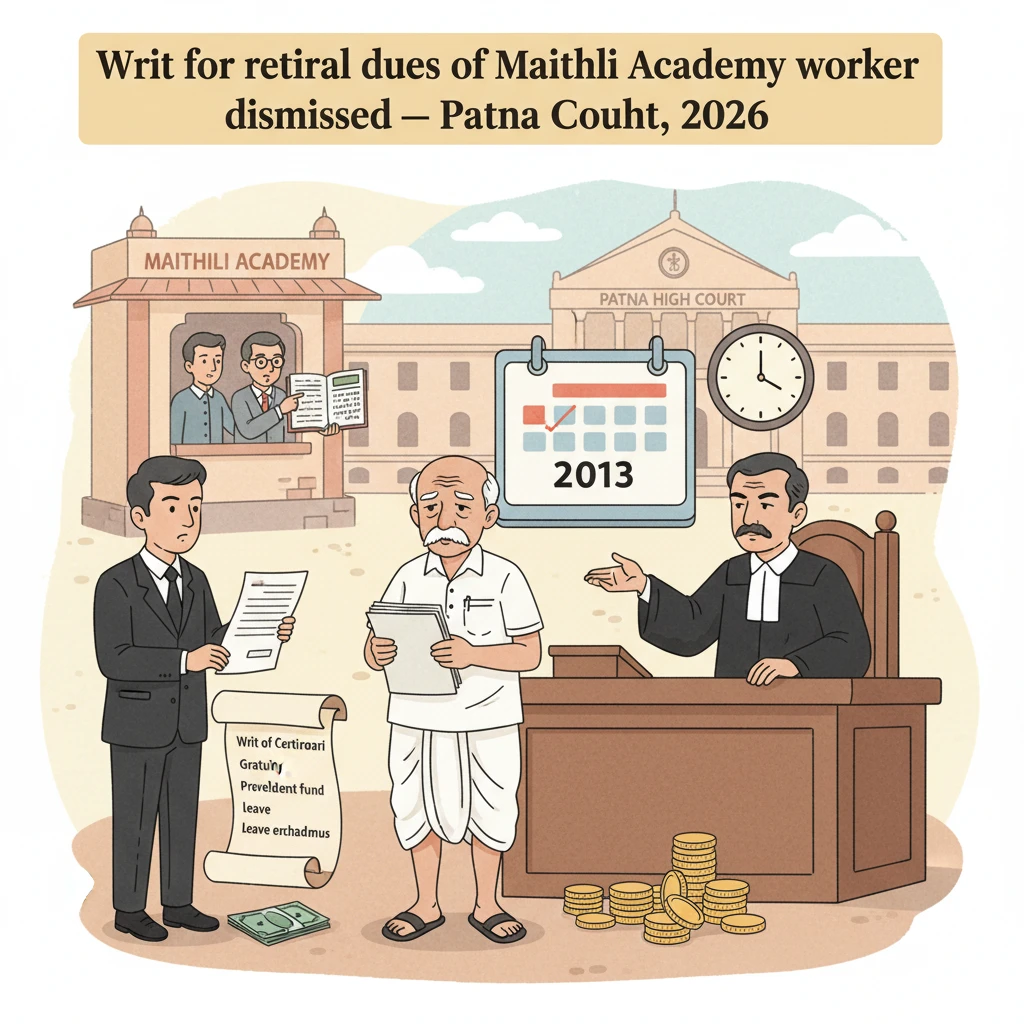
The petitioner was employed as a Peon in Maithili Academy, Patna, an institution created to promote the Maithili language and literature.
According to the petitioner, he was made to retire from service with effect from 31.12.2006. This was done through Letter No. 06/07 dated 03.01.2007 issued by the Chairman-cum-Director of Maithili Academy.
The petitioner claimed that this retirement was premature. He relied on a letter dated 08.03.2002 written by the Director-cum-Secretary of Maithili Academy to the Joint Secretary-cum-Director, Department of Higher Education, Government of Bihar, to say that he was entitled to continue working till 31.01.2010.
He also stated that he was paid only half salary during his service and that a large part of his retiral dues such as arrears of salary, gratuity, provident fund and leave encashment had not been paid.
After making representations from January 2007 onwards, and not getting relief, he finally approached the Patna High Court by filing Civil Writ Jurisdiction Case No. 20975 of 2013. In this writ petition, he asked the Court to quash his retirement order and to direct payment of retiral dues as per the Sixth Pay Commission along with interest.
What the Court Examined and Decided
The case was heard by Hon’ble Justice Smt. G. Anupama Chakravarthy. The Court considered the pleadings of the petitioner and the counter affidavit filed on behalf of the State authorities.
The petitioner’s stand was that his retirement order was arbitrary. He said no notice was given to him and no separate proceeding was held to determine his age before issuing the order. He said this violated principles of natural justice.
He further claimed that the authority had decided his age only by looking at his physical appearance, and not on the basis of his service records. He alleged that this approach was illegal.
On the financial side, the petitioner pleaded that the Academy had not correctly placed his dues before the Government while seeking release of funds, and that similarly situated employees had been paid their retiral dues while his amounts were unlawfully withheld.
The State authorities (respondent nos. 2 and 3) filed a detailed counter affidavit. They first pointed out that the reliefs sought were themselves confusing. On one hand, the petitioner was challenging the retirement order dated 03.01.2007. On the other hand, he was also asking for retiral dues calculated after pay revision under the Sixth Pay Commission, which logically presumes that he had already retired.
The respondents then stressed the long delay in filing the writ petition. The petitioner had retired with effect from 31.12.2006, but the writ case was instituted in 2013, almost six years later. No explanation for this delay was offered in the petition.
Placing reliance on Supreme Court decisions in Chennai Metropolitan Water Supply and Sewerage Board and others vs. T.T. Murali Babu, (2014) 4 SCC 1088, and Karnataka Power Corporation Ltd. vs. K. Thangappan and another, (2006) 4 SCC 322, the respondents argued that High Courts exercising writ jurisdiction under Article 226 of the Constitution can refuse to entertain stale claims filed after inordinate delay.
The State side also informed the Court that other employees of Maithili Academy had earlier approached the Patna High Court for similar reliefs. In particular, reference was made to C.W.J.C. No. 15038 of 2009 (Ugra Nath Jha vs. The State of Bihar and others). In that case, by judgment dated 25.09.2014, the writ petition had been dismissed with liberty to the petitioner to approach the Civil Court for recovery of dues, after noticing that Maithili Academy is “State” within the meaning of Article 12 of the Constitution.
The respondents then explained the legal status of Maithili Academy. The Academy was established under Government Resolution contained in Memo No. 876 dated 11.03.1975 as a “Society” registered under the Societies Registration Act, 1860. Its purpose was to preserve and promote Maithili language and literature, and it functioned as per its memorandum of association and by-laws.
According to the counter affidavit, the by-laws of the Academy contain no provision for pension, gratuity, leave encashment or other retiral benefits to employees. The respondents alleged that the petitioner had not placed these by-laws on record and had concealed this important aspect.
The State further submitted that the employees of Maithili Academy are not Government employees. They are only entitled to honorarium, and this honorarium cannot be automatically revised according to Pay Commission recommendations. In support of this position, the department had taken an opinion from the Law Department, Government of Bihar.
The Law Department’s opinion, quoted in paragraphs 23 and 24 of the counter affidavit, clearly stated that the State Government was under no obligation to release grants-in-aid to Maithili Academy for payment of gratuity or leave encashment to its retired employees, especially since no Government approval had been given for such payments.
The respondents also relied on a judgment of the Supreme Court dated 30.01.2019 in S.L.P.(C) No. 18502 of 2018 (State of Bihar and another vs. Dr. Sachindra Narayan and others) relating to A.N. Sinha Institute of Social Studies, Patna. In that case, the Supreme Court held that employees of autonomous societies cannot be treated at par with Government employees and the State cannot be burdened with payment of retirement benefits. It was argued that the same reasoning applied to Maithili Academy.
On top of this, counsel for Maithili Academy pointed out that the Academy itself was no longer in existence. Therefore, any order directing the Academy to pay retiral benefits out of State Government funds would not arise.
After hearing both sides, the Patna High Court examined the materials on record.
First, on the question of delay, the Court found that the writ petition had been filed after an “inordinate and unexplained delay” from the date of the impugned order of retirement. The Court noted that no satisfactory explanation was given for waiting nearly six years before filing the case. Because writ jurisdiction under Article 226 is discretionary, the Court held that the petitioner was not entitled to relief when he had slept over his rights for such a long period.
Secondly, the Court considered the nature of Maithili Academy and the liability of the State Government. It accepted that Maithili Academy is a society registered under the Societies Registration Act, 1860 and governed by its own memorandum of association and by-laws.
The Court noted that the State Government does release annual grants-in-aid to the Academy, but only to meet establishment and functional expenses. This financial assistance does not create any obligation on the State to bear the Academy’s retiral liabilities.
The Court further held that employees of such an institute cannot be treated at par with State Government employees. Accordingly, the State cannot be burdened with responsibility to pay pension to the employees of the Academy.
Finally, the Court took note of the submission that Maithili Academy itself is no longer in existence. Once the institution has closed down, there is no practical scope to direct it to pay retiral benefits, and directing the State to meet those liabilities would also not be justified.
In light of these findings, the High Court concluded that the writ petition lacked merit. The petition was dismissed and any interlocutory applications were disposed of.
Why This Judgment Matters
This decision is significant for employees of autonomous bodies, academies and societies in Bihar, particularly those who receive honorarium and are not regular Government staff.
The Patna High Court has made it clear that approaching the Court after many years of delay, without justification, can lead to outright dismissal of a case. Workers who feel wronged must act promptly and not wait for years before going to court.
The judgment also reinforces that grant-in-aid from the State Government to autonomous institutions does not automatically create a right to pension, gratuity or leave encashment from the State. Unless the institution’s own rules provide such benefits, and unless the Government has clearly approved them, retired staff cannot demand that the State pay these amounts.
For employees of bodies like Maithili Academy, the ruling shows that they may have to explore other remedies, such as civil suits for recovery of dues, rather than expecting writ courts to grant them Government-level retirement benefits.
Legal Issues and Answers
- Issue: Can a former employee of Maithili Academy, retired by order dated 03.01.2007, seek quashing of that order and claim retiral dues through a writ petition filed nearly six years later?
Answer: No. The Patna High Court held that the petition was barred by inordinate and unexplained delay and therefore no discretionary relief under Article 226 could be granted. - Issue: Is the State Government liable to pay pension, gratuity and leave encashment to employees of Maithili Academy out of grants-in-aid provided to the Academy?
Answer: No. The Court held that Maithili Academy is a registered society governed by its own by-laws, that grants-in-aid are only for establishment and functional expenses, and that the State cannot be burdened with retiral liabilities of such an autonomous institute. - Issue: Can the Court direct payment of retiral benefits when the autonomous body (Maithili Academy) is no longer in existence?
Answer: No. The Court noted that since the Academy is no more in existence, there is no question of directing it to pay retiral benefits from State funds.
Cases Cited by the Court
- (2014) 4 SCC 1088, Chennai Metropolitan Water Supply and Sewerage Board and others vs. T.T. Murali Babu.
- (2006) 4 SCC 322, Karnataka Power Corporation Ltd. vs. K. Thangappan and another.
- C.W.J.C. No. 15038 of 2009, Ugra Nath Jha vs. The State of Bihar and others, judgment dated 25.09.2014 (Patna High Court).
- S.L.P.(C) No. 18502 of 2018, State of Bihar and another vs. Dr. Sachindra Narayan and others, judgment dated 30.01.2019 (Supreme Court of India).
Case Details
Case Number: Civil Writ Jurisdiction Case No. 20975 of 2013
Case Title: Kalikant Jha vs. The State of Bihar and others
Coram: Hon’ble Justice Smt. G. Anupama Chakravarthy
Date of Judgment: 30.01.2026
Citation: 2026(2) PLJR 259
Advocates:
- For the Petitioner: M/s K.N. Choubey, Sr. Advocate; Ambuj Nayan Chaubey; Ashok Kumar Garg, Advocates
- For the State: Mr. Manoj Kumar, AC to GP 4
- For Respondent Nos. 4 and 5 (Maithili Academy): M/s J.N. Thakur, Advocate
Nature of the Case: Writ petition under Article 226 of the Constitution of India challenging premature retirement order and seeking payment of retiral dues.
Link to the Judgment: Patna High Court Judgment in CWJC No. 20975 of 2013
If you found this explanation helpful and wish to stay informed about
how legal developments may affect your rights in Bihar,
you may consider following Samvida Law Associates for more updates.







