

Case Background
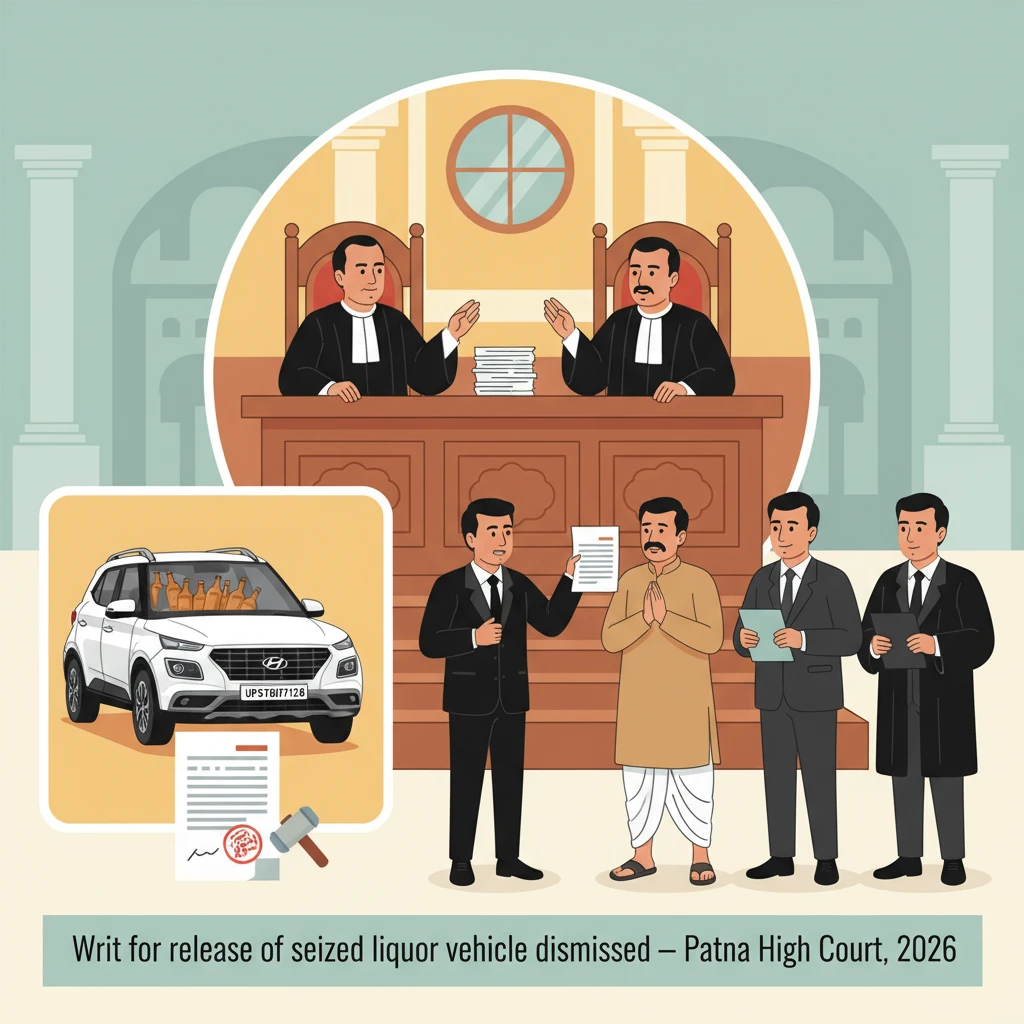
The case arose out of Durgawati P.S. Case No. 169/2024, registered on 21.06.2024 under Section 30(a) of the Bihar Prohibition and Excise (Amendment) Act, 2018. The informant, a Sub-Inspector of Durgawati Police Station, received secret information at about 9:00 hours that a white Hyundai Venue car was parked on the road towards the northern side of village Khuthan and that illicit liquor was kept in it.
The police team reached the spot in a government vehicle. They found the white Hyundai Venue standing on the road with all four doors closed. In the presence of two police personnel, the car was searched. According to the FIR, 350.250 litres of illicit liquor were recovered from the car.
From the car, a copy of its registration certificate was also found. The registration showed the present petitioner as the owner, with his address. The police seized the car and the liquor, prepared a seizure list, and registered Durgawati P.S. Case No. 169/2024.
Later, Excise (Vehicle Confiscation) Case No. 24/2025 was initiated before the Sub-Divisional Magistrate, Mohania (Kaimur). By order dated 01.07.2025, that court confiscated the vehicle bearing Registration No. UP57BH7128 (Hyundai Venue, with the specific chassis and engine numbers noted in the order) and directed that it be sold by auction.
The petitioner then approached the Patna High Court in Civil Writ Jurisdiction Case No. 1800 of 2026, seeking quashing of the Sub-Divisional Magistrate’s order of confiscation and auction.
What the Court Examined and Decided
The Division Bench of Hon’ble Mr. Justice Mohit Kumar Shah and Hon’ble Mr. Justice Arun Kumar Jha heard the matter. The judgment is an oral judgment delivered on 30.03.2026 (per Hon’ble Mr. Justice Mohit Kumar Shah).
The petitioner’s counsel participated through video conferencing. The State was represented by learned Government Pleader-2.
Petitioner’s version and arguments
The petitioner claimed he had purchased the Hyundai Venue on loan and had been paying monthly EMI of Rs. 15,758/- since 01.12.2022, finally settling the loan on 01.11.2025. To meet this financial burden, he stated that he used the Zoom Car Application to rent out his car and had already rented it twice earlier.
For the incident in question, he alleged that one “Mr. Farukdin” booked the vehicle through the Zoom Car Application. The petitioner said he handed over the vehicle to this person after taking his Aadhaar card, PAN card, photocopy of driving licence and entering into a rental agreement dated 18.06.2024.
According to the petitioner, he later came to know that his car had been seized in connection with Durgawati P.S. Case No. 169/2024 due to recovery of illicit liquor. On 22.06.2024, he allegedly called this renter to know his location and expected time of return of the car. He claimed the renter misbehaved with him and did not return the car.
He further stated that on the same day, 22.06.2024, he approached Police Station Kishangarh, Delhi to lodge a complaint against the renter for not returning the car. He was allegedly informed there that his car had already been seized in connection with Durgawati P.S. Case No. 169/2024.
The petitioner’s counsel argued that no person had been apprehended from the place of occurrence when the car was seized. He said this cast doubt on the seizure process and made the seizure memo unreliable. He also complained that, although he had approached the Sub-Divisional Magistrate, Mohania (Kaimur) for release of the car, that court rejected his plea “mechanically” through the order dated 01.07.2025.
Notably, the petitioner made it clear that he did not want to use the statutory appeal available under Section 92 of the Bihar Prohibition and Excise Act, 2016 against the confiscation order. He claimed that this appeal remedy was not efficacious and asked the High Court to decide his writ petition on merits.
The petitioner relied on a previous Patna High Court judgment dated 16.05.2019 in CWJC No. 7612 of 2019 (Rajesh Giri vs. State of Bihar & Ors.). In that case the Court had ordered release of a vehicle seized with liquor, subject to conditions. He sought similar relief.
State’s stand and objections
The State opposed the writ petition, pointing to the counter-affidavit. It argued that the story put forward by the petitioner – about a rental through an app and a later police complaint in Delhi – did not inspire confidence and its truth had yet to be tested.
The State highlighted that the rental agreement about the car was said to be dated 18.06.2024, and the car was seized just a few days later on 21.06.2024 with 350.250 litres of illicit liquor. While the petitioner claimed to have gone to Kishangarh Police Station, Delhi on 22.06.2024, there was no FIR or complaint on record from that police station.
The State stressed that it is undisputed that 350.250 litres of illicit foreign liquor were recovered from the car and that the petitioner is the registered owner of that vehicle. It also relied on Section 47 of the Act, 2016 to say that the owner of the vehicle need not be present at the spot for liability to arise.
Relying on Section 56 of the Bihar Prohibition & Excise (Amendment) Act, 2022 and Rule 12A(3) of the Bihar Prohibition and Excise (Amendment) Rules, 2022, the State argued that the Collector or authorised officer can confiscate any vehicle used for transporting illicit liquor, if satisfied that releasing it would not be in public interest. The Sub-Divisional Magistrate had exercised this power, confiscated the vehicle and ordered its auction.
The State submitted that the petitioner had an effective statutory appeal under Section 92 of the Act, 2016 against the confiscation order. In that appeal, all factual issues about the rental agreement and alleged non-return of the car could be properly examined, evidence could be led, and the authority could take a considered view. It argued that such disputed questions of fact cannot be appropriately decided in a writ petition under Article 226 of the Constitution.
Court’s consideration of the statutory scheme
The Patna High Court examined the statutory provisions in detail. It noted that Section 30(a) of the Bihar Prohibition and Excise (Amendment) Act, 2018 prescribes severe punishment for unlawful manufacture, transport, possession or other dealings in liquor without licence.
The Court referred to Section 56 of the Amendment Act, 2022, which empowers the Collector or authorised officer to confiscate items when an offence under the Act is committed. These items include any premises, any vehicle or conveyance, the liquor itself, and any other item related to the case.
The Court also reproduced Section 58 of the Act, detailing how the District Collector can order confiscation after receiving a report of seizure, whether or not prosecution is launched, and the obligation to give a reasonable opportunity of hearing before passing a confiscation order. It also allows sale of confiscated property by public auction if the Collector feels it is in public interest.
Further, the Court discussed Section 57B of the Amendment Act, 2022 and Rules 12A and 13A of the Bihar Prohibition and Excise (Amendment) Rules, 2021. These provisions deal with the release of seized vehicles on payment of penalty and the procedure for confiscation and auction if the vehicle is not released.
Rule 12A(3), which was central to this case, states that if, on a report by the police or excise officer, the Collector or authorised officer is satisfied that releasing the vehicle would not be in public interest, he shall proceed with confiscation and auction.
Findings on facts and alternative remedy
The Court recorded that there is no dispute that 350.250 litres of illicit liquor were recovered from the petitioner’s car in Durgawati P.S. Case No. 169/2024. Therefore, on the face of it, an offence under Section 30(a) of the Amendment Act, 2018 was made out because illicit liquor was being transported in the vehicle.
In view of the provisions, the Collector or authorised officer had the power to confiscate the vehicle. The Sub-Divisional Magistrate, Mohania (Kaimur), after considering the law, concluded in the impugned order dated 01.07.2025 that releasing the vehicle on penalty would not be in public interest, given the large quantity of liquor seized. The officer therefore confiscated the vehicle and ordered auction.
The High Court observed that, once the vehicle had already been confiscated, the issue of release on payment of penalty under Rule 12A(2) was no longer relevant. The correct remedy for the petitioner was to challenge the confiscation order by filing an appeal under Section 92 of the Act, 2016.
Section 92 provides that all final orders passed by the Collector are appealable to the Excise Commissioner within 90 days, and other orders are appealable as per the hierarchy prescribed. Thus, an independent statutory appeal mechanism exists for challenging confiscation orders.
The Court underlined that the petitioner’s case involved several disputed questions of fact: the genuineness of the rental agreement, the conduct of the alleged renter, and the alleged attempt to lodge a complaint in Delhi. Determining these issues would require oral and documentary evidence, which cannot be properly evaluated in writ jurisdiction under Article 226.
The Court referred to several Supreme Court decisions, including Thansingh Nathmal v. Superintendent of Taxes (A.I.R. 1964 SC 1419), Punjab National Bank v. Atmanand Singh (2020) 6 SCC 256, Babubhai Muljibhai Patel v. Nandlal Khodidas Barot (1974) 2 SCC 706, and Government of Andhra Pradesh v. Thummala Krishna Rao (1982) 2 SCC 134. It relied on these to emphasize that where statutory remedies exist and factual disputes require evidence, writ jurisdiction should not be invoked.
The Court also cited Seth Chand Ratan v. Pandit Durga Prasad (2003) 5 SCC 399 and Radha Krishan Industries v. State of Himachal Pradesh (2021) 6 SCC 771. These cases reinforce the principle that when rights and liabilities are created by statute and a specific remedy or procedure is provided, parties should ordinarily exhaust such remedies before approaching the High Court under Article 226.
Distinguishing the earlier Rajesh Giri judgment
The Bench carefully considered the 2019 decision in Rajesh Giri, which the petitioner had relied upon. It pointed out important differences:
First, in Rajesh Giri, only a meagre quantity of 540 ml of Indian Made Foreign Liquor had been recovered. In contrast, the present case involved a huge quantity of 350.250 litres of illicit liquor.
Second, in Rajesh Giri, there was no confiscation proceeding pending regarding the vehicle at the time the High Court ordered its release. Here, by the time the writ petition was filed, the Sub-Divisional Magistrate had already passed the order dated 01.07.2025 confiscating the vehicle and directing its auction.
Moreover, in Rajesh Giri the release was ordered subject to the petitioner furnishing two sureties, one local, to the extent of the insured value of the vehicle. In the present case, the petitioner had not shown any willingness to accept conditions for release or proposed any safeguards.
For these reasons, the Court held that the earlier judgment could not be used to seek similar relief in this case.
Final conclusion
The Court recorded that, when specifically asked, the petitioner’s counsel declined to avail the appeal remedy under Section 92 even after the Court indicated it could stay the vehicle’s auction if such appeal was pursued.
Given the statutory scheme, the factual disputes, and the availability of a specific appellate remedy, the Court held that the writ petition was not maintainable and there was no merit in it. It dismissed Civil Writ Jurisdiction Case No. 1800 of 2026.
Why This Judgment Matters
This judgment is important for vehicle owners whose cars are seized in prohibition cases in Bihar. It shows that once a vehicle is found carrying a large quantity of illicit liquor, authorities can confiscate it and order its auction, even if the registered owner claims someone else was using the car.
The Patna High Court has made it clear that owners must first use the appeal allowed under Section 92 of the Bihar Prohibition and Excise Act, 2016 to challenge confiscation orders. The High Court will not normally decide such cases directly through a writ petition, especially when facts are disputed and evidence is needed.
The judgment also clarifies that old orders of release of vehicles, passed in very different circumstances (such as small quantities of liquor and no confiscation order), cannot automatically be applied to every new case. Each case will depend on the quantity of liquor, the stage of proceedings, and whether public interest supports release of the vehicle.
Legal Issues and Answers
- Issue: Can the Patna High Court, in a writ petition under Article 226, quash a confiscation and auction order passed by the Sub-Divisional Magistrate in a liquor seizure case where large quantity of illicit liquor was recovered from the petitioner’s vehicle?
Answer: No. The Court held that, in view of the statutory scheme for confiscation and appeal under Section 92 of the Bihar Prohibition and Excise Act, 2016 and the presence of disputed facts requiring evidence, the writ petition was not maintainable and the petitioner must pursue the statutory appeal. - Issue: Does the earlier Patna High Court decision in Rajesh Giri, directing release of a seized vehicle, govern a case involving 350.250 litres of illicit liquor where the vehicle has already been confiscated and ordered to be auctioned?
Answer: No. The Court distinguished Rajesh Giri on facts, noting the meagre quantity of liquor in that case and absence of confiscation proceedings, and held it inapplicable to the present case.
Cases Cited by the Court
- Thansingh Nathmal & others v. Superintendent of Taxes, Dhubri & Ors., A.I.R. 1964 SC 1419
- Punjab National Bank and others v. Atmanand Singh and others, (2020) 6 SCC 256
- Babubhai Muljibhai Patel v. Nandlal Khodidas Barot, (1974) 2 SCC 706
- Government of Andhra Pradesh v. Thummala Krishna Rao & Anr., (1982) 2 SCC 134
- Seth Chand Ratan v. Pandit Durga Prasad (D) By Lrs. & Others, (2003) 5 SCC 399
- Radha Krishan Industries v. State of Himachal Pradesh & Ors., (2021) 6 SCC 771
- Rajesh Giri v. State of Bihar & Ors., judgment dated 16.05.2019 in CWJC No. 7612 of 2019 (distinguished)
Case Details
Case Number: Civil Writ Jurisdiction Case No. 1800 of 2026
Case Title: Prayagadhwaj Yadav @ Prayag v. State of Bihar & Ors.
Citation: 2026(3) PLJR 228
Coram: Hon’ble Mr. Justice Mohit Kumar Shah; Hon’ble Mr. Justice Arun Kumar Jha
Date of Judgment: 30.03.2026
Advocates:
- For the petitioner: Mr. Abhigyan Kumar, Advocate; Mr. Saurabh Yadav, Advocate (appearing virtually)
- For the State: Mr. Prashant Pratap, Government Pleader-2
Nature of the Case: Writ petition under Article 226 of the Constitution challenging confiscation and auction order in Excise (Vehicle Confiscation) Case No. 24/2025 arising out of Durgawati P.S. Case No. 169/2024 under Section 30(a) of the Bihar Prohibition and Excise (Amendment) Act, 2018.
Link to the Judgment: Patna High Court Judgment in CWJC No. 1800 of 2026
If you found this explanation helpful and wish to stay informed about
how legal developments may affect your rights in Bihar,
you may consider following Samvida Law Associates for more updates.







