

Case Background
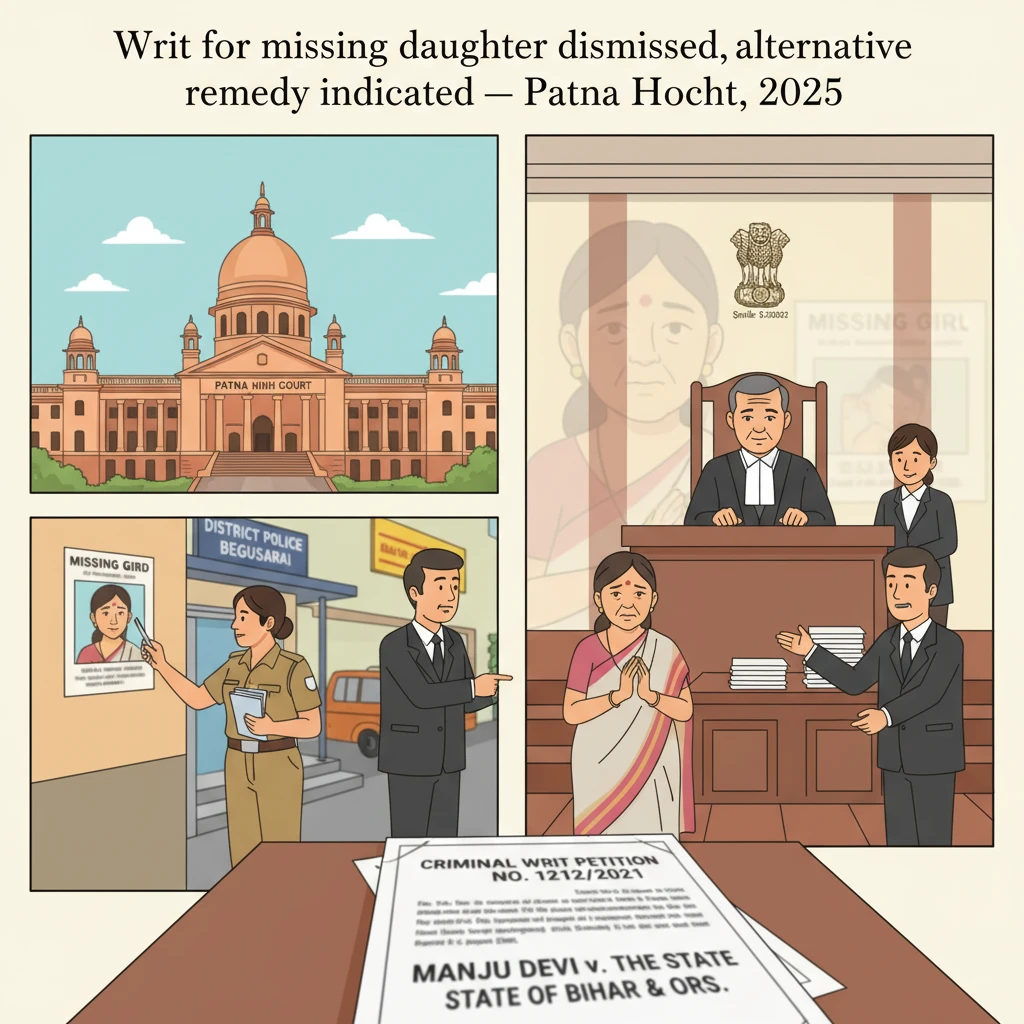
This case arises from the disappearance of the petitioner Manju Devi’s daughter from Village Samsa, Police Station Nawkothi, District Begusarai.
According to the First Information Report (FIR), the girl went missing at about 11:00 PM on 01.09.2018.
On 10.09.2018, the petitioner lodged Nawkothi P.S. Case No. 93 of 2018 against two named accused, Dayanand Chaudhary and Subodh Kumar Chaudhary, under Section 366A read with Section 34 of the Indian Penal Code.
The allegation was that the daughter had gone missing and the petitioner suspected that these persons had kidnapped her.
The FIR mentioned that the missing daughter used to sit in the house of neighbour Anju Devi.
It also referred to specific mobile numbers: the daughter’s mobile no. 9162289307, stated to be switched off; the accused’s mobile no. 7782814007, stated to be active; and another number 9815526083 from which threats were allegedly sent to the petitioner’s mobile no. 9534990356.
The petitioner requested the police to search for her daughter and take appropriate action.
Despite registration of the case and passage of about seven years, the daughter remained untraced.
Feeling that the police had failed to adequately investigate and recover the girl, the petitioner approached the Patna High Court in Criminal Writ Jurisdiction Case No. 1212 of 2021.
She sought a writ of mandamus directing the police authorities to recover and produce her daughter and to release her in the petitioner’s favour.
What the Court Examined and Decided
The writ petition came before Hon’ble Mr. Justice Jitendra Kumar of the Patna High Court.
The core relief sought was a direction to the police to recover the missing girl and hand her over to the petitioner.
Though framed as a mandamus, the grievance was effectively that the police investigation was not yielding recovery of the girl.
The State authorities filed their response.
They stated that they had taken all possible steps to trace the missing daughter but, despite their best efforts, she could not be recovered.
They clarified that a charge-sheet had been filed against the FIR-named accused persons and that supplementary investigation was still in progress.
According to the State, several specific steps had been taken to search for the girl.
These included giving advertisements in the media and pasting pamphlets containing her photograph at bus stands, railway stations and other public places.
CIG publication was done.
The missing girl’s report was also sent to the District Missing Unit, the Special Juvenile Unit and the Prevention of Human Trafficking Unit, among others.
Yet the girl remained traceless.
The petitioner, however, emphasised that even after about seven years from lodging of the FIR, the police had failed to recover the girl.
On this basis, she sought intervention of the High Court in its writ jurisdiction.
The Court carefully examined the material on record.
It noted that there was no allegation that the missing girl was in any illegal confinement by the State authorities or by private individuals at the time of hearing.
The petitioner only suspected that her daughter had been kidnapped by the FIR-named accused persons.
Following the registration of the FIR, the police had investigated, filed charge-sheet and continued supplementary investigation to trace the girl.
The Court observed that the real grievance of the petitioner was not that the daughter was in present illegal custody, but that the police was not conducting what she considered “proper investigation”, especially in relation to search and recovery of the victim.
The Judge underlined that search and recovery of the victim of any offence is part of the investigation process.
The Court explained that a writ of habeas corpus could be issued only where there is a clear case of illegal confinement by State authorities or private persons.
In the present case, there was no such allegation supported by material.
It was, therefore, not a straightforward habeas corpus situation, but a case where the petitioner was dissatisfied with the progress and effectiveness of the police investigation.
Against this backdrop, the Court examined whether it should exercise writ jurisdiction under Article 226 of the Constitution or whether the petitioner had another effective remedy.
It referred to Section 156(3) of the Code of Criminal Procedure (Cr.P.C.) and its equivalent Section 175(3) of the Bharatiya Nagarik Suraksha Sanhita (B.N.S.S.), as well as Section 97 Cr.P.C. and its equivalent Section 100 B.N.S.S.
Section 156(3) Cr.P.C. authorises any Magistrate empowered under Section 190 to order an investigation.
Section 97 Cr.P.C. empowers a District Magistrate, Sub-divisional Magistrate or Magistrate of the first class to issue a search-warrant if there is reason to believe that a person is confined under circumstances amounting to an offence.
On recovery, the person must be produced before a Magistrate who will pass appropriate orders.
The Court relied on the Supreme Court decision in Sakiri Vasu v. State of U.P., (2008) 2 SCC 409.
In that decision, the Supreme Court had held that if a person has a grievance that the police has not registered an FIR or is not conducting proper investigation, the remedy is first to approach the Superintendent of Police, and if still dissatisfied, to approach the Magistrate under Section 156(3) Cr.P.C.
The Magistrate can then direct registration of FIR, order proper investigation and even monitor the investigation.
The Supreme Court had clearly advised that High Courts should ordinarily refuse to entertain writ petitions or Section 482 Cr.P.C. petitions in such matters and should instead relegate the aggrieved person to these alternative remedies.
The Patna High Court also noted that Section 97 Cr.P.C./Section 100 B.N.S.S. gives the Magistrate power to issue a search warrant to recover a person believed to be wrongfully confined, with the requirement that the recovered person be produced before the Magistrate.
Thus, the judicial magistrate has wide powers both to ensure proper investigation and to order search and recovery of a person if there is material suggesting wrongful confinement.
The judgment then surveyed several decisions from other High Courts which held that habeas corpus is generally not maintainable in simple missing person cases where there is no allegation or material indicating illegal detention.
These included:
- Showkat Ahmad Mir v. Nighat Begum (High Court of Jammu and Kashmir and Ladakh at Srinagar, CRM(M) No. 240 of 2022)
- Jaishree v. State of U.P., 2024 SCC OnLine All 162 (Allahabad High Court)
- Selvaraj v. State, 2018 SCC OnLine Mad 14215 (Madras High Court)
- Mamonikakoty v. State of Assam, 2021 SCC OnLine Gau 2584 (Gauhati High Court)
- Jaymati Sahu v. State of Chhattisgarh, 2022 SCC OnLine Chh 737 (Chhattisgarh High Court)
- Nimananda Biswal v. State of Odisha, 2023 SCC OnLine Ori 5628 (Orissa High Court)
- Simmi Bai v. State, 2025 SCC OnLine MP 893 (Madhya Pradesh High Court)
- Babita v. State of Rajasthan, 2025 SCC OnLine Raj 5227 (Rajasthan High Court)
These rulings, quoted at length by the Patna High Court, consistently stress that:
a writ of habeas corpus is intended for cases of illegal detention, is not a routine remedy for tracing missing persons, and that missing cases must be dealt with under regular criminal law procedures.
The Court then turned to the broader question of when writ petitions should be entertained where an efficacious alternative remedy exists.
It distinguished between “maintainability” and “entertainability” of writ petitions, relying on the Supreme Court’s decisions in Godrej Sara Lee Ltd. v. Excise and Taxation Officer-cum-Assessing Authority, (2023) SCC OnLine SC 95, Whirlpool Corporation v. Registrar of Trade Marks, Mumbai, (1998) 8 SCC 1, and Radha Krishan Industries v. State of Himachal Pradesh, (2021) 6 SCC 771.
These decisions clarify that:
while the High Court’s jurisdiction under Article 226 is plenary and not barred merely because an alternative remedy exists, the Court generally adopts a self-imposed rule of refusing writs where such remedy is available, except in certain exceptional situations like violation of fundamental rights, breach of natural justice, lack of jurisdiction, or challenge to the validity of a law.
Applying these principles to the present case, the Court noted:
- The petitioner’s grievance was about the quality and result of police investigation, not about direct illegal detention.
- There exists an efficacious alternative remedy: the petitioner can approach the Jurisdictional Judicial Magistrate under Section 156(3)/Section 175(3) B.N.S.S., and also invoke Section 97 Cr.P.C./Section 100 B.N.S.S. for search warrants.
- The police has already taken steps such as publication, circulation of photographs and continuing supplementary investigation, and has filed a charge-sheet against the named accused.
- No exceptional circumstance was pleaded to justify bypassing these statutory mechanisms and invoking the High Court’s extraordinary writ jurisdiction.
On these grounds, the Court held that it would not be appropriate to continue the writ proceedings.
Instead, it would be “desirable” for the petitioner to move an appropriate application before the concerned Judicial Magistrate, seeking directions for proper investigation and search for the victim girl.
Ultimately, the Patna High Court dismissed the writ petition.
However, it expressly granted liberty to the petitioner to approach the Jurisdictional Magistrate under Section 156(3)/Section 175(3) of the B.N.S.S. with an application for issuance of a search warrant and for further necessary steps.
The Court clarified that if such an application is filed, the concerned Magistrate is duty bound to act upon it and ensure that the police “leave no stone unturned” in searching for the victim.
Why This Judgment Matters
This judgment is important for families of missing persons in Bihar and beyond.
It explains that the Patna High Court will not normally use its writ powers to directly supervise police investigation in a missing person case unless there is clear material showing illegal detention.
Instead, the Court has clearly pointed to the proper legal route: approaching the Jurisdictional Magistrate under Section 156(3) Cr.P.C./Section 175(3) B.N.S.S. and Section 97 Cr.P.C./Section 100 B.N.S.S.
The Magistrate can then order and monitor proper investigation and issue search warrants, if justified.
For lay persons, this means that when the police do not trace a missing family member despite an FIR, the next effective step is not always a writ in the High Court.
Rather, they should file an appropriate application before the Magistrate, who has strong statutory powers to push the police to act.
The decision also reinforces a broader constitutional principle: writ jurisdiction is extraordinary and discretionary.
Where the criminal procedure already provides clear remedies and supervisory tools, those remedies must normally be used first.
Legal Issues and Answers
- Issue: Can the Patna High Court, in a writ petition, direct the police to recover and produce a missing girl when there is no specific allegation or proof of her illegal detention?
Answer: No. In the absence of a prima facie case of illegal confinement, and where the grievance is about investigation, the petitioner must seek relief before the Jurisdictional Magistrate under Section 156(3)/Section 175(3) B.N.S.S. and Section 97 Cr.P.C./Section 100 B.N.S.S., rather than through a writ petition. - Issue: Is a writ petition maintainable or to be entertained when an efficacious alternative statutory remedy exists for seeking proper investigation?
Answer: While the writ is legally maintainable, the High Court will ordinarily refuse to entertain it where an effective alternative remedy exists, unless exceptional grounds such as violation of fundamental rights, breach of natural justice, lack of jurisdiction, or challenge to vires are shown. No such exception was made out in this case. - Issue: Are missing person complaints appropriately treated as habeas corpus petitions?
Answer: Generally no. Consistent with other High Courts, the Patna High Court held that missing person cases, without specific material of illegal detention, should be handled as regular criminal cases under the Penal Code and Cr.P.C., not through habeas corpus writs.
Cases Cited by the Court
- Sakiri Vasu v. State of U.P., (2008) 2 SCC 409
- Showkat Ahmad Mir v. Nighat Begum, CRM(M) No. 240 of 2022, High Court of Jammu and Kashmir and Ladakh at Srinagar
- Jaishree v. State of U.P., 2024 SCC OnLine All 162 (Allahabad High Court)
- Selvaraj v. State, 2018 SCC OnLine Mad 14215 (Madras High Court)
- Mamonikakoty v. State of Assam, 2021 SCC OnLine Gau 2584 (Gauhati High Court)
- Jaymati Sahu v. State of Chhattisgarh, 2022 SCC OnLine Chh 737 (Chhattisgarh High Court)
- Nimananda Biswal v. State of Odisha, 2023 SCC OnLine Ori 5628 (Orissa High Court)
- Simmi Bai v. State, 2025 SCC OnLine MP 893 (Madhya Pradesh High Court)
- Babita v. State of Rajasthan, 2025 SCC OnLine Raj 5227 (Rajasthan High Court)
- Godrej Sara Lee Ltd. v. Excise and Taxation Officer-cum-Assessing Authority and Others, 2023 SCC OnLine SC 95
- Whirlpool Corporation v. Registrar of Trade Marks, Mumbai and Ors., (1998) 8 SCC 1
- Radha Krishan Industries v. State of Himachal Pradesh and Others, (2021) 6 SCC 771
Case Details
Case Number: Criminal Writ Jurisdiction Case No. 1212 of 2021; arising out of Nawkothi P.S. Case No. 93 of 2018, District Begusarai
Case Title: Manju Devi v. The State of Bihar & Ors.
Coram: Hon’ble Mr. Justice Jitendra Kumar
Date of Judgment: 12.09.2025
Citation: 2026 (3) PLJR 18
Advocates:
- For the Petitioner: Mr. Anshudhar Sharma, Advocate; Mrs. Namita Sharma, Advocate
- For the State: Mr. Suman Kumar Jha, AC to AAG-3; Mr. Saurav Kumar Verma, Advocate
Nature of the Case: Criminal writ petition seeking mandamus/habeas-type relief for recovery and production of a missing girl and supervision of investigation
Link to Judgment: Click here to read the full Patna High Court judgment
If you found this explanation helpful and wish to stay informed about
how legal developments may affect your rights in Bihar,
you may consider following Samvida Law Associates for more updates.







