
Case Background
This case came before the Patna High Court as a Criminal Writ Jurisdiction Case, numbered 417 of 2019. It arose from Karakat Police Station Case No. 148 of 1998, in the district of Rohtas.
The two petitioners are related to each other and belong to the same village in Rohtas district. Both had been convicted in a criminal case and were serving life sentences. They were lodged in Open Jail, Buxar, under the authority of the Jail Superintendent and Jailor there.
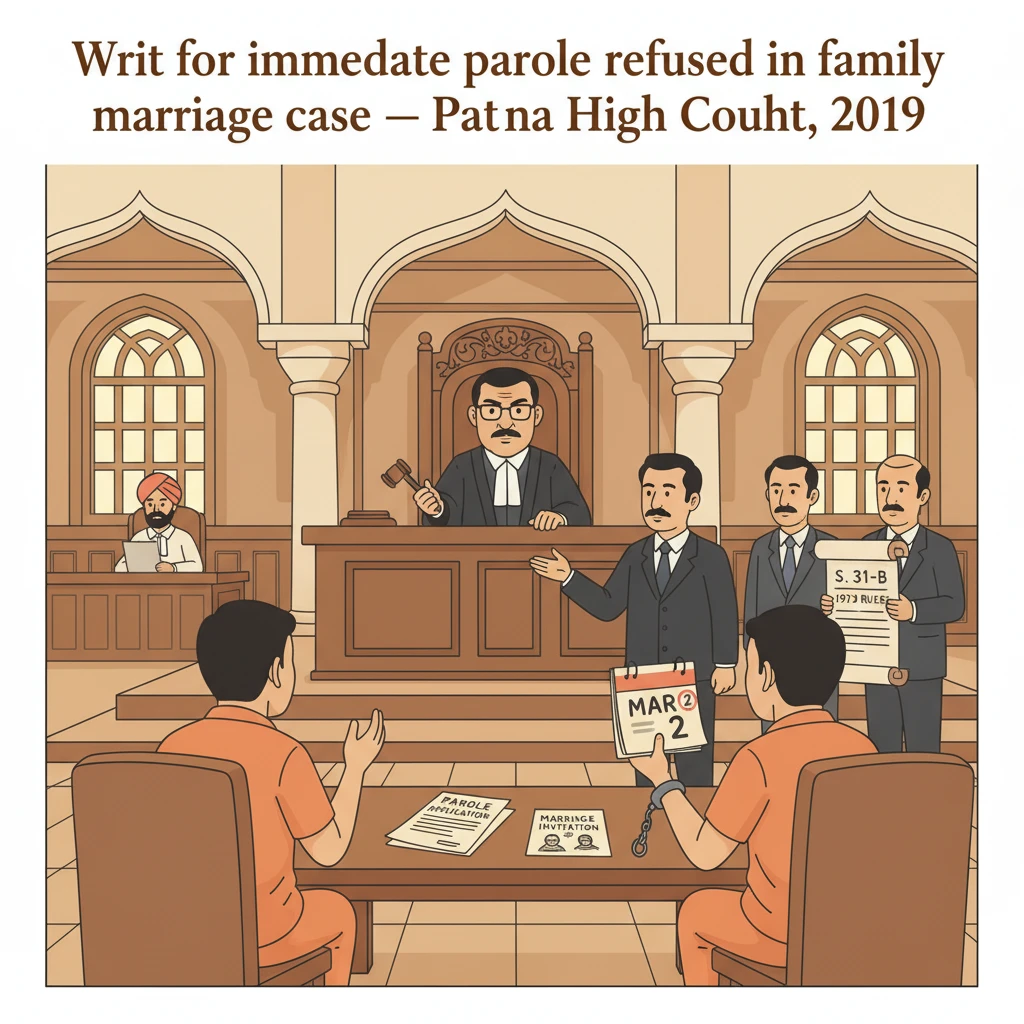
In February 2019, the petitioners wanted temporary release from jail because of a family function. The daughter of petitioner no. 1, who is also the sister of petitioner no. 2, was to be married on 2 March 2019.
On 14 February 2019, an application was moved before the State Government seeking parole from 25 February 2019 to 11 March 2019. This period covered the date of the marriage and the related ceremonies.
Very soon after filing this application to the State, the petitioners approached the Patna High Court by way of this criminal writ petition. They sought a mandamus, that is, a direction from the Court to the State Government to consider and grant their parole application in light of Section 31-B of the Prisoners Act, 1900.
What the Court Examined and Decided
The Division Bench, consisting of Hon’ble the Chief Justice and Hon’ble Justice Smt. Anjana Mishra, heard arguments from both sides on 25 February 2019. Learned counsel Shri Pramod Kumar Singh appeared for the petitioners, and learned counsel Shri Manish Kumar represented the State of Bihar.
The core request from the petitioners was not a challenge to their conviction or life sentence. Instead, it was a limited prayer for temporary release on parole to attend the marriage of a close family member. They wanted the Court to compel the State Government to act quickly and grant parole for specific dates.
The petitioners based their plea on Section 31-B of the Prisoners Act, 1900. This provision deals with release of prisoners on parole. The Court reproduced Section 31-B in the judgment to show the legal framework controlling parole in Bihar.
Under Section 31-B(1), the State Government, or any authority to which it delegates its powers, may direct that a prisoner be released on parole, either on conditions or without conditions, for a period not exceeding thirty days at a time. The time required for travel to and from prison is excluded. However, this power can be used only on the recommendation of the District Parole Board.
The first proviso to Section 31-B(1) sets out clear conditions that must be met before parole can be granted. A prisoner must have served at least one year of sentence, excluding remissions, his conduct in prison must have been uniformly good in the opinion of the District Parole Board, there must be reasonable probability that he will not commit any crime while on parole, and in case of a second or later parole, at least six months must have passed from the expiry of the earlier parole.
The second proviso further limits that a prisoner cannot be released on parole under this provision more than three times.
Section 31-B(2) excludes certain categories of prisoners from this benefit. It does not apply to prisoners convicted of offences listed in the Schedule annexed to Part of the Act, or those classified as habitual criminals under rules framed under the Prisons Act, 1894 and having more than three previous convictions.
Under Section 31-B(3), the period spent on parole counts towards the total sentence, provided the prisoner surrenders on time and his conduct during parole remains satisfactory.
After setting out the law, the Court recorded what the State had submitted about the procedure. The State pointed out that the power under Section 31-B is guided by the Bihar Prisoners (Parole) Rules, 1973.
These Rules allow parole for special reasons, and one such recognised reason is the marriage of the son or daughter of the convict. Therefore, the situation presented by the petitioners — marriage of the daughter of petitioner no. 1 — is a category where parole can be considered.
The Rules also state that the power to grant parole is exercised either by the State Government or by an authority nominated by the State Government. But this can happen only after the District Parole Board makes its recommendation.
The Court then described the structure of the District Parole Board. It consists of the District Magistrate, the Superintendent of Police, two members of the State Legislature nominated by the State Government, and the Superintendent of the District Jail or Central Jail, as the case may be. This shows that parole decisions are intended to be collective and carefully scrutinised, not taken lightly or in haste.
The order of release on parole can be passed only after all this procedure is completed. Rule 8 of the 1973 Rules further provides that the date of release should ordinarily not be more than four months from the date of the order of release. This gives an outer time limit for the effectiveness of the release order.
On the facts of this case, the Court noted that the parole application to the State Government was made on 14 February 2019. Soon thereafter, the writ petition was filed before the Patna High Court asking for a mandamus. The petitioners effectively wanted the Court to command the State Government to decide their application, and to do so within a period of seven days so that they could attend the marriage on 2 March 2019.
The Bench considered whether such a direction would be appropriate. While it was accepted that the State Government can itself dispose of such an application in accordance with the law, the Court questioned whether it should fix such a short and rigid time frame through a judicial order.
The Court observed that issuing a mandamus requiring compliance within seven days might curtail the time needed for proper assessment. The District Parole Board has to examine the prisoner’s record, behaviour, risk of reoffending, and other relevant factors before making its recommendation. Rushing this exercise under pressure of a court-imposed deadline could compromise the thoroughness of the evaluation.
Therefore, the Court held that it would not be appropriate to interfere at this stage by directing the State to complete the entire procedure and grant parole within seven days. Doing so would, in effect, bypass or compress the statutory process that has been carefully laid down under Section 31-B and the Bihar Parole Rules, 1973.
However, the Court did not close the doors on the petitioners entirely. It clarified that its refusal to issue a mandamus was without prejudice to the petitioners’ right to approach the State Government for an early decision in the matter. In simple terms, the petitioners were left free to pursue their parole request before the executive authorities and to ask those authorities to act quickly.
The Court further stated that it would be open to the State Government to pass appropriate orders after complying with the prescribed procedure and acting in accordance with law. This means the State must still consider the parole application, but the Court would not dictate the exact time limits or the outcome.
In the end, the criminal writ petition was consigned to records with these observations. No direction for release on parole was issued, and no timeline was imposed on the State.
Why This Judgment Matters
This judgment is important for prisoners and families who may wish to seek temporary release for events like marriages, funerals, or other urgent family needs. It clarifies that even if the reason is sympathetic, the Patna High Court will not bypass or shorten the statutory parole process.
The decision shows that parole is not an automatic right, but a matter to be considered by the State Government and the District Parole Board following Section 31-B of the Prisoners Act, 1900 and the Bihar Prisoners (Parole) Rules, 1973.
For families, this case highlights the need to apply for parole well in advance of important dates. Courts may not grant emergency directions if the statutory procedure still needs time for proper assessment.
For the State authorities, the judgment is a reminder that while courts will not ordinarily fix strict timelines, they still expect parole applications to be processed in accordance with law, and prisoners are free to press for an early decision before the Government.
Legal Issues and Answers
- Issue: Can the Patna High Court, in a criminal writ, direct the State Government to decide and grant parole to life convicts within a very short period for a family function?
Answer: The Court declined to issue such a mandamus, holding that parole must be processed under Section 31-B of the Prisoners Act, 1900 and the Bihar Prisoners (Parole) Rules, 1973, based on the assessment and recommendation of the District Parole Board. - Issue: Does the pendency of a parole application justify bypassing the role of the District Parole Board and other authorities?
Answer: No. The Court held that compelling a decision within seven days would improperly curtail the time needed for the Board’s assessment and recommendation before the State considers release on parole.
Cases Cited by the Court
- No previous judicial decisions or case law were cited or relied upon in this judgment. The Court decided the matter based on Section 31-B of the Prisoners Act, 1900 and the Bihar Prisoners (Parole) Rules, 1973.
Case Details
Case Number: Criminal Writ Jurisdiction Case No. 417 of 2019, arising out of P.S. Case No. 148 of 1998, Karakat Police Station, District Rohtas.
Case Title: Uma Shankar Tiwary and another v. The State of Bihar and others.
Coram: Hon’ble the Chief Justice Amreshwar Pratap Sahi and Hon’ble Justice Smt. Anjana Mishra.
Citation: 2019 (3) PLJR 546.
Advocates: For the petitioners: Mr. Pramod Kumar Singh, Advocate; Mr. Umesh Prasad, Advocate; Mr. Suraj Kumar, Advocate. For the respondents/State of Bihar: Mr. Manish Kumar, Advocate.
Nature of the case: Criminal writ petition seeking a mandamus to the State Government for consideration and grant of parole to two life convicts.
Date of Judgment: 25 February 2019.
Link to Judgment: https://patnahighcourt.gov.in/viewjudgment/MTYjNDE3IzIwMTkjMSNO-ZnQe5jCGOj0=
If you found this explanation helpful and wish to stay informed about
how legal developments may affect your rights in Bihar,
you may consider following Samvida Law Associates for more updates.







