
Case Background
The case arose from Bairiya Police Station Case No. 167 of 2018 in West Champaran district. The police registered an FIR under Section 30(a) of the Bihar Prohibition and Excise Act, 2016 and Sections 272 and 273 of the Indian Penal Code.
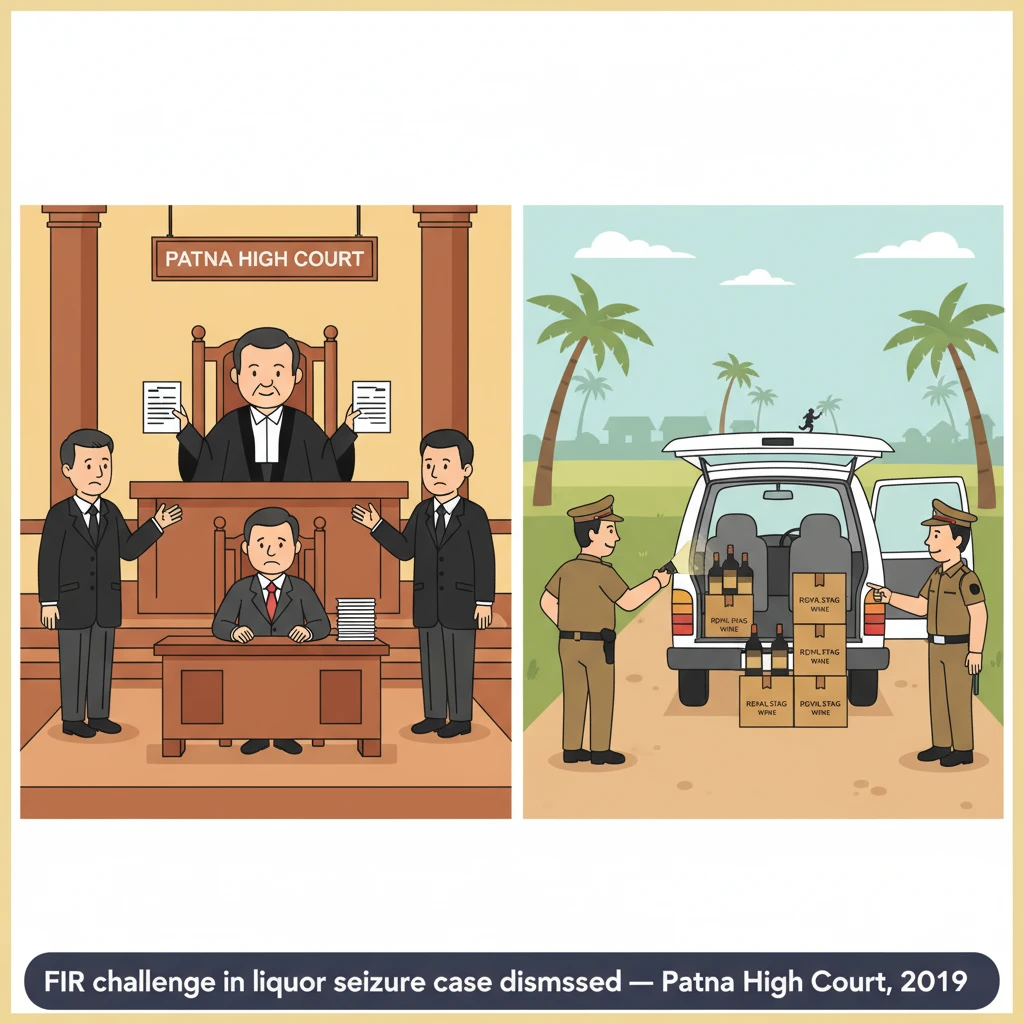
The FIR was based on information that a Maruti van was carrying a large quantity of illicit liquor. When the police intercepted the vehicle, the occupants allegedly managed to run away. On searching the van, the police recovered six cartons of Royal Stag wine, each carton containing 232 pieces of 180 ml.
The petitioner, Vicky Kumar, was named in this FIR. He then approached the Patna High Court under Articles 226 and 227 of the Constitution of India by filing Criminal Writ Jurisdiction Case No. 750 of 2019. His prayer was to set aside the FIR itself so that the criminal case against him would come to an end at the threshold.
What the Court Examined and Decided
The matter came up before Hon’ble Mr. Justice Ashwani Kumar Singh of the Patna High Court on 29 April 2019. The Court heard both sides: the petitioner through his counsel and the State of Bihar through its counsel.
The petitioner’s main argument was that his name had been included in the FIR only on suspicion. He claimed that he was not caught at the spot when the vehicle was intercepted. According to him, there was no material to connect him with the alleged offence.
The petitioner’s counsel argued that there was no concrete evidence that he was manufacturing, possessing, buying, selling, distributing, collecting, importing, exporting, transporting or removing any intoxicant or liquor. On this basis, he contended that the petitioner could not have been made an accused under Section 30(a) of the Bihar Prohibition and Excise Act.
In simple terms, the petitioner said: “I was not present, I was only suspected, and there is no proof that I was dealing in liquor. Therefore, the FIR against me should be quashed.”
On the other hand, the State opposed the writ petition. The State’s counsel explained how the FIR came to be lodged. He stated that the police had received confidential information that the petitioner and others were carrying a huge quantity of illicit liquor in a Maruti van.
Acting on this secret information, the police intercepted the van. However, the persons travelling in the van, including the petitioner as alleged, managed to escape from the spot. When the police searched the van, they found six cartons of Royal Stag wine, with 232 pieces of 180 ml in each carton.
The State argued that this recovery of a large quantity of liquor from the vehicle linked to the accused persons, including the petitioner, was sufficient to register the case and to proceed with investigation. The offence under Section 30(a) of the Excise Act being cognizable, the police were duty-bound to register the case.
The State’s counsel further contended that the allegations in the FIR, combined with the seizure of liquor, clearly made out a prima facie offence under Section 30(a) of the Bihar Prohibition and Excise Act. Therefore, there was no illegality in the police action.
After hearing both sides and going through the FIR annexed to the writ petition, the Court carefully examined the allegations. The Court noted that there was a specific allegation in the FIR about the involvement of the petitioner in the trade of illicit liquor.
The Court recorded that, based on the secret information, the police had intercepted the van. Though the occupants of the van, including the petitioner, had managed to escape, the recovery from the vehicle was significant: six cartons of Royal Stag wine containing 232 pieces of 180 ml each were found inside the Maruti van.
The Court then took note of the legal framework. It observed that there is complete prohibition of liquor and intoxicant in the State of Bihar. The Bihar Prohibition and Excise Act, 2016 has been enacted to enforce, implement and promote complete prohibition of liquor and intoxicants in the State.
The FIR in this case was specifically registered under Section 30(a) of the Excise Act. To understand whether the FIR disclosed an offence, the Court reproduced Section 30 in full. The section provides penalty for unlawful import, export, transport, manufacture, possession, sale, etc. of liquor or intoxicants, and also deals with related activities such as cultivating hemp, running illegal factories, and possessing materials or apparatus for preparing or packing liquor.
Section 30(a) covers a wide range of acts: manufacturing, possessing, buying, selling, distributing, collecting, bottling, importing, exporting, transporting or removing any intoxicant or liquor without authority or in violation of the Act, rules, orders, notifications or licence conditions. The punishment prescribed is very severe: imprisonment for a term not less than ten years, which may extend to life, and fine not less than one lakh rupees, which may extend to ten lakh rupees.
After setting out this legal provision, the Court explained its understanding. From a reading of Section 30(a), it held that any person who, in contravention of the Act, is found involved in manufacturing, possessing, buying, selling, distributing, collecting, bottling, importing, exporting, transporting or removing liquor or intoxicant, is liable for this heavy punishment.
The key question for the Court, therefore, was whether the FIR in this case contained allegations that would bring the petitioner within the scope of Section 30(a). The Court concluded that the answer was yes.
The Court held that the allegations made in the FIR clearly attracted the ingredients of Section 30(a) of the Excise Act. The FIR stated that the petitioner and others were carrying huge quantity of illicit liquor in the Maruti van, which was intercepted by the police. The fact that the occupants escaped did not erase this allegation; nor did it change the fact that a large quantity of liquor was recovered from the vehicle immediately thereafter.
On this basis, the Court rejected the petitioner’s claim that his name was mentioned only on suspicion and without material. The Court did not go into the question of whether the petitioner was in fact guilty; that issue was left for investigation and trial. The Court only examined whether the FIR disclosed a cognizable offence that justified police investigation.
The Court held that, at this stage, it could not say that the registration of the case against the petitioner was unjustified. Since the FIR contained specific allegations relating to illicit liquor and the recovery supported those allegations, the police had acted within their powers in registering the case and proceeding with investigation.
Finding no illegality or arbitrariness in the police action, the Court refused to interfere. Accordingly, the writ application filed under Articles 226 and 227 of the Constitution was dismissed.
As a result, the FIR in Bairiya P.S. Case No. 167 of 2018 remains valid, and the criminal proceedings under Section 30(a) of the Bihar Prohibition and Excise Act and Sections 272 and 273 of the IPC will continue in accordance with law.
Why This Judgment Matters
This judgment is important for anyone facing cases under the Bihar Prohibition and Excise Act, 2016. It shows that the Patna High Court is very cautious in cancelling FIRs at an early stage, especially where there is recovery of liquor.
Even if an accused person was not arrested on the spot, if the FIR mentions his or her name along with a seizure of liquor, the Court may treat this as sufficient ground for investigation to continue. The Court will not normally stop the case unless the FIR does not disclose any offence at all.
The decision also underlines the strict approach of Bihar’s prohibition law. Section 30(a) carries very heavy punishment, and the Court has shown that it will not lightly interfere with police action taken to enforce total prohibition.
For residents of Bihar, this means that any suspected involvement in storing, transporting or dealing with liquor can lead to serious criminal consequences, and attempts to get FIRs quashed may not succeed if the FIR records specific allegations and a seizure.
Legal Issues and Answers
- Issue: Whether the FIR in Bairiya P.S. Case No. 167 of 2018, alleging that the petitioner was involved in carrying illicit liquor, should be quashed under Articles 226 and 227 of the Constitution.
Answer: No. The Patna High Court held that the FIR contained definite allegations of the petitioner’s involvement and, along with the recovery of liquor, clearly attracted Section 30(a) of the Bihar Prohibition and Excise Act. The police action in registering and investigating the case was held to be justified, and the writ petition was dismissed.
Cases Cited by the Court
- No previous judicial decisions or case laws are cited or relied upon in the text of this judgment.
Case Details
Case Number: Criminal Writ Jurisdiction Case No. 750 of 2019; arising out of Bairiya P.S. Case No. 167 of 2018
Case Title: Vicky Kumar v. The Principal Secretary, Department of Excise, Government of Bihar & Ors.
Citation: 2019(3) PLJR 459
Court: High Court of Judicature at Patna
Coram: Hon’ble Mr. Justice Ashwani Kumar Singh
Date of Judgment: 29-04-2019
Advocates: Mr. Ashok Kumar Gupta, Advocate for the petitioner; Mr. Kumar Manish, SC-5 for the respondents (State of Bihar and authorities)
Statutory Provisions Involved: Articles 226 and 227 of the Constitution of India; Section 30(a) of the Bihar Prohibition and Excise Act, 2016; Sections 272 and 273 of the Indian Penal Code
Nature of the Case: Criminal writ petition seeking quashing of FIR in a prohibition case
Result: Writ petition dismissed; FIR and investigation allowed to continue
Link to Judgment: View original judgment on Patna High Court website
If you found this explanation helpful and wish to stay informed about how legal developments may affect your rights in Bihar, you may consider following Samvida Law Associates for more updates.







