

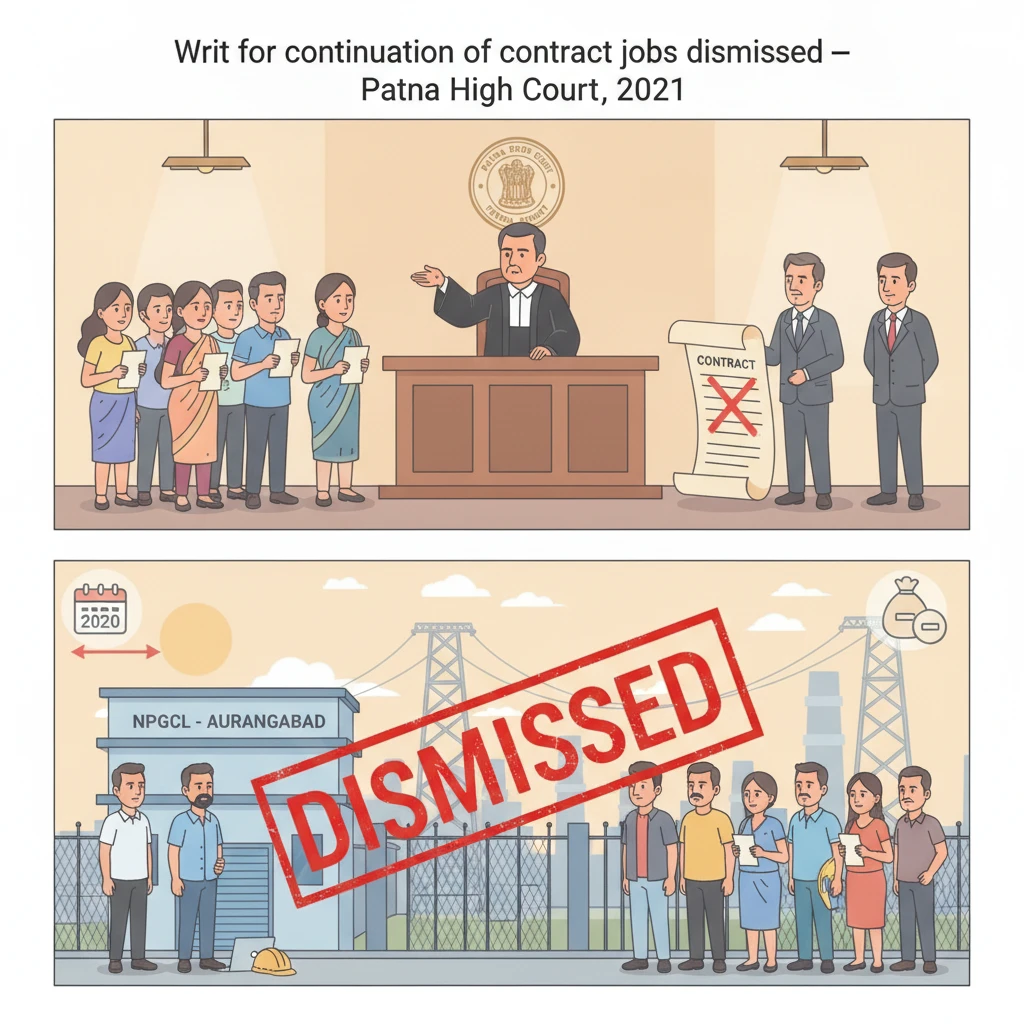
Case Background
This case arose from a dispute between a group of 14 workers and their contractual employer, Utility Power-tech Limited, commonly referred to in the judgment as UPL.
UPL was stated to have been constituted in 1995. Under contract agreements, UPL provides office support staff and workers in all projects of National Thermal Power Corporation Limited (NTPC). Nabinagar Power Generating Company Limited (NPGCL), located in Aurangabad district, Bihar, is a wholly owned subsidiary of NTPC.
The petitioners claimed that they were deployed as support manpower at NPGCL through UPL. Their deployment was said to be in response to a purchase order placed by NPGCL to UPL for one year. According to the petitioners, that arrangement had been extended continuously for years in the past, as the nature of job and post was, in their view, permanent in nature.
The petitioners filed Civil Writ Jurisdiction Case No. 8607 of 2021 before the Patna High Court. They challenged alleged discontinuance and reduction of benefits and sought directions to allow them to continue as supporting staff at NPGCL, along with payment of salary and certain allowances.
What the Court Examined and Decided
The Patna High Court, presided over by Hon’ble Mr. Justice Chakradhari Sharan Singh, heard the matter online on 08.10.2021 due to COVID-19 restrictions.
The Court first recorded the basic structure of the employment arrangement as asserted by the petitioners. UPL, described as a joint venture of Reliance Infrastructure Limited and NTPC Limited, had issued appointment letters to the petitioners. These letters were produced before the Court as Annexure P/1 series.
The petitioners stated that they had been working in different departments at NPGCL for several years through UPL. The writ petition detailed their individual positions and length of service:
Petitioner No. 1 was said to be working as Supervisor/High Skilled Worker in the Civil Department for more than four and a half years. Petitioner No. 2 was described as a Skilled Worker in the R&R Department for more than two and a half years. Petitioner No. 3 claimed to be Senior Accountant/High Skilled Worker in the Finance Department for more than six years. Petitioner No. 4 was said to be Supervisor/High Skilled Worker in the R&R Department for more than three and a half years.
Petitioner No. 5 was described as Supervisor/High Skilled Worker in the Safety Department for more than four years. Petitioner No. 6 was said to be Senior Accountant/High Skilled Worker in the Finance Department for more than nine years. Petitioner No. 7 was stated to be Supervisor/High Skilled Worker for more than six years. Petitioner No. 8 was said to be Supervisor/High Skilled Worker in the C&M Department for more than eleven years.
Petitioner No. 9 claimed to be Supervisor/High Skilled Worker in the R&R Department for more than seven years. Petitioner No. 10 was stated to be a Skilled Worker in the R&R Department for more than three years. Petitioner No. 11 was described as Supervisor/High Skilled Worker in the IT Department for more than four years. Petitioner No. 12 was said to be a Skilled Worker in the C&M Department for more than three years. Petitioner No. 13 was stated to be a Skilled Worker in the R&R Department for more than four years, and petitioner No. 14 as Supervisor/High Skilled Worker in the C&M Department for more than three years.
The petitioners relied on the fact that their contract period from 17.06.2020 to 16.06.2021, as per a purchase order dated 15.06.2020, was still in force. On this basis, they sought directions to allow them to continue as supporting staff against various posts in the office of NPGCL at Nabinagar, Aurangabad. They also sought similar relief for other similarly situated persons.
They further claimed direction for payment of salary with interest from 26.12.2020 till continuance of employment under the contract period from 17.06.2020 to 16.06.2021. In addition, they alleged that their house rent allowance, conveyance allowance, mobile allowance and other benefits had been arbitrarily reduced, and they wanted these to be restored.
Along with the main writ petition, the petitioners filed I.A. No. 1 of 2021 under Order I Rule 10(2) of the Code of Civil Procedure, seeking addition of 49 more persons as petitioners in the same case.
The Court first dealt with this interlocutory application. It held that I.A. No. 1 of 2021 was “completely misconceived” and rejected it. The judgment does not elaborate further on the reasons, but the rejection meant that the writ petition would proceed only with the original 14 petitioners.
Coming to the appointment letters, the Court examined the nature of engagement as reflected in those documents. It recorded that from these letters it was evident that the petitioners had been engaged “on assignment on fixed tenure basis” for the project site at NPGCL, Nabinagar. Thus, their employment was clearly on a fixed-term contractual basis and tied to the project.
Counsel for the petitioners, Mr. Binod Kumar Singh, advanced several arguments. He submitted that since the service contract for deployment of supervising staff was still in force between the petitioners and UPL, the company was obligated to allow the petitioners and other similarly placed persons to discharge their duties.
He further argued that the petitioners were entitled to salary with interest for the entire period during which they had sat on ‘Dharana’, as they were allegedly illegally restrained from performing their work. According to him, because the petitioners were ready to work but were prevented, they should not lose their wages.
He also contended that the allowances, such as house rent allowance, conveyance allowance and mobile allowance, had been arbitrarily reduced by UPL, and that the petitioners were entitled to restoration and payment of these benefits.
On the question of maintainability of the writ petition, learned counsel submitted that UPL was “State” within the meaning of Article 12 of the Constitution of India. He based this on the fact that NTPC Limited is a Government of India company and UPL is a joint venture of Reliance Infrastructure Limited and NTPC Limited. The argument, in essence, was that because of this nexus with a government company, UPL’s actions were amenable to writ jurisdiction.
The Court, however, did not accept the approach of the petitioners for more than one reason. It noted that from the pleadings themselves it was clear that the nature of the dispute was an industrial dispute between workers deployed by a contractor and the contracting agency, relating to continuation of employment, payment of wages and allowances.
Crucially, the Court recorded that workers deployed by UPL at the project of NPGCL had already approached the State Labour Department, Government of Bihar. A conciliation proceeding had been undertaken by the Regional Labour Commissioner (Central), Patna under the Industrial Disputes Act.
In light of this factual position, the Court formed the view that the writ petition under Article 226 of the Constitution was not maintainable. The judgment specifically states that the writ application “cannot be maintained in the light of the assertions made in the writ application in view of the nature of dispute amongst the parties,” particularly when a conciliation proceeding under the Industrial Disputes Act was already underway.
The existence of an ongoing statutory process before the Labour Department was thus a key factor. Disputes relating to termination, non‑payment of wages or conditions of service of workmen are normally to be addressed under the Industrial Disputes Act, 1947, before forums such as conciliation officers, labour courts or industrial tribunals, rather than through a writ petition, unless exceptional circumstances exist.
Accordingly, the Court declined to go into the merits of the petitioners’ claims about their continued deployment, alleged illegal restraint during ‘Dharana’, or reduction of allowances. It did not rule on whether UPL was “State” under Article 12, nor on whether the petitioners were in fact entitled to wages or benefits. Instead, it focused on the proper forum and process for such claims.
Finally, the Court dismissed the writ petition. At the same time, it protected the petitioners’ right to pursue their remedies by granting them liberty to raise their claim before the “appropriate forum under the Industrial Disputes Act, 1947.” There was no order as to costs.
Why This Judgment Matters
This decision is important for contract workers and support staff working at large projects through contractors, especially in Bihar.
Many such workers, like those deployed through UPL at NPGCL, believe their jobs are permanent because they have worked for several years. When their services are stopped or allowances are cut, they often consider filing writ petitions directly in the High Court.
The Patna High Court here clearly signals that where the dispute is about employment terms, continuation in service, or payment of wages and allowances, and where labour machinery under the Industrial Disputes Act is already seized of the matter, the High Court will normally not entertain a writ petition.
The judgment also shows that even if workers believe a company is linked to the government, that alone may not be enough to bypass labour law forums. The correct route for such grievances is to proceed under the Industrial Disputes Act and pursue conciliation and, if necessary, adjudication before labour courts or tribunals.
For contractors and principal employers, the ruling reinforces that courts expect labour disputes to be handled through the specialised statutory process rather than through parallel writ proceedings.
Legal Issues and Answers
- Issue: Can contract workers deployed through a contractor at a power project seek, by writ under Article 226, directions for continuation of their engagement, payment of salary with interest, and restoration of allowances, when an industrial dispute on the same issues is already pending in conciliation?
Answer: The Patna High Court held that such a writ petition is not maintainable in view of the nature of the dispute and the ongoing conciliation proceedings under the Industrial Disputes Act, 1947. The workers must pursue their claims before the appropriate forum under that Act. - Issue: Could 49 additional persons be added as petitioners in the same writ proceeding through an interlocutory application under Order I Rule 10(2) of the Code of Civil Procedure?
Answer: The Court found I.A. No. 1 of 2021 seeking such addition to be completely misconceived and rejected it.
Cases Cited by the Court
- The judgment does not refer to or rely on any previous decided cases.
Case Details
Case Number: Civil Writ Jurisdiction Case No. 8607 of 2021
Case Title: Sonu Kumar & Ors. v. Utility Power-tech Ltd. & Ors.
Citation: 2022 (1) PLJR 866
Court: High Court of Judicature at Patna
Coram: Hon’ble Mr. Justice Chakradhari Sharan Singh
Date of Judgment: 08-10-2021
Advocates: For the petitioners: Mr. Binod Kumar Singh, Advocate; Ms. Vagisha Pragya Vacaknavi, Advocate. For the State of Bihar: Mr. Sarvesh Kumar, G.P.-24. For NTPC: Mr. Tuhin Shankar, Advocate. Names of counsel for other private respondents are not recorded in the judgment.
Respondents: Utility Power-tech Ltd. and its office bearers; Nabinagar Power Generating Company Ltd.; Director HR, NTPC Limited; Collector, Aurangabad; Regional Labour Commissioner, Patna; Labour Superintendent, Aurangabad.
Nature of the Case: Writ petition under Article 226 of the Constitution of India seeking directions for continuation of contractual engagement and payment of salary and allowances; with an interlocutory application for impleadment of additional petitioners.
Final Outcome: Interlocutory application for adding 49 petitioners rejected as misconceived. Writ petition dismissed as not maintainable in view of the nature of the dispute and the ongoing conciliation proceeding under the Industrial Disputes Act, 1947, with liberty to the petitioners to raise their claim before the appropriate forum under that Act. No order as to costs.
Link to Judgment: Click here to read the full judgment of the Patna High Court
If you found this explanation helpful and wish to stay informed about how legal developments may affect your rights in Bihar, you may consider following Samvida Law Associates for more updates.







