

Case Background
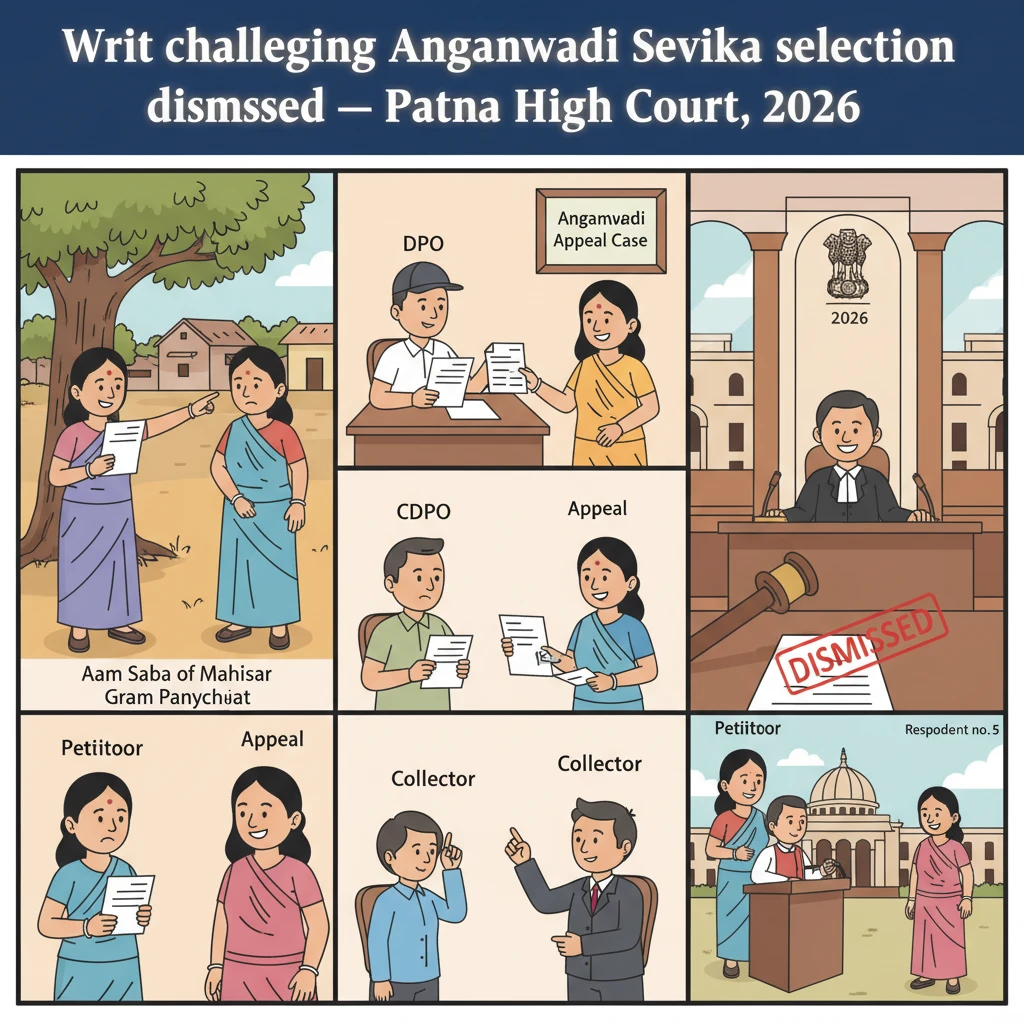
This case arose out of a dispute over selection to the post of Anganwadi Sevika at Anganwadi Centre No. 361, Ward No. 6, Gram Panchayat Mahisar, under Runnisaidpur Block in Sitamarhi district.
On 11.06.2016, the authorities issued an advertisement inviting applications for appointment of Anganwadi Sevika for this centre. Six candidates, including the writ petitioner and respondent no. 5, applied.
An Aam Sabha (general meeting) was convened on 03.11.2016 under the chairmanship of the Ward Member of Ward No. 6, who was also the Chairperson of the Selection Committee. A merit list of three candidates was prepared where the petitioner’s name appeared along with two others, but respondent no. 5’s name did not appear.
The reason recorded for excluding respondent no. 5 from the panel was that her name was not present in the voter list of the ward concerned. Following the Aam Sabha, a letter of selection dated 03.11.2016 was issued in favour of the petitioner for appointment as Anganwadi Sevika.
Respondent no. 5 challenged this selection by filing Anganwadi Appeal Case No. 11 of 2017 before the District Programme Officer (DPO), Sitamarhi. By order dated 06.09.2017, the DPO allowed the appeal, set aside the petitioner’s appointment, and directed the Child Development Project Officer (CDPO), Runnisaidpur, to convene a fresh Aam Sabha and complete the selection process afresh.
In compliance with this order, a fresh Aam Sabha was held on 26.09.2017. In that meeting, respondent no. 5 was selected as Anganwadi Sevika for Anganwadi Centre No. 361, and a selection letter was issued in her favour.
Aggrieved, the petitioner filed Anganwadi Appeal Case No. 59 of 2017 before the Collector, Sitamarhi. By order dated 15.06.2021, the Collector rejected her appeal and held that there was no illegality in the DPO’s order dated 06.09.2017.
The petitioner then approached the Patna High Court under its civil writ jurisdiction, challenging both the DPO’s order dated 06.09.2017 and the Collector’s order dated 15.06.2021, and also seeking to quash the selection of respondent no. 5 dated 26.09.2017.
What the Court Examined and Decided
The writ petition was heard by Hon’ble Mr. Justice Partha Sarthy. The Court heard the counsel for the petitioner, the State of Bihar, and respondent no. 5. No one appeared for respondent nos. 6 and 7.
The main controversy before the Court was whether the authorities had committed any illegality by cancelling the petitioner’s selection and approving the selection of respondent no. 5 as Anganwadi Sevika.
The petitioner’s counsel accepted that, on educational marks, she stood lower in merit than respondent no. 5. The petitioner had secured 47% marks, whereas respondent no. 5 had secured 55.2% marks in matriculation or equivalent examination.
However, the petitioner argued that marks were not the sole criteria under the relevant guidelines for appointment of Anganwadi Sevika. She stressed one specific objection: that respondent no. 5 was allegedly not a voter of the ward where the Anganwadi Centre was located on the relevant date.
According to the petitioner, since respondent no. 5’s name was not included in the voter list at the time of the first Aam Sabha on 03.11.2016, she was rightly excluded from the panel then. The petitioner claimed that the authorities, while allowing the appeal of respondent no. 5, failed to properly appreciate this shortcoming and committed an error of law in overturning the original selection.
On this basis, the petitioner requested the Court to set aside the orders of the DPO and the Collector, and to restore her earlier selection as Anganwadi Sevika.
The State’s counsel opposed the writ petition. He supported the orders of the DPO and the Collector and submitted that there was no illegality in the process followed by the authorities.
Counsel for respondent no. 5 also strongly opposed the petition. He emphasised that there was no dispute regarding comparative merit: respondent no. 5 had secured higher marks than the petitioner, and her selection therefore followed the principle of merit-based appointment as prescribed in the guidelines.
He further argued that the Aam Sabha resolution, on the basis of which the petitioner was initially selected, suffered from procedural irregularities. In particular, the Chairperson of the Aam Sabha had not signed the resolution, which was contrary to the guidelines governing such selections.
On the voter list issue, counsel for respondent no. 5 pointed out that both the DPO and the Collector had examined this contention in detail. They had considered the relevant voter lists and concluded that the absence of respondent no. 5’s name at one point in time was due to an error of the Booth Level Officer (BLO), and not because she was actually not a voter of the area.
The Court then examined the record and the reasoning in the impugned orders.
The Court first noted that under Clause 4 of the 2016 guidelines for appointment of Anganwadi Sevika, matriculation or equivalent qualification is the eligibility criterion. It was not disputed that both the petitioner and respondent no. 5 met this requirement, and that respondent no. 5 had higher marks (55.2%) compared to the petitioner (47%).
Regarding the voter list objection, the Court referred to the findings of the DPO and the Collector. In the voter list of 2011, the name of respondent no. 5’s father-in-law appeared at serial no. 59. After his death, the voter list prepared for the Panchayat Elections in 2016 recorded the names of respondent no. 5’s family members at serial nos. 76, 77, 78 and 82.
It was noted in the impugned orders that the name of respondent no. 5 herself had not been included in that voter list due to an error on the part of the BLO. Importantly, it was recorded that an application had been submitted on 05.06.2015 for inclusion of her name in the voter list. This application was filed even before the Anganwadi Sevika advertisement was issued on 11.06.2016.
Further, the authorities found that in the amended or corrected voter list published on 24.11.2016, the name of respondent no. 5 appeared at serial no. 45. The DPO and the Collector treated this as evidence that respondent no. 5 was in fact resident and entitled to be on the voter list, and that the earlier omission was a clerical error which later stood corrected.
The High Court carefully considered these findings. It observed that both the DPO, Sitamarhi and the Collector, Sitamarhi had dealt with the voter list issue in detail and had returned clear factual conclusions. The Court did not find any perversity or illegality in their appreciation of this material.
In light of the higher marks of respondent no. 5, the existence of her family in the voter list, her application for inclusion prior to the advertisement, and the subsequent correction showing her name in the voter list, the Court held that the authorities were justified in treating her as eligible.
The Court also noted that the first Aam Sabha resolution had defects, including non-signing by the Chairperson, as highlighted on behalf of respondent no. 5 and referred to in the impugned orders. This reinforced the decision to set aside the petitioner’s initial selection and to redo the selection process.
Taking these factors together, the Court concluded that the DPO had rightly allowed Anganwadi Appeal Case No. 11 of 2017 and cancelled the petitioner’s appointment, and that the Collector was correct in dismissing Anganwadi Appeal Case No. 59 of 2017 filed by the petitioner.
The Court therefore held that there was no illegality in the order dated 06.09.2017 passed by the DPO, Sitamarhi, nor in the order dated 15.06.2021 passed by the Collector, Sitamarhi. It also found no merit in the writ petition.
Accordingly, the Patna High Court dismissed the writ application. As a result, the selection of respondent no. 5 as Anganwadi Sevika for Anganwadi Centre No. 361 remains undisturbed.
Why This Judgment Matters
This judgment is significant for Anganwadi Sevika selections and similar local appointments in Bihar. It highlights that merit in terms of educational marks remains an important factor once basic eligibility is satisfied.
For candidates, the decision shows that minor technical gaps in documents such as voter lists, especially when caused by official error and later rectified, may not be enough to cancel a higher‑merit candidate’s selection.
For authorities, the judgment supports the approach of looking at the overall record, including applications for correction and subsequent updated voter lists, instead of rigidly relying on a single snapshot of records.
The Patna High Court’s ruling also underlines that when appellate authorities like the District Programme Officer and the Collector have carefully considered factual disputes and given detailed reasons, the High Court will be slow to interfere in writ jurisdiction.
Legal Issues and Answers
- Issue: Whether the orders of the District Programme Officer dated 06.09.2017 and the Collector dated 15.06.2021, setting aside the petitioner’s selection and upholding the selection of respondent no. 5 as Anganwadi Sevika, suffered from illegality warranting interference in writ jurisdiction.
Answer: No. The Patna High Court held that both authorities had properly considered the comparative merit and the voter list dispute, and found no illegality in their orders or in the selection of respondent no. 5.
Cases Cited by the Court
- No earlier judicial decisions are cited or relied upon in the text of this judgment.
Case Details
Case Number: Civil Writ Jurisdiction Case No. 537 of 2022
Case Title: Kumari Archana @ Archana Kumari @ Archana Devi v. The State of Bihar & Ors.
Citation: 2026 (3) PLJR 278
Coram: Hon’ble Mr. Justice Partha Sarthy
Advocates:
For the petitioner: Mr. Upendra Prasad, Advocate; Ms. Veena Kumari Jaiswal, Advocate
For the State: Mr. S.K. Mandal, SC-3; Mr. Arjun Prasad, AC to SC-3
For respondent no. 5: Mr. Rajesh Kumar Sharma, Advocate
Advocates for respondent nos. 6 and 7: None appeared
Nature of the Case: Writ petition under civil writ jurisdiction challenging appellate orders and selection to the post of Anganwadi Sevika.
Date of Judgment: 02.04.2026
Link to Judgment: Official Patna High Court judgment link
If you found this explanation helpful and wish to stay informed about
how legal developments may affect your rights in Bihar,
you may consider following Samvida Law Associates for more updates.







