
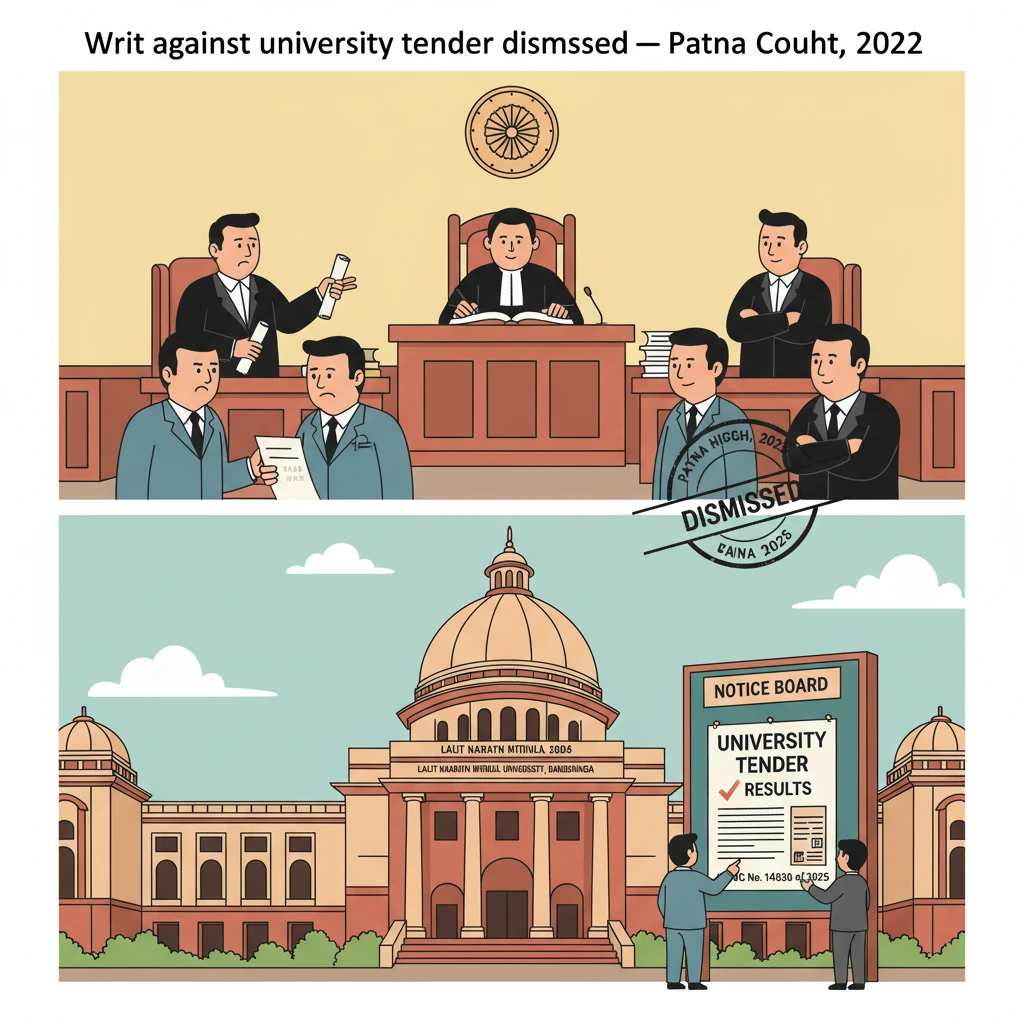
Case Background
Lalit Narayan Mithila University, Darbhanga issued a Notice Inviting Tender (NIT) vide Advertisement No. EST/01/2025. The tender was for “Hiring of agency for providing Security and Housekeeping service for the L.N. Mithila University, Darbhanga.”
The tender documents, especially Section III – Special Conditions of Contract, required bidders to quote statutory components like Employees’ State Insurance (ESI), Employees’ Provident Fund (EPF), Bonus, Uniform, Uniform washing and House Rent Allowance (HRA) “on the current rate as per the Govt. Norms” in the prescribed financial bid format. It was clearly stated that “Bidders not quoting rates in accordance with the prescribed format will be outrightly rejected.”
The petitioner, M/s Frontline (NCR) Business Solutions Pvt. Ltd., participated in the tender along with other bidders, including respondent no. 4, M/s Samanta Security and Services Pvt. Ltd. Three bidders, including the petitioner, respondent no. 4 and Elitefalcons Pvt. Ltd., were found technically qualified. Their financial bids were opened on 06.08.2025.
On evaluation of financial bids, respondent no. 4 was declared the lowest bidder (L1). The petitioner was placed as L3. The University then executed a formal agreement with respondent no. 4 on 30.08.2025, and respondent no. 4 commenced work under that contract.
Only after the declaration of financial results, the petitioner submitted a representation on 06.08.2025 to the Registrar (respondent no. 3), alleging irregularities in the winning bid. Another technically qualified bidder, Elitefalcons Pvt. Ltd., also submitted a representation on 07.08.2025. According to the petitioner, these objections were neither considered nor replied to.
Aggrieved by the declaration of respondent no. 4 as L1 and the award of the contract, the petitioner approached the Patna High Court under Article 226 of the Constitution, challenging the Tender Evaluation Committee’s decision dated 06.08.2025 and seeking directions to award the work to a bidder complying with the NIT.
What the Court Examined and Decided
The Division Bench of the Patna High Court, speaking through Hon’ble Mr. Justice Alok Kumar Sinha, with Hon’ble the Chief Justice concurring, examined four core issues: maintainability of the writ after contract conclusion, compliance by respondent no. 4 with tender conditions on statutory dues, interpretation of Condition No. (iii) of the Special Conditions, and whether the University’s decision was arbitrary, mala fide or violative of Article 14.
First, the Court considered whether it could entertain the writ petition at all, given that the tender process had already culminated in a signed contract and commencement of work. It noted that the financial bids had been opened, respondent no. 4 declared L1, and agreement executed on 30.08.2025. Respondent no. 4 had already started performing the contract.
The Court reiterated that writ jurisdiction in tender matters is primarily preventive, not curative. Judicial review under Article 226 is generally not used to unsettle concluded contracts, except in cases of clear mala fides, arbitrariness, or violation of statutory or constitutional provisions.
Relying on Jagdish Mandal v. State of Orissa, (2007) 14 SCC 517, and State of U.P. v. Sudhir Kumar Singh, (2020) 10 SCC 492, the Bench emphasized that interference after contract execution is permissible only in cases of patent illegality or mala fide that causes prejudice. Mere dissatisfaction of an unsuccessful bidder is not enough.
Applying these principles, the Court found that the petitioner approached the Court only after losing the tender and after the agreement was executed. By that time, a vested right had accrued in favour of respondent no. 4, and obligations had already arisen on the University’s side. Interfering at such a late stage would disturb a concluded contract and could cause administrative and financial complications.
The Court therefore held that the writ petition, having been filed after declaration of the financial bid and execution of the agreement, could not be entertained at that stage.
Despite this finding, the Court went on to consider the petitioner’s main grievance: that respondent no. 4’s financial bid was non-compliant because it allegedly quoted “NIL” or lower figures for statutory components like Bonus and EPF, contrary to the NIT and labour laws.
The Court examined Condition No. (iii) of the Special Conditions, which required bidders to quote ESI, EPF, Bonus, Uniform, Uniform washing and HRA “on the current rate as per the Government norms” in the financial bid, and warned that non-conforming bids would be rejected. The key phrase was “as per norms,” which the Court interpreted to mean the applicable statutory prescriptions under legislations like:
- Payment of Bonus Act, 1965
- Employees’ State Insurance Act, 1948
- Employees’ Provident Funds and Miscellaneous Provisions Act, 1952
The petitioner argued that respondent no. 4’s quotation of “NIL” Bonus and lesser EPF was a serious deviation that should have disqualified it. The Court carefully reviewed the record and found that:
The “NIL” entry in the Bonus column was confined only to specific categories: Security Supervisor (Ex-Man) and Security Guard with arms (Ex-Man). These categories were to be paid monthly wages of ₹26,280 and ₹23,218 respectively, which are above the statutory wages ceiling of ₹21,000 under the Payment of Bonus Act.
Under Section 2(13) read with Section 10 of the Payment of Bonus Act, employees drawing wages beyond the notified ceiling are not entitled to statutory bonus. Therefore, quoting “NIL” Bonus for those categories was consistent with law and with the tender requirement that statutory components be quoted “as per norms.”
On ESI, the Court noted that under the Employees’ State Insurance Act, 1948, as amended in 2016, coverage extends only to employees drawing wages up to ₹21,000 per month, and employer’s contribution is 3.25 percent of wages. Respondent no. 4 had quoted the contribution rate in line with this statutory mandate. There was no material to suggest that any employee who fell within the ESI limit was being deprived of coverage or contribution.
On EPF, the Court referred to the EPF Scheme, 1952, where Para 2(f) defines “excluded employee” as one whose monthly wage exceeds ₹15,000. The stand of respondent no. 4 was that it had quoted contributions up to the statutory wage ceiling and indicated a fixed contribution where wages exceeded the ceiling. The Court accepted that explanation, finding that the tender did not require bidders to assume PF liability beyond what the EPF Act itself required.
For HRA, Uniform and Uniform washing, no concrete discrepancy was shown by the petitioner. The Court held that the financial bid of respondent no. 4, when read as a whole, showed adherence to the statutory minima under all three Acts. The petitioner could not point to any specific statutory provision that had been violated.
The Court then turned specifically to the interpretation of Condition No. (iii) of the Special Conditions. It stressed that the requirement to quote statutory wages and deductions “as per norms” must be read harmoniously with central labour laws. While those laws express thresholds in monthly wages, the tender required figures on a daily wage basis. The Court explained that this is not a conflict, but a matter of arithmetic conversion, for example:
- ₹21,000 per month (Bonus Act / ESI ceiling) → approximately ₹807.69 per day (on 26 working days)
- ₹15,000 per month (EPF ceiling) → approximately ₹576.92 per day (on 26 working days)
The prescribed format in the NIT is procedural and meant to ensure comparability among bids. It does not permit or require bidders to enter figures that contradict central labour laws. If a statutory head is inapplicable to a category (for example, bonus for employees above the statutory wage ceiling), entering “NIL” in that column is a correct and lawful use of the format, not a deviation.
The Court further observed that the principle of “substantial compliance” applies: essential conditions must be met, but minor or formal variations that do not affect the essence of compliance should not be used to disqualify a bid.
Finally, on the allegation of arbitrariness and mala fide in declaring respondent no. 4 as L1, the Bench examined the decision-making process of the University. It relied heavily on the Supreme Court’s settled law in:
- Tata Cellular v. Union of India, (1994) 6 SCC 651
- Jagdish Mandal v. State of Orissa, (2007) 14 SCC 517
- Central Coalfields Limited v. SLL-SML (Joint Venture Consortium), Civil Appeal No. 8004 of 2016
- Afcons Infrastructure Ltd. v. Nagpur Metro Rail Corporation Ltd., (2016) 16 SCC 818
These decisions limit judicial review in tender matters to checking if the decision is lawful, free from arbitrariness, mala fide or bias, and in public interest. Courts are not to re-evaluate bids or substitute their own view on commercial or technical aspects.
The Patna High Court held that there was no evidence that the University acted dishonestly, irrationally or with intent to favour respondent no. 4. The evaluation was based on objective financial comparison and statutory norms. The fact that respondent no. 4’s work had commenced and no complaint had been received about its performance also supported the University’s decision.
The Court concluded that:
- The writ petition was belated and not maintainable at such an advanced stage of the contract.
- Respondent no. 4’s bid complied with statutory and tender requirements regarding Bonus, ESI, EPF and allied components.
- Condition No. (iii) of the Special Conditions was properly applied in harmony with central labour laws.
- The University’s decision to award the contract to respondent no. 4 did not suffer from arbitrariness, mala fide or violation of Article 14.
Accordingly, the writ application was dismissed, with all pending interlocutory applications disposed of and no order as to costs.
Why This Judgment Matters
This judgment is important for companies and institutions participating in government and university tenders, especially in Bihar.
First, it makes clear that once a tender process has ended with a signed contract and the successful bidder has started work, the Patna High Court will be very slow to interfere under Article 226. Unsuccessful bidders cannot wait to see the result and then challenge it after the agreement is executed.
Second, the Court has clarified how tender conditions that refer to statutory dues like Bonus, ESI and EPF must be read. The requirement to quote these components “as per norms” means as per the relevant labour laws. If the law itself says that certain categories are excluded or that ceilings apply, a bidder’s quote reflecting that exclusion or ceiling is not a violation of the NIT.
Third, the judgment reassures universities and public bodies that as long as they follow the tender terms and apply labour laws correctly, their commercial decisions will be respected. Courts will not act like appellate authorities over tender evaluation, especially when there is no proof of dishonesty or manipulation.
Finally, for workers and staff engaged through such agencies, the decision underscores that statutory protections under the Payment of Bonus Act, ESI Act and EPF Act remain the baseline. The Court’s focus was on whether those minimum legal rights were preserved in the winning bid, not on forcing bidders to pay more than what the law mandates.
Legal Issues and Answers
- Issue: Can a writ petition be entertained after the financial bid is opened, contract executed and work commenced?
Answer: No. The Court held that writ jurisdiction is mainly preventive. After a concluded contract and commencement of work, interference is not warranted unless clear mala fide, arbitrariness or statutory violation is proved, which was not shown here. - Issue: Did respondent no. 4 violate mandatory tender conditions on Bonus, ESI, EPF, HRA and allied components by quoting “NIL” or lower amounts?
Answer: No. The Court found that respondent no. 4’s entries matched statutory norms. “NIL” Bonus was quoted only for employees above the statutory wage ceiling. ESI and EPF contributions were correctly limited to statutory thresholds. No statutory breach or tender violation was demonstrated. - Issue: Was the University’s decision declaring respondent no. 4 as L1 and awarding the contract arbitrary, mala fide or violative of Article 14 of the Constitution?
Answer: No. The Court held that the decision followed the NIT, Special Conditions and labour laws, and there was no evidence of bias or unfair preference. Judicial review does not permit re-evaluation of commercial decisions in such circumstances.
Cases Cited by the Court
- Jagdish Mandal v. State of Orissa, (2007) 14 SCC 517
- State of U.P. v. Sudhir Kumar Singh, (2020) 10 SCC 492
- Tata Cellular v. Union of India, (1994) 6 SCC 651
- Central Coalfields Limited v. SLL-SML (Joint Venture Consortium), Civil Appeal No. 8004 of 2016
- Afcons Infrastructure Ltd. v. Nagpur Metro Rail Corporation Ltd., (2016) 16 SCC 818
Case Details
Case Number: Civil Writ Jurisdiction Case No. 14030 of 2025
Case Title: M/s Frontline (NCR) Business Solutions Pvt. Ltd. v. Lalit Narayan Mithila University & Ors.
Coram: Hon’ble the Chief Justice; Hon’ble Mr. Justice Alok Kumar Sinha
Citation: 2025 (4) PLJR 429
Advocates:
- For the petitioner: Mr. Umesh Prasad Singh, Senior Advocate; Mr. Vaibhava Veer Shanker, Advocate; Mr. Kumar Gaurav, Advocate
- For the respondents (general): Mr. Bindhyachal Rai, Advocate
- For Lalit Narayan Mithila University: Mr. Md. Nadim Seraj, Advocate; Mr. Shaileshh Kumar, Advocate
- For respondent no. 4 (Samanta Security and Services Pvt. Ltd.): Mr. Siddhartha Prasad, Advocate; Mr. Om Prakash Kumar, Advocate
Nature of the Case: Writ petition under Article 226 of the Constitution challenging tender evaluation and award of contract for security and housekeeping services
Date of Judgment: 24.09.2025
CAV Date: 16.09.2025
Link to Judgment: Click here to read the full judgment of the Patna High Court
If you found this explanation helpful and wish to stay informed about
how legal developments may affect your rights in Bihar,
you may consider following Samvida Law Associates for more updates.







