
Case Background
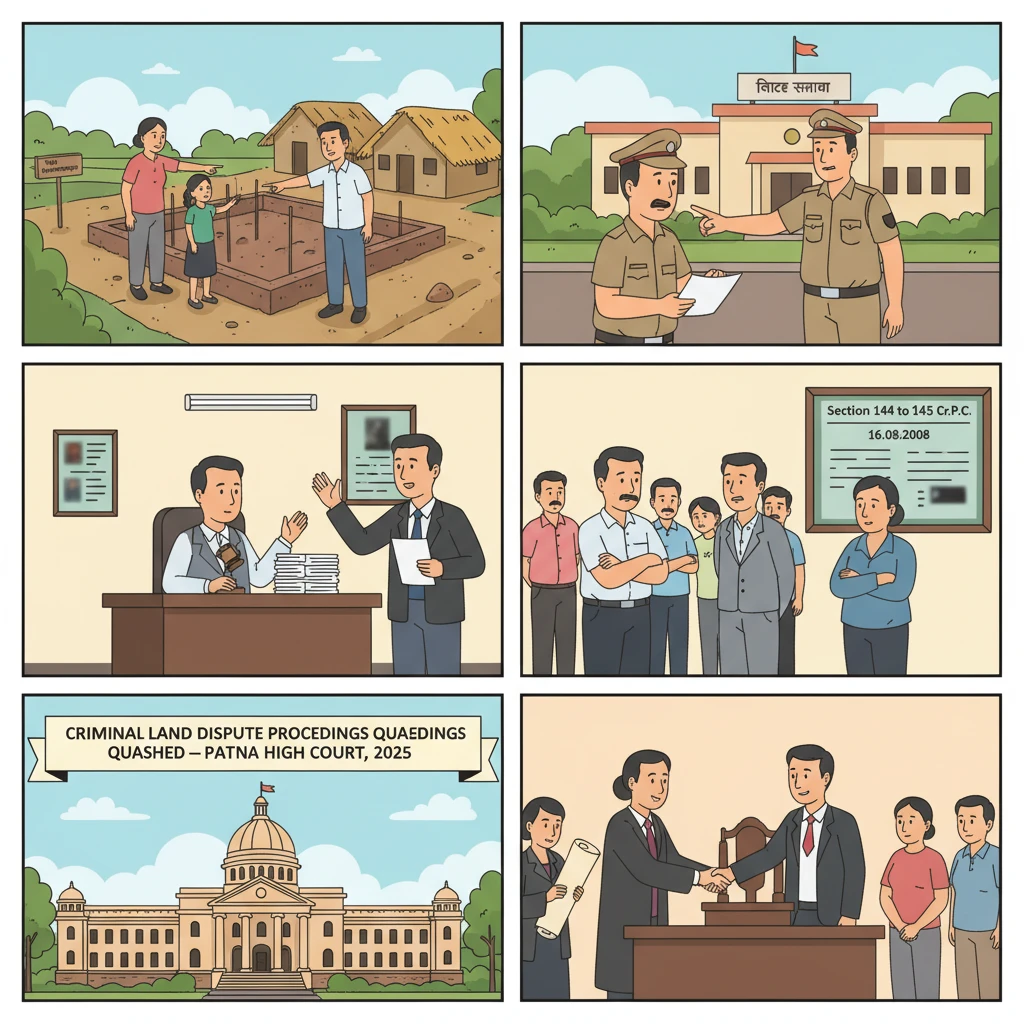
The matter arose from a long-running dispute between close relatives over a piece of land in Village Mathurapur, District Bhagalpur. Both sides are agnates, that is, members of the same extended family.
The land in question relates to Khata No. 221, Khesra No. 2169, measuring 24 decimals. According to the record, there had been a partition between the two sides in the past, and thereafter both sides constructed temporary houses on this land.
The opposite parties later alleged that the petitioner tried to construct a permanent house over what they claimed to be joint property. When they protested, they claimed the petitioner abused them. They then went to the local police station.
The police recommended initiation of proceedings under Section 144 of the Code of Criminal Procedure (Cr.P.C.) and also lodged a criminal case. Based on this, a proceeding under Section 144 Cr.P.C. was started in the court of the Sub-Divisional Magistrate (SDM), Naugachia.
After notice under Section 144 Cr.P.C., the petitioner and other accused appeared and filed show cause. They denied the allegations about possession and asserted that the petitioner had constructed his house much earlier, before the Section 144 proceeding was started.
The petitioner’s stand was that there was no real dispute over actual possession; instead, the quarrel was about survey entries. During survey operations, the review authority had entered the names of both sides in the record (Khatiyan), and the opposite parties allegedly tried to use this to raise a false possession dispute over land where both sides already had their residential houses.
On 16.08.2008, the SDM converted the proceeding from Section 144 Cr.P.C. to Section 145 Cr.P.C. and directed the parties to file written statements about their claims of possession. Later, on 30.04.2015, the case (Miscellaneous Case No. 296 of 2008, T.R. No. 05/16) was transferred to the court of the Executive Magistrate, Naugachia.
The Executive Magistrate, without issuing fresh notice under Section 145 Cr.P.C., proceeded ex parte, examined witnesses of the opposite parties only, and on 17.05.2016 passed an ex parte order against the petitioner. The petitioner then filed Criminal Revision No. 95 of 2016 before the 1st Additional Sessions Judge, Naugachia.
On 24.07.2017, the Revisional Court dismissed the revision and affirmed the Executive Magistrate’s order. Aggrieved, the petitioner approached the Patna High Court by filing an application under Section 482 Cr.P.C. seeking quashing of both the order of the Executive Magistrate dated 17.05.2016 and the Revisional Court’s order dated 24.07.2017.
What the Court Examined and Decided
The Patna High Court, presided over by Hon’ble Mr. Justice Purnendu Singh, heard counsel for the petitioner, for opposite party no. 4, and for the State. The central question was whether the SDM and the Executive Magistrate had lawfully exercised their powers under Sections 144 and 145 Cr.P.C., and whether the Revisional Court correctly upheld those orders.
The Court first noted that the original application before the SDM, Naugachia, related to determination of possession over the land in Khata No. 221, Khesra No. 2169, measuring 24 decimals. Both sides admitted that they were agnates and that there had been a partition, after which each side built temporary houses on this land.
The opposite parties alleged that the petitioner tried to raise a permanent house over the joint property, leading to protest, abuse, and ultimately a police recommendation for action under Section 144 Cr.P.C. and lodging of a criminal case. This formed the basis of the preventive proceeding before the SDM.
The petitioner’s challenge focused on how the SDM and subsequent authorities had handled the proceedings. The petitioner argued that:
- After receiving notice under Section 144 Cr.P.C., he had appeared and filed a detailed show cause denying the allegations.
- The dispute was not about who was in possession, because both sides were admittedly living on the land. It was about entries made in the Khatiyan during survey.
- On 16.08.2008, the SDM converted the proceeding into one under Section 145 Cr.P.C. without properly considering the petitioner’s show cause and documents.
- After transfer of the case on 30.04.2015 to the Executive Magistrate, no fresh notice under Section 145 Cr.P.C. was issued to the petitioner. The Executive Magistrate proceeded ex parte, took only the opposite parties’ evidence, and passed the order dated 17.05.2016.
- The Revisional Court, in Criminal Revision No. 95 of 2016, affirmed the order without proper analysis or application of mind.
On the other hand, opposite party no. 4 argued that the SDM had exercised jurisdiction properly after an enquiry and was satisfied, based on evidence and the entry of their names in the Khatiyan, that the opposite parties were in possession of the land. It was contended that both the SDM and the Revisional Court had rightly based their orders on actual possession of the opposite parties.
The High Court examined in detail the legal framework under Sections 144 and 145 Cr.P.C., which were reproduced in the judgment. Section 144 deals with urgent cases of nuisance or apprehended danger to public peace, and Section 145 deals with procedure where a dispute concerning land or water is likely to cause breach of peace.
The Court emphasised that at the stage of Section 144 there must be an enquiry by a competent officer or the Magistrate to assess the situation. From the SDM’s order and the enquiry report placed on record by opposite party no. 4, the Court found that:
- Though the SDM mentioned that an enquiry was conducted, the report did not show any clear opinion formed by the SDM on the basis of the police and Circle Officer’s report.
- The enquiry report did not demonstrate that a proper spot enquiry had been carried out.
- The report only stated that the land was in possession of the opposite parties on the basis of entries in the Khatiyan.
The Court then raised the crucial question: whether the SDM was justified in initiating and proceeding under Section 145 Cr.P.C. in these circumstances.
The High Court noted that the petition filed under Section 144 Cr.P.C. by the opposite parties did not mention any payment of rent or other concrete indicators of actual possession. The SDM’s order lacked discussion of any solid evidence produced by the opposite parties.
Justice Purnendu Singh recorded a clear finding that the SDM had, in the exercise of jurisdiction, “in most mala fide manner” proceeded to pass the order under influence. The Court considered this a serious procedural and substantive flaw.
To support its reasoning, the High Court relied on the Supreme Court judgment in Ashok Kumar v. State of Uttarakhand, (2013) 3 SCC 366. Extracting paragraphs 13 to 16 from that case, the Court highlighted the Supreme Court’s key principles:
- The ingredients for passing an order under Section 145(1) do not automatically justify attachment of property under Section 146 Cr.P.C.; the Magistrate must be satisfied that an “emergency” exists.
- A case of emergency is different from a mere apprehension of breach of peace; the Magistrate must record reasons and base the finding on materials on record.
- When reports show that one party is in possession, rightly or wrongly, the Magistrate cannot attach the property on the ground of emergency.
- If a civil suit about possession is already pending, it is for the civil court to decide who is in possession, and criminal attachment under Section 146 Cr.P.C. is generally unwarranted in absence of real emergency.
The Patna High Court then referred to the settled law in State of Haryana v. Bhajan Lal, 1992 Supp (1) SCC 335, noting that under Section 482 Cr.P.C., the High Court can interfere where the matter is essentially civil in nature but is being pursued as a criminal dispute.
The Court observed that in the present case:
- Both sides failed to produce convincing evidence showing exclusive possession, but both admitted being in possession of their respective parts.
- The opposite parties themselves claimed that there had been no partition and no partition suit was pending.
- This clearly showed that the core dispute was civil, relating to land and family partition, not a criminal wrong.
The Revisional Court, according to the High Court, also erred. It concluded that the land was in possession of the opposite parties without referring to rent receipts or other credible proof, and it did not properly consider the legal provisions before affirming the Executive Magistrate’s ex parte order.
Taking all this together, the Patna High Court held that the SDM’s and Executive Magistrate’s orders under Section 145 Cr.P.C., as affirmed by the Revisional Court, could not stand. The dispute was primarily civil in nature and contained no such criminal element that would justify preventive criminal proceedings being used as a substitute for civil remedies.
Accordingly, the Court quashed and set aside the order dated 17.05.2016 passed by the S.D.O./Executive Magistrate in Miscellaneous Case No. 296 of 2008 (T.R. No. 05/16) and the order dated 24.07.2017 passed by the 1st Additional Sessions Judge, Naugachia in Criminal Revision No. 95 of 2016. The criminal miscellaneous application under Section 482 Cr.P.C. was disposed of.
Finally, the Court clarified that the parties are at liberty to avail appropriate remedy before the competent civil court. Thus, any future contest over title or partition of the land must be decided by a civil court, not through criminal law machinery.
Why This Judgment Matters
This judgment is important for families involved in land disputes, especially in rural Bihar and similar settings. It confirms that criminal proceedings under Sections 144 and 145 Cr.P.C. cannot be misused to settle what is essentially a civil land or partition dispute.
The Patna High Court has underlined that mere entries in survey records or Khatiyan are not enough to start or sustain such preventive criminal proceedings. There must be clear material about actual possession and real risk of breach of peace, and Magistrates must follow the procedure strictly and fairly.
The ruling also sends a message to Executive Magistrates and police that they cannot act in a mala fide or influenced manner. Orders affecting possession of land must be based on evidence and proper enquiry, not on one-sided claims.
For ordinary people, the judgment explains that if the heart of the dispute is about who owns land or how family property should be divided, the proper place is the civil court. Using criminal law as a shortcut can be struck down by the High Court.
Legal Issues and Answers
-
Issue: Whether the SDM/Executive Magistrate was justified in initiating and continuing proceedings under Sections 144 and 145 Cr.P.C. on the basis of the enquiry and materials on record in a family land dispute.
Answer: No. The High Court held that the enquiry was flawed, based mainly on Khatiyan entries, and that the SDM acted in a mala fide manner, without proper evidence of possession or genuine breach of peace. -
Issue: Whether the criminal proceedings under Sections 144 and 145 Cr.P.C., as affirmed in revision, could continue when the dispute was essentially civil in nature.
Answer: No. Relying on precedents including State of Haryana v. Bhajan Lal, the Court held that in the absence of any real criminal element, criminal proceedings cloaking a civil land dispute should not be allowed to proceed and must be quashed under Section 482 Cr.P.C. -
Issue: What remedy remains available to the parties after quashing of the criminal proceedings.
Answer: The Court clarified that the parties may seek appropriate relief before the competent civil court regarding their land dispute.
Cases Cited by the Court
- Ashok Kumar v. State of Uttarakhand, (2013) 3 SCC 366 – relied upon for distinguishing mere apprehension of breach of peace from an “emergency” and for limiting use of Sections 145–146 Cr.P.C. where civil remedies exist.
- State of Haryana v. Bhajan Lal, 1992 Supp (1) SCC 335 – cited on the scope of the High Court’s powers under Section 482 Cr.P.C. to quash criminal proceedings when the dispute is essentially civil.
Case Details
Case Number: Criminal Miscellaneous No. 4170 of 2018
Arising From: P.S. Case No. — Year-1111, Thana —, District — (details not specified in judgment)
Case Title: Surendra Yadav v. The State of Bihar & Ors.
Citation: 2026(1) PLJR 22
Coram: Hon’ble Mr. Justice Purnendu Singh
Date of Judgment: 25-11-2025
Advocates:
- For the petitioner: Mr. Vikram Singh, Advocate
- For Opposite Party No. 4: Mr. Shashi Shekhar, Advocate
- For the State: Mr. Ajit Kumar, A.P.P.
Nature of the Case: Criminal miscellaneous application under Section 482 Cr.P.C. seeking quashing of orders passed under Sections 144 and 145 Cr.P.C. and order in criminal revision.
Link to Judgment: Full text of Patna High Court judgment
If you found this explanation helpful and wish to stay informed about
how legal developments may affect your rights in Bihar,
you may consider following Samvida Law Associates for more updates.







