

Case Background
The case arose from loans taken by a charitable trust running a school in Rohtas district. Petitioner no. 1 is a trust formed for the purpose of setting up a school. Petitioner no. 2 is the Managing Trustee of this trust.
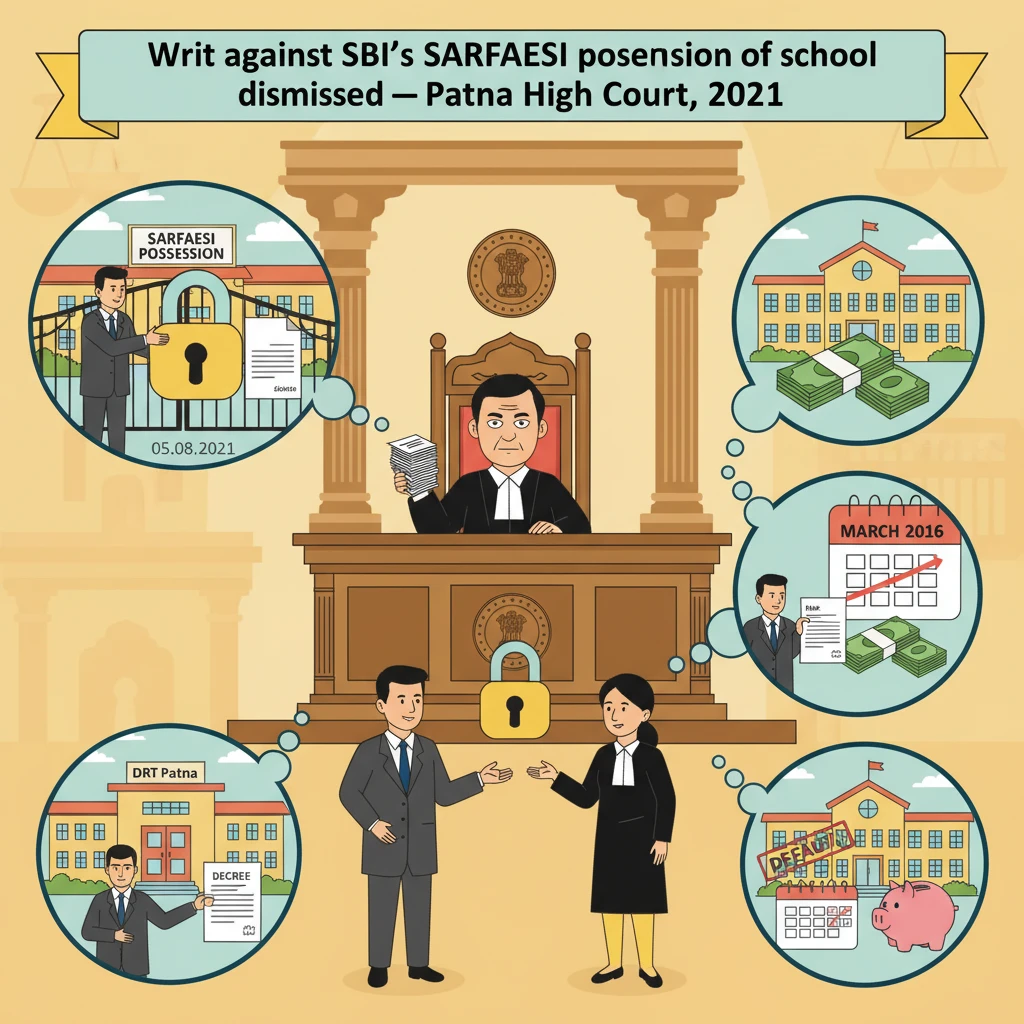
The petitioners had taken a term loan of Rs. 150 lakhs from the State Bank of India, Bikramganj Branch. Using this loan, they constructed the school building. Later, in March 2016, they applied for enhancement of the loan. The Bank sanctioned a further amount of Rs. three crores.
Over time, the petitioners failed to pay the instalments regularly. Because of this non-payment, the loan account was declared Non-Performing Asset (N.P.A.) by the Bank. Once the account turned N.P.A., the Bank started recovery action for the entire outstanding amount.
The Bank filed Original Application (O.A.) No. 295 of 2018 before the Debt Recovery Tribunal, Patna under Section 19 of the Recovery of Debt and Bankruptcy Act, 1993. The Tribunal decreed the case on 02.02.2019 against the petitioners. After the decree, Recovery Proceeding (R.P.) No. 162 of 2019 was registered for recovery of the decreed amount.
Along with these steps, the Bank also resorted to the Securitization and Reconstruction of Financial Assets and Enforcement of Security Interest Act, 2002 (Sarfaesi Act, 2002). Acting under Section 13(4) of this Act, the Bank’s authorised officer took possession of the school building and prepared an inventory. The petitioners claimed that possession of the building was taken on 05.08.2021 and the entire premises were locked.
Aggrieved by this action, the petitioners filed the present writ petition before the Patna High Court. They prayed for quashing the inventory dated 05.01.000 (as mentioned in the judgment) prepared by the authorised officer, by which possession of the school building was taken under Section 13(4) of the Sarfaesi Act, 2002.
What the Court Examined and Decided
The writ petition came up before a Division Bench of Hon’ble Mr. Justice Rajan Gupta and Hon’ble Mr. Justice Mohit Kumar Shah. The judgment was delivered on 08.12.2021, with Hon’ble Mr. Justice Rajan Gupta speaking for the Bench.
The petitioners’ senior counsel argued that the Bank had suddenly taken possession of the school building on 05.08.2021 and locked the premises, supposedly under Section 13(4) of the Sarfaesi Act, 2002. According to the petitioners, this action needed to be quashed by the High Court in its writ jurisdiction.
The petitioners stated before the Court that they were ready to liquidate the due amount in instalments and enter into an amicable settlement with the Bank. They pleaded that the Court should consider their case sympathetically because closure of the school would affect the future prospects of the children studying there.
The Bench did not accept this submission at face value. The judges directly put a query to the petitioners’ senior counsel. They asked whether the petitioners were ready to pay even the outstanding amount of loan which, according to the petitioners themselves, was due and payable to the tune of Rs. 3.50 crores.
On this specific query, the Court records that the learned senior counsel for the petitioners failed to give any satisfactory reply. In other words, while the petitioners spoke of settlement and instalments, they did not show any clear willingness or plan to deposit even the amount they themselves admitted as due.
On the other hand, counsel for the respondent Bank raised a preliminary objection about the maintainability of the writ petition. He argued that the petitioners had an alternative statutory remedy. Under Section 17(1) of the Sarfaesi Act, 2002, any person aggrieved by measures taken by the secured creditor under Section 13(4) can approach the Debt Recovery Tribunal.
Here, the Bank’s action of taking possession of the secured asset (the school building) was clearly a measure under Section 13(4). Therefore, as per the Bank’s argument, the correct forum for challenging this was the Debt Recovery Tribunal, not the High Court through a writ petition.
The Court heard both sides and examined the record. It came to two clear conclusions.
First, the Court held that the petitioners had failed to show their bona fides. The Bench specifically noted that the petitioners were not ready to deposit any substantial amount out of the outstanding loan, even according to their own calculation. This lack of readiness to make a meaningful payment weighed against them when they sought extraordinary relief from the High Court.
Second, the Court held that the writ petition itself was not maintainable. The judges pointed out that the proper remedy for the petitioners was to file an appeal (application) under Section 17 of the Sarfaesi Act, 2002 before the Debt Recovery Tribunal. This is a clear and specific mechanism established by Parliament for borrowers to challenge actions like taking possession of secured assets.
To support this view, the Division Bench relied on binding Supreme Court decisions. The judgment refers to three important cases:
1. United Bank of India vs. Satyawati Tondon, reported in (2010) 8 SCC 110.
2. Standard Chartered Bank vs. Noble Kumar, reported in (2013) 9 SCC 620.
3. State Bank of Travancore vs. Mathew K.C., reported in (2018) 3 SCC 85.
These Supreme Court rulings emphasise that when a special statute like the Sarfaesi Act provides a complete remedy, High Courts should not generally entertain writ petitions against recovery actions. Instead, borrowers must first use the specific appeal or application process given in the statute.
Following these precedents, and keeping in view the scheme of the Sarfaesi Act, 2002, the Patna High Court held that it could not interfere in writ jurisdiction. The Division Bench observed that considering the facts, the law, and the apex court judgments, there was no merit in the writ petition.
Accordingly, the writ petition was dismissed. The Court did not pass any order as to costs, meaning each party was to bear its own costs.
The judgment does not record any further directions, such as time-bound relief or interim protection. It simply dismisses the writ petition, thereby leaving it open for the petitioners to avail the statutory remedy under Section 17 of the Sarfaesi Act, 2002 if they so choose.
Why This Judgment Matters
This decision is significant for borrowers, especially educational institutions and trusts that have mortgaged their properties for loans. It underlines that once a loan account is classified as N.P.A. and the Bank initiates action under the Sarfaesi Act, the primary forum for dispute is the Debt Recovery Tribunal.
Many borrowers approach the High Court directly, hoping for quick relief on compassionate grounds such as running a school or hospital. The Patna High Court in this case makes it clear that sympathy alone cannot override statutory procedures, particularly when the borrower is not ready to pay even a substantial part of the admitted dues.
The judgment reinforces that the High Court will usually not interfere with SARFAESI measures so long as the statutory remedy under Section 17 is available. This aligns with Supreme Court guidance and reduces the scope for bypassing specialised tribunals.
For lenders like banks, the ruling confirms that lawful possession taken under Section 13(4) will not lightly be disturbed by writ courts. For borrowers, it is a reminder to act early, maintain repayments as far as possible, and, if action under the Sarfaesi Act starts, to promptly approach the Debt Recovery Tribunal instead of relying on writ petitions.
Legal Issues and Answers
- Issue: Can the borrower trust challenge SBI’s possession of the school building under Section 13(4) of the Sarfaesi Act, 2002 directly before the Patna High Court by way of a writ petition?
Answer: No. The Patna High Court held that the writ petition was not maintainable because the petitioners had an adequate alternative remedy of filing an application under Section 17(1) of the Sarfaesi Act, 2002 before the Debt Recovery Tribunal. - Issue: Did the petitioners establish sufficient bona fides to justify any interference by the High Court in exercise of writ jurisdiction?
Answer: No. The Court held that the petitioners failed to show bona fide because they were not prepared to deposit any substantial amount towards the outstanding loan, even as per their own admitted liability of Rs. 3.50 crores.
Cases Cited by the Court
- United Bank of India vs. Satyawati Tondon, (2010) 8 SCC 110.
- Standard Chartered Bank vs. Noble Kumar, (2013) 9 SCC 620.
- State Bank of Travancore vs. Mathew K.C., (2018) 3 SCC 85.
Case Details
Case Number: Civil Writ Jurisdiction Case No. 19703 of 2021
Case Title: Charter Awadh Educational Trust & Anr. vs. State Bank of India & Ors.
Citation: 2022(1) PLJR 61
Court: High Court of Judicature at Patna
Coram: Hon’ble Mr. Justice Rajan Gupta and Hon’ble Mr. Justice Mohit Kumar Shah
Date of Judgment: 08-12-2021
Nature of the Case: Writ petition seeking quashing of inventory and possession taken under Section 13(4) of the Sarfaesi Act, 2002.
Advocates:
For the Petitioners: Mr. M.N. Parvat, Senior Advocate; Mr. Praveen Prabhakar, Advocate.
For the Respondents (State Bank of India and its officers/branches): Mr. Sanjay Singh Thakur, Advocate; Mr. Parijat Saurav, Advocate.
Link to Judgment: Click here to access the official Patna High Court judgment
If you found this explanation helpful and wish to stay informed about
how legal developments may affect your rights in Bihar,
you may consider following Samvida Law Associates for more updates.







