

Case Background
The petitioner is the owner of four shops (UG–04, UG–05, UG–06 and UG–06A) on the first floor of a multi‑storeyed building named “Jaikriti Pearl Court” at East Boring Canal Road, Patna. She purchased these premises through a registered sale deed dated 30.01.2016 and was in peaceful possession.
Respondent no. 5, a construction firm, through its partners (respondent nos. 6 and 7), approached her to join their business. They made her guarantor for loan facilities taken from Indian Bank. In return, they promised to pay her Rs. 35,00,000/- per year. According to the petitioner, this amount was in fact paid till 2019.
On the strength of this arrangement, the petitioner signed various bank documents and stood guarantor for multiple loan facilities. She says these signatures were taken without giving her copies of loan agreements, sanction letters or statements of account, leaving her unaware of the number and nature of the loans for which she had become guarantor.
The loans were secured by mortgaging flats of respondent no. 6 and the petitioner’s shop property. After 2019, respondents 5 to 7 allegedly stopped paying the promised annual amount and hid the worsening financial condition of their firm.
On 02.05.2023, Indian Bank issued three separate notices to respondent no. 5 in respect of three different loan accounts, claiming a total overdue amount of Rs. 5,79,713/-. These notices were also served on the petitioner as guarantor. She says respondents 6 and 7 told her to ignore them as routine bank communications.
Later, on 29.06.2024, the Bank’s Authorised Officer issued a demand notice under Section 13(2) of the SARFAESI Act. This notice, served on respondents 5 to 7 including the petitioner, stated that two loan accounts had been declared Non‑Performing Assets on 27.06.2024 and demanded Rs. 2,62,06,848.83, plus interest.
On 28.08.2024, the Bank issued a possession notice under Section 13(4) of the SARFAESI Act read with Rules 8 and 9 of the Security Interest (Enforcement) Rules, 2002 and took physical possession of the secured assets, including the petitioner’s shops.
Aggrieved, the petitioner filed S.A. No. 287 of 2024 before the Debt Recovery Tribunal (DRT), Patna, on 27.09.2024, challenging the whole SARFAESI action.
During the pendency of this securitisation application, the Bank issued an auction sale notice dated 10.10.2024 fixing the auction for 13.11.2024. On an interlocutory application filed by the petitioner, the DRT passed an interim order on 04.11.2024 directing the Bank not to confirm the sale till the date of hearing.
In its reply dated 19.11.2024 before the DRT, the Bank admitted that all secured assets, including the petitioner’s shops, had already been sold by e‑auction in three lots in favour of respondent no. 8, a private company. The DRT then directed the petitioner to seek impleadment of the auction purchaser.
The petitioner filed an application dated 23.12.2024 seeking to implead respondent no. 8. However, on 04.02.2025, in the petitioner’s absence and without passing any order on the impleadment application, the DRT dismissed S.A. No. 287 of 2024 by a final order. On the next day, 05.02.2025, a sale certificate was issued in favour of respondent no. 8.
What the Court Examined and Decided
Before the Patna High Court, the petitioner sought quashing of the DRT’s final order dated 04.02.2025 and of the entire SARFAESI proceedings. She also asked for cancellation of the auction sale of her shops and a direction to the Bank to accept repayment from her after settlement.
Her main legal attack was on the validity of the Bank’s action under the SARFAESI Act because of alleged non‑compliance with Section 26D, which deals with registration of security interests with the Central Registry of Securitisation Asset Reconstruction and Security Interest of India (CERSAI).
The petitioner’s senior counsel argued that Section 26D clearly says a secured creditor cannot exercise any right under the SARFAESI Act unless the security interest is properly registered with CERSAI. He submitted that the registration relied upon by the Bank was defective and misleading.
According to the petitioner, her shops were wrongly described in the CERSAI records in the name of the borrower, even though they admittedly belonged to her as guarantor. She also alleged that the floor details were incorrectly mentioned. She treated this as a deliberate attempt to misrepresent the identity of the secured asset and prejudice her rights. On that basis, she claimed the CERSAI registration was non‑existent in law and all subsequent SARFAESI steps were void from the beginning.
The petitioner further said she had always been ready to clear the outstanding dues, after adjusting amounts already realised by sale of other secured assets. She accused the Bank of acting with undue haste and auctioning her property without giving her a real opportunity to redeem the loan. She also complained that the DRT, while dismissing her S.A., did not consider her readiness and willingness to pay.
Another grievance was procedural. The petitioner alleged that respondent no. 9 filed a counter affidavit on behalf of respondent no. 8, the auction purchaser company, on 20.12.2024 without any board resolution and without respondent no. 8 having been formally impleaded at that time. She claimed that although the DRT had allowed her to implead the auction purchaser on 18.12.2024, the auction purchaser, in collusion with the Bank, hurriedly filed an “unauthorised” counter affidavit even before formal impleadment. The DRT allegedly relied on this material while dismissing the S.A. in her absence, which, according to her, violated natural justice.
The petitioner also pointed out that she had executed a registered lease deed on 05.03.2024 in favour of a lessee, much before the loan was declared NPA and before the Section 13(2) demand notice. She argued that lawful possession was with the lessee, who had the right to remain in possession for the period of lease. She relied on Supreme Court judgments in PHR Invent Educational Society vs. UCO Bank (2024) 6 SCC 579 and Whirlpool Corporation v Registrar of Trademarks (1998) 8 SCC 1 to urge that the High Court should exercise writ jurisdiction despite alternate remedies.
On the other side, counsel for the Bank argued that the writ petition itself was not maintainable. They emphasised that the SARFAESI Act is a complete code, and after dismissal of S.A. No. 287 of 2024, the petitioner had a clear appellate remedy under Section 18 before the Debts Recovery Appellate Tribunal (DRAT), Allahabad. Without using that statutory appeal, she had rushed to the High Court, which, they said, should not be encouraged.
The Bank maintained that all SARFAESI steps were carried out strictly as per law. The accounts were declared NPA on 27.06.2024, demand notice under Section 13(2) was issued on 29.06.2024 and served on the petitioner, but she never filed any objection or representation under Section 13(3A). Thereafter, as per the Act and Rules, possession notice was issued and symbolic possession taken, followed by physical possession and auction proceedings.
The Bank also accused the petitioner of approaching the Court with “unclean hands”, alleging inconsistent pleadings and suppression of facts, including her earlier enjoyment of Rs. 35 lakh per year from the borrower. They pointed out that the application dated 23.12.2024 before the DRT was in fact for impleading one Arti Kumari, not the auction purchaser, to show that her narration before the High Court was misleading.
On the question of CERSAI registration, the Bank flatly denied non‑compliance. They said the secured assets were duly registered, as reflected in Annexure‑9/R filed before the DRT. They explained that the CERSAI format requires disclosure of the borrower’s name even where the property belongs to a guarantor. Therefore, recording the borrower’s name against the secured asset did not make the registration invalid.
The Bank further argued that the alleged lease deed was neither a valid registered document created before the mortgage nor relevant for the petitioner’s rights in this writ. The lessee had already filed an independent S.A. before the DRT and a separate writ petition (CWJC No. 6517 of 2025), so the petitioner could not raise the lessee’s grievances in her own case.
Regarding the auction sale, the Bank submitted that the auction was fair and competitive. The shops were offered at a reserve price of Rs. 1,78,00,000/- and were sold for Rs. 2,44,60,000/-, about 40% above reserve, which, according to them, disproved any allegation of undervaluation.
The Bank and the auction purchaser both urged that the High Court should not interfere with a concluded auction where a sale certificate had already been issued, relying on Supreme Court decisions including United Bank of India v. Satyawati Tandon (2010) 8 SCC 110, Narayan Chandra Ghosh v. UCO Bank (2011) 4 SCC 548, Celir LLP v. Bafna Motors (Mumbai) Pvt. Ltd. (2024) 2 SCC 1, Varimadugu Obi Reddy v. B. Sreenivasulu (2023) 2 SCC 168, and related judgments.
Justice Anil Kumar Sinha of the Patna High Court examined these rival submissions. The Court first highlighted that the SARFAESI Act is a self‑contained code which provides complete remedies under Sections 17 and 18. Referring to Satyawati Tandon, the Court reiterated that when effective statutory remedies are available, High Courts should ordinarily decline to exercise writ jurisdiction, especially in matters of recovery of bank dues.
The Court also cited Rikhab Chand Jain v. Union of India, 2025 LiveLaw (SC) 1129, in which the Supreme Court held that if a petitioner, by his own conduct, disables himself from using statutory remedies, the discretionary remedy under Article 226 should normally not be granted.
Applying these principles, the Court noted that the petitioner had already used the remedy under Section 17 (before the DRT). After dismissal of her S.A., an efficacious appellate remedy under Section 18 before the DRAT, Allahabad, was clearly available. The writ petition was thus viewed as an attempt to bypass that appellate forum.
On the CERSAI issue, the Court rejected the petitioner’s argument that the security interest was not validly registered. The Court recorded that the Bank had produced documentary evidence showing registration. It clarified that Section 26D requires registration of the security interest, not “perfection of title”. Further, as per the prescribed registration format, the secured assets of borrower and guarantor are recorded as assets of the borrower because their liability is joint. Hence, the Supreme Court judgment in PHR Invent Educational Society, on which the petitioner relied, was held inapplicable to the facts.
As for alleged violation of natural justice before the DRT, including the timing of the auction purchaser’s pleadings and non‑consideration of the impleadment application, the High Court held that these were issues that could be effectively raised in an appeal under Section 18. They did not, by themselves, justify bypassing the statutory appellate route.
The Court then turned to the law governing interference with auction sales. By quoting paragraphs from Celir LLP v. Bafna Motors (2024) 2 SCC 1 and Celir LLP v. Sumati Prasad Bafna (2020 SCC OnLine SC 3727), the Court stressed that courts must protect the sanctity of auctions. Once a public auction is concluded and confirmed, it should not be set aside lightly, except on fundamental grounds like fraud, collusion or serious underpricing causing substantial injury.
The Court noted that in this case the auction had already concluded and the sale certificate had been issued on 05.02.2025 in favour of respondent no. 8. The rights of a bona fide third‑party purchaser had therefore crystallised. Any interference at this stage, without the petitioner first pursuing the statutory appeal, would frustrate the object of the SARFAESI Act, damage public confidence in auctions and deter participation.
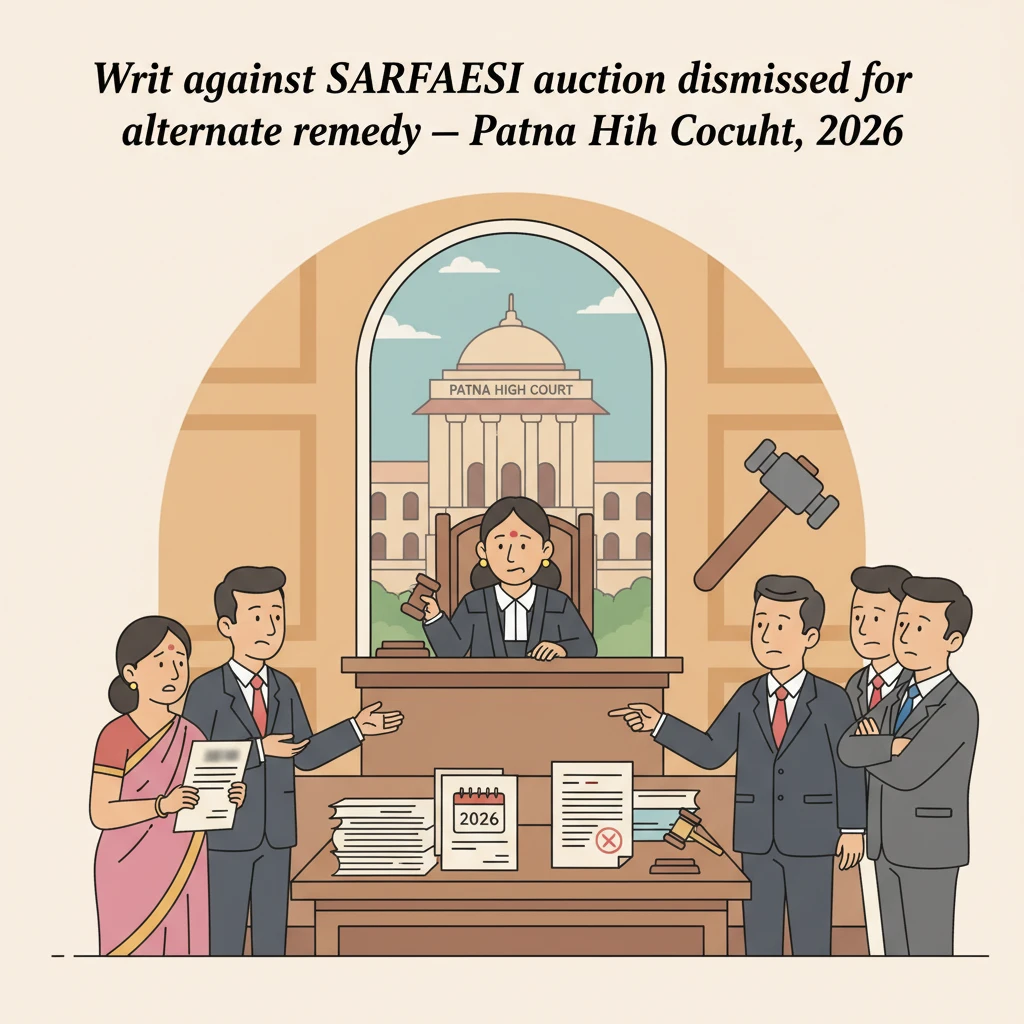
In the end, the Court held that none of the grounds raised disclosed any exceptional circumstance that could justify writ interference under Article 226. It described the writ petition as an attempt to circumvent the appellate remedy under Section 18 of the SARFAESI Act and disposed of the petition with these observations. The Court did not grant any relief on the merits of the SARFAESI action or the auction.
Why This Judgment Matters
This judgment is significant for borrowers, guarantors and property owners whose properties are used as security for loans. It sends a clear message that when a specialised law like the SARFAESI Act provides a full system of appeal, the Patna High Court will rarely step in through a writ petition.
Even where a guarantor alleges defects in CERSAI registration, non‑consideration of their willingness to repay, or complaints about DRT procedure, the Court expects them first to use the appeal before the Debts Recovery Appellate Tribunal.
The decision also reinforces that once an auction under SARFAESI is completed and a sale certificate issued, courts are very slow to interfere, especially where a third‑party purchaser has paid a price higher than the reserve price. This protects the certainty of auctions and encourages genuine bidders to participate.
For ordinary citizens in Bihar who stand as guarantors or allow their property to be mortgaged, the case highlights the importance of understanding the loan documents, monitoring bank notices, and promptly using remedies before the DRT and DRAT instead of waiting and then going directly to the High Court.
Legal Issues and Answers
Issue: Can the Patna High Court set aside SARFAESI proceedings and an auction sale when the debtor/guarantor has an available appellate remedy under Section 18 of the SARFAESI Act?
Answer: No. The Court held that because the petitioner had already used the Section 17 remedy and could file an appeal under Section 18 before the DRAT, the writ petition under Article 226 was not maintainable in the absence of exceptional circumstances.
Issue: Does alleged defect or inaccuracy in CERSAI registration under Section 26D make SARFAESI action void so as to justify writ interference?
Answer: No. The Court found that the Bank had produced documents showing registration. Section 26D requires registration, not perfection of title, and the recording of the asset in the borrower’s name in the prescribed format does not invalidate the registration.
Issue: Should the High Court interfere with a concluded auction and sale certificate issued under SARFAESI, on grounds of alleged procedural irregularities before the DRT?
Answer: No. Relying on Supreme Court precedents, the Court held that auctions should not be lightly disturbed once rights of a bona fide third‑party purchaser have crystallised. Any grievances must first be pursued in the statutory appeal.
Cases Cited by the Court
- United Bank of India v. Satyawati Tandon, (2010) 8 SCC 110
- Narayan Chandra Ghosh v. UCO Bank & Ors., (2011) 4 SCC 548
- Celir LLP v. Bafna Motors (Mumbai) Pvt. Ltd., (2024) 2 SCC 1
- Varimadugu Obi Reddy v. B. Sreenivasulu, (2023) 2 SCC 168
- Rikhab Chand Jain v. Union of India & Ors., 2025 LiveLaw (SC) 1129
- Celir LLP v. Sumati Prasad Bafna & Others, 2020 SCC OnLine SC 3727
- PHR Invent Educational Society v. UCO Bank & Ors., (2024) 6 SCC 579 (relied on by petitioner but held inapplicable)
- Whirlpool Corporation v. Registrar of Trademarks, Mumbai, (1998) 8 SCC 1 (relied on by petitioner but held inapplicable)
Case Details
Case Number: Civil Writ Jurisdiction Case No. 2771 of 2025
Case Title: Pushplata Ishwar v. The Presiding Officer, Debt Recovery Tribunal, Patna & Others
Court: High Court of Judicature at Patna
Coram: Hon’ble Mr. Justice Anil Kumar Sinha
Date of Judgment: 20.01.2026
Citation: 2026 (2) PLJR 118
Advocates:
- For the petitioner: Mr. Shekhar Singh, Senior Advocate; Mr. Sunit Kumar, Advocate; Mr. Nishant Kumar, Advocate; Mr. Rishav Kumar, Advocate
- For the auction purchaser: Mr. Sanjeev Kumar, Advocate; Mr. P.S. Mishra, Advocate
- For the respondent Bank: Mr. Sanjay Singh Thakur, Advocate
Nature of the case: Writ petition under Article 226 of the Constitution challenging orders of the Debt Recovery Tribunal and SARFAESI proceedings, including auction sale and sale certificate.
Link to full judgment: Patna High Court Judgment – CWJC No. 2771 of 2025
If you found this explanation helpful and wish to stay informed about
how legal developments may affect your rights in Bihar,
you may consider following Samvida Law Associates for more updates.







