

Case Background
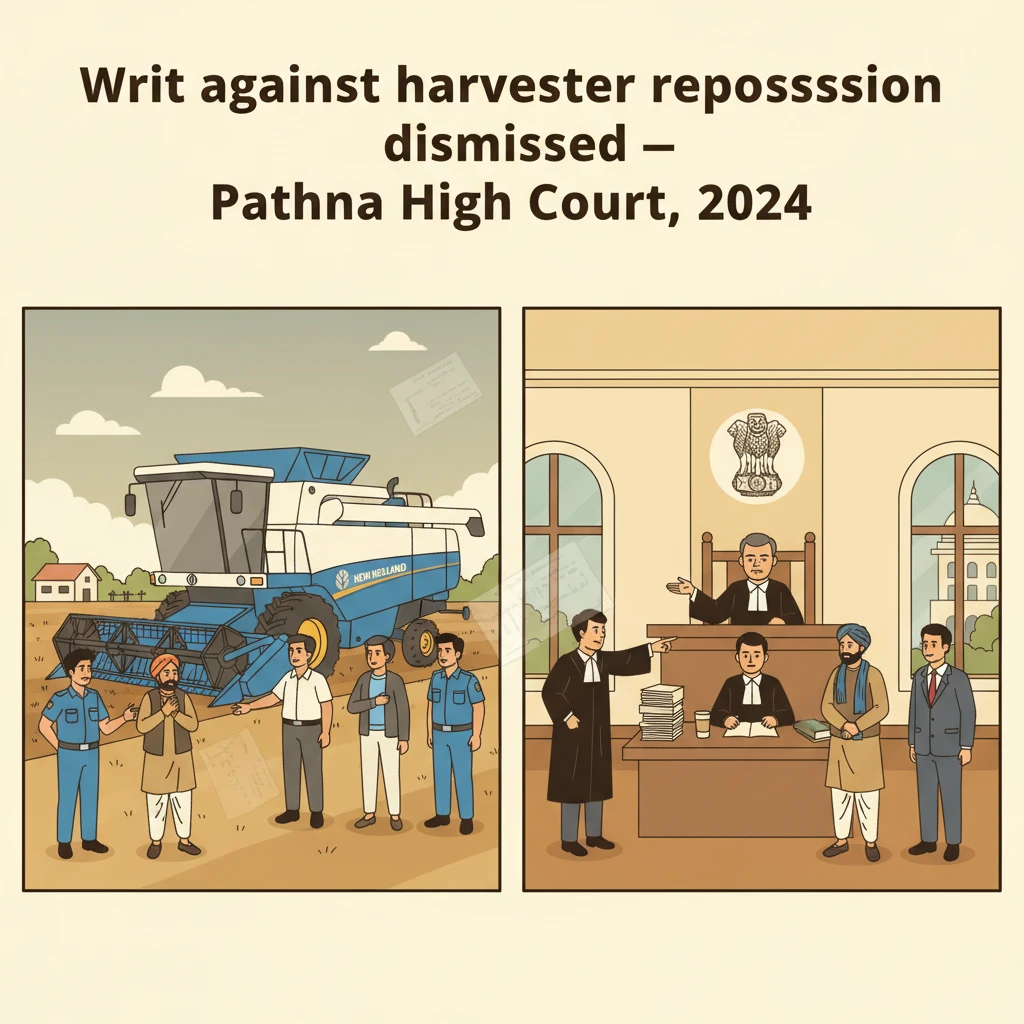
The case arose from a hire purchase loan for an agricultural harvesting machine. The petitioner bought a New Holland TC 5.30 Combine Harvester under a Hire Purchase Agreement executed with respondent no. 6, a non-banking financial company.
The agreement was signed on 15 November 2019. Under it, the finance company agreed to advance a loan of Rs. 24,80,000 for the purchase of the machine. The petitioner himself paid an initial amount of Rs. 8,00,000 towards the sale price.
According to the petitioner, soon after the purchase, the COVID-19 pandemic hit. He claimed that from 1 January 2020 to 19 July 2022, all work, including agricultural activity, remained closed. Because of this, he said he could not use the harvester to earn income and therefore could not pay his monthly instalments regularly, though he stated he paid about Rs. 7,00,000 during this period.
The dispute reached the Patna High Court after the finance company repossessed the harvester on 1 December 2022. The petitioner alleged that this was done forcibly, without any prior notice, and with the help of local police attached to the concerned police station. He approached the Court in a criminal writ petition seeking restoration of possession of the harvester and other incidental reliefs.
What the Court Examined and Decided
The matter was heard by Hon’ble Mr. Justice Bibek Chaudhuri in Criminal Writ Jurisdiction Case No. 797 of 2023. The key question was whether the repossession of the combine harvester was illegal and whether such a dispute could be decided in writ jurisdiction.
The petitioner’s counsel accepted at the outset that a hire purchase agreement is essentially contractual in nature. He also fairly stated that, generally, the lender’s action under such an agreement is not open to interference in writ proceedings unless the agreement itself is unconscionable or opposed to public policy.
To explain the law on hire purchase, he relied on the Supreme Court decision in Orix Auto Finance (India) Ltd. v. Jagmander Singh, (2006) 2 SCC 598. He further placed strong reliance on Citicorp Maruti Finance Ltd. v. S. Vijayalaxmi, (2012) 1 SCC 1.
Referring to paragraph 27 of Citicorp Maruti Finance, he argued that while the financier may be treated as owner till full payment, this does not allow it to take back possession by force. He stressed that even as per Reserve Bank of India guidelines and the financier’s own internal norms, recovery must follow due process and not use muscle power.
The petitioner’s main factual allegation was that no notice of default, repossession, or sale was ever served on him. He drew attention to Clause 14 of the Hire Purchase Agreement, which governs “Repossession and sale of Asset”.
Clause 14.1(a) allows the lender or its agents to enter the premises where the asset is located and take possession, but only after giving a written notice of seven business days. After taking possession, the lender must give another written notice of seven business days asking the borrower to pay all outstanding dues. If the borrower pays within this period, the asset must be re-delivered to him.
Clause 14.1(b) then allows the lender, on continued default, to dispose of the asset by private contract, auction, or any method permitted by law. Clause 14.1(c) permits dispensing with notice only in narrow situations, such as when the borrower intends to part with possession, uses the asset for unlawful purposes, or dismantles it, reducing its value.
The petitioner argued that no such notices were given, and instead, with “illegal help” from police, the respondents simply took away the harvester. He also highlighted an arbitration clause in the agreement and argued that the financier should have invoked arbitration rather than unilaterally seizing the asset. For this proposition, he relied on a Patna High Court Co-ordinate Bench decision in Dhananjay Seth and Ors. v. Union of India and Ors., (2023) 4 BLJ 284, where forcible repossession was criticised as violating the right to livelihood with dignity.
On the other side, counsel for respondents 6 to 9 relied heavily on their counter affidavit. The Court looked at paragraph 9 of that affidavit. It recorded that the first EMI of Rs. 1,46,100 was due on 2 March 2020, but the petitioner did not pay on that date. Instead, he made the first EMI payment only on 6 August 2020 and remained irregular thereafter.
Because of continuing default, the loan account was declared a Non-Performing Asset (NPA). On 1 May 2021, the respondents issued a notice informing the petitioner of his failure to pay instalments and asking him to pay regularly along with the outstanding sum of Rs. 1,80,657. The petitioner did not comply.
Subsequently, on 8 June 2021, a loan recall notice was issued calling upon the petitioner to clear total outstanding dues of Rs. 17,40,605 within seven working days, failing which the company would proceed for recovery in terms of the agreement. The petitioner again failed to pay. This recall notice was annexed as Annexure R6/4 to the counter affidavit.
The respondents stated that only thereafter did they inform the local police that they intended to repossess the harvester. On this information, the hypothecated asset was repossessed.
In line with Clause 14, the respondents further said that they issued a notice on 7 December 2022 to the petitioner, the co-borrower, and the guarantor, demanding Rs. 19,26,093 and giving an opportunity to repay to recover the machine. This was described as a “pre-sell notice”. Despite this, no payment was made to retake possession.
The loan account statement showed that as on 17 July 2023, the total outstanding against the petitioner was Rs. 23,66,315.29.
On these facts, respondents argued that they had fully complied with Clause 14. They maintained that pre-possession notice, post-possession notice, and sale notice were duly served on the borrower, co-borrower and guarantor.
To support their legal position, they cited the Supreme Court judgment in Anup Sarmah v. Bhola Nath Sharma, (2013) 1 SCC 400. In that case, the Court held that in a hire purchase agreement, the purchaser is essentially a trustee or bailee, and the financer remains owner. Therefore, if the financier seizes the vehicle, no criminal case can lie, as he is repossessing his own goods.
The High Court noted that Anup Sarmah appears to contradict the earlier ratio in Citicorp Maruti Finance regarding forcible repossession. The Court also referred to M/s Magma Fincorp Ltd. v. Rajesh Kumar Tiwari, (2020) 10 SCC 399, where the Supreme Court clarified that while the financier may be owner, forcible possession cannot be taken without following due process of law.
Summing up the legal position, the Patna High Court held that the consistent principle from all these decisions is that the lender must follow due process and the terms of the contract when repossessing an asset.
The Court then applied this principle to the facts of the case. It carefully examined Annexures R/6 series and accepted them as the notices required under Clause 14. The judge explicitly disagreed with the petitioner’s claim that no notice was served before repossession.
The Court found that due notices had in fact been issued. When the petitioner did not comply, the respondents informed the police that they would take repossession with police help. On this basis, the Court concluded that Clause 14 had been “substantially complied” with.
In the final part of the judgment, the Court addressed the broader question of whether such a dispute could be decided in writ jurisdiction. It observed that the entire relationship between the petitioner and respondents 6 to 9 arose out of contract. The alleged grievance was about violation of contractual terms in taking back the harvester.
The State and its authorities had been made respondents mainly to bring the matter under writ jurisdiction. However, the “essential disputes” were contractual and about alleged breach of contract.
The Court reiterated the settled rule that contractual obligations are generally not enforceable through writ petitions, unless a clear issue of public policy is involved. In this case, the petitioner had not shown that the respondents’ conduct violated any public policy.
Since due process under the contract had been broadly followed and no public law element was established, the Court refused to grant any relief. It held that there was no merit in the writ petition and dismissed it on contest, with no order as to costs.
Why This Judgment Matters
This judgment is important for farmers and small business owners who buy expensive machines on finance. It shows that if a borrower defaults and the finance company sends proper notices as per the agreement, the High Court will be slow to interfere in repossession through a writ petition.
The Patna High Court underlines that hire purchase disputes are mainly contractual. Unless there is a clear violation of public policy or basic legal safeguards, the borrower cannot usually use writ jurisdiction to challenge repossession.
At the same time, the Court confirms that financiers must follow due process and their own contract terms. They cannot simply take forcible possession without notice. In this case, the petition failed because the Court was satisfied that several notices had been served and the borrower remained in default.
Legal Issues and Answers
- Issue: Did the finance company and police illegally repossess the combine harvester without following the Hire Purchase Agreement and due process of law?
Answer: No. The Court held that pre-possession, recall, and pre-sale notices were issued as required under Clause 14, and repossession followed substantial compliance with the contract. - Issue: Can a borrower challenge such contractual repossession in writ jurisdiction by alleging violation of fundamental rights and public policy?
Answer: Generally no. The Court held that disputes arising purely from contractual obligations are not amenable to writ jurisdiction unless public policy is clearly involved, which was not shown here.
Cases Cited by the Court
- Orix Auto Finance (India) Ltd. v. Jagmander Singh, (2006) 2 SCC 598.
- Citicorp Maruti Finance Ltd. v. S. Vijayalaxmi, (2012) 1 SCC 1.
- Dhananjay Seth and Ors. v. Union of India and Ors., (2023) 4 BLJ 284.
- Anup Sarmah v. Bhola Nath Sharma, (2013) 1 SCC 400.
- M/s Magma Fincorp Ltd. v. Rajesh Kumar Tiwari, (2020) 10 SCC 399.
Case Details
Case Number: Criminal Writ Jurisdiction Case No. 797 of 2023
Case Title: Prinsu Kumar v. The State of Bihar & Ors.
Citation: 2024 (2) PLJR 707
Court: High Court of Judicature at Patna
Coram: Hon’ble Mr. Justice Bibek Chaudhuri
Date of Judgment: 05-04-2024
Advocates:
For the petitioner: Md. Waziur Rahman, Advocate; Mr. Nishant Kumar Sinha, Advocate.
For respondents 6 to 9: Mr. Amish Kumar, Advocate; Mr. Prahakar Thakur, Advocate.
For the State: Mr. Iqbal Asif Niazi, AC to GP 5.
Nature of the Case: Criminal writ petition challenging repossession of a financed vehicle and seeking restoration of possession.
Final Outcome: Writ petition dismissed on contest; no order as to costs.
Link to judgement; https://patnahighcourt.gov.in/viewjudgment/MTYjNzk3IzIwMjMjMSNO-yYIY9PLrnvs=
If you found this explanation helpful and wish to stay informed about how legal developments may affect your rights in Bihar, you may consider following Samvida Law Associates for more updates.







