
Case Background
The dispute started from a civil suit between two private individuals over a property at Marhowra Khurd in Saran district. The suit is Title Suit No. 178 of 1998 before the court of Munsif 3rd, Chapra.
During the pendency of this title suit, the present petitioner applied before the trial court for permission to repair an old house situated on the disputed plot. He also wanted to repair a shop which, according to him, was on the verge of demolition.
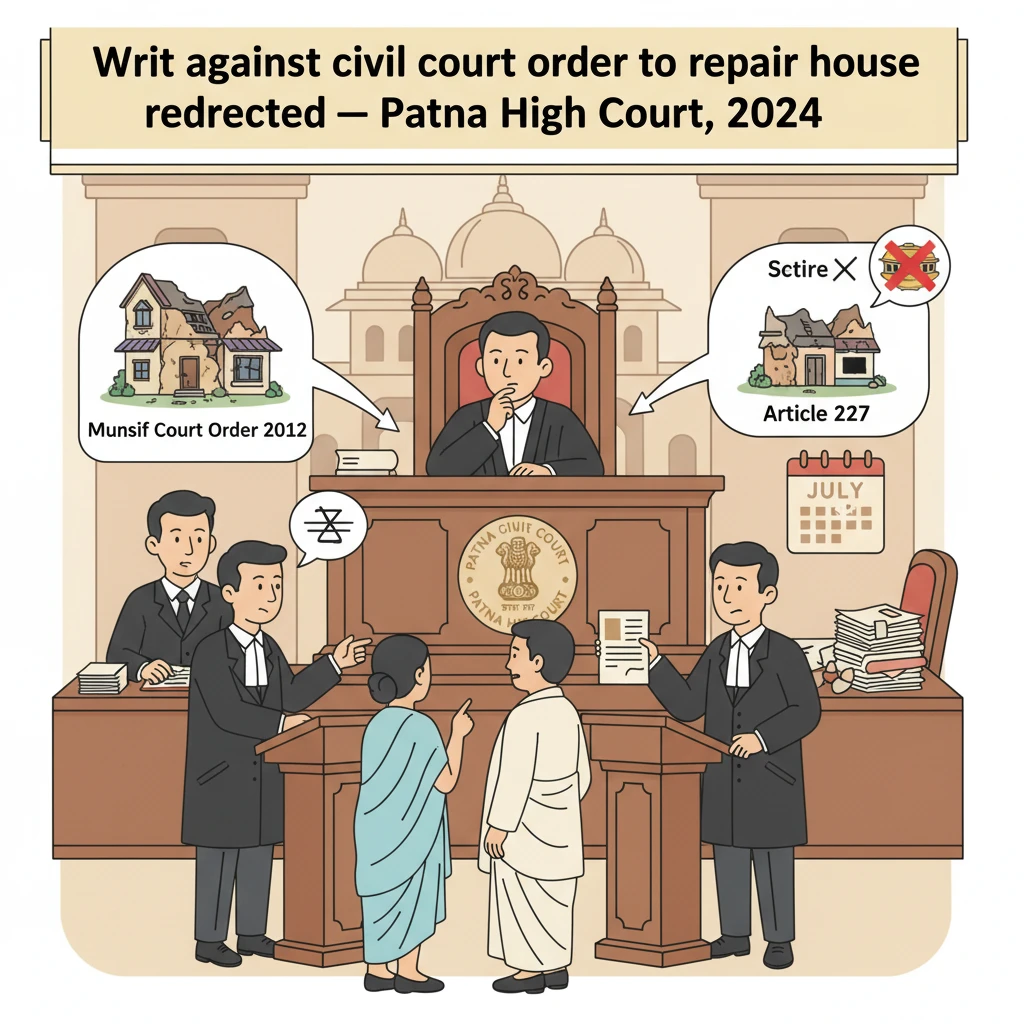
On 19.12.2012, the Munsif 3rd, Chapra, passed an order rejecting this application. The trial court did not allow the petitioner to carry out the proposed repairs. This order is described in the High Court judgment as the “impugned order”.
Feeling aggrieved, the petitioner approached the Patna High Court in 2014 by filing Civil Writ Jurisdiction Case No. 10381 of 2014. He sought a writ of certiorari to set aside the Munsif’s order dated 19.12.2012 in T.S. No. 178 of 1998 and also requested direct permission from the High Court to repair the shop said to be on the verge of demolition.
Thus, the dispute reached the Patna High Court not on the final decision in the title suit, but only on an interim order passed by the civil court during the pendency of that long-pending suit.
What the Court Examined and Decided
The matter came up before Hon’ble Mr. Justice Mohit Kumar Shah on 10.07.2024. Both sides were represented by the same advocate, Mr. Basant Kumar Singh. At the very outset, the learned counsel for the parties drew the Court’s attention to the legal position on filing writ petitions against interlocutory orders of civil courts.
It was pointed out that earlier, in view of a Division Bench judgment of the Patna High Court dated 13.05.2010 in C.R. No. 1067 of 2009 (Durga Devi v. Vijay Kumar Poddar & Ors.), writ petitions were being filed even against interlocutory orders. These are orders which do not finally decide the suit or proceeding, and the case continues thereafter in the trial court.
However, the Supreme Court later revisited this issue in Radhey Shyam and Another v. Chhabi Nath and Others, reported in (2015) 5 SCC 423. The Patna High Court judgment reproduces paragraphs 18 and 25 to 30 of this Supreme Court decision in detail, because it directly controls the maintainability of the present writ petition.
From this Supreme Court ruling, the High Court highlighted several key principles. The Supreme Court clearly stated that challenges to judicial orders of civil courts should be made by way of appeal, revision or under Article 227 of the Constitution, and not by writs under Articles 226 or 32.
The Supreme Court observed that all courts within the jurisdiction of a High Court are subordinate to it and subject to its control and supervision under Article 227. Writ jurisdiction under Article 226 is constitutionally conferred on High Courts, but the broad principles of writ jurisdiction followed in England apply in India mainly against tribunals, authorities or courts other than regular judicial/civil courts.
The Supreme Court held that writs such as certiorari are meant for correcting errors of jurisdiction or patent illegality committed by tribunals or authorities, not for intervening in judicial orders of ordinary civil courts. For civil courts, the appropriate control mechanism is appeal, revision or superintendence under Article 227.
In paragraph 27 of Radhey Shyam, reproduced in the Patna judgment, the Supreme Court settled the position in three clear points: (i) judicial orders of civil courts are not amenable to writ jurisdiction under Article 226; (ii) jurisdiction under Article 227 is distinct from jurisdiction under Article 226; and (iii) the contrary view earlier taken in Surya Dev Rai v. Ram Chander Rai, (2003) 6 SCC 675, is overruled.
The Supreme Court also cautioned High Courts against frequently interfering in pure property disputes between private individuals, especially in matters like partition, landlord–tenant issues, execution of money decrees, and other private property disputes. It stressed that writ courts should not step in unless there is some statutory violation or collusion with a statutory authority.
Based on this authoritative clarification from the Supreme Court, the legal position on how to challenge civil court orders was firmly changed. The Patna High Court noted that, following Radhey Shyam, even the Rules of the High Court at Patna had been amended.
Specifically, Rule 6 of Chapter IIIA now lays down that petitions under Article 227 of the Constitution of India, in respect of any order or any proceeding before any civil court, are to be filed in Civil Miscellaneous Jurisdiction and numbered as Civil Miscellaneous cases (C. Misc. No.).
This rule directly affects cases like the present one, where an interlocutory order of a Munsif in a title suit is being questioned. Since the present case was filed as a writ petition under Article 226 (Civil Writ Jurisdiction Case No. 10381 of 2014), it did not match the procedure mandated by the amended High Court Rules and the law declared by the Supreme Court.
Recognising this, learned counsel for the petitioner submitted that, in view of the legal position under Radhey Shyam and the amended High Court Rules, some time may be granted to convert the present writ petition into a Civil Miscellaneous Petition under Article 227.
The Patna High Court accepted this submission. In paragraph 4 of the judgment, the Court granted two weeks’ time to the petitioner for converting the present writ petition into a Civil Miscellaneous Petition. This means that, instead of treating it as a writ petition under Article 226, the case would proceed as a petition under Article 227, which is the proper constitutional route to challenge such civil court orders.
In paragraph 5, the Court also issued a direction to its Registry. The Registry was instructed to extend full cooperation to the petitioner’s counsel so that the conversion of the case to a Civil Miscellaneous Petition could be done at the earliest. After conversion, the Registry has been told to list the matter on a priority basis before the appropriate Bench which deals with such matters.
The Court gave a specific reason for seeking priority listing: the present case has been pending in the High Court for ten years, having been filed in 2014 and decided on this preliminary issue in 2024. The Court thus wanted the converted matter to be taken up quickly once the procedural defect is cured.
Importantly, the Patna High Court did not examine or decide the merits of the petitioner’s grievance about repairing the old house or the shop. The judgment is confined to the proper legal route for challenging the Munsif’s order. The final decision on whether the petitioner may repair the property will depend on future orders passed in the Civil Miscellaneous Petition under Article 227, and possibly on the outcome of the underlying title suit.
Why This Judgment Matters
This judgment is important for anyone involved in property disputes pending in civil courts in Bihar, particularly those who want to challenge orders passed during the course of the suit. It clarifies that you cannot directly file a writ petition under Article 226 before the Patna High Court against such judicial orders.
Instead, the correct approach is to use the remedies provided in law: appeal, revision, or a petition under Article 227, which in Patna is handled as a Civil Miscellaneous case. If a litigant wrongly files a writ petition, the case may face delay or may need procedural conversion, as happened here.
The judgment also shows that the High Court is keen to follow the Supreme Court’s ruling in Radhey Shyam and the amended Patna High Court Rules. At the same time, it is conscious of delay and has asked the Registry to treat the converted matter on a priority basis because the case has already remained pending for ten years.
For ordinary litigants, the practical takeaway is simple: if you are unhappy with an order of a civil court in your private property case, you should consult about filing an appeal, revision, or Article 227 petition, not a writ petition under Article 226.
Legal Issues and Answers
- Issue: Can an interlocutory judicial order of a civil court, passed in a private property dispute, be challenged before the Patna High Court through a writ petition under Article 226 of the Constitution?
Answer: In view of the Supreme Court’s decision in Radhey Shyam v. Chhabi Nath, judicial orders of civil courts are not amenable to writ jurisdiction under Article 226. Such orders must instead be challenged via appeal, revision, or a petition under Article 227, which at Patna is to be filed as a Civil Miscellaneous case. - Issue: What procedural course should be followed for the present challenge to the Munsif’s order rejecting permission to repair the disputed house and shop?
Answer: The Patna High Court granted two weeks’ time to the petitioner to convert the writ petition into a Civil Miscellaneous Petition under Article 227 and directed the Registry to assist in the conversion and list the case on priority before the appropriate Bench.
Cases Cited by the Court
- Durga Devi v. Vijay Kumar Poddar & Ors., C.R. No. 1067 of 2009 (Patna High Court, Division Bench, judgment dated 13.05.2010)
- Radhey Shyam and Another v. Chhabi Nath and Others, (2015) 5 SCC 423
- Surya Dev Rai v. Ram Chander Rai, (2003) 6 SCC 675
- Waryam Singh v. Amarnath, AIR 1954 SC 215 : 1954 SCR 565
- Ouseph Mathai v. M. Abdul Khadir, (2002) 1 SCC 319
- Shalini Shyam Shetty v. Rajendra Shankar Patil, (2010) 8 SCC 329 : (2010) 3 SCC (Civ) 338
- Sameer Suresh Gupta v. Rahul Kumar Agarwal, (2013) 9 SCC 374 : (2013) 4 SCC (Civ) 345
- Shail v. Manoj Kumar, (2004) 4 SCC 785 : 2004 SCC (Cri) 1401
- Mahendra Saree Emporium (2) v. G.V. Srinivasa Murthy, (2005) 1 SCC 481
- Salem Advocate Bar Assn. (2) v. Union of India, (2005) 6 SCC 344
Case Details
Case Number: Civil Writ Jurisdiction Case No. 10381 of 2014
Case Title: Manoj Prasad v. Ram Deyal Sah @ Ram Deyal Prasad
Coram: Hon’ble Mr. Justice Mohit Kumar Shah
Date of Judgment: 10.07.2024
Citation: 2024(4) PLJR 629
Advocates: Mr. Basant Kumar Singh for the petitioner; Mr. Basant Kumar Singh for the respondent
Nature of the Case: Writ petition under Article 226 challenging an interlocutory order of a civil court in a title suit, with direction to convert into Civil Miscellaneous Petition under Article 227
Impugned Order: Order dated 19.12.2012 passed by Munsif 3rd, Chapra in T.S. No. 178 of 1998 (Ram Deyal Sah v. Manoj Prasad), rejecting application seeking permission to repair an old house and shop on the disputed plot
Current Status as per this Judgment: Petitioner granted two weeks’ time to convert the writ petition into a Civil Miscellaneous Petition; Registry directed to assist and list the matter on priority after conversion
Official Link to the Judgment: Click here to access the Patna High Court judgment
If you found this explanation helpful and wish to stay informed about how legal developments may affect your rights in Bihar, you may consider following Samvida Law Associates for more updates.







