
Case Background
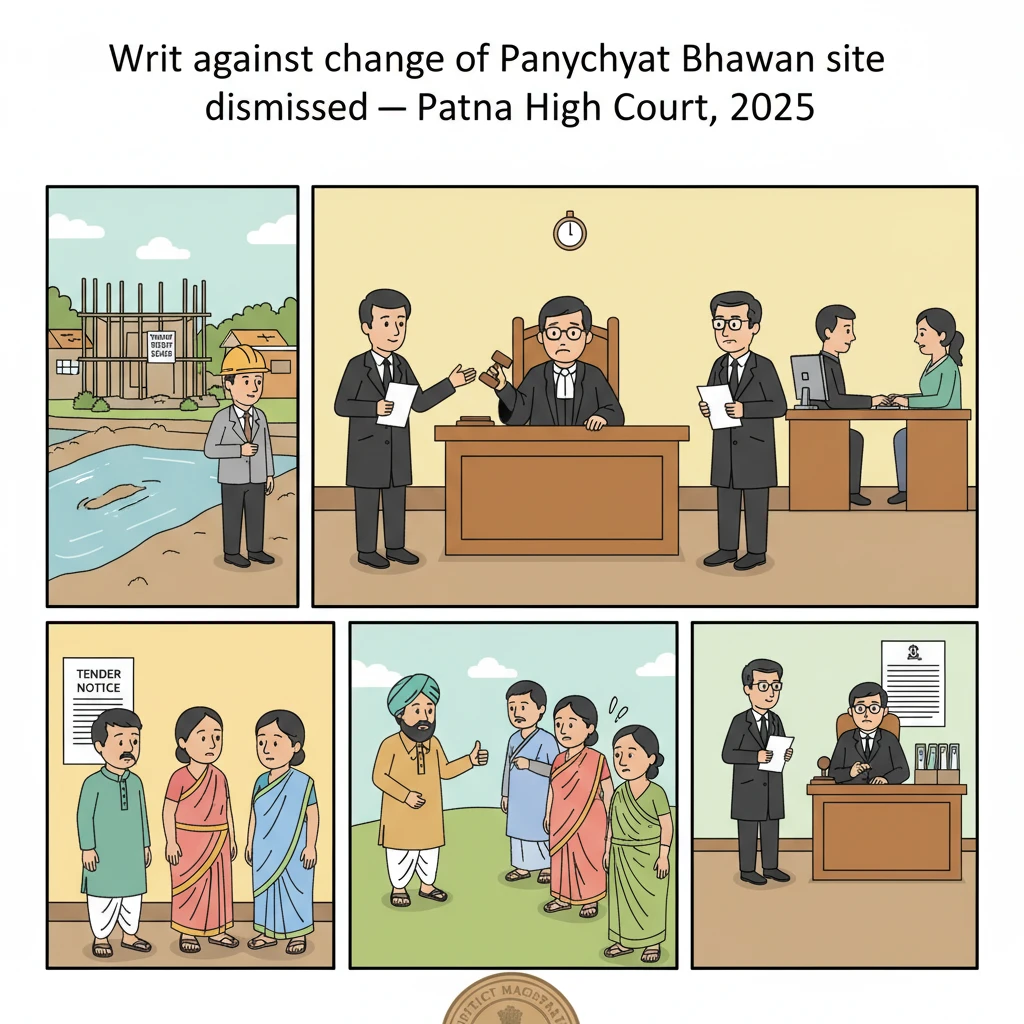
This case concerns where a Panchayat Sarkar Bhawan for Pakahi Jhajhara and nearby Gram Panchayats should be built, and who can legally challenge that decision.
Originally, the then Mukhiya of Pakahi Jhajhara had, on 21.09.2012, requested construction of the Panchayat Sarkar Bhawan on government land at Mauza-Pakahi, Khata No. 718, Khesra No. 1204 (referred to as Mauza-Pakahi, Plot No. 1204), measuring 4 acres 37 decimals.
The Circle Officer got the land measured through the Anchal Amin on 15.10.2012. A trace map was prepared, demarcation was done, and a joint inspection was carried out by the Block Development Officer and Circle Officer on 06.11.2012. The Circle Officer then wrote to the District Panchayati Raj Officer, Darbhanga on 28.11.2012 about the suitability of this land.
After considering these reports, the authorities sanctioned construction of the Panchayat Sarkar Bhawan at Mauza-Pakahi. The Executive Engineer issued Tender Notice No. 2/14-15 for five works, including this building at Pakahi, with an estimated cost of Rs. 95,38,455/- and 12 months for completion. Only one bidder, the private respondent contractor, participated and was declared successful.
Later, on 11.05.2016, the Engineer-in-Chief approved award of the tender to this contractor for construction of the Panchayat Sarkar Bhawan at Kusheshwar Asthan, Pakahi-Jhajhara, Darbhanga. However, by then a new Mukhiya had been elected in June 2016.
After the new Mukhiya took charge, objections were raised by Mukhiyas of other Gram Panchayats in the cluster against the Pakahi site. An Aam Sabha of Gram Panchayat Raj Pakahi-Jhajhara was held on 02.08.2016. It unanimously resolved to cancel the earlier land at Mauza-Pakahi, Plot No. 1204 and to construct the Panchayat Sarkar Bhawan at Mauza-Jhajhara, Plot No. 1019, admeasuring 1 acre, recorded in the name of the Education Department for the Middle School, Jhajhara.
The Circle Officer, Kusheshwar Asthan, recommended this new site to the Sub-Divisional Officer, Biraul. The SDO, by letter dated 15.09.2016, recommended to the District Panchayati Raj Officer and the District Magistrate, Darbhanga, that the site be changed to Mauza-Jhajhara, Plot No. 1019, subject to no objection from the Education Department. He recorded that the new land was more suitable and adjacent to the road.
On 06.12.2016, the District Magistrate, Darbhanga approved the change, allowing construction at Mauza-Jhajhara, Plot No. 1019 instead of Mauza-Pakahi, Plot No. 1204.
The petitioners, two residents of village Pakahi, then filed this writ petition in 2017. They sought quashing of the Aam Sabha decision dated 02.08.2016 and the District Magistrate’s order dated 06.12.2016, and asked for a direction to construct the Panchayat Sarkar Bhawan at the original Pakahi site, Plot No. 1204.
What the Court Examined and Decided
The Patna High Court, through Hon’ble Mr. Justice Mohit Kumar Shah, examined two main questions: (i) whether the petitioners had the legal right (locus standi) to file the writ, and (ii) whether the change of site from Pakahi to Jhajhara was illegal or contrary to government guidelines.
Petitioners’ case
The petitioners argued that Plot No. 1204 at Mauza-Pakahi was a large, suitable piece of land, originally selected after full official verification. They said the government had already sanctioned the site, prepared estimates, floated the tender and awarded it to the contractor specifically for construction at Khesra No. 1204.
They claimed the new site at Mauza-Jhajhara, Plot No. 1019 was smaller, low-lying compared to the adjoining road, and would need heavy soil filling, causing unnecessary extra expenditure. They also pointed out that it was near the settlement (tola) of Scheduled Caste residents and attached to the Middle School, Jhajhara, arguing that political activities at the Panchayat Sarkar Bhawan would disturb students and the school environment.
They stressed that Plot No. 1019 belonged to the school and alleged no proper permission had been obtained from the Education Department, making the decision illegal. They further asserted that the claim of waterlogging at Plot No. 1204 was false and that the land was “normal” and fit for habitation.
They heavily relied on a letter dated 21.08.2015 issued by the Principal Secretary, Panchayati Raj Department, Government of Bihar, to all District Magistrates. This guideline, based on a Cabinet decision, required that a Panchayat Sarkar Bhawan must invariably be constructed at the headquarter village of the concerned Gram Panchayat. It also directed that construction at any other village contrary to this order should be stopped and reviewed.
The petitioners stated that Pakahi village was the headquarters of Gram Panchayat Raj Pakahi-Jhajhara and that about 70% of the voters of the Panchayat belonged to Pakahi, which had full road connectivity. They pointed to earlier correspondence (including a letter dated 04.10.2012 by the Circle Officer to the Additional Collector) certifying that Plot No. 1204 was at the Panchayat headquarters.
They alleged that the new Mukhiya had got the site changed to Plot No. 1019 with vested and oblique motives, contrary to the 21.08.2015 guidelines. They also referred to letters from the Engineer-in-Chief and Chief Engineer in 2017 calling for enquiry and even directing stoppage of construction pending enquiry regarding change of site.
State and Mukhiya’s response
The State and the Mukhiya strongly opposed the writ and first questioned its maintainability. They argued that the petitioners had not shown any personal legal right that was infringed and were not themselves affected by the location of the Panchayat Sarkar Bhawan.
On facts, the State said that objections were filed by Mukhiyas of different Gram Panchayats in Kusheshwar Asthan Block regarding the earlier selected Pakahi site. According to them, the land at Mauza-Pakahi, Plot No. 1204 was low-lying “Bandh” land, part of a river, prone to long-term waterlogging and with poor communication access.
The District Panchayat Raj Officer had asked the Circle Officer to enquire. The Circle Officer’s report dated 22.06.2015 noted that Mukhiyas of Panchayats Chigri, Simraha, Harauli and Gothani said the land was unsuitable and suggested an alternative at Mauza-Jhajhara, Thana No. 261, Plot No. 1019. The Headmaster (Principal), Chairman, Secretary and five members of the School Management Committee gave their no objection to construction of the Panchayat Sarkar Bhawan on this school land.
The State’s affidavit further stated that another representation, along with the Aam Sabha proceedings of 02.08.2016, was filed before the Sub-Divisional Officer, Biraul. The SDO sought a detailed report from the Circle Officer on 27.08.2016. In his report dated 07.09.2016, the Circle Officer recorded that Plot No. 1204 at Mauza-Pakahi was Anabad Bihar Sarkar land, type “Bandh”, where 20–25 Dalit families had been residing and that the land was far from the main road. He also recorded that these residents objected to their displacement.
The report stated that the Aam Sabha on 02.08.2016, in view of these protests, unanimously resolved to cancel the earlier site and select Mauza-Jhajhara, Plot No. 1019, admeasuring 1 acre, for the Panchayat Sarkar Bhawan. This land was recorded in the name of the Education Department, Purushottam Middle School, Jhajhara, as “Ghanhar-II”, adjacent to the main road and suitable for construction.
The Sub-Divisional Officer, Biraul, in his letter dated 15.09.2016, recommended to the District Magistrate that Panchayat Sarkar Bhawan be constructed at Plot No. 1019, noting that it was adjacent to Main Road No. 81 (Satighat to Jhajhara), free from encumbrances and far more accessible than the Pakahi site.
The successor Mukhiya of Gram Panchayat Raj Pakahi-Jhajhara (elected in June 2016) stated in his counter affidavit that the petitioners were petty contractors and land brokers set up by the former Mukhiya to run a proxy litigation, and that the Panchayat Sarkar Bhawan was meant not only for Pakahi-Jhajhara Gram Panchayat but for a cluster of seven Gram Panchayats.
He also highlighted that more than 25 Dalit and Mahadalit families had been living on Plot No. 1204 for 25–30 years, and some had received parchas of settlement. These families, as well as Mukhiyas of other Gram Panchayats, had objected to construction at Pakahi and had submitted representations in 2015. He stated that about 80% of the work at the new site, Plot No. 1019, had been completed: the ground floor fully and the first floor up to roof level, before work was stopped due to the Court’s interim order.
The Executive Engineer (Respondent No. 12) supported this, stating that the new site was adjacent to main road no. 81 and surrounded by a post office, health centre, high school, raised platform and market, making it more suitable.
The contractor (Respondent No. 14) clarified that he was implementing the work at the site directed by authorities and was not involved in the dispute between villagers and Mukhiyas. He said that around 60–65% of the work had been completed, but he had received only about 40% of the contract value (Rs. 37,07,407/-). He argued that scrapping or shifting the project at this stage would waste public money.
Court’s finding on locus standi
The Court first addressed whether the petitioners had the right to maintain the writ petition. Relying on the Supreme Court judgments in Ayaaubkhan @ Noorkhan Pathan v. State of Maharashtra (2013) 4 SCC 465 and Vinoy Kumar v. State of U.P. (2001) 4 SCC 734, the Court reiterated that:
- Only a person who suffers a legal injury or whose legal right is affected can approach the High Court under Article 226.
- There must be a judicially enforceable right of the petitioner himself for a writ to be issued, except in habeas corpus, quo warranto or genuine public interest litigation.
- A stranger or a person with only psychological, imaginary or indirect grievance has no locus standi.
The Court examined the writ petition and found that the petitioners had not pleaded how they personally suffered any legal injury from the site change. There was no averment of any specific legal right in their favour being violated by the District Magistrate’s order dated 06.12.2016 or by the Aam Sabha resolution.
Therefore, the Court held that the writ petition was not maintainable at their instance and was liable to be dismissed on this ground alone.
Court’s view on merits and government guidelines
Despite finding lack of locus standi, the Patna High Court still examined the merits. It looked at the sequence: earlier approval of Plot No. 1204 at Pakahi, objections by other Gram Panchayats, reports of Circle Officer and SDO, Aam Sabha resolution, and the District Magistrate’s approval of the new site at Plot No. 1019, Jhajhara.
The Court accepted the State’s factual position that Plot No. 1204 was Anabad Bihar Sarkar land, type “Bandh”, part of a river, with waterlogging, far from the main road and occupied by 20–25 Dalit families. It also accepted that the new site at Jhajhara, Plot No. 1019, was adjacent to main road no. 81, free from encumbrances, and surrounded by important public institutions like post office, health centre, and schools.
On the guidelines in the letter dated 21.08.2015 requiring construction at the Gram Panchayat headquarters, the Court noted that there was a serious dispute as to whether Mauza-Pakahi was in fact the headquarter village of Gram Panchayat Raj Pakahi-Jhajhara. In that background, and given the suitability and accessibility of the Jhajhara site, the Court held that there was no violation of the Panchayati Raj Department guidelines.
The Court, therefore, found no illegality or ambiguity in the decision of the District Magistrate, Darbhanga dated 06.12.2016 approving the new site at Mauza-Jhajhara, Plot No. 1019.
Stage of construction and public loss
The Court then considered the advanced stage of construction at the new site. It noted that the Mukhiya’s affidavit stated that 80% of work had been completed (ground floor finished, first floor up to roof level), and the petitioners had not denied this specific assertion in their rejoinder.
The contractor had also stated that 60–65% of contract work was done, with only about 40% of the amount paid. The Court accepted that substantial public money had already been invested and that stopping or shifting the project now would delay the Panchayat Sarkar Bhawan, cause huge cost escalation and result in wastage of public funds.
The Court referred to a Division Bench judgment of the Patna High Court in Ashok Kumar v. State of Bihar, CWJC No. 9939 of 2012, reported in 2015 (3) PLJR 265. In that case, even though the Court held that construction of an expensive museum in Patna was not in public interest and the process lacked transparency, it declined to stall the project as construction was nearing completion. The Division Bench had directed that if the museum became unviable, its infrastructure should not be sold to private entities but used for public purposes.
Applying the same reasoning, the Single Judge held that shelving the almost-completed Panchayat Sarkar Bhawan project at Jhajhara would be injudicious and improper.
Final outcome
Combining all these aspects, the Patna High Court concluded that:
- The petitioners lacked locus standi as they had not shown any personal legal right or injury.
- Even on merits, there was no illegality in changing the site from Pakahi to Jhajhara.
- Stopping the project at an advanced stage would severely harm public interest by wasting public money and delaying essential infrastructure.
Accordingly, the writ petition was dismissed.
Why This Judgment Matters
This judgment has two clear practical messages.
First, not every local resident can file a writ petition simply because they disagree with a development decision, such as where a government building should be located. The person must show that a specific legal right of theirs has been violated. Otherwise, the Patna High Court will treat it as an improper or proxy challenge and dismiss it.
Second, when a public project like a Panchayat Sarkar Bhawan is almost complete, courts are very reluctant to halt or undo it. Even if there are disputes over the choice of site, the Court weighs the potential waste of public money and the delay in making facilities available to people.
The judgment also indicates that government guidelines about locating Panchayat Sarkar Bhawans at Gram Panchayat headquarters will be applied with reference to real ground conditions—suitability of land, access by common people, and occupation by vulnerable communities like Dalit and Mahadalit families.
For villagers, this judgment signals that objections about location should be raised timely before executive authorities, and that decisions taken through Aam Sabha, backed by proper enquiries and official approvals, will carry significant weight.
Legal Issues and Answers
- Issue: Can the writ petition be maintained by residents who do not show any specific legal right affected by the change of site of a Panchayat Sarkar Bhawan?
Answer: No. The Court held the petitioners had no locus standi as they did not plead or prove any personal legal right or legal injury. On this ground alone, the writ petition was not maintainable. - Issue: Was the District Magistrate’s order dated 06.12.2016 approving a new site at Mauza-Jhajhara, Plot No. 1019, for the Panchayat Sarkar Bhawan illegal or contrary to government guidelines requiring construction at the Panchayat headquarter village?
Answer: No. The Court found that the earlier Pakahi site was unsuitable and occupied by Dalit families, the Jhajhara site was more suitable and accessible, and there was serious dispute about Pakahi being the Panchayat headquarters. Hence, no violation of guidelines was made out and the order dated 06.12.2016 was upheld. - Issue: Should the Court interfere with or stall the Panchayat Sarkar Bhawan construction at Jhajhara when a large portion of the work was already complete?
Answer: No. Referring to earlier precedent, the Court held that stopping the project at such an advanced stage would waste public funds and cause delay and cost escalation, which would not be in public interest.
Cases Cited by the Court
- Ayaaubkhan @ Noorkhan Pathan v. State of Maharashtra & Others, (2013) 4 SCC 465 – on locus standi and the need for legal injury.
- Vinoy Kumar v. State of U.P. & Others, (2001) 4 SCC 734 – on who is an “aggrieved person” under Article 226.
- Ashok Kumar v. State of Bihar & Ors., CWJC No. 9939 of 2012, reported in 2015 (3) PLJR 265 – on not stalling a public project at a near-complete stage despite concerns.
Case Details
Case Number: Civil Writ Jurisdiction Case No. 546 of 2017
Case Title: Brij Nandan @ Siya Ram Yadav & Anr. v. The State of Bihar & Ors.
Citation: 2025 (2) PLJR 647
Court: High Court of Judicature at Patna
Coram: Hon’ble Mr. Justice Mohit Kumar Shah
Date of Judgment: 07.04.2025
Advocates:
- For the Petitioners: Mr. Janardan Prasad Singh, Senior Advocate; Mr. Jagdish Prasad Singh, Advocate
- For the State (Respondent Nos. 1–8, 11–13): Mr. Kameshwar Pd. Gupta, GP-10; Mr. Virendra Kuar, AC to GP-10
- For Respondent No. 9 (Mukhiya, Gram Panchayat Raj Pakahi Jhajhara): Mr. Rantan Kumar, Advocate
- For Respondent No. 14 (Contractor): Mr. Abhay Shankar Singh, Advocate; Mr. Barun Kumar Singh, Advocate
Nature of the Case: Writ petition under Article 226 of the Constitution of India challenging the Aam Sabha resolution dated 02.08.2016 and the District Magistrate’s order dated 06.12.2016 regarding change of land for construction of a Panchayat Sarkar Bhawan.
Link to Judgment: https://patnahighcourt.gov.in/viewjudgment/MTUjNTQ2IzIwMTcjMSNO-2vbKehS0E28=
If you found this explanation helpful and wish to stay informed about how legal developments may affect your rights in Bihar, you may consider following Samvida Law Associates for more updates.







