

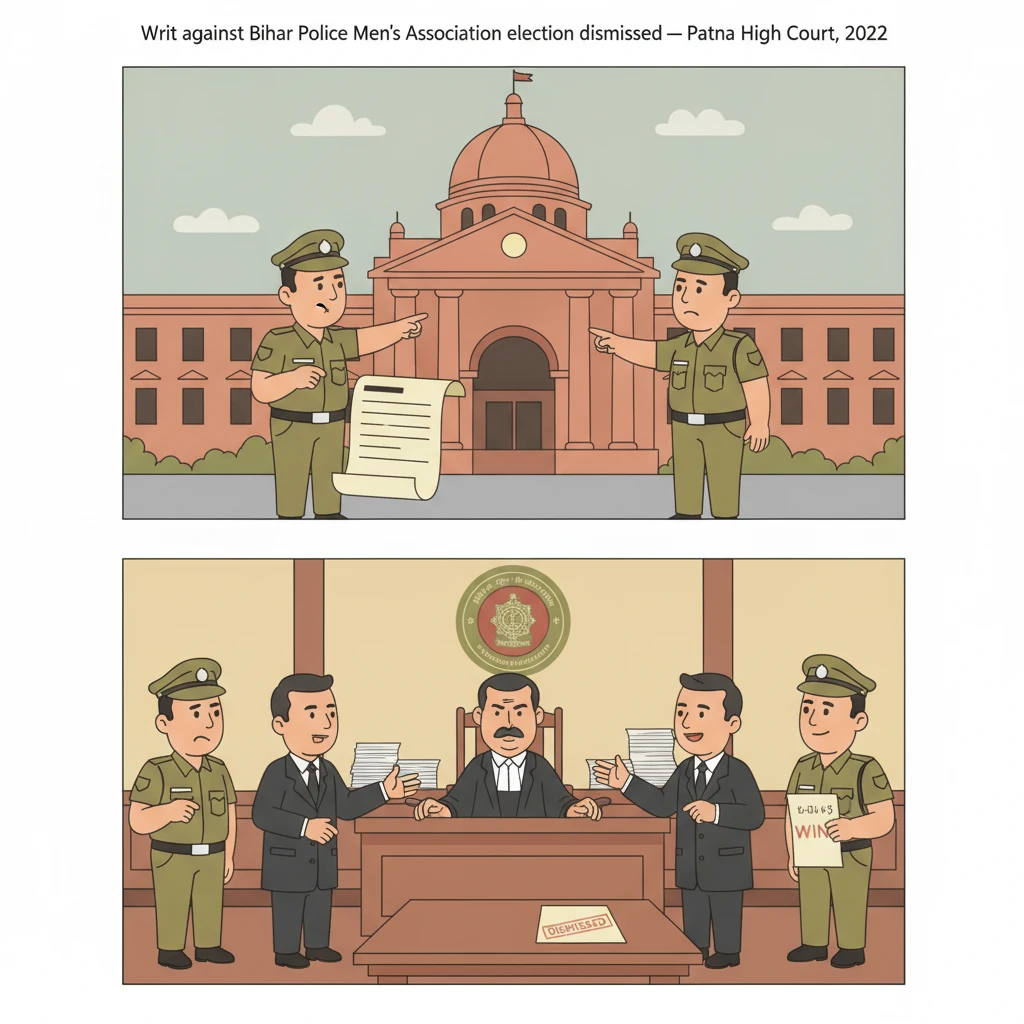
Case Background
The petitioner is a constable in the Bihar Police, posted at Gaya. He approached the Patna High Court under Article 226 of the Constitution of India.
He challenged the candidature and nomination of respondent no. 6 for the post of “Pradesh Adhyaksh” (State President) of the Bihar Police Men’s Association. According to the petitioner, respondent no. 6 had been transferred from Patna to Lakhisarai but had not joined at the transferred place.
On this basis, the petitioner claimed that respondent no. 6’s candidature itself was invalid. He also asked the Court to direct that free and fair elections of the Central Executive of the Bihar Police Men’s Association be conducted.
While this writ petition was pending, the election of the Bihar Police Men’s Association was held. On 20.03.2021, respondent no. 6 was declared elected as the Pradesh Adhyaksh of the Association.
After this development, in August 2021, the petitioner filed an interlocutory application seeking amendment of the writ petition. By this, he sought to specifically challenge the election of respondent no. 6 as Pradesh Adhyaksh, and not just his nomination.
What the Court Examined and Decided
The Division Bench, speaking through Hon’ble Mr. Justice Chakradhari Sharan Singh, identified the central legal question at the very start. The key issue was whether the Bihar Police Men’s Association is amenable to the writ jurisdiction of the High Court under Article 226 of the Constitution of India.
The Bench explained that this question had two parts. The first part was whether the Association could be treated as “State” under Article 12 of the Constitution. If it was “State” in this sense, it would clearly be open to writ jurisdiction.
If the answer to that was no, then the second question arose: even if not “State”, did the Association discharge any public function or public duty so that a writ could still be issued against it.
This framing of the issue was important because the reliefs sought by the petitioner were entirely about the internal election of the Bihar Police Men’s Association. Unless the Association came within the legal reach of Article 226, the High Court could not go into the validity of its electoral process.
The Court then referred to earlier judicial decisions on the same Association. The identical issue had come up earlier in Constable No. 756 Liaquit Ali v. State of Bihar and Others, CWJC No. 15891 of 2017, decided on 22.11.2017 by a Single Judge of the Patna High Court.
In Liaquit Ali’s case, the Single Judge had examined Supreme Court judgments in Federal Bank Ltd. v. Sagar Thomas and Others, (2003) 10 SCC 733, and Zee Telefilms Ltd. and Another v. Union of India and Others, (2005) 4 SCC 649. On that basis, it was held that a writ proceeding against an association which is not “State” under Article 12, is not an authority, not a statutory body, not an instrumentality or agency of the State, not financed by the State, and is purely a private body formed voluntarily by its members with its own rules and regulations and discharging no public duty, is not maintainable.
The Division Bench in the present case made it clear that the decision in Liaquit Ali concerned this very Bihar Police Men’s Association. The Court further noted that a similar view had been taken later by a Single Bench in CWJC No. 5589 of 2015, Rakesh Kumar Singh and Another v. The Director General-cum-Inspector General of Police and Others, decided on 09.07.2018.
Against this backdrop, the Court examined the submissions of the petitioner’s counsel. The petitioner relied heavily on guidelines dated 18.03.2021 issued by the Director General of Police, Bihar. On the strength of this guideline, counsel argued that respondent no. 6’s nomination was invalid, as he had been transferred from Patna to Lakhisarai, had not joined there, yet continued to contest for the post in the Association.
The petitioner submitted that the election had been conducted in accordance with the guidelines of the Director General of Police and under the supervision of a senior police officer of the rank of Inspector General of Police, who was acting as Chief Election Officer. On this basis, he urged that the High Court should interfere in writ jurisdiction as the election process had not followed the guidelines in relation to respondent no. 6’s eligibility.
However, the Court recorded that the petitioner had not been able to place any material on record to show that the Bihar Police Men’s Association was either “State” within the meaning of Article 12 of the Constitution or a body discharging any public function.
The Bench then itself examined the guideline dated 18.03.2021. It noted that the guideline had been issued taking into account the provisions of the Bihar Police-Forces (Restriction of Rights) Act, 1966. The circular dealt with the posting of office-bearers of the Association and their participation in elections for posts in the district units of the Association.
The circular also referred to the Bihar Government Servants (Recognition of Service Association) Rules, 1960, framed by notification dated 20.07.1960. These Rules concern the recognition of service associations of government servants. Rule 4 of the Rules lays down conditions for recognition of a service association, and Rule 5 sets out the conditions subject to which recognition is granted.
The Division Bench held that mere recognition of a service association under these Rules does not make such an association “State” under Article 12 of the Constitution of India. The recognition only regulates the relationship between the Government and the association as a recognised body of employees; it does not transform the association into a State authority.
The Court further referred to the Bihar Police Act, 2007. This Act has been enacted to regulate the establishment and management of the police service in Bihar. The Bench observed that there is no provision in the Bihar Police Act, 2007 which assigns any public function to an association of police force members such as the Bihar Police Men’s Association.
Instead, any recognition given to a service association, including the Bihar Police Men’s Association, is only under the Bihar Government Servants (Recognition of Service Association) Rules, 1960. This framework, in the Court’s view, did not convert the Association into a public authority.
The Court then turned to the nature and purpose of the Bihar Police Men’s Association. From the material available, the Association appeared to have been formed to look after the welfare of its members. The Bench held that such a welfare association cannot be said to be discharging any important public function that would make it amenable to writ jurisdiction under Article 226 of the Constitution.
On this reasoning, the Division Bench concluded that the Bihar Police Men’s Association is neither “State” within the meaning of Article 12, nor does it perform any important public function. Therefore, it is not amenable to writ jurisdiction.
Since the core relief sought by the petitioner was to question the election of office-bearers of this Association—a private body—the Court held that raising an election dispute of a private association through a writ petition under Article 226 was “thoroughly misconceived”.
Consequently, the writ application was dismissed. The interlocutory application filed for amendment, and any other such application, was also disposed of. No further directions were issued.
Why This Judgment Matters
This judgment is important for police personnel and members of other service associations in Bihar who may be unhappy with internal elections or office-bearers.
The Patna High Court has clearly held that the Bihar Police Men’s Association is a private welfare body. It is not “State” under the Constitution and it does not perform public functions in a way that allows its internal matters to be challenged through writ petitions.
In practical terms, this means that members who have grievances about nominations, voting eligibility, or election results in the Association cannot ordinarily seek relief under Article 226 against the Association itself.
The Court also made it clear that even if government authorities like the Director General of Police issue guidelines, and senior police officers supervise the election process, that alone does not convert the Association into a public authority.
For members, the key takeaway is that disputes about office-bearers or elections of such an association are treated as disputes of a private body. They must be resolved within the framework of the Association’s own rules or through other appropriate legal remedies, but not through a writ petition claiming violation of public law rights.
Legal Issues and Answers
-
Issue: Is the Bihar Police Men’s Association amenable to writ jurisdiction under Article 226 of the Constitution of India, either as “State” under Article 12 or as a body discharging public functions?
Answer: No. The Court held that the Association is not “State” within Article 12, is not a statutory or State-funded body, and does not discharge any important public function. It is therefore not amenable to writ jurisdiction. -
Issue: Can the High Court, in writ jurisdiction, interfere with the election of office-bearers of the Bihar Police Men’s Association, including the election of its Pradesh Adhyaksh?
Answer: No. Since the Association is a private welfare body not subject to writ jurisdiction, an election dispute regarding its internal posts cannot be entertained under Article 226. The writ petition was held to be thoroughly misconceived and was dismissed.
Cases Cited by the Court
- Constable No. 756 Liaquit Ali v. State of Bihar and Others, CWJC No. 15891 of 2017 (Single Bench, Patna High Court, decided on 22.11.2017).
- Rakesh Kumar Singh and Another v. The Director General-cum-Inspector General of Police and Others, CWJC No. 5589 of 2015 (Single Bench, Patna High Court, decided on 09.07.2018).
- Federal Bank Ltd. v. Sagar Thomas and Others, (2003) 10 SCC 733.
- Zee Telefilms Ltd. and Another v. Union of India and Others, (2005) 4 SCC 649.
Case Details
Case Number: Civil Writ Jurisdiction Case No. 8923 of 2021
Case Title: Sujit Kumar Singh v. The State of Bihar & Others
Coram: Hon’ble Mr. Justice Chakradhari Sharan Singh and Hon’ble Mr. Justice Madhuresh Prasad
Citation: 2022(2) PLJR 55
Date of Judgment: 02.03.2022
Advocates:
- For the petitioner: Mr. Rajan Ghoshrave, Advocate
- For the respondents: Mr. Sanoj Kumar Sharma, AC to AAG-3
Nature of the Case: Writ petition under Article 226 of the Constitution of India challenging candidature and subsequent election to the post of Pradesh Adhyaksh of the Bihar Police Men’s Association.
Link to the Judgment: Patna High Court Judgment in CWJC No. 8923 of 2021
If you found this explanation helpful and wish to stay informed about how legal developments may affect your rights in Bihar, you may consider following Samvida Law Associates for more updates.







