

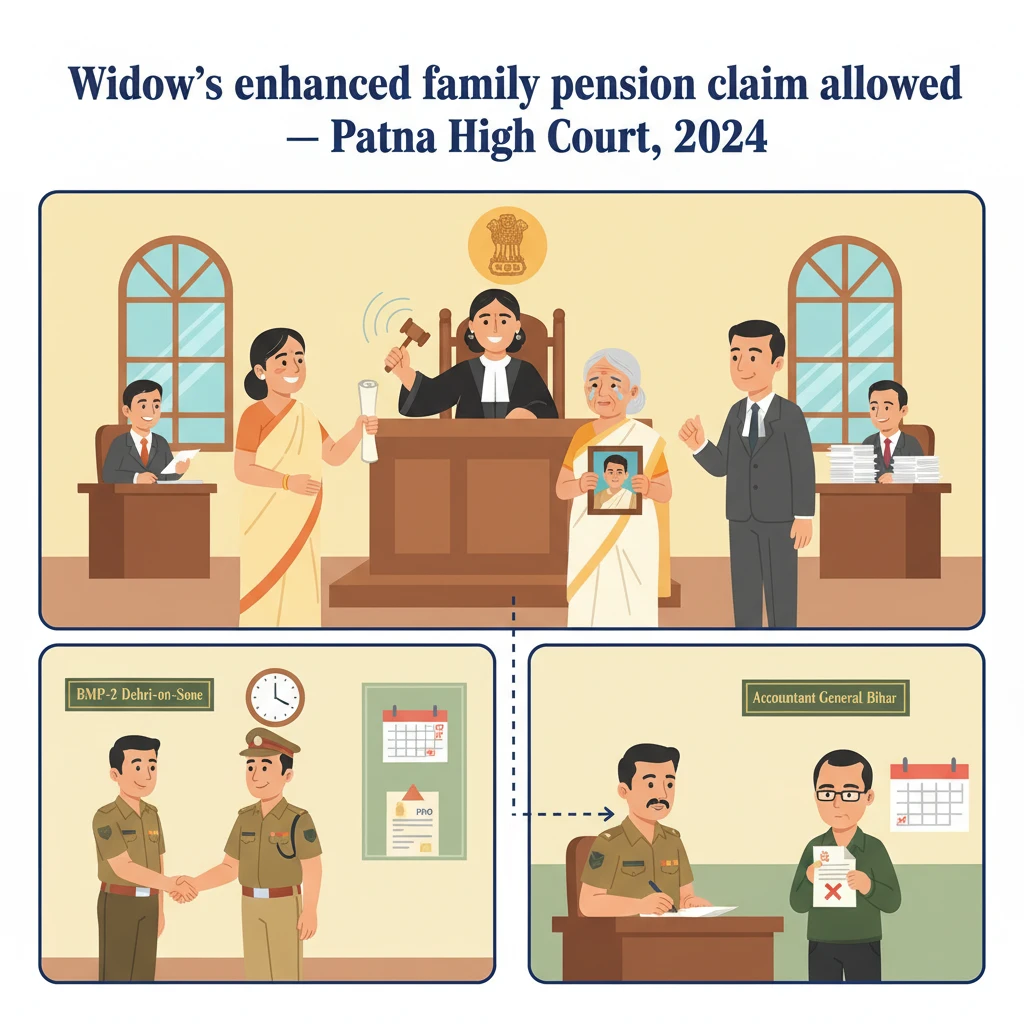
Case Background
The petitioner is the widow of a former Constable of Bihar Military Police-2. Her husband had joined service on 23.02.1997. He later opted for voluntary retirement from the post of Constable while posted at BMP-2, Dehri-on-Sone under the Commandant, BMP-2.
Although his normal date of superannuation was 30.11.2016, he took voluntary retirement with effect from 31.03.2007 due to personal difficulties. Respondent Nos. 2 and 3 accepted this voluntary retirement and sent the relevant documents and service book to the office of the Accountant General, Bihar.
The Accountant General then issued PPO No. 429433 (V) dated 25.05.2007, fixing his pension at Rs. 4371/- per month with effect from 01.04.2007. Later, by letter dated 13.10.2010, his pension was revised and fixed at Rs. 7373/- per month.
The petitioner’s husband died on 09.02.2016. After his death, the petitioner became entitled to family pension under the Bihar Pension Rules, 1950. She was in fact paid family pension @ Rs. 2948/- per month from 10.02.2016.
On learning the details of the pension fixation, the petitioner believed that she was entitled to enhanced family pension for a certain period after her husband’s death. On 18.10.2020, she submitted a representation before the Department and the Senior Accounts Officer (A.G., Bihar) seeking correct fixation of family pension and grant of enhanced family pension.
What the Court Examined and Decided
The core dispute before the Patna High Court was not about the petitioner’s right to basic family pension, which she was already receiving. It was about the period and applicability of “enhanced family pension” after the death of her husband, a voluntarily retired government employee.
After the petitioner’s representation, the Commandant, Bihar Military Police-2, Dehri-on-Sone examined her case. He sent a letter to the Accountant General, Bihar, Patna, vide Memo No. 623 dated 08.02.2021. In this letter, he recommended that enhanced family pension should be ensured for the petitioner till she attained 67 years of age or for seven years after the death of the pensioner, whichever was earlier.
In response, the Senior Accounts Officer, A.G., Bihar, through Letter No. 1132 dated 10.02.2021, rejected the claim. The office of the Accountant General took the stand that enhanced family pension is payable only in cases where the employee was in service on or after 01.04.2007, or for up to ten years after the employee died during his service period. This stand was based on Finance Department Resolution No. 1206 dated 22.08.2013.
According to that view, because the petitioner’s husband had taken voluntary retirement on 31.03.2007 and died much later on 09.02.2016, the petitioner was not entitled to enhanced family pension from the date of his death. Instead, they treated the period from 31.03.2007 as the relevant date for counting enhanced family pension.
During the pendency of the writ petition, the petitioner’s pending representation was again rejected in the same manner. This was done by the Senior Accounts Officer, Bihar, Patna through Letter No. 478 dated 24.08.2023. The petitioner challenged this later rejection by filing I.A. No. 1 of 2023 in the present writ case.
The respondents, including the Accountant General and the Commandant, Bihar Military Police-II, filed their counter affidavits. They maintained that, since the petitioner’s husband took voluntary retirement on 31.03.2007 and died on 09.02.2016, enhanced family pension could be admissible only from the date of voluntary retirement and not from the date of death.
Relying on Resolution No. 1206 dated 22.08.2013 of the Finance Department, they argued that if a government servant dies while in service, enhanced family pension is payable for ten years from the date of death. However, if the employee had already retired, the family would only get enhanced family pension for seven years from the date of retirement. They thus treated 31.03.2007 as the starting date and denied enhanced family pension beyond 31.03.2014.
The petitioner’s counsel challenged this approach. He argued that Resolution No. 1206 dated 22.08.2013 did not apply to the petitioner’s case at all. Instead, he relied on an earlier Finance Department resolution, Memo No. 1764 dated 26.09.2006, which had extended the period for enhanced family pension.
According to the petitioner’s reading of Memo No. 1764 dated 26.09.2006, enhanced family pension would be available both when an employee dies during service and when an employee dies after superannuation. The entitlement would run for seven years from the date of death or till the deceased would have attained a specified age, whichever was earlier. Initially the age ceiling was 65 years, later increased to 67 years.
The petitioner’s counsel also submitted that Resolution No. 1206 dated 22.08.2013 introduced a ten-year enhanced family pension only for families of employees who died on or after 01.04.2007 during service. That, he argued, was a separate scheme for death while in service and had nothing to do with cases of death after retirement.
Justice Harish Kumar of the Patna High Court closely examined both the competing resolutions and the factual sequence. The Court first looked at Resolution No. 1206 dated 22.08.2013. On a plain reading, the Court found that its applicability was “restricted only” to employees who died on or after 01.04.2007 or died during their service period. Where this condition is satisfied, the enhanced family pension is payable for ten years. But the Court clearly noted that this resolution does not apply to employees who die after retirement.
The Court observed that in the present case, the petitioner’s husband’s voluntary retirement was approved with effect from 31.03.2007. That was his date of retirement. He died in 2016, long after leaving service. Therefore, the Court held that Resolution No. 1206 dated 22.08.2013 was “certainly not applicable” to his case. On this reasoning, the Accountant General’s repeated reliance on this resolution to deny the widow’s claim was held to be misplaced.
The Court then turned to Memo No. 1764 dated 26.09.2006 issued by the Finance Department, Government of Bihar. The judgment reproduces the relevant Hindi text of the resolution. This resolution, read with the earlier instructions it modified, provided that if a government servant dies during service, their family is entitled to enhanced family pension from the date of death for seven years, or up to a particular age of the deceased (earlier 65 years, later raised to 67 years), whichever happens earlier.
The same resolution clarified that this benefit would also extend to cases where death occurs after retirement. It also stated that, in no circumstance, could the enhanced family pension exceed the basic pension that the deceased employee was drawing.
In paragraph 12, the Court summarised this position: the employee who dies during the service period or after superannuation is entitled to enhanced family pension till seven years from the date of death, or up to the age of 67 years of the deceased employee, whichever is earlier, subject to the ceiling that it cannot exceed the basic pension.
Applying this rule to the petitioner’s case, the Court in paragraph 13 clearly concluded that the husband of the petitioner retired with effect from 31.03.2007 and died in 2016. Therefore, Memo No. 1764 dated 26.09.2006 squarely applied. As a result, the petitioner was held entitled to enhanced family pension for seven years from the date of her husband’s death, or up to the age of 67 years of the deceased, whichever occurred first.
In view of this legal position, the Court quashed Letter No. 1132 dated 10.02.2021 and Letter No. 478 dated 24.08.2023 issued by the Senior Accounts Officer, Bihar, Patna, both of which had rejected the petitioner’s claim on the incorrect basis of Resolution No. 1206 dated 22.08.2013.
Finally, in paragraph 15, the Court directed the Accountant General, Bihar to reconsider the petitioner’s claim for enhanced family pension strictly in light of Memo No. 1764 dated 26.09.2006. The Accountant General was further directed to ensure all consequential benefits, preferably within eight weeks from the date the order is received or produced.
With these directions, the writ petition was allowed.
Why This Judgment Matters
This judgment is significant for families of government employees in Bihar who took voluntary retirement or retired normally and then died afterwards. It clarifies that such families can still claim enhanced family pension for a limited period after death, under Memo No. 1764 dated 26.09.2006.
The Patna High Court made it clear that the later Resolution No. 1206 dated 22.08.2013 applies only where an employee dies while still in service. Authorities cannot use this later resolution to deny benefits to widows of retired employees.
For affected families, this decision reinforces that they can rely on the 2006 Finance Department resolution to seek correction of their PPO and claim enhanced family pension for up to seven years from the date of death or until the deceased would have turned 67, whichever is earlier.
It also sends a message to departments and the Accountant General’s office that they must carefully select the correct government resolution and cannot curtail pensionary benefits by misapplying later schemes meant for different situations.
Legal Issues and Answers
- Issue: Whether the petitioner, as widow of a voluntarily retired constable who died after retirement, was entitled to enhanced family pension calculated from the date of his death, and which government resolution governed her claim.
Answer: Yes. The Patna High Court held that Memo No. 1764 dated 26.09.2006 applied, not Resolution No. 1206 dated 22.08.2013. Under the 2006 memo, she is entitled to enhanced family pension for seven years from her husband’s death or until he would have turned 67, whichever is earlier. - Issue: Whether the Accountant General was justified in rejecting the enhanced family pension claim by treating 31.03.2007 (date of voluntary retirement) as the relevant date and relying on Resolution No. 1206 dated 22.08.2013.
Answer: No. The Court quashed the rejection letters, holding that Resolution No. 1206 covers only employees dying on or after 01.04.2007 during service and does not extend to death after retirement. - Issue: What directions should be issued to ensure implementation of the correct pension law.
Answer: The Court directed the Accountant General, Bihar to reconsider and fix the petitioner’s enhanced family pension in accordance with Memo No. 1764 dated 26.09.2006 and grant all consequential benefits within eight weeks.
Cases Cited by the Court
- The judgment does not refer to or rely on any earlier judicial decisions. It proceeds solely on the basis of Finance Department resolutions and the Bihar Pension Rules, 1950.
Case Details
Case Number: Civil Writ Jurisdiction Case No. 7652 of 2023
Case Title: Muniya Devi v. The State of Bihar & Ors.
Court: High Court of Judicature at Patna
Coram: Hon’ble Mr. Justice Harish Kumar
Date of Judgment: 08.01.2024
Citation: 2024(1) PLJR 517
Advocates:
- For the Petitioner: Mr. M. N. Parbat, Senior Advocate with Mr. Sanjay Kumar Mishra, Advocate
- For the State: Mr. Dhirendra Kumar, AC to GP 5
- For the Accountant General: Mr. Ram Yash Singh, Advocate
Nature of the Case: Writ petition under Article 226 of the Constitution of India seeking direction for correction of PPO and grant of enhanced family pension under the Bihar Pension Rules, 1950 and Finance Department resolutions.
Impugned Orders: Letter No. 1132 dated 10.02.2021 and Letter No. 478 dated 24.08.2023 issued by the Senior Accounts Officer, Bihar, Patna, rejecting the petitioner’s claim for enhanced family pension.
Final Outcome: Writ petition allowed; impugned letters quashed; Accountant General, Bihar directed to refix and pay enhanced family pension and consequential benefits as per Memo No. 1764 dated 26.09.2006 within eight weeks.
Link to Full Judgment: Patna High Court Judgment in CWJC No. 7652 of 2023
If you found this explanation helpful and wish to stay informed about how legal developments may affect your rights in Bihar, you may consider following Samvida Law Associates for more updates.







