
Case Background
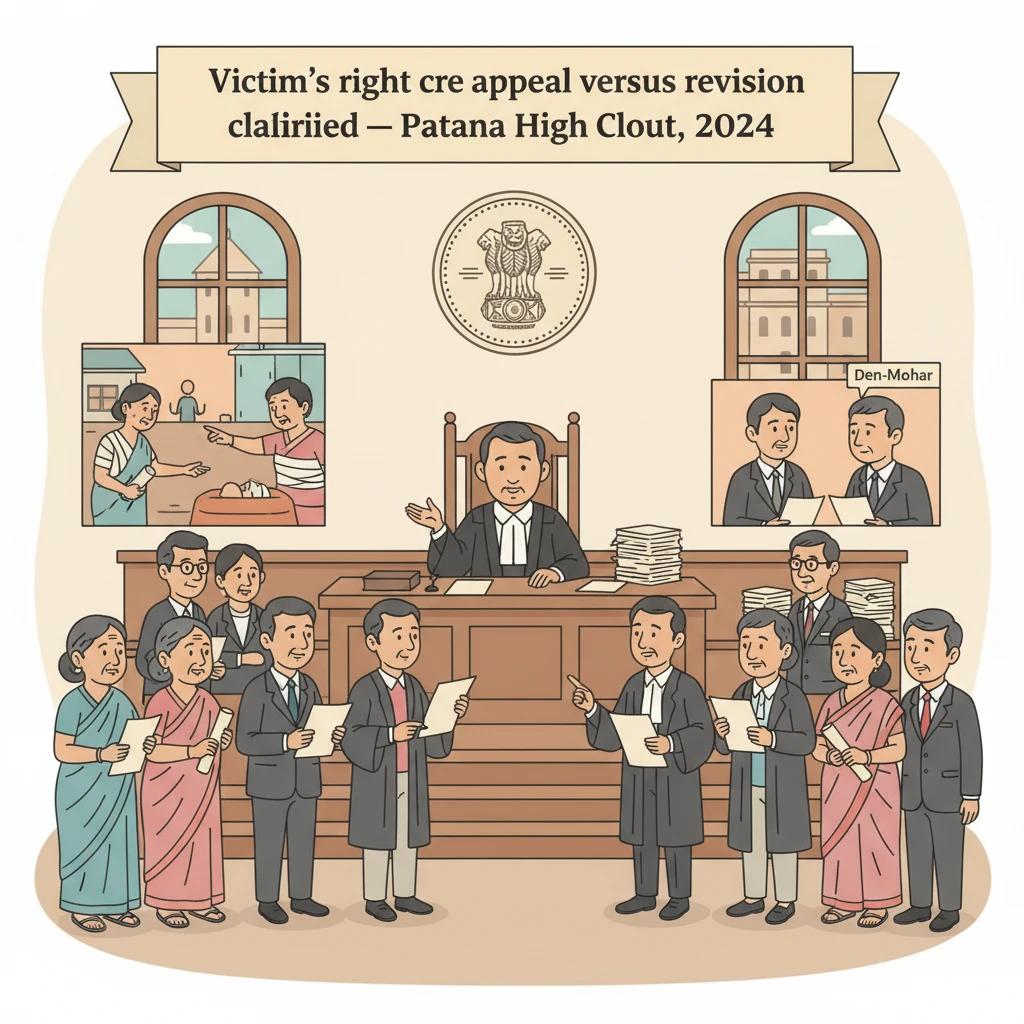
This judgment by the Patna High Court deals with five connected criminal revision applications. All involve complaints of family disputes, cruelty, assault, or harassment, where the accused were either acquitted or their sentence was reduced.
In each matter, the person approaching the High Court is either the original complainant (informant) or close family members of the complainant. They describe themselves as “victims” under Section 2(wa) of the Code of Criminal Procedure, 1973 (Cr.P.C.).
The core question before the Court was not about re‑examining the evidence in each criminal case. Instead, the Court had to decide a common legal point: as “victims”, could these persons maintain criminal revision petitions under Sections 397 and 401 Cr.P.C., or should they file an appeal under the proviso to Section 372 Cr.P.C.?
All five revisions were heard together by Hon’ble Mr. Justice Bibek Chaudhuri, who delivered a common judgment on 1 March 2024.
What the Court Examined and Decided
The Court first described each of the five criminal revision cases to show how they reached the High Court.
In Criminal Revision No. 133 of 2020, the petitioner was the informant in Malsalami P.S. Case No. 103 of 2010. She alleged that her husband’s elder brother called her husband for a discussion on partition of the house. During this meeting, some relatives allegedly caught hold of her husband. Two of them allegedly brought sharp cutting tools (Chewaniya and Hasua), and one allegedly attacked her husband on the chest and hand, causing serious injuries which required surgery and 30 stitches.
On this statement, police registered a case under Sections 341, 342, 323, 324, 307, 506, 504 and 34 of the Indian Penal Code (IPC). After investigation, a chargesheet was filed, and the accused faced trial in Sessions Trial No. 1586 of 2011 before the Additional Sessions Judge, Vth Court, Patna City. On 11 September 2019, the trial court acquitted all four accused (Opposite Party Nos. 2 to 5). The informant then filed Criminal Revision No. 133 of 2020 before the Patna High Court against this acquittal.
In Criminal Revision No. 137 of 2020, the petitioner was the informant in Nabinnagar P.S. Case No. 28 of 2009 (G.R. No. 488 of 2009) under Sections 341, 323, 504 and 34 IPC. Police filed a chargesheet, and the case was tried by the A.C.J.M., VIIth Court, Aurangabad. The trial court acquitted the accused. The informant challenged this acquittal in Criminal Appeal No. 72 of 2017 before the Additional Sessions Judge, Vth Court, Aurangabad, but the appeal was dismissed and the acquittal affirmed. The informant then filed a revision before the High Court against this appellate judgment.
In Criminal Revision No. 136 of 2020, the petitioner was the informant in Madhubani Town P.S. Case No. 314 of 2000. She alleged that her marriage with Opposite Party No. 1 was solemnized about seven years before the complaint as per Mohammedan customs. Den-Mohar was fixed at Rs. 16,786/-. Her family allegedly gave jewellery, utensils, furniture, clothes and other items worth about Rs. 75,000/-. Initially, she lived happily at her matrimonial home, but later her husband and in-laws allegedly started torturing her, saying she was unable to bear a child and demanding money from her parental home.
According to her, when she could not bring money, she was subjected to physical and mental cruelty and was finally driven out of her matrimonial home “in a single cloth”. Police submitted a chargesheet under Sections 323, 498A and 34 IPC. The trial court acquitted all the accused. She filed Criminal Appeal No. 48 of 2013, which was dismissed on 4 December 2019. She then moved the High Court in revision.
Criminal Revision No. 131 of 2020 related to Naubatpur P.S. Case No. 119 of 2002. The original informant, Kiran Kumari, alleged that she married one Nawal Kishore in 1981, and in that marriage she had one son and three daughters. She alleged that after the death of her son, she was subjected to mental and physical cruelty by her husband and in-laws. She further alleged that her husband contracted a second marriage during the subsistence of their marriage, and that the second wife had a child and lived with him in Delhi.
On the basis of her complaint, Naubatpur P.S. Case No. 119 of 2002 was registered on 1 July 2002 under Sections 498A, 494 and 341 IPC. The husband was convicted under Section 498A IPC in G.R. No. 1014 of 2002 by the S.D.J.M., Danapur, on 19 July 2010 and sentenced to two years’ rigorous imprisonment and a fine of Rs. 10,000/-.
During the trial, the informant Kiran Kumari died. Her husband filed Criminal Appeal No. 178 of 2010 before the Additional Sessions Judge, 1st Court, Danapur. The appellate court modified the sentence to the period of imprisonment already undergone and reduced the fine to Rs. 5,000/-. The present revision (No. 131 of 2020) was filed by the daughters of late Kiran Kumari, describing themselves as victims along with their deceased mother and challenging this modification.
Criminal Revision No. 138 of 2020 also arose from Naubatpur P.S. Case No. 119 of 2002. Here, the daughters of late Kiran Kumari challenged the judgment dated 3 February 2019 of the Additional Sessions Judge, 1st Court, Danapur in Criminal Appeal No. 206 of 2011. That appellate court had dismissed the appeal and confirmed the order dated 19 July 2010 passed by the S.D.J.M., Danapur in T.R. No. 846 of 2010, which had acquitted Opposite Party Nos. 3 and 4 under Sections 498A and 34 IPC, and acquitted Opposite Party Nos. 2 to 4 under Section 494 IPC. The daughters, calling themselves victims, filed this revision.
After setting out these factual backgrounds, the Patna High Court turned to the central legal issue: who is a “victim” under Section 2(wa) Cr.P.C., and what remedy is open to such a victim when there is an acquittal or a reduction of sentence?
The Court reproduced Section 2(wa), which defines “victim” as a person who has suffered any loss or injury caused by the act or omission for which the accused is charged, and includes his or her guardian or legal heir.
To explain the reach of this definition, the Court relied on a Full Bench decision of the Delhi High Court in Ram Phal vs. State and Ors., reported in 2015 CrlJ 3220. That judgment held that there must be a direct relationship between the injury and the person who suffered it. The injury cannot be remote; it has to be proximate. At the same time, whether the connection is close enough is a fact-based enquiry. Courts must examine each case individually.
The Delhi Full Bench also clarified that where the direct victim cannot prefer an appeal due to trauma, shock, or disability, close relatives, guardians, or others in a similar position can file an appeal on the victim’s behalf under the proviso to Section 372 Cr.P.C.
The Patna High Court then analysed the definition of “victim” in two parts. First, a victim is the person who directly suffers loss or injury from the act or omission of the accused. Second, the definition also covers legal heirs who suffer harm due to the injury caused to that direct victim.
Applying this to the four revisions filed by the daughters of the informant and by the informants themselves, the Court held that in Criminal Revision Nos. 131 and 138 of 2020, the daughters of late Kiran Kumari were clearly victims. Their mother was treated with cruelty, driven out of her matrimonial home, and her husband allegedly remarried. The daughters, as her legal heirs, suffered harm due to these acts and could therefore act as victims and challenge the appellate judgments.
Similarly, in Criminal Revision Nos. 136 and 137 of 2020, the petitioners themselves were directly subjected to alleged cruelty or assault. They therefore fell squarely within Section 2(wa) Cr.P.C. and could maintain revision applications against the appellate orders.
The Court then examined Criminal Revision No. 133 of 2020 separately. It accepted that the informant-wife, whose husband suffered an alleged murderous attack, also suffered mental trauma, agony, and injury due to the assault. She too was a “victim” under Section 2(wa).
However, the crucial point here was the nature of the impugned order. In that case, the acquittal of the accused was by a Sessions Court in a case involving Section 307 IPC, which is triable by a Sessions Court. For such an order of acquittal, the proviso to Section 372 Cr.P.C. specifically gives the “victim” a right to file an appeal.
The Court discussed the scope of revisions under Sections 397 and 401 Cr.P.C. It recalled that while the High Court’s power to revise an acquittal is not barred, it is “severely restricted”, as recognised by the Supreme Court in Johar & Ors. vs. Mangal Prasad & Anr., AIR 2008 SC 1165. The revisional jurisdiction cannot ordinarily interfere with an acquittal unless there is an apparent error of law or procedure, manifest illegality, or gross miscarriage of justice.
The Court further noted that Section 401(3) bars the High Court, in revision, from converting an acquittal into a conviction. Revision is therefore narrower in scope than appeal, which allows full re‑examination of facts and law.
Keeping all these principles in mind, and relying also on a Division Bench judgment of the Patna High Court reported in 2015 (2) PLJR 798, along with the Full Bench decision in Ram Phal, the Court concluded that where an appeal remedy is expressly available to a victim under the proviso to Section 372 Cr.P.C., a revision is not the proper route.
In Criminal Revision No. 133 of 2020, since the impugned order was a Sessions Court acquittal and the informant was a victim, she had a statutory right of appeal as a victim against acquittal. Therefore, the revision petition was held not maintainable. The Court disposed of this revision, leaving it open to the petitioner to pursue an appeal before the competent court.
In contrast, the other four revisions (Nos. 131, 136, 137, and 138 of 2020) were all directed against judgments of appellate courts — either modifying the sentence of the husband or confirming acquittals of other accused persons. In these situations, the Court held that the victims could properly invoke the revisional jurisdiction under Sections 397 and 401 Cr.P.C. Therefore, these four revisions were found maintainable and were directed to be listed for hearing on merits.
Why This Judgment Matters
This judgment is important for victims of crime and their families in Bihar and beyond. It explains who can act as a “victim” in criminal proceedings. Not only the person directly harmed, but also their legal heirs who suffer due to that harm can approach the court.
The judgment is especially relevant in cases of cruelty within marriage, second marriage during subsisting marriage, and domestic violence where the original complainant may have died or is unable to act. Daughters and other close relatives can step in as victims and challenge orders that they believe are unjust.
The decision also clarifies the correct legal path. If you are a victim challenging an acquittal by a trial court, you should ordinarily file an appeal under the proviso to Section 372 Cr.P.C., rather than a revision. But if you are challenging a later appellate judgment that modifies sentence or upholds an acquittal, a criminal revision under Sections 397 and 401 Cr.P.C. may be maintainable.
For ordinary citizens, this judgment of the Patna High Court shows that the law recognises their suffering and gives them specific rights. But it also shows that using the correct legal remedy — appeal or revision — is crucial to ensure that the High Court can hear their case.
Legal Issues and Answers
- Issue: Who is a “victim” under Section 2(wa) Cr.P.C., and can legal heirs like daughters of a deceased informant file proceedings as victims?
Answer: A victim is the person who suffers loss or injury from the accused’s act, and the term includes legal heirs who suffer harm due to injury caused to that person. Daughters of a deceased informant, who suffered due to cruelty and second marriage of their father, are victims and can file revision against appellate court orders. - Issue: When should a victim file an appeal under the proviso to Section 372 Cr.P.C., and when is a criminal revision under Sections 397 and 401 Cr.P.C. maintainable?
Answer: If the impugned order is a trial court’s acquittal in a sessions triable case, the victim should file an appeal under the proviso to Section 372 Cr.P.C.; a revision is not maintainable. Where the challenge is to an appellate court’s judgment modifying sentence or confirming acquittal, a revision by the victim under Sections 397 and 401 Cr.P.C. is maintainable. - Issue: How far can the High Court interfere with an acquittal in revision?
Answer: The High Court’s revisional power against acquittal is very limited. It cannot convert an acquittal into a conviction and will interfere only to correct apparent errors of law or procedure, manifest illegality, or gross miscarriage of justice.
Cases Cited by the Court
- Johar & Ors. vs. Mangal Prasad & Anr., AIR 2008 SC 1165 – cited on the limited scope of revisional jurisdiction against acquittal.
- Ram Phal vs. State and Ors., 2015 CrlJ 3220 (FB, Delhi High Court) – cited on the meaning and scope of “victim” under Section 2(wa) Cr.P.C. and the right of relatives to appeal under the proviso to Section 372 Cr.P.C.
- Division Bench judgment of Patna High Court, 2015 (2) PLJR 798 – relied upon regarding the right of a victim-informant to file an appeal under the proviso to Section 372 Cr.P.C.
Case Details
Case Numbers:
Criminal Revision No. 133 of 2020; Criminal Revision No. 131 of 2020; Criminal Revision No. 136 of 2020; Criminal Revision No. 137 of 2020; Criminal Revision No. 138 of 2020.
Case Titles:
Criminal Revision No. 133 of 2020 – Aruna Devi vs. The State of Bihar & Ors.
Criminal Revision No. 131 of 2020 – Jyoti Kumari & Ors. vs. The State of Bihar & Anr.
Criminal Revision No. 136 of 2020 – Ruhi Begam vs. The State of Bihar & Ors.
Criminal Revision No. 137 of 2020 – Chandan Kumar Soni @ Ajay Soni vs. The State of Bihar & Ors.
Criminal Revision No. 138 of 2020 – Jyoti Kumari & Ors. vs. The State of Bihar & Ors.
Coram:
Hon’ble Mr. Justice Bibek Chaudhuri.
Citation:
2024 (2) PLJR 285.
Advocates:
In Criminal Revision No. 133 of 2020 – For the petitioner: Mr. Ranjit Kumar; For the respondents: Mr. Ajay Kumar.
In Criminal Revision No. 131 of 2020 – For the petitioners: Mr. Dronacharya; For the respondents: Ms. Anita Kumari Singh.
In Criminal Revision No. 136 of 2020 – For the petitioner: Mr. Arbind Kumar Singh; For the respondents: Mr. Akhileshwar Dayal.
In Criminal Revision No. 137 of 2020 – For the petitioner: Mr. Ranjit Kumar; For the respondents: Mr. Uday Chand Prasad.
In Criminal Revision No. 138 of 2020 – For the petitioners: Mr. Dronacharya; For the respondents: Mr. Atul Chandra.
Nature of the Cases:
All five matters are criminal revision applications under Sections 397 and 401 Cr.P.C., arising from orders of acquittal or modification of sentence passed by trial and appellate courts.
Link to the Judgment:
Patna High Court Judgment – 1 March 2024
If you found this explanation helpful and wish to stay informed about
how legal developments may affect your rights in Bihar,
you may consider following Samvida Law Associates for more updates.







