

Case Background
This case arose from land mutation proceedings relating to land situated at Mauza Balbhadrapur, Thana No. 534, Khata No. 491, Khesra No. 2521 in District Darbhanga.
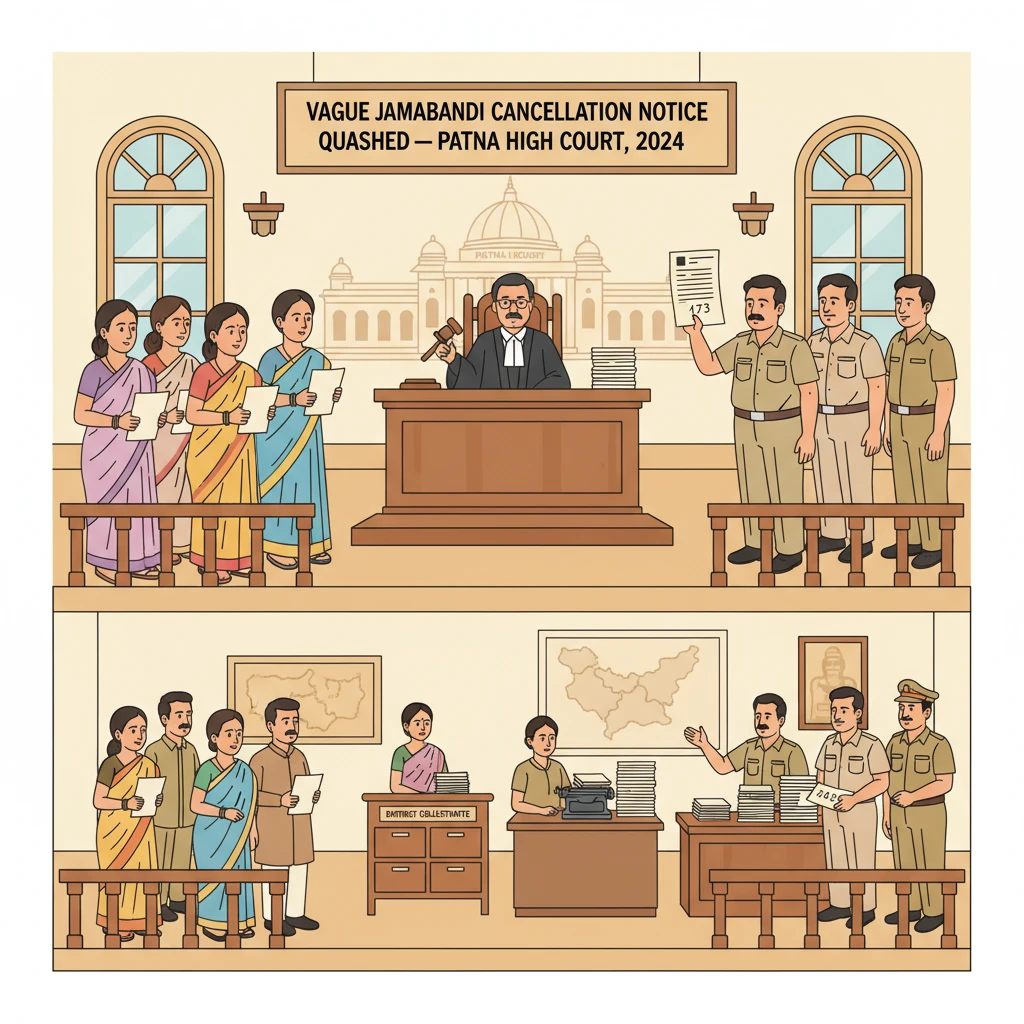
Multiple landholders, as petitioners, approached the Patna High Court under its civil writ jurisdiction. They questioned a notice issued by the Additional Collector, Darbhanga.
The impugned notice was Memo No. 698 dated 29.08.2024. By this notice, the petitioners were called to appear before the Additional Collector on 25.10.2024.
The notice stated that it was based on Letter No. 2433 dated 26.12.2023 from the Circle Officer, Bahadurpur. On the basis of that letter, Jamabandi Cancellation Case No. 173 of 2023-24 had been started against the petitioners.
Feeling aggrieved, the petitioners filed Civil Writ Jurisdiction Case No. 16269 of 2024 before the Patna High Court. They sought quashing of Memo No. 698 dated 29.08.2024.
What the Court Examined and Decided
The matter was heard by Hon’ble Mr. Justice Satyavrat Verma on 24.10.2024. The Court heard Sri Chitranjan Sinha, learned Senior Counsel for the petitioners, and learned AC to GP-2 for the State.
At the very outset, learned Senior Counsel for the petitioners drew the Court’s attention to Section 9 of the Bihar Land Mutation Act, 2011. This section deals with cancellation of jamabandi.
Section 9(1) states that the Additional Collector may, either on his own (suo motu) or on an application, make inquiries about any jamabandi which has been created in violation of any law in force or in contravention of any executive instruction issued in that regard.
The provision further authorizes the Additional Collector, after giving reasonable opportunity to the concerned parties to appear, adduce evidence and be heard, to cancel such jamabandi, dispossess the person claiming under it, and deliver possession to the legitimate owner or custodian on such terms as may appear fair and equitable.
Sub-section (2) makes it clear that jamabandi shall not be cancelled without giving reasonable opportunity of being heard to all parties having interest in that jamabandi.
Sub-sections (3) to (5) provide for how a petition for cancellation can be filed, how the Additional Collector can also act on reference from a government department or suo motu, and how he must enquire and then pass such order as he deems fit.
Sub-sections (6) and (7) provide for appeal to the District Collector and revision before the Divisional Commissioner, along with powers to condone delay and the requirement of giving reasonable opportunity of hearing before modifying or setting aside orders.
On the basis of this provision, learned Senior Counsel for the petitioners accepted that the Additional Collector does have legal power to enquire into and cancel jamabandi.
However, he submitted that when a proceeding to cancel jamabandi is initiated, the Additional Collector must record in the notice the reasons on which the proceeding is based. In simple terms, the notice must say what law or which executive instruction was allegedly violated when the jamabandi was created.
The petitioners’ counsel pointed out the contents of the impugned Memo No. 698 dated 29.08.2024 (Annexure-24 to the writ petition). This memo simply informed the petitioners that the Circle Officer, Bahadurpur, through Letter No. 2433 dated 26.12.2023, had recommended cancellation of their jamabandi for the land in question.
According to the petitioners, this notice did not state any grounds. It did not say how or why the jamabandi was supposedly illegal. It did not mention any specific violation of any law or any government instruction.
Learned Senior Counsel therefore argued that the notice was vague. He submitted that, as per Section 9, jamabandi can be cancelled only if it has been created in violation of law or executive instructions, but the notice was completely silent on this crucial aspect.
The Court then heard the State’s side. Learned counsel for the State was not in a position to dispute the specific submission that the notice did not disclose the reasons behind its issuance, nor did it mention which law or executive instruction had been violated at the time of creation of the jamabandi.
After hearing both sides, the Court examined the notice and the legal requirement under Section 9.
The Court recorded its prima facie view that the notice had been issued without recording the reasons on which the jamabandi cancellation case had been instituted.
The notice did not say which law or which executive instruction had been breached when the jamabandi was first created. In the absence of such particulars, the Court found the notice to be vague.
Because of this vagueness, the Court held that the notice could not stand. A person who receives such a notice should be able to understand why their jamabandi is under threat and what they have to defend themselves against. Here, the petitioners only knew that the Circle Officer had made a recommendation, but they did not know the actual allegations.
Accordingly, the Court quashed the notice contained in Memo No. 698 dated 29.08.2024. This memo had been issued by the Additional District Magistrate (ADM), Darbhanga, calling the petitioners to appear in Jamabandi Cancellation Case No. 173 of 2023-24.
With this, the Court allowed the writ application.
At the same time, the Court added an important clarification. It stated that the authorities would still be at liberty to proceed against the petitioners in accordance with law.
This means that if the authorities still believe that the jamabandi is illegal or contrary to executive instructions, they can start fresh proceedings. But any such fresh action must comply with Section 9, including giving a clear notice mentioning the reasons and the alleged violations.
The judgment therefore does not give a final finding on the validity of the jamabandi itself. It focuses only on the legality and sufficiency of the notice that started the cancellation case.
Why This Judgment Matters
This judgment is important for landholders across Bihar whose jamabandi records might be questioned by revenue authorities.
The Patna High Court has made it clear that while the Additional Collector has wide powers under Section 9 of the Bihar Land Mutation Act, 2011, these powers must be used in a fair and transparent way.
Before cancelling any jamabandi, the authorities must issue a proper notice. That notice must clearly say what law or which executive instruction was violated when the jamabandi was created.
Without such reasons, landholders are left in the dark and cannot properly defend their rights. This judgment protects them from vague and unsupported notices.
At the same time, the Court has not stopped the government from acting altogether. It has only insisted that any future action be “in accordance with law” and supported by clear reasons, with an opportunity of hearing.
For ordinary citizens, this means that if they receive a notice about cancellation of their jamabandi, they can check whether the notice mentions specific grounds. If it does not, this judgment gives a clear example of how such a notice can be challenged.
Legal Issues and Answers
- Issue: Can the Additional Collector initiate jamabandi cancellation proceedings under Section 9 of the Bihar Land Mutation Act, 2011 by issuing a notice that does not disclose any reasons or alleged legal violations?
Answer: No. The Patna High Court held that a notice which does not state the reasons or specify which law or executive instruction was violated is vague and unsustainable, and such a notice was quashed, though fresh proceedings in accordance with law were permitted.
Cases Cited by the Court
- No prior judgments or case law have been cited or relied upon in the text of this judgment.
Case Details
Case Number: Civil Writ Jurisdiction Case No. 16269 of 2024
Case Title: Ram Naresh Roy & Ors. v. The State of Bihar & Ors.
Citation: 2024(4) PLJR 839
Court: High Court of Judicature at Patna
Coram: Hon’ble Mr. Justice Satyavrat Verma
Date of Judgment: 24.10.2024
Advocates: Sri Chitranjan Sinha, Senior Counsel for the petitioners; Mr. Binodanand Mishra, Advocate for the petitioners; learned AC to GP-2 for the respondents/State; Government Pleader-2 shown as appearing for the respondents.
Respondents: State of Bihar through Chief Secretary and various revenue and district authorities, including the Additional Chief Secretary-cum-Principal Secretary, Revenue and Land Reforms Department; Commissioner, Darbhanga Division; District Magistrate-cum-Collector, Darbhanga; Additional Collector, Darbhanga; Deputy Collector Land Reforms, Darbhanga; Sub Divisional Officer Sadar, Darbhanga; Circle Officer, Bahadurpur, Darbhanga.
Nature of the Case: Writ petition (civil) challenging a notice initiating jamabandi cancellation proceedings under Section 9 of the Bihar Land Mutation Act, 2011.
Impugned Action: Memo No. 698 dated 29.08.2024 issued by the Additional Collector/ADM, Darbhanga, in Jamabandi Cancellation Case No. 173 of 2023-24, based on Letter No. 2433 dated 26.12.2023 from the Circle Officer, Bahadurpur.
Link to Full Judgment: Click here to read the full Patna High Court judgment
If you found this explanation helpful and wish to stay informed about how legal developments may affect your rights in Bihar, you may consider following Samvida Law Associates for more updates.







