
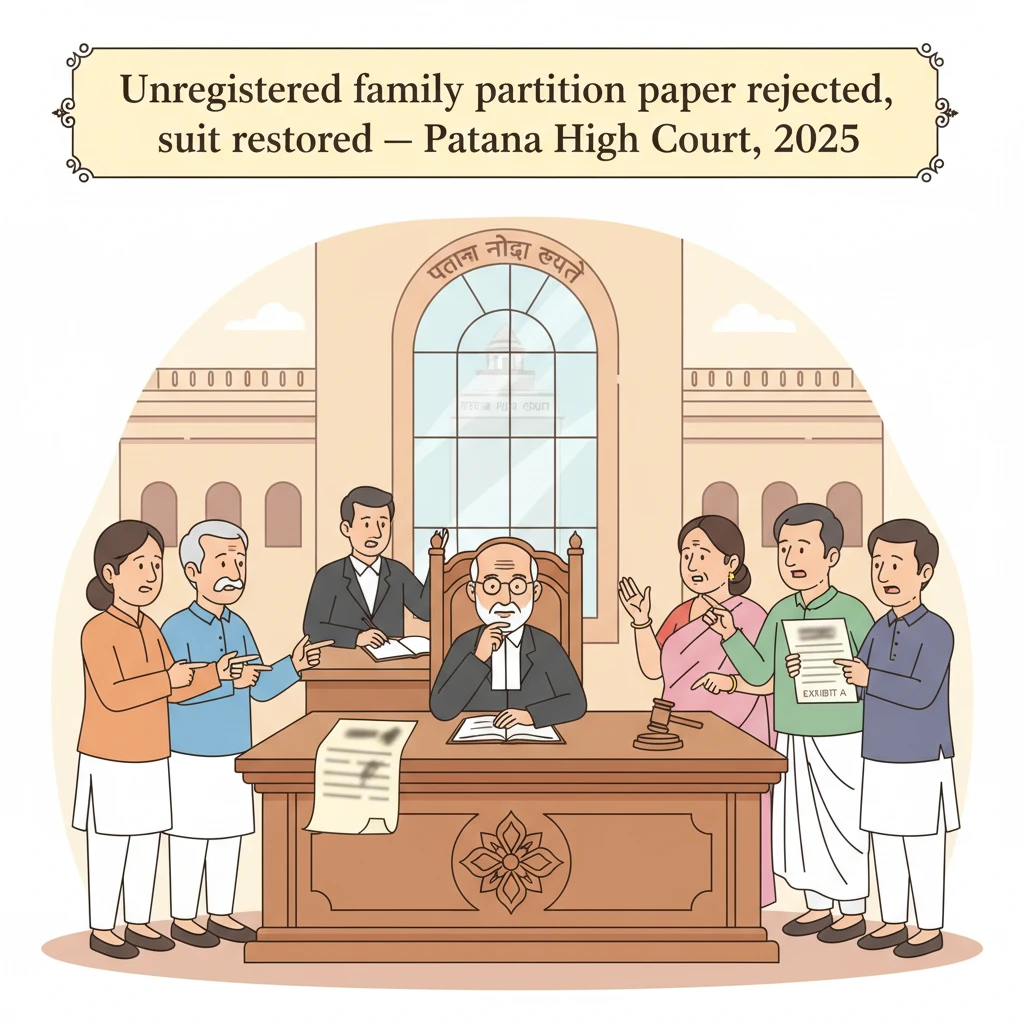
Case Background
This case arose from a long-running family dispute over ancestral and jointly purchased agricultural and homestead lands in village Hajiyapur, District Gopalganj.
The plaintiffs (later the appellants in the High Court) and the defendants (later the respondents) are all descendants of a common ancestor, Ramkishun. Their genealogy and relationship were admitted by both sides.
According to the plaintiffs, the suit lands were ancestral properties of both branches. Due to disturbances in the family, there was a separation in the year 1970. However, they claimed that while they started living separately and some lands were cultivated separately, there had been no partition of the properties by “metes and bounds”, i.e., no clear physical division of each plot.
They stated that some ancestral lands had been exchanged, and some suit properties were sold jointly after 1970. They also claimed that the lands mentioned in Schedule-II of the plaint were purchased from the joint family nucleus and remained in joint possession. They therefore filed Title (Partition) Suit No. 21 of 1993 seeking partition of their half share in the Schedule I to IV properties.
Defendant nos. 1 to 7 (first set of defendants) contested the suit. They alleged that not all family properties had been included, that several purchasers of different parcels were not made parties, and that the suit was bad for non-joinder of necessary parties and for partial partition. They also asserted that a full partition by metes and bounds had already taken place long before.
Their main stand was that a partition had occurred in 1936, when ancestral and jointly acquired properties were divided half-and-half between the two branches. They pleaded that a “kora deed” (memorandum) of partition was prepared on 05.09.1936, which got damaged with time. According to them, a fresh memorandum of partition was drawn on 22.11.1970 (marked as Exhibit A) between Rama Pandey and Uma Pandey, with signatures of “panches”.
On this basis, they claimed that each side had been separately dealing with and selling its allotted properties, and that certain later purchases in the name of one branch were self-acquired and not joint family properties.
Other defendants (defendant no. 12 and defendant nos. 18 to 21) filed written statements but did not lead evidence and stopped pursuing the case. Only the first set of defendants effectively contested the suit.
The Sub-Judge V, Gopalganj, framed ten issues and, by judgment dated 12.07.2005 in Title (Partition) Suit No. 21 of 1993, partly accepted the plaintiffs’ case and passed a preliminary decree.
The first set of defendants then filed Title Appeal No. 77 of 2005/06 of 2007 before the Additional District Judge I, Gopalganj. By judgment and decree dated 14.07.2008, the appellate court reversed the trial court, accepted Exhibit A as valid, and dismissed the plaintiffs’ suit.
The plaintiffs approached the Patna High Court in Second Appeal No. 255 of 2008. A Bench of the High Court initially dismissed their second appeal on 16.07.2014. The plaintiffs then obtained special leave from the Supreme Court in Civil Appeal No. 3657 of 2018.
The Supreme Court set aside the High Court’s 2014 dismissal order, remanded the second appeal to the Patna High Court for a decision on merits, and itself framed five substantial questions of law focused mainly on the nature and legal effect of Exhibit A. On 10.01.2023, the Patna High Court admitted the second appeal incorporating these questions.
What the Court Examined and Decided
Justice Khatim Reza, sitting in the Patna High Court, focused largely on Exhibit A. This was the core document relied on by the defendants to say that a binding partition had already happened and that a fresh partition suit was not maintainable.
The substantial questions framed by the Supreme Court asked:
- Whether the first appellate court’s findings on Exhibit A were sustainable.
- What was the true nature of Exhibit A: a partition deed or merely a memorandum recognising an earlier partition.
- Whether Exhibit A bound the plaintiffs, and to what extent.
- Whether Exhibit A required registration and, if so, with what effect.
- Whether, given that Exhibit A was exhibited in evidence, any objection about its admissibility or legality could still be raised in second appeal.
The High Court treated question (ii) about the true nature of Exhibit A as the central issue, since the other questions flowed from it.
Arguments by the Plaintiffs (Appellants)
The appellants argued that Exhibit A, dated 22.11.1970, was in substance a partition deed that required registration under Section 17 of the Registration Act.
Plaintiff no. 1, examined as PW-14, had categorically denied signing any partition deed in 1970. In the plaint also, they denied the genuineness of Exhibit A. The defendants, despite this denial, did not seek examination of the disputed signature by a handwriting expert, nor did they produce the original 1936 “kora deed” that they claimed Exhibit A was based upon.
The plaintiffs pointed out that Exhibit A did not contain khata numbers or plot numbers and was unregistered, making it unreliable as a partition document. They also highlighted from the cross-examination of DW-7 that Exhibit A had in fact been exhibited with objection.
They admitted that a separation in 1970 had occurred, and that some lands were sold jointly with recitals about separation. However, they stressed that this was not a partition by metes and bounds of all properties.
They relied on Supreme Court and Patna High Court precedents to argue that:
- Mere severance of joint family status does not change the joint character of property without an actual partition (M.L. Subbaraya Setty vs. M.L. Nagappa Setty, (2002) 4 SCC 743).
- Separate residence and separate cultivation alone do not prove a partition by metes and bounds (Deoki Mallah vs. Surji Mallahain, (1999) 1 PLJR 199).
- A fresh partition instrument like the 1970 deed required registration under Section 17 of the Registration Act, as noted in Sita Ram Bahma vs. Ramvatar Bhama, (2018) 2 PLJR 279.
They also maintained that, because Exhibit A introduced new terms about houses, homestead land, a cattle-fold, and properties purchased after 1936, it was not a mere memorandum of a past partition but a fresh operative partition that had to be registered. Being unregistered, it was inadmissible and could not bind them.
Arguments by the Defendants (Respondents)
The first set of defendants, supported by respondent no. 8, firmly asserted a partition in 1936 and said Exhibit A was only a rewritten memorandum (yadasht) of that older partition.
They argued that the original 1936 “kora batwara” had become damaged by moisture. Therefore, in 1970, a fresh memorandum (Exhibit A) was written, reciting that partition had already taken place in 1343 Fasli (1936). They said Exhibit A did not itself effect a partition but only recorded the existing arrangement; hence, it did not require registration.
They emphasised the evidence of DW-17 and DW-10 (described as panches and purchasers), who testified that they were present at the time Exhibit A was written and that both Rama Pandey and Uma Pandey signed it. DW-18 (contesting defendant no. 4) also supported the execution of Exhibit A. According to them, the plaintiffs led no expert or other evidence to prove forgery or fabrication, so the burden to discredit Exhibit A was not discharged.
They also relied on earlier depositions of family members in other cases. In particular, they referred to the deposition of the plaintiffs’ mother, Basmati Kuer, in SCC Suit No. 258 of 1938, where she had stated that her husband had died two years earlier and that her son Uma Pandey was karta of her family because she was “separate”. They argued that this showed separation since the 1930s.
Similarly, they pointed to the deposition of Uma Pandey’s wife, Sushila Devi, in Title Suit No. 21 of 1966 to suggest that Rama Pandey and Uma Pandey had been separate since the time of Raghunandan and Sukhlal @ Shivnandan. They cited mortgage deeds and sale deeds as showing separate dealing with properties.
They also argued that the suit was bad for partial partition, because properties sold earlier by either side and some other lands were not included and several purchasers were not impleaded. They relied on decisions like Chattu Pradhan vs. Kailash Pradhan (AIR 1991 (1) BLJR 711).
On admissibility, they contended that since Exhibit A had been marked in evidence without proper objection, its contents stood admitted and its legality or admissibility could not be challenged now in second appeal. They cited A.V.S. Perumal vs. Vadivelu Asari (AIR 1986 Madras 341) and P.C. Purushothama Reddiar vs. S. Perumal (AIR 1972 SC 608).
Respondent no. 8 further argued that the conduct of parties, including sale deeds after 1970 that mentioned partition, showed that the 1936 partition had been acted upon, and that Exhibit A was only a record of that fact. They relied on Kale vs. Deputy Director of Consolidation ((1976) 3 SCC 119) and Ravinder Kaur Grewal vs. Manjit Kaur ((2020) 9 SCC 706) to support their understanding of family arrangements and partition documents.
High Court’s Analysis of Exhibit A
Justice Reza closely examined Exhibit A, described in it as “Kora Batwara Bakhudha”. The document recited that partition between the ancestors had taken place in 1936, that a kora batwara had been prepared then, and that due to damage of that old document a fresh writing was prepared.
However, the Court noted that Exhibit A went beyond merely restating the old arrangement. On its own terms, it recorded that both parties agreed to exchange certain properties from the earlier partition as per their convenience. Schedule I properties were now allotted to Rama Pandey (party no. 1) and Schedule II to Uma Pandey (party no. 2), and the parties would get their names mutated accordingly.
At page 5 of Exhibit A, four specific terms were mentioned for the first time:
- The cattle-fold (bathan) and its appurtenant land and “sehan” were allotted to Uma Pandey (party no. 2).
- All lands of the house, all old house lands, and all homestead and purchased property of one Chili Pandey were allotted to Rama Pandey (party no. 1).
- Properties purchased after the earlier partition were to remain with Rama Pandey (party no. 1).
- Both parties agreed to abide by these terms by a stated Fasli date (30th Jeth 1378 Fasli).
The Court held that these terms clearly created fresh rights in specific properties, including homestead land, bathan, and post-partition acquisitions, and altered earlier allotments. Thus, even on the defendants’ own version, Exhibit A was not a mere copy of the 1936 kora batwara.
In the Court’s view, Exhibit A itself partitioned or re-partitioned several properties and adjusted rights. It was therefore a partition deed reducing a fresh arrangement to writing, with the clear purpose that the terms should be evidenced by it. Such a document squarely required registration under Section 17(1)(b) of the Registration Act.
The Court also observed that the schedules in Exhibit A did not mention khata or plot numbers, only areas. It did not clearly disclose which specific plots were allotted to each side. Moreover, on the evidence, the defendants had not successfully proved an earlier partition by metes and bounds in 1936 or even in 1970.
Findings on Evidence and Earlier Judgments
The High Court checked the deposition of the plaintiffs’ mother, Basmati Kuer, in the 1938 suit (Exhibit G/2) and held that the first appellate court had misread it. She had deposed that:
“It is two years ago that my husband died. Uma Pandey is my son of four years of age. Raghunandan Pandey was the karta of the family. We are joint. But I am the karta since we are separate.”
From this, the Court concluded that at that time the family was joint, with Raghunandan as karta, and that Uma was still a minor. This did not prove a prior partition between the present branches as asserted by the defendants.
The Court also considered sale deeds Ext. 1, Ext. 1/A, and Ext. 1/B. These were registered sale deeds jointly executed by Rama Pandey and Uma Pandey in 1978 and 1983 in respect of ancestral properties. This joint dealing even after the alleged 1936 and 1970 partitions showed that the defendants’ story of an earlier complete partition by metes and bounds was doubtful.
On admissibility, the Court accepted that Exhibit A had in fact been exhibited with objection, as shown from DW-7’s cross-examination. Therefore, the plaintiffs were not barred from challenging its admissibility and nature in second appeal.
Given that Exhibit A was found to be a substantive unregistered partition deed affecting immovable property, the Court held it was inadmissible in evidence and could not bind the plaintiffs. As a result, the entire basis on which the first appellate court had reversed the trial court and dismissed the partition suit fell away.
Final Decision
The Patna High Court answered the substantial questions of law in favour of the appellants:
- Exhibit A is an unregistered partition deed, not merely a memorandum of an earlier partition.
- It required registration under Section 17(1)(b) of the Registration Act.
- Being unregistered, Exhibit A was inadmissible in evidence and did not bind the plaintiffs.
- The first appellate court’s reliance on Exhibit A to reverse the trial court was legally unsustainable.
Consequently, the High Court set aside the judgment and decree dated 14.07.2008 passed by the Additional District Judge I, Gopalganj in Title Appeal No. 77 of 2005/06 of 2007. It restored and affirmed the trial court’s judgment and preliminary decree dated 12.07.2005 in Title (Partition) Suit No. 21 of 1993, which had granted the plaintiffs partition of their half share in specified properties.
The second appeal was allowed, with no order as to costs, and the lower court records were directed to be transmitted back.
Why This Judgment Matters
This judgment is important for families in Bihar and elsewhere who rely on informal papers or “kora batwara” documents to claim that partition has already taken place.
The Patna High Court makes it clear that:
- If a document itself creates or alters rights in immovable property, especially in a joint family partition, it is a partition deed and must be registered.
- Merely calling a document “yadasht” or a memorandum does not save it from registration if it actually makes a fresh division or transfer of rights.
- Unregistered partition deeds cannot be used as evidence to defeat a co-sharer’s claim to partition.
The decision also underlines that simple separation in residence or cultivation, or even old statements about “separation”, are not enough to deny a co-sharer’s legal share unless a properly proved partition by metes and bounds is shown.
For villagers and families who often rely on informal writings and oral understandings, this judgment is a caution: if you want a binding, legally enforceable partition that can be used in courts and for mutation, it should be done in a way that meets legal requirements, including registration where necessary.
Legal Issues and Answers
-
Issue: What is the true nature of Exhibit A: a valid partition deed, or only a memorandum recognising an earlier partition?
Answer: The Court held that Exhibit A was a fresh partition deed altering and allotting properties, not a mere record of a past partition. -
Issue: Does Exhibit A require registration, and what is the effect of it being unregistered?
Answer: Yes. As an instrument of partition affecting immovable property, Exhibit A required registration under Section 17(1)(b) of the Registration Act; being unregistered, it was inadmissible and did not bind the plaintiffs. -
Issue: Was the first appellate court justified in reversing the trial court’s partition decree on the basis of Exhibit A?
Answer: No. Once Exhibit A is treated as an inadmissible unregistered partition deed, the first appellate court’s reliance on it was unsustainable, and the trial court’s decree had to be restored.
Cases Cited by the Court
- M.L. Subbaraya Setty (Dead) by LRS. & Ors. vs. M.L. Nagappa Setty (Dead) by LRS. & Ors., (2002) 4 SCC 743.
- Deoki Mallah vs. Surji Mallahain & Ors., (1999) 1 PLJR 199.
- Sita Ram Bahma vs. Ramvatar Bhama, (2018) 2 PLJR 279.
- A.V.S. Perumal vs. Vadivelu Asari, AIR 1986 Madras 341.
- P.C. Purushothama Reddiar vs. S. Perumal, AIR 1972 SC 608.
- Chattu Pradhan vs. Kailash Pradhan, AIR 1991 (1) BLJR 711.
- Kale & Ors vs. Deputy Director of Consolidation & Ors, (1976) 3 SCC 119.
- Ravinder Kaur Grewal & Ors vs. Manjit Kaur & Ors, (2020) 9 SCC 706.
Case Details
Case Number: Second Appeal No. 255 of 2008
Case Title: Uma Pandey & Anr vs. Munna Pandey & Ors
Coram: Hon’ble Mr. Justice Khatim Reza
Citation: 2025 (4) PLJR 696
Nature of the Case: Second appeal arising out of a title (partition) suit
Trial Court: Sub-Judge V, Gopalganj, in Title (Partition) Suit No. 21 of 1993 (judgment dated 12.07.2005)
First Appellate Court: Additional District Judge I, Gopalganj in Title Appeal No. 77 of 2005/06 of 2007 (judgment dated 14.07.2008)
Supreme Court: Civil Appeal No. 3657 of 2018 (order remanding second appeal; details to be seen from Supreme Court record)
Date of Patna High Court Judgment in Second Appeal: 31.10.2025
Advocates:
- For the appellants: Mr. Jitendra Prasad Singh, Senior Advocate, with Mr. Abhishek Kumar, Advocate, and Ms. Sripriya Sinha, Advocate.
- For respondent nos. 1 to 7: Mr. Shivnandan Prasad Singh, Senior Advocate, with Mr. Indu Bhushan, Advocate, and Mr. Rakesh Kumar, Advocate.
- For respondent no. 8: Mr. Gaurav Kumar, Advocate.
Link to the Judgment: Click here to view the official judgment of the Patna High Court
If you found this explanation helpful and wish to stay informed about
how legal developments may affect your rights in Bihar,
you may consider following Samvida Law Associates for more updates.







