

Case Background
The case concerns recruitment to the post of Civil Judge (Junior Division) in the Bihar Judicial Service through the 30th Bihar Judicial Service Competitive Examination, 2018. This examination was conducted by the Bihar Public Service Commission (BPSC) pursuant to Advertisement No. 06 of 2018 to fill 349 posts of Civil Judge (Junior Division).
The petitioner belongs to the unreserved category. On her request under the Right to Information Act, 2005, the BPSC supplied a combined merit list of 351 candidates. Her name appeared at serial number 180 in this combined merit list or select list.
Out of 349 notified vacancies, 175 were earmarked for unreserved category candidates. Due to 35 per cent lateral reservation for women, 62 of these unreserved posts were reserved for female candidates. It is an admitted position that BPSC made recommendations to fill all advertised vacancies and sent a final select list to the General Administration Department through Letter No. 90 dated 02.12.2019.
The last candidate in the unreserved (general) category who found place in this final select list had obtained 517 marks and was at serial number 173 in the combined merit list. The petitioner had secured 516 marks (456 in written examination and 60 in interview) and thus stood at serial number 180. Because her score was one mark less than the last recommended general category candidate, she did not find place in the final select list forwarded for appointment.
Initially, the petitioner challenged the final select list on the ground that reserved category candidates were wrongly adjusted against unreserved posts. She sought quashing of the final selection list for reserved candidates in the unreserved category and a direction to appoint her as Civil Judge (Junior Division).
While the writ petition was pending, another candidate, Swati Chaturvedi, who had obtained 517 marks and was at serial number 174 in the same combined merit list, approached the High Court in C.W.J.C. No. 3952 of 2020. She claimed appointment on the ground that certain recommended candidates had not joined and that she had identical marks as the last selected general category candidate.
By judgment dated 01.03.2021 in Swati Chaturvedi’s case, a Division Bench of the Patna High Court found that six posts remained vacant due to non-joining of selected candidates. Applying the directions of the Supreme Court in Malik Mazhar Sultan (3) and in an earlier Patna High Court decision in Manoj Kumar Tiwari, the Bench directed the State to requisition one post for Swati Chaturvedi and BPSC to recommend her name for appointment.
After this, the present petitioner filed I.A. No. 01 of 2021 seeking an additional relief: a mandamus directing the respondents to appoint her against the vacant posts that had arisen in the 30th Bihar Judicial Service due to non-joining, asserting that she was next in line on the merit list after candidates already adjusted in reserved categories.
What the Court Examined and Decided
The petitioner argued that seven candidates from the select list did not join, including six from the unreserved category, leaving those posts vacant. She submitted that, following the decision in Swati Chaturvedi, five posts in the unreserved category still remained vacant. She contended that she, at rank 180 with 516 marks, was next in line in the general merit list because the candidates at serial numbers 176 and 177 had already been appointed in reserved categories.
The petitioner had also addressed representations dated 26.12.2019 to the Additional Chief Secretary, General Administration Department, and to the Joint Secretary-cum-Examination Controller of BPSC, requesting consideration for appointment against these vacant posts.
Her legal submissions were anchored on the Bihar Civil Service (Judicial Branch) (Recruitment) Rules, 1955 and the Supreme Court’s directions in Civil Appeal No. 1867 of 2006, known as Malik Mazhar Sultan (3). She stressed that these rules and directions emphasise filling all notified vacancies and keeping the select list alive until the next list is published.
The petitioner relied on the Supreme Court’s judgment in Rahul Dutta v. State of Bihar, concerning the same 30th Judicial Service Examination. In that case, Rule 5A of the Recruitment Rules was struck down as contrary to Malik Mazhar Sultan (3), reinforcing that judicial recruitment in Bihar must comply with the Supreme Court’s guidelines.
She also referred to earlier Patna High Court decisions in Manoj Kumar Tiwari and Swati Chaturvedi to argue that where notified vacancies remain unfilled due to non-joining, they must be filled from the existing merit list in order of merit. She asserted that the Recruitment Rules do not provide for “cut-off marks” beyond qualifying marks, and that BPSC had no authority to treat the marks of the last recommended candidate as a cut-off to exclude others.
The High Court of Judicature at Patna, appearing through its Registrar General, resisted the claim. It argued that the Recruitment Rules are silent on filling vacancies through a supplementary list in cases of non-joining, and this silence should be read as a prohibition. On this basis, it contended that the directions in Malik Mazhar Sultan (3) could not override the Rules.
The High Court’s counsel maintained that the last recommended general category candidate’s score of 517 had become the cut-off mark. As the petitioner had only 516 marks, she was said to have no indefeasible right to claim appointment. Relying on Union of India v. S. Vinod Kumar, it was argued that fixing such a cut-off based on the last selected candidate’s marks is not arbitrary or violative of Article 14.
The High Court also cited Surendra Narain Singh v. State of Bihar to submit that supplementary lists are contemplated in the Rules only for Scheduled Castes and Scheduled Tribes when adequate reserved candidates are not available, not for unreserved vacancies. Further reliance was placed on High Court of Kerala v. Reshma A. to argue that Supreme Court directions in Malik Mazhar Sultan (3) do not override valid State judicial service rules, and that the earlier Patna High Court decision in Swati Chaturvedi should be treated as per incuriam for not noticing Reshma A.
BPSC, when questioned directly by the Bench, took a different and crucial stand. It candidly stated that there was no conscious decision by the State Government, the High Court, or the Commission to fix any cut-off marks. The marks of the last recommended general category candidate were simply treated as a de facto cut-off because the merit list was “run down” only up to the number of advertised vacancies. BPSC described itself as merely a recommending body acting on requisitions from the State and orders of the High Court.
The State of Bihar supported the High Court’s stand in argument, but its counter affidavits relied heavily on two old departmental circulars: Memorandum No. 2374 dated 16.07.2007 and a circular dated 5 April 1955. These circulars stated that unfilled vacancies due to non-joining would be carried forward to the next recruitment year and that recommendation lists would be valid only for one year.
The Court found several problems with the State’s affidavits. They contained spelling and grammatical errors, and, more importantly, failed to disclose key facts: up to which date vacancies were requisitioned, when the advertisement for the 31st Bihar Judicial Service was issued, and how and when the posts fell vacant. Despite this vagueness, the State claimed that vacancies arising after the 30th Judicial Service recommendations had already been covered in the 31st Judicial Service recruitment.
Turning to the legal framework, the Bench carefully examined Rules 15–23 of the 1955 Recruitment Rules. It noted that these Rules prescribe qualifying marks, preparation of a merit list, and nomination of candidates in order of merit, leaving the final selection to the Governor. The Rules also allow supplementary lists specifically for Scheduled Castes and Scheduled Tribes if adequate reserved candidates are not included in the main list.
However, relying on the Supreme Court’s decision in Surendra Narain Singh, the Bench read Rule 20 more broadly. The Supreme Court had interpreted “such candidates” in Rule 20 to mean candidates from the existing merit list, not only SC/ST candidates, so that vacancies originally reserved for SC/ST but remaining unfilled could be filled from general candidates in the merit list without compromising on standards. The Patna High Court held that there is no bar in the Recruitment Rules against preparing a supplementary list for unreserved vacancies arising due to non-joining of recommended candidates.
The Court next revisited the Supreme Court’s directions in All India Judges’ Association and Malik Mazhar Sultan (3). It noted that these decisions were intended to ensure that all existing judicial vacancies are filled quickly and that select lists remain valid until the next list is published. It emphasised that the Supreme Court later modified its directions to require notification of existing vacancies plus anticipated vacancies for one year and inclusion of some candidates in a wait list.
In Rahul Dutta, the Supreme Court had already struck down Rule 5A(3) of the Recruitment Rules as inconsistent with Malik Mazhar Sultan (3), demonstrating that Bihar’s judicial recruitment must align with those directions.
Addressing the argument based on High Court of Kerala v. Reshma A., the Bench carefully distinguished that case. In Kerala, the dispute concerned appointments against future vacancies under an amended rule which extended the life of the select list. In contrast, the present case involved only vacancies that were part of the original 30th Judicial Service advertisement and later fell vacant because some recommended candidates did not join. These were neither additional nor future vacancies. The Court held that Reshma A., Rakhi Ray and Hirandra Kumar dealt with different factual situations where candidates sought appointment against vacancies not originally notified or sought to use general directions to override age and eligibility provisions in rules.
The Bench concluded that the Patna High Court’s own earlier decisions in Manoj Kumar Tiwari and Swati Chaturvedi correctly harmonised the Recruitment Rules with the Supreme Court’s directions in Malik Mazhar Sultan (3). In those cases, this Court had already held that where notified vacancies remain unfilled due to non-joining, they must be filled from the existing merit list in order of merit, and that government circulars like the 2007 resolution have no application to judicial service recruitment under Article 234.
Importantly, the Court observed that there was no conscious policy decision by the State or the High Court to fix 517 as a cut-off mark and exclude all candidates below that mark, nor was there any rule authorising BPSC to do so. The concept of a cut-off mark in S. Vinod Kumar was based on a clear decision of the employer; that situation did not exist here.
The Bench was also critical of the State for repeatedly relying on circulars already rejected in Swati Chaturvedi and for filing vague and incoherent affidavits, which attempted to create confusion about vacancies and the 31st Judicial Service advertisement.
Recognising its wide powers under Article 226, and drawing on Supreme Court authority affirming that High Courts can mould relief to prevent injustice and uphold the rule of law, the Bench decided to grant effective relief not just to the petitioner but to all qualified candidates above her in the merit list.
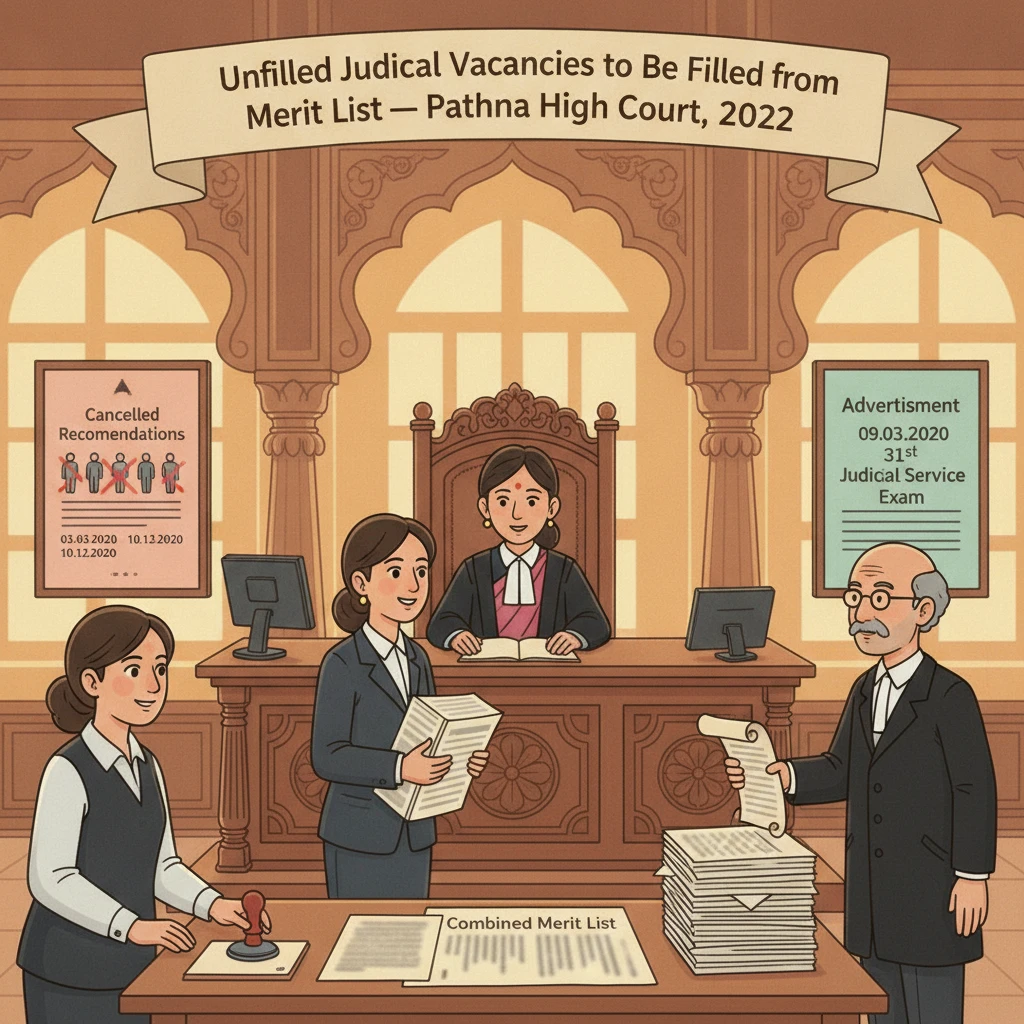
The Court held that the petitioner had established a clear case for mandamus. It directed the State Government to send requisition for all posts that remained vacant due to non-joining of recommended candidates under Advertisement No. 06 of 2018. It further directed BPSC to recommend names from the existing combined merit list/select list, in order of merit, to fill those posts. The writ petition was thus allowed.
Why This Judgment Matters
This judgment is important for all candidates appearing in judicial service and other public recruitment examinations in Bihar.
First, the Patna High Court has clarified that when candidates who are recommended for appointment do not join, the resulting vacancies cannot simply be carried forward or lost, at least in judicial service. If a combined merit list exists and is still valid, the authorities must move down the list and fill those posts in order of merit.
Second, the decision protects aspirants from arbitrary “cut-off marks” that are not backed by any rule or conscious policy decision. The Court made it clear that BPSC cannot fix or infer a cut-off on its own merely from the marks of the last recommended candidate.
Third, the judgment reinforces that old departmental circulars, which are not framed under Article 234 in consultation with the High Court and BPSC, cannot control judicial service recruitment. This helps maintain the independence and proper staffing of the subordinate judiciary.
Finally, by directing that all such vacant posts be filled from the existing merit list, the Court advances the larger constitutional goal of strengthening the justice delivery system, as emphasised by the Supreme Court in All India Judges’ Association and Malik Mazhar Sultan (3).
Legal Issues and Answers
- Issue: Can vacancies in Bihar Judicial Service, arising because some selected candidates did not join, be left unfilled or carried forward when a combined merit list still exists?
Answer: No. The Court held that such vacancies, being part of the originally notified posts, must be filled from the existing combined merit list/select list in order of merit, by issuing appropriate mandamus to the State and BPSC. - Issue: Did BPSC or the State validly fix a “cut-off mark” of 517 to deny appointment to candidates, like the petitioner, with lesser marks though they were in the merit list?
Answer: No. There was no conscious decision or rule authorising fixation of such a cut-off. Treating the marks of the last recommended candidate as a cut-off was impermissible and could not defeat the petitioner’s claim. - Issue: Do departmental circulars of 1955 and 2007, and the principle in Reshma A., prevent filling these vacancies from the existing list?
Answer: No. The Court held that these circulars have no statutory force in judicial service recruitment under Article 234, and that Reshma A. dealt with a different factual situation involving future vacancies. Here, the vacancies were part of the original notification and must be filled from the merit list.
Cases Cited by the Court
- Malik Mazhar Sultan (3) and Another v. Uttar Pradesh Public Service Commission and Others, (2008) 17 SCC 703 and (2009) 17 SCC 24
- All India Judges’ Association & Others v. Union of India & Others, (2002) 4 SCC 247
- Rahul Dutta & Others v. State of Bihar & Others, (2019) 5 SCC 158
- Surendra Narain Singh & Others v. State of Bihar & Others, (1998) 5 SCC 246
- Union of India & Others v. S. Vinod Kumar & Others, (2007) 8 SCC 100
- High Court of Kerala v. Reshma A. & Others, (2021) 3 SCC 755
- Rakhi Ray v. High Court of Delhi, (2010) 2 SCC 637
- Hirandra Kumar v. High Court of Allahabad, (2020) 17 SCC 410
- Prem Singh v. Haryana SEB, (1996) 4 SCC 319
- Maharashtra Chess Association v. Union of India & Others, (2020) 13 SCC 285
- Competent Authority v. Barangore Jute Factory, (2005) 13 SCC 477
- Special Agricultural Produce Market Committee for Fruits and Vegetables, Golimangla v. N. Krishnappa & Others, (2017) 13 SCC 239
- Manoj Kumar Tiwari v. State of Bihar & Others, C.W.J.C. No. 14921 of 2019 (Patna High Court)
- Swati Chaturvedi v. State of Bihar & Others, C.W.J.C. No. 3952 of 2020 (Patna High Court)
Case Details
Case Number: Civil Writ Jurisdiction Case No. 7751 of 2020
Case Title: Jyoti Joshi v. The State of Bihar & Others
Citation: 2022 (1) PLJR 740
Court: High Court of Judicature at Patna
Coram: Hon’ble Mr. Justice Ashwani Kumar Singh and Hon’ble Mr. Justice Rajeev Ranjan Prasad
Date of Judgment: 09.02.2022
Nature of Case: Writ petition under Article 226 of the Constitution seeking appointment to the post of Civil Judge (Junior Division) and directions for filling unfilled vacancies from the existing merit list.
Advocates:
- For the Petitioner: Mr. P. K. Shahi, Senior Advocate; Mr. Satyendra Pandey, Advocate
- For Respondent No. 2 (Patna High Court): Mr. Piyush Lall, Advocate
- For the State of Bihar: Mr. Saroj Kumar Sharma, AC to AAG 3
- For BPSC: Mr. Sanjay Pandey, Advocate
Link to Judgment: Full text of judgment on Patna High Court website
If you found this explanation helpful and wish to stay informed about
how legal developments may affect your rights in Bihar,
you may consider following Samvida Law Associates for more updates.







