
Case Background
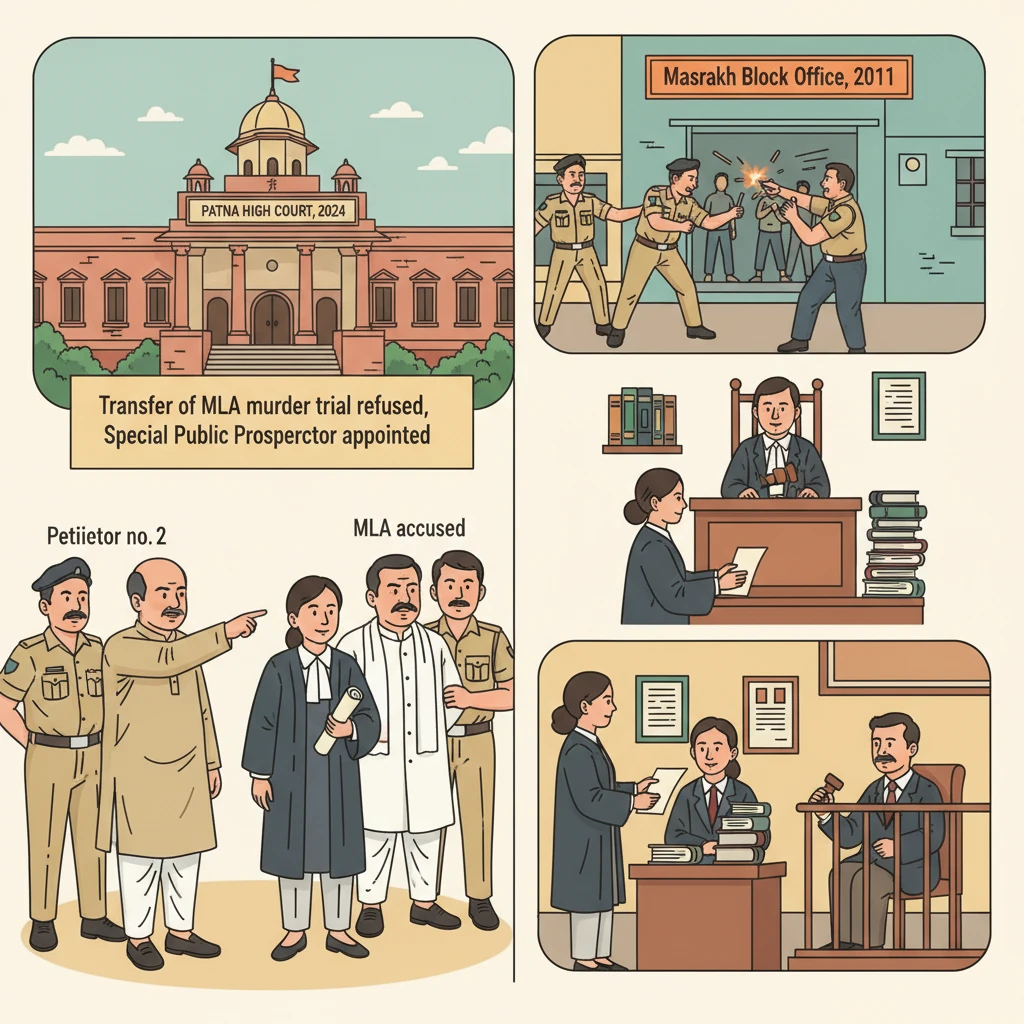
The proceedings before the Patna High Court arose from Masrakh P.S. Case No. 224 of 2011, District Saran. The case concerns the alleged firing on 17.12.2011 at the Masrakh Block Office, in which Munna Singh, bodyguard of the informant, lost his life and the informant himself was allegedly targeted.
Criminal Writ Jurisdiction Case No. 71 of 2023 was filed by the widow of Munna Singh (petitioner no. 1) and the informant (petitioner no. 2). They complained mainly about the conduct of the prosecution and sought, among other reliefs, appointment of a Special Public Prosecutor of integrity to conduct Sessions Trial No. 78 of 2015 arising from this FIR.
The same petitioners later filed Criminal Miscellaneous No. 2228 of 2024 under Section 407 of the Code of Criminal Procedure, 1973 (CrPC). In this application, they requested transfer of Sessions Trial No. 78 of 2015 from the court of the Additional Sessions Judge-VII-cum-MP/MLA Special Judge, Saran at Chapra, to the MP/MLA Special Court at Patna.
Both matters involved the same FIR, parties and grievances about fairness of trial. The High Court tagged them together by order dated 08.01.2024 and delivered a common judgment on 01.02.2024.
What the Court Examined and Decided
The Patna High Court first considered the writ petition seeking appointment of a Special Public Prosecutor. Petitioner no. 1 is the widow of Munna Singh, who was engaged as bodyguard of petitioner no. 2. According to the FIR, Munna Singh was shot dead during a heated situation at the Block Office meeting in Masrakh. Charges were later framed against three accused, including a sitting MLA, under Sections 302/34 and other provisions of the Indian Penal Code and Section 27 of the Arms Act.
The petitioners alleged that respondents 9 to 11 (the accused in the Sessions Trial) are highly influential. One is a sitting MLA, another is an influential person, and the third is his son. They also pointed out that respondent no. 11 had recently been convicted by the Supreme Court in Masrakh P.S. Case No. 62 of 1995, in which the Court had severely criticised the earlier conduct of the trial and the State machinery. They relied on the Supreme Court judgment in Harendra Rai v. State of Bihar and Others, 2023 SCC OnLine SC 1023, to show how powerful accused can subvert criminal trials.
The key grievance, however, was not formally against the trial judge but against the Public Prosecutor and the Additional Public Prosecutor conducting Sessions Trial No. 78 of 2015. The petitioners claimed that these prosecutors were damaging the prosecution case and acting in collusion with the defence.
They cited several examples from the ongoing trial:
PW-1 Maheshwar Singh, an alleged eye-witness and victim, was examined over five dates and his evidence ran into 112 paragraphs. He had earlier given a written report for registration of FIR, which was not separately registered. The petitioners complained that though he was a crucial witness, the prosecutors did not use his testimony effectively.
PW-2 Upendra Singh, the informant and petitioner no. 2, was examined across five dates and his evidence contained 163 paragraphs. He is also an alleged eye-witness. PW-3, then SHO of Masrakh Police Station, was also an alleged eye-witness. According to the petitioners, in his examination-in-chief the prosecution did not elicit the names of the accused, and he mentioned only one accused (Kedar Nath Singh) when cross-examined by the defence. The petitioners argued that the prosecution should have re-examined him and, if necessary, had him declared hostile, which was not done.
Similar complaints were made regarding PW-5 Sanjay Kumar and PW-6 Kanhaiya Kumar, who, according to the petitioners, deviated from their earlier statements under Sections 161 and 164 CrPC but were neither recalled nor declared hostile. PW-7, the doctor who treated injured witness Maheshwar Singh, was alleged to have given an unfavourable version in cross-examination without any prosecutorial attempt to confront him or declare him hostile.
The petitioners repeatedly approached the trial court through written petitions pointing out what they saw as misconduct by the prosecutors. They opposed examination of six non‑charge-sheeted witnesses whose names were sought to be added by the prosecution in November 2022. They also apprised State authorities in writing but claimed no effective action was taken.
During the High Court proceedings in the writ case, significant developments occurred. On 12.01.2024, the Advocate General informed the Court that after receiving an application from petitioner no. 2, he had asked the State Government to examine the issue promptly, especially in light of the Supreme Court’s criticism in the earlier Masrakh case (Case No. 62 of 1995). The Court asked the Advocate General to call for the records regarding appointment of a Special Public Prosecutor, examine the credentials of advocates considered for that role, and prioritise competence and integrity.
On the same date, senior counsel appearing for the accused (respondents 9 to 11) stated that they would not contest appointment of a Special Public Prosecutor and that the State was free to choose any suitable lawyer. They only emphasised that choice of public prosecutor belongs to the State, and that victims may appoint their own counsel with court permission.
On 23.01.2024, the Advocate General reported that he was not satisfied with the manner in which an Additional Public Prosecutor had been named earlier as Special Public Prosecutor by the Law Minister. He noted that the Law Secretary had originally opined in favour of allowing an existing Additional Public Prosecutor, Shri Dayanand Rai, to continue, but later, after discussion with the Minister, gave an alternative note allowing appointment of any other advocate from a list given by the District Magistrate. The Minister then picked the name at Serial No. 17 as Special Public Prosecutor. The Advocate General felt that, to remove all doubt and ensure a fair trial, a new Special Public Prosecutor from among practicing lawyers of the Patna High Court should be appointed. He worked out some names accordingly.
On 29.01.2024, he informed the Court that he had recommended appointment of Mr. Ajay Mishra, Additional Public Prosecutor of the High Court, as Special Public Prosecutor in the trial court. The accused side did not object to this choice. The petitioners’ counsel also expressed satisfaction with the Advocate General’s stand and steps.
In view of this consensus and State action, the High Court held that the issue of appointment of a Special Public Prosecutor in Sessions Trial No. 78 of 2015 had been resolved. The Court therefore did not go into the wider factual allegations against the earlier prosecutors, leaving it open to the competent authority to examine those allegations in accordance with law. It directed the State Government to notify the name of the Special Public Prosecutor, as suggested by the Advocate General, within two weeks. The Special Public Prosecutor was directed to conduct the trial in the best interest of the prosecution, and the State Government, District Magistrate and Superintendent of Police, Saran at Chapra, were told to provide all necessary logistic support. With these directions, the writ petition was disposed of.
The second part of the judgment addressed the transfer petition under Section 407 CrPC. The petitioners sought shifting of Sessions Trial No. 78 of 2015 from Chapra to Patna, primarily on the ground of alleged influence of the accused and the earlier prosecutorial conduct. They described the incident in detail: petitioner no. 2’s wife was a Panchayat Samiti member who had narrowly lost an earlier election; there were alleged extortion attempts; on 17.12.2011 at about 11:45 a.m. she was inside the meeting hall; petitioner no. 2, his bodyguard Munna Singh, and other persons were outside; a scuffle allegedly occurred involving the MLA and his bodyguards, leading later, around 2:45 p.m., to firing in which Munna Singh was hit when he tried to shield the informant; further shots were allegedly fired by the MLA and another accused; and the revolver of Munna Singh was allegedly taken away.
The Court traced the procedural history: statements of important witnesses under Section 164 CrPC were recorded on 17.01.2012; charge-sheet filed on 26.08.2012 under various IPC sections and Section 27 of the Arms Act; cognizance taken on 03.02.2013; and the case committed to the Sessions Court on 19.02.2015. Charges were framed only on 07.12.2021, roughly six and a half years later. Evidence commenced thereafter, with the Court setting out dates on which different prosecution witnesses, including PW-1 and PW-2, were examined and cross‑examined.
The High Court carefully examined the trial court’s orders. It noted that whenever the informant filed applications—for security, for not examining certain “gained over” witnesses, for legal action against PW-5 for false evidence, for summoning the Magistrate who recorded Section 164 statements—the trial court recorded and often accepted his objections or requests. Importantly, on 06.01.2023, the trial court rejected the prosecution’s petition dated 18.11.2022 seeking to examine six non‑charge‑sheeted witnesses. It did so after considering the informant’s objections, the need for speedy trial of MP/MLA cases monitored by the Supreme Court in Ashwini Kumar Upadhyay v. Union of India, and lack of cogent reasons for adding new witnesses. The trial court found that such a move would only delay the case.
Similarly, when the Additional Public Prosecutor later sought to recall PW-3 under Section 311 CrPC to prove seized material exhibits, the informant opposed this, arguing that any competent police officer from Masrakh Police Station could do the formal proof. By order dated 06.04.2023, the trial court agreed with the informant and directed that seized materials be produced and proved by a competent police officer from the police station rather than recalling PW-3.
The High Court observed that throughout, there was no allegation from the petitioners that the trial judge was biased or partial. All their complaints centred on the alleged lax or collusive conduct of the prosecutors. The petitions filed in the trial court on 06.08.2022 and 20.08.2023, and other applications, did not carry any accusation against the court itself.
The Court then examined the legal test for transfer under Section 407 CrPC and Supreme Court precedents, including Gurcharan Dass Chadha v. State of Rajasthan, AIR 1966 SC 1418; Maneka Sanjay Gandhi v. Rani Jethmalani, (1979) 4 SCC 167; Abdul Nazar Madani v. State of T.N., (2000) 6 SCC 204; and particularly K. Anbazhagan v. Superintendent of Police, Chennai, (2004) 3 SCC 767. These cases emphasise that transfer can be ordered where there is reasonable apprehension that justice will not be done, or where public confidence in the fairness of the trial is seriously undermined. The apprehension must be reasonable, not based on conjecture, and the focus is on fair trial and public justice, not on personal convenience.
In K. Anbazhagan, the Supreme Court had ordered transfer of trials against a then Chief Minister where, after change of government, a new Public Prosecutor was appointed, 76 prosecution witnesses were recalled, 64 resiled from their earlier evidence, and the prosecutor did not declare them hostile. There, the Court found strong indications of subversion of justice and failure of prosecution, justifying transfer.
Comparing that situation with the present one, the Patna High Court found crucial differences. Here, one accused is already in jail in another case; the sitting MLA-accused belongs to a party that is not in power in Bihar; and, most importantly, the Advocate General himself has taken the initiative to ensure appointment of an independent Special Public Prosecutor from the High Court. The accused have not objected to this appointment. The trial court, on available material, has been responsive to the informant’s objections and has not passed any order that appears biased or unfair.
In these circumstances, the Court held that at this stage the petitioners cannot be said to have a reasonable apprehension that they will not get justice from the present MP/MLA Court at Saran. It therefore refused to transfer Sessions Trial No. 78 of 2015 to Patna. However, it kept the door open by clarifying that the petitioners may approach the High Court afresh if, at any future stage, they get a reasonable apprehension of miscarriage of justice.
Why This Judgment Matters
This judgment is significant for victims and informants in serious criminal cases, especially where accused persons are politically powerful. The Patna High Court has recognised the importance of fair and transparent prosecution and has not hesitated to intervene in the choice of Special Public Prosecutor when doubts were raised.
At the same time, the Court has drawn a clear line between dissatisfaction with prosecution strategy and a legal basis for transferring a trial. Transfer of a criminal case from one district to another is an exceptional step. It is not enough to allege that prosecutors have not done a robust job; there must be some material suggesting that the trial court cannot hold a fair and impartial trial, or that public confidence in the process has been badly shaken.
For victims and their families, the judgment shows that they can seek appointment of a Special Public Prosecutor and can assist the prosecution through their own counsel. They can file applications before the trial court to point out lapses, oppose examination of suspicious witnesses, or ask the court to call particular witnesses or documents. The trial court is expected to consider these requests fairly, as was done in this case.
For lawyers and prosecutors, the decision reinforces that they are officers of the court and must act to assist the court in bringing out the truth, not to favour either side. Where serious complaints arise, higher courts and the Advocate General may re‑examine appointments and ensure suitably independent prosecutors are in place.
Overall, the judgment balances the rights of victims to a robust prosecution with the principle that criminal trials should normally continue in the court having jurisdiction, unless there is a strong, objective reason to shift them. It also ensures continuing oversight by giving the petitioners liberty to seek transfer later if a genuine risk of injustice emerges.
Legal Issues and Answers
- Issue: Should the Patna High Court direct the State to change the Public Prosecutor in Sessions Trial No. 78 of 2015 arising out of Masrakh P.S. Case No. 224 of 2011?
Answer: In view of the Advocate General’s stand and the State’s agreement to appoint a new Special Public Prosecutor from the Patna High Court, and absence of opposition from the accused, the Court held that the issue stood resolved. It directed the State Government to notify the name of the Special Public Prosecutor suggested by the Advocate General within two weeks and to provide full logistic support. - Issue: Whether Sessions Trial No. 78 of 2015 pending before the MP/MLA Court, Saran at Chapra, should be transferred to the MP/MLA Court at Patna under Section 407 CrPC?
Answer: No. The Court found no allegation or material showing bias or partiality on the part of the trial court, and held that the petitioners’ grievances related mainly to the conduct of earlier prosecutors. With a new Special Public Prosecutor being appointed and the trial court having fairly considered the informant’s objections, there was no reasonable apprehension that justice would not be done. The transfer petition was rejected, though liberty was reserved to move afresh if a future reasonable apprehension of miscarriage of justice arises.
Cases Cited by the Court
- Harendra Rai v. State of Bihar and Others, 2023 SCC OnLine SC 1023
- K. Anbazhagan v. Superintendent of Police, Chennai and Others, (2004) 3 SCC 767
- Gurcharan Dass Chadha v. State of Rajasthan, AIR 1966 SC 1418
- Maneka Sanjay Gandhi and Another v. Rani Jethmalani, (1979) 4 SCC 167
- Abdul Nazar Madani v. State of T.N. and Another, (2000) 6 SCC 204
- Pal Sing and Another v. Central Bureau of Investigation and Others, (2005) 12 SCC 329
- Shiv Kumar v. Hukam Chand and Another, (1999) 7 SCC 467
- Reference to Ashwini Kumar Upadhyay and Others v. Union of India and Others (monitoring MP/MLA cases)
Case Details
Case Number: Criminal Writ Jurisdiction Case No. 71 of 2023; Criminal Miscellaneous No. 2228 of 2024; both arising out of Masrakh P.S. Case No. 224 of 2011, District Saran.
Case Title: Annu Devi & Anr. v. The State of Bihar & Ors.
Citation: 2024 (2) PLJR 166
Coram: Hon’ble Mr. Justice Rajeev Ranjan Prasad
Date of Judgment: 01.02.2024 (CAV; CAV date 29.01.2024)
Advocates (Cr.W.J.C. No. 71 of 2023):
- For the petitioners: Mr. Amit Narayan, Advocate; Mr. Abhigyan Kumar, Advocate; Ms. Ritika Roy, Advocate; Mrs. Sneha Kumari, Advocate
- For the State/respondents: Mr. P.K. Shahi, Advocate General; Mr. P.N. Sharma, AC to Advocate General
Advocates (Cr. Misc. No. 2228 of 2024):
- For the petitioners: Mr. Amit Narayan, Advocate; Mr. Abhigyan Kumar, Advocate; Ms. Ritika Roy, Advocate; Mrs. Sneha Kumari, Advocate
- For opposite party no. 9: Mr. Rajendra Narayan, Senior Advocate; Mr. Praijat Saurav, Advocate
- For opposite party no. 10: Mr. Basant Kumar Chaudhary, Senior Advocate; Mr. Shashi Bhushan Kumar, Advocate
- For the State: Mr. Satya Nand Shukla, APP
Nature of the Case: (i) Criminal writ petition seeking appointment of a Special Public Prosecutor and related directions in a pending Sessions Trial; (ii) Criminal miscellaneous application under Section 407 CrPC seeking transfer of Sessions Trial No. 78 of 2015 from MP/MLA Court, Saran at Chapra, to MP/MLA Court, Patna.
Link to Judgment: Click here to access the full judgment on the Patna High Court website
If you found this explanation helpful and wish to stay informed about
how legal developments may affect your rights in Bihar,
you may consider following Samvida Law Associates for more updates.







