

Case Background
The petitioner was selected through the Civil Services Examination, 2015 and offered appointment to the Indian Revenue Service (Customs and Central Excise) Group “A” by letter dated 08.12.2016.
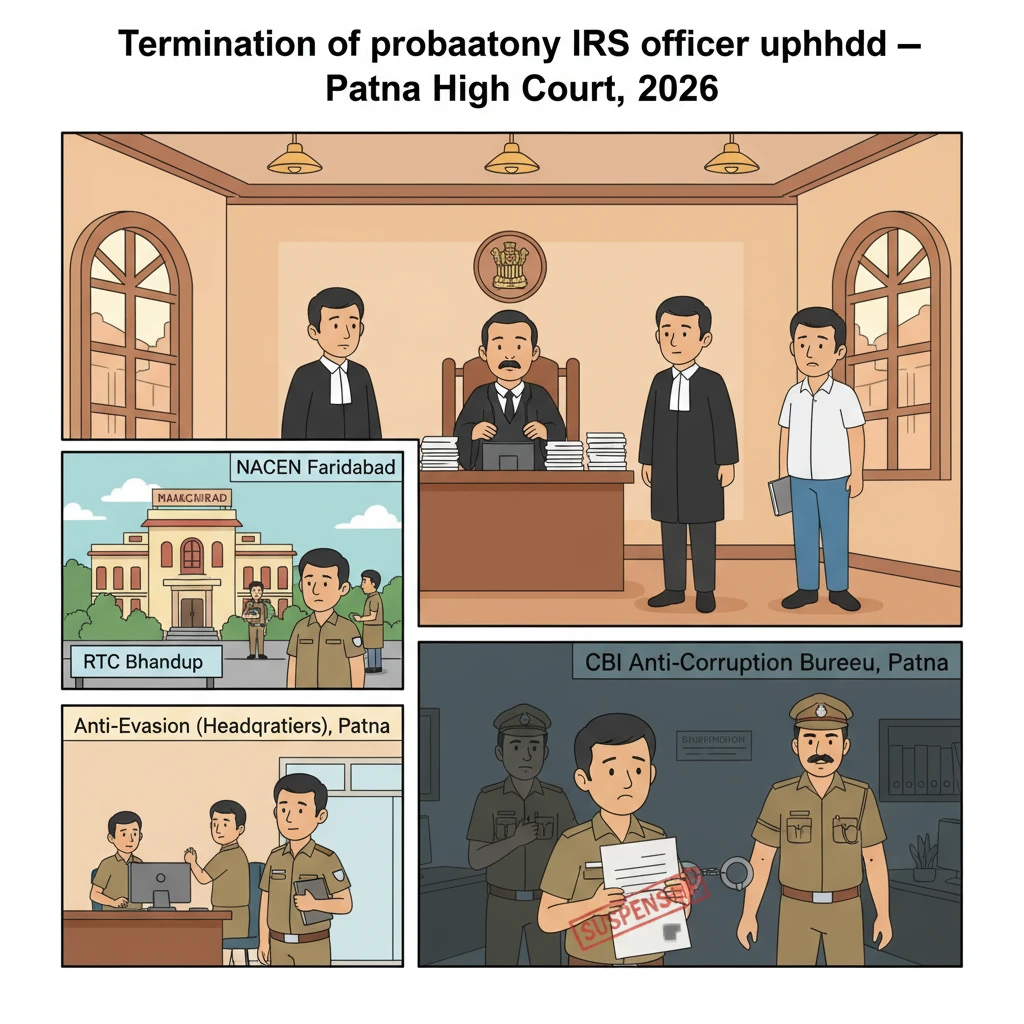
He joined training at the National Academy of Customs, Excise & Narcotics (NACEN), Faridabad on 22.12.2016. After completing training there in July 2017, he was sent to the Regional Training Centre at Bhandup, Mumbai, where he reported on 14.07.2017 and completed his training.
Following field training at different places, he joined at Patna on 12.12.2017. In May 2018, he was given independent charge as Assistant Commissioner, Anti-Evasion (Headquarters), Patna.
Under his appointment terms, he had to pass Part-I and Part-II departmental examinations in Customs and Central Excise laws within a two-year probation period. He appeared in these examinations between 03.07.2018 and 09.07.2018, passed all papers except Paper X, and later cleared Paper X on 30.11.2018. He thus completed the mandatory examinations within two years of joining.
On 27.06.2019, a CBI case (RC No. 023 2019 A 0007) was registered against him and a Superintendent, under Section 7 of the Prevention of Corruption Act, 1988 and Section 120B IPC. The petitioner was arrested on 27.06.2019 and sent to judicial custody on 28.06.2019.
Because he was detained for more than 48 hours, he was placed under deemed suspension with effect from 27.06.2019 vide order dated 01.08.2019. His suspension was periodically extended by orders dated 19.09.2019, 18.03.2020 and 14.09.2020. The co-accused Superintendent’s suspension, however, was revoked on 14.09.2020.
The petitioner challenged his suspension and its extensions before the Central Administrative Tribunal (CAT), Patna Bench, in O.A. No. 050/00362/2020. While that matter was pending, the Under Secretary, Department of Revenue, issued order dated 05.02.2021 terminating his services under Rule 5(1) of the Central Civil Services (Temporary Service) Rules, 1965 (CCS Temporary Service Rules, 1965).
The petitioner then filed O.A. No. 050/00105/2021 before the CAT challenging the termination order. By a common order dated 08.04.2024, the CAT dismissed both original applications. The present writ petitions (CWJC No. 11330 of 2024 and CWJC No. 12052 of 2024) before the Patna High Court arose from that CAT order.
What the Court Examined and Decided
The Division Bench of Hon’ble Mr. Justice Mohit Kumar Shah and Hon’ble Mr. Justice Alok Kumar Pandey heard both writ petitions together and delivered a common judgment on 03.04.2026.
In the first writ (CWJC No. 11330 of 2024), the petitioner attacked the termination order dated 05.02.2021. His main contentions were:
First, he argued that he had completed all requirements of probation. Under the appointment letter dated 08.12.2016, the probation period was two years. During that period he was to undergo training at NACEN Faridabad and RTC Bhandup and pass Part-I and Part-II departmental examinations. He claimed that he had finished training and examinations within this period, so the government could not treat him as a probationer without following the procedure in the Master Circulars on probation and confirmation.
Second, he relied on Office Memoranda dated 11.03.2019 and 02.07.2018 (Master Circulars of the Department of Personnel & Training on probation and confirmation). These circulars state that normally probation should not be extended beyond one year (and never beyond double the normal period), that a Board of senior officers should assess the probationer’s reports, and that a probationer is deemed to have completed probation if no order confirming, discharging or reverting him is issued within eight weeks after expiry of double the normal probation.
He argued that these safeguards, including an opportunity to be heard, were not followed before terminating him, and therefore the order was punitive and illegal.
Third, he attacked the reasons later disclosed in the respondents’ written statement before the CAT. There, the authorities said his services were terminated because he had not successfully completed his training and had remained “unauthorizedly absent” during the furbisher course, and because he was caught red-handed taking a bribe, which allegedly showed lack of moral responsibility.
The petitioner contended that the expression “unauthorized absence” was stigmatic. He pointed out that the furbisher courses were scheduled in four spells, and produced letters from the Additional Director General, NACEN, asking the Chief Commissioner to relieve him for such courses. He argued he was never relieved, so he could not be blamed for not attending.
He also argued that branding him as having been caught taking a bribe was stigmatic because the criminal case was still pending and he had not been convicted.
Fourth, he highlighted that an order dated 18.03.2020 from the Under Secretary mentioned that a draft charge-sheet under Rule 14 of the CCS (CCA) Rules, 1965 was under consideration. He submitted that once disciplinary proceedings were contemplated, his services could not be terminated under Rule 5(1) of the CCS Temporary Service Rules, 1965 without holding a full departmental enquiry.
He further argued that the CCS Temporary Service Rules, 1965 did not apply to him because of Rule 2(g), in light of the Indian Revenue Service (Customs and Central Excise) Group ‘A’ Rules, 2016 (IRS Rules, 2016) notified on 22.04.2016.
He also contended that the CAT’s decision was self-contradictory: on one hand it held he was no longer on probation, and on the other it held there was no confirmation order, yet treated him as a temporary employee covered by the CCS Temporary Service Rules, 1965.
He relied on Supreme Court judgments such as Karnataka State Road Transport Corporation v. S. Manjunath, Ratnesh Kumar Choudhary v. IGIMS, and V.P. Ahuja v. State of Punjab to argue that where termination is founded on misconduct or is stigmatic, a regular enquiry complying with natural justice is required.
On the other side, the Union of India and departmental authorities, represented by the learned Additional Solicitor General of India, Dr. K.N. Singh, gave a detailed account of the training position and the CBI case.
They stated that the 68th Batch of officer trainees, including the petitioner, started training at NACEN on 19.12.2016. A furbisher course for this batch ran from 13.08.2018 to 07.09.2018. During this course, attendance records showed that eight officers, including the petitioner, had less than 75% attendance and were treated as unauthorizedly absent, amounting to indiscipline. As a result, they were denied the furbisher course completion certificate.
The petitioner and his controlling authority were informed that his furbisher course would be repeated with the next batch (69th Batch). However, before that could happen, he was allegedly caught red-handed by the CBI on 27.06.2019 while accepting a bribe of Rs. 2.5 lakhs, arrested, and placed under suspension.
The respondents argued that after examining his case, they found he had not successfully completed training, had been unauthorizedly absent during the furbisher course, and had been arrested in a corruption case. The appointing authority considered him unfit to remain in service. Since he was still not confirmed as on 05.02.2021, he was a temporary employee. Invoking Rule 5(1) of the CCS Temporary Service Rules, 1965, read with clause (vi) of his appointment letter and Rule 6(3) of the IRS Rules, 2016, his services were discharged by an order of termination simpliciter.
They emphasised that a temporary employee or probationer has no right to hold the post, and the department can discharge such a person without a show-cause notice, so long as the order is not punitive or stigmatic. They relied on Supreme Court decisions including High Court of Judicature at Patna v. Pandey Madan Mohan Prasad Sinha and Rajasthan High Court v. Ved Priya.
The Patna High Court first analysed the governing rules. Clause (iv)–(vi) and (xiv) of the appointment letter fixed probation at two years, allowed extension for failure in exams or any other reason, authorised discharge if work or conduct was unsatisfactory or the probationer was unlikely to become efficient, and made the IRS Rules, 2016 applicable.
Rule 6 of the IRS Rules, 2016 provides for two years’ probation (extendable), confirmation on successful completion, and discharge if the controlling authority finds the officer not fit for permanent appointment during probation or its extension. Rule 6(5) makes government instructions on probation and confirmation applicable, under which the DOPT Office Memorandum dated 11.03.2019 (Master Circular) was issued.
Clause 27 of that Master Circular states that an officer will be deemed to have successfully completed probation only if no order confirming, discharging or reverting him is issued within eight weeks after expiry of double the normal probation period.
The Court found that the petitioner joined on 19.12.2016. Double the normal probation (two years) came to four years, and adding eight weeks would end on 12.02.2021. However, his services were terminated on 05.02.2021, before that date. Therefore, there was no deemed completion of probation, and he remained a probationer/temporary government servant on the date of termination.
The Bench further held that the CCS Temporary Service Rules, 1965 were applicable. There was no notification exempting officers like the petitioner from those Rules, and they did not expressly exclude probationers. As such, his status was covered by both the IRS Rules, 2016 and the CCS Temporary Service Rules, 1965.
Under Rule 5(1) of the CCS Temporary Service Rules, 1965, services of a temporary Government servant can be terminated at any time by written notice, or forthwith by payment of one month’s pay and allowances. The Court reproduced the termination order dated 05.02.2021, which simply invoked the proviso to Rule 5(1), terminated his services forthwith, and directed payment of one month’s pay in lieu of notice. The order itself contained no reasons, no reference to misconduct, and no stigma.
Reading Rule 6(3) of the IRS Rules, 2016 together with Rule 5(1) of the CCS Temporary Service Rules, 1965, the Court held that neither rule requires a show-cause notice, departmental enquiry, or reasons before discharging a probationer/temporary employee on grounds of unsuitability. They permit the controlling authority to form an opinion based on overall conduct during probation.
The Bench relied on the Supreme Court’s decision in Pandey Madan Mohan Prasad Sinha, where it was held that a probationer has no right to hold the post, natural justice principles requiring pre-decisional hearing do not apply to termination of a probationer, and adverse material can be used by the authority to find him unfit for confirmation so long as the order itself is not punitive.
The Court found the authorities’ reliance on the petitioner’s arrest in a bribery case and his non-completion of the furbisher course to be within the permissible zone of assessing his suitability. It observed that such events could legitimately form a basis for concluding that a probationer was not fit for permanent appointment.
The Court distinguished the Supreme Court authorities cited by the petitioner (S. Manjunath, Ratnesh Kumar Choudhary, V.P. Ahuja) on the ground that they dealt with situations where termination orders were truly based on misconduct and were punitive in nature. Here, no departmental inquiry was started or dropped, and the order of 05.02.2021 remained one of discharge simpliciter, not punishment.
Accordingly, the Court concluded that the termination order did not suffer from illegality or infirmity and that the CAT had rightly dismissed the challenge.
In the second writ (CWJC No. 12052 of 2024), the petitioner challenged the original deemed suspension order dated 01.08.2019 and the subsequent extension orders dated 19.09.2019, 18.03.2020 and 14.09.2020.
He relied on Ajay Kumar Choudhary v. Union of India, where the Supreme Court held that suspension should ordinarily not extend beyond three months without service of a charge-sheet, and that further extension requires a reasoned order.
The respondents, however, pointed out that the petitioner had been arrested in a CBI case and remained in custody for more than 48 hours. Under the CCS (Classification, Control & Appeal) Rules, 1965, such a person is deemed to be under suspension from the date of detention. They stated that sanction for prosecution was granted on 14.01.2020 and that CBI had advised initiating major penalty proceedings, but before that could materialise his services were terminated on 05.02.2021.
They explained that each extension of suspension was in accordance with Rule 10(6) of the CCS (CCA) Rules, 1965, based on the recommendation of the Suspension Review Committee and with approval of the competent authority, taking into account the pending CBI case.
The Court reproduced Rule 10(6), which mandates review of suspension before 90 days and allows extension in blocks of up to 180 days on Review Committee recommendations.
On examining these provisions, the Court found no illegality in the suspension or its extensions. It further held that the guidelines in Ajay Kumar Choudhary did not apply because that decision concerned a regular government servant, not a probationer/temporary employee like the petitioner. Moreover, in the present case, there was no requirement of conducting a full departmental enquiry prior to termination during probation.
Therefore, the Court upheld the CAT’s view that the suspension and its extensions were valid.
In the final analysis, the Bench held that there was no perversity, irrationality or impropriety in the CAT’s common order dated 08.04.2024 and dismissed both writ petitions as devoid of merit.
Why This Judgment Matters
This Patna High Court decision is important for probationary and temporary government servants, especially newly recruited Group “A” officers.
It makes clear that even after successfully passing departmental examinations, a probationer does not gain a right to the post until confirmation. If serious issues arise during probation—such as criminal investigation, arrest, or non-completion of mandatory training—the government can discharge the probationer by a simple termination order under the applicable service rules.
The judgment also clarifies that Master Circulars on probation and confirmation, including the concept of deemed completion of probation after double the period plus eight weeks, will not come to the aid of a probationer if the employer acts to discharge him before that outer time limit.
For government servants facing criminal cases, the ruling shows that deemed suspension on arrest for more than 48 hours, and periodic extensions of suspension under Rule 10(6) of the CCS (CCA) Rules, are legally sustainable if properly reviewed, even when no departmental charge-sheet is ultimately served because the person is removed as a probationer.
For ordinary readers and civil service aspirants, the message is that probation is a testing phase. Good exam results alone are not enough; overall conduct, including integrity and discipline, remains under scrutiny. An arrest or serious allegation during this period can lead to discharge from service without the protections that apply to confirmed staff.
Legal Issues and Answers
- Issue: Could the probationary IRS officer’s services be terminated under Rule 5(1) of the CCS Temporary Service Rules, 1965 without a departmental enquiry, despite completion of examinations and ongoing CBI proceedings?
Answer: Yes. The Court held he remained a probationer/temporary government servant on 05.02.2021; under Rule 6(3) of the IRS Rules, 2016 read with Rule 5(1) of the CCS Temporary Service Rules, 1965, his services could be discharged simpliciter without enquiry or prior notice. - Issue: Did non-completion of the furbisher course and the corruption case make the termination order punitive or stigmatic so as to attract Article 311 and principles of natural justice?
Answer: No. The order of 05.02.2021 was a simple termination invoking Rule 5(1), without reciting misconduct or stigma. The authority could rely on such factors to assess suitability during probation without converting the order into a punishment. - Issue: Were the deemed suspension order dated 01.08.2019 and its extensions invalid for exceeding three months without a charge-sheet, in light of Ajay Kumar Choudhary?
Answer: No. The Court held that Rule 10(6) of the CCS (CCA) Rules, 1965 permitted review and extension of suspension up to 180 days at a time, which was duly followed. The Ajay Kumar Choudhary guidelines were found inapplicable to this probationer’s case.
Cases Cited by the Court
- High Court of Judicature at Patna v. Pandey Madan Mohan Prasad Sinha, (1997) 10 SCC 409.
- Rajasthan High Court v. Ved Priya and another, 2020 SCC OnLine SC 337.
- State of Punjab and Others v. Sukhwinder Singh, (2005) 5 SCC 569.
- Karnataka State Road Transport Corporation and Another v. S. Manjunath, (2000) 5 SCC 250 (cited by petitioner, distinguished).
- Ratnesh Kumar Choudhary v. Indira Gandhi Institute of Medical Sciences, Patna, Bihar & Ors., (2015) 15 SCC 151 (cited by petitioner, distinguished).
- V.P. Ahuja v. State of Punjab and Others, (2000) 3 SCC 239 (cited by petitioner, distinguished).
- Ajay Kumar Choudhary v. Union of India and Another, (2015) 7 SCC 291 (cited by petitioner, held inapplicable).
Case Details
Case Numbers: Civil Writ Jurisdiction Case No. 12052 of 2024; Civil Writ Jurisdiction Case No. 11330 of 2024.
Case Title: Chandan Prakash Pandey v. The Union of India & Ors. (in both CWJC No. 12052 of 2024 and CWJC No. 11330 of 2024).
Citation: 2026 (3) PLJR 176.
Coram: Hon’ble Mr. Justice Mohit Kumar Shah; Hon’ble Mr. Justice Alok Kumar Pandey.
Date of Judgment: 03.04.2026.
Originating Orders Challenged: Common order dated 08.04.2024 passed by the Central Administrative Tribunal, Patna Bench, Patna in O.A. No. 050/00105/2021 and O.A. No. 050/00362/2020; termination order dated 05.02.2021; suspension and suspension-extension orders dated 01.08.2019, 19.09.2019, 18.03.2020 and 14.09.2020.
Advocates:
For the petitioner in both writ petitions: Mr. Munna Pd Dixit, Advocate.
For the respondents in both writ petitions: Dr. K.N. Singh, Additional Solicitor General of India; Mr. Anshuman, Senior Standing Counsel, CGST & CX; Mr. Shivaditya Dhari Sinha, Advocate.
Nature of the case: Writ petitions under Article 226 of the Constitution challenging a CAT order in service matters (termination of probationary appointment and validity of deemed suspension and its extensions).
Link to full judgment: Patna High Court Judgment dated 03.04.2026 in CWJC No. 12052 of 2024 with CWJC No. 11330 of 2024
If you found this explanation helpful and wish to stay informed about how legal developments may affect your rights in Bihar, you may consider following Samvida Law Associates for more updates.







