
Case Background
The respondent was appointed on 21.04.2014 as Reader-cum-Associate Professor (Pravachak) in Government Tibbi College and Hospital, Kadamkuan, Patna. His appointment was on a contractual basis after a walk-in interview conducted by the authorities.
He served for about six years. The judgment records that during this period no drawbacks were found in his service.
On 10.04.2019, the Health Department, Government of Bihar, issued an order stating that doctors appointed on contractual basis would continue to work till they reach the age of superannuation or till regular appointment, whichever is earlier.
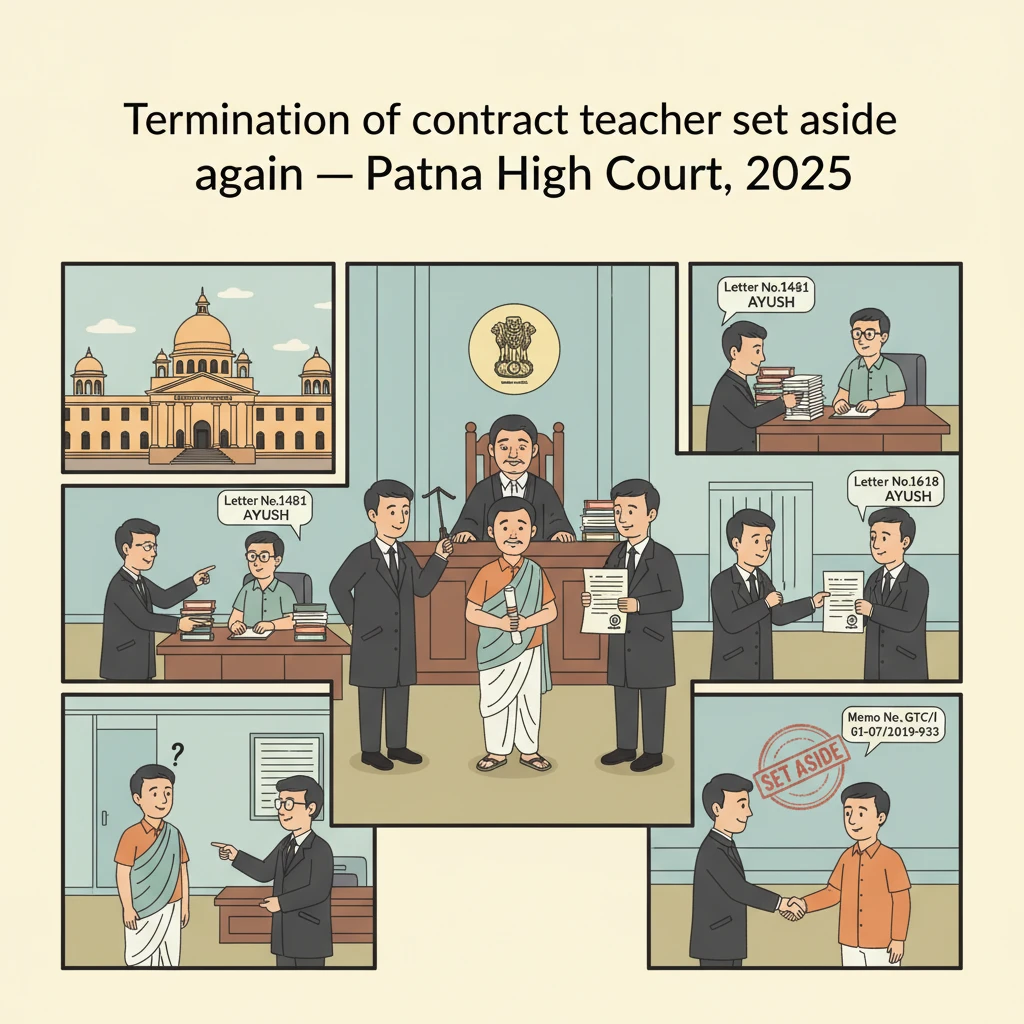
Despite this general policy, on 05.11.2019 a show cause notice (Letter No.1481 AYUSH) was issued to the respondent. The notice alleged that his appointment had been made without obtaining roster clearance, which is the formal approval relating to reservation roster.
The respondent replied to the show cause notice on 14.11.2019. According to the judgment, this reply was not considered by the Department. Instead, he was removed from service by Letter No.1618 AYUSH dated 03.12.2019 and subsequent Letter No.860 dated 04.12.2019 on the ground that his appointment was contrary to the roster point.
The respondent challenged the notice dated 05.11.2019 and the termination orders by filing CWJC No.25452 of 2019. That writ petition was allowed by the High Court. The orders dated 03.12.2019 and 04.12.2019 were set aside, and he was reinstated in service with retrospective effect.
However, the issue did not end there. On the same alleged ground of lack of roster clearance, another show cause notice was issued to him vide Letter No.820 dated 09.11.2020, asking him to make his representation within one week.
The respondent submitted his reply on 18.11.2020. According to the present judgment, the Department again ignored his reply and passed a “reasoned order” bearing Memo No. GTC/U1-07/2019-933 dated 29.12.2020, holding that his appointment was in breach of roster clearance and terminating his service with effect from the date of that order.
The respondent then challenged this second termination order by filing CWJC No.5728 of 2021. He argued that he had been appointed against ideal roster point No.5, which was meant for an unreserved (general) category candidate, and that he himself belonged to the unreserved category. He also disputed the claim in letter No.933 dated 29.12.2020 that he had been paid salary from 04.12.2019 to 24.03.2020, stating that four months’ salary had not, in fact, been paid.
The learned Single Judge accepted the respondent’s challenge, particularly noting that a copy of the ideal roster letter had not been served on him. The Single Judge set aside the order dated 29.12.2020 and allowed the writ petition on 18.07.2024. The State of Bihar then filed the present Letters Patent Appeal No.1067 of 2024 against that decision.
What the Court Examined and Decided
The Division Bench of the Patna High Court, comprising Hon’ble Mr. Justice Sudhir Singh and Hon’ble Mr. Justice Ramesh Chand Malviya, heard the intra-court appeal filed by the State. The Court examined whether the Single Judge’s order needed to be interfered with.
On behalf of the State, it was argued that the order dated 18.07.2024 in CWJC No.5728 of 2021 was bad in law and on facts. Counsel submitted that the Single Judge had proceeded in a casual manner and had failed to properly appreciate the reasons for terminating the respondent’s contractual service.
The State particularly relied on Health Department letter No.852 dated 17.09.2014. According to the State, this letter clearly mentioned that roster clearance for making the appointment was “under process.” The State argued that this showed the appointment had been made before roster clearance was obtained, and the Single Judge had committed a gross error by ignoring this fact when concluding that the initial appointment appeared to be in accordance with the roster point.
The State also submitted that the then Principal of the College had been proceeded against departmentally and punished for making appointments contrary to the reservation policy, including the appointment of the respondent and two others. According to the State, this indicated that the entire appointment process, including the respondent’s engagement, was contrary to the requirement of prior roster clearance.
The State’s stand, as recorded by the Division Bench, was that the appointment of the respondent (and two others) had been made without roster clearance, which was still in process, as evident from the Health Department’s letter dated 17.09.2014. This, they claimed, made the initial engagement in 2014 bad in law, and therefore the Single Judge’s judgment was fit to be set aside.
The Division Bench then turned to the record of the writ proceedings. A key point noted by the Court was what the State had not said in its counter affidavit before the Single Judge. The Bench recorded that the appellants had nowhere stated that the vacancy on which the respondent was appointed was not available for general category and was actually reserved for some other category.
In other words, the State never asserted that the respondent had been appointed on a post earmarked for a reserved category candidate. The “only contention” was that at the time of his appointment, roster clearance was still under process, and thus the appointment should not have been made without such clearance.
The Division Bench considered this distinction crucial. The Court reasoned that if the appointment was not actually made against a reserved category vacancy, and therefore did not cause any substantive prejudice to candidates from reserved categories in public employment, then the appointment could not be held illegal on that basis alone.
The Bench observed that mere irregularities in the process of appointment on the part of the appointing authority do not, by themselves, make the appointment bad, unless they result in prejudice to the rights of other candidates. The Court emphasised that no such prejudice had been shown.
Further, the Court noted that it was not the case of the appellants that, after obtaining roster clearance, it was found that the respondent had in fact been appointed on a roster point earmarked for a reserved category candidate. Thus the foundational claim that the appointment violated the reservation roster remained unsupported by any specific assertion about the post being a reserved one.
On this reasoning, the Division Bench concluded that the Single Judge’s decision did not suffer from any infirmity requiring interference. The focus of the appeal on procedural irregularity (absence of prior roster clearance) was not enough to overturn the reinstatement, especially in the absence of any allegation that the appointment had deprived a reserved category candidate of a rightful post.
The Court therefore held that the appeal lacked merit. It affirmed the Single Judge’s order which had set aside the termination order dated 29.12.2020 and directed reinstatement with consequential benefits. The Letters Patent Appeal was dismissed.
By dismissing the appeal, the Division Bench effectively confirmed that the respondent’s contractual engagement, though challenged for alleged procedural irregularity, could not be retrospectively treated as illegal where no substantive violation of reservation rights was shown.
Why This Judgment Matters
This judgment is significant for contract appointees in government institutions in Bihar, especially in the health and medical education sectors. The Patna High Court has underlined that the State cannot simply cancel appointments years later by citing lack of roster clearance, without demonstrating actual harm to reserved category candidates.
For employees, the ruling shows that long-standing contractual appointments cannot be lightly terminated after years of service only on the basis of internal procedural lapses by the department, if no reservation rule has been substantively violated.
For the administration, the judgment is a reminder that reservation policies and roster clearance are serious requirements, but their breach must be shown in concrete terms. A mere statement that “roster clearance was under process” is not enough to terminate an individual, particularly when there is no assertion that he or she occupied a reserved category post.
The judgment also reinforces that when the State takes action that affects livelihood, it must fairly consider the person’s reply to show cause and place on record clear facts about how any rule or roster was violated. Absent such clarity, the courts may intervene and protect the employee.
Legal Issues and Answers
-
Issue: Can a contractual appointment in a government college be treated as illegal and terminated solely because roster clearance was “under process,” when there is no allegation that the appointee occupied a reserved category post?
Answer: No. The Patna High Court held that where it is not shown that the appointment was against a reserved category vacancy or that any reserved candidate’s rights were prejudiced, mere absence or pendency of roster clearance is an irregularity and does not by itself render the appointment illegal. -
Issue: Did the Division Bench find any ground to interfere with the Single Judge’s order reinstating the contractual teacher with consequential benefits?
Answer: No. The Court found no merit in the State’s appeal and held that the Single Judge’s order did not require interference, as the State had not shown any substantive violation of reservation norms or prejudice to reserved category candidates.
Cases Cited by the Court
- No prior case law is cited or relied upon in the text of this judgment.
Case Details
Case Number: Letters Patent Appeal No.1067 of 2024 in Civil Writ Jurisdiction Case No.5728 of 2021
Case Title: The State of Bihar & Ors. v. Md. Zahid Iqbal
Coram: Hon’ble Mr. Justice Sudhir Singh and Hon’ble Mr. Justice Ramesh Chand Malviya
Citation: 2025(4) PLJR 114
Advocates: For the Appellants (State of Bihar): Mr. Arvind Kumar, AC to SC-18; For the Respondent: Mr. Satish Chandra Jha, Advocate; Md. Ataul Haque, Advocate
Nature of the Case: Intra-court appeal (Letters Patent Appeal) against the order of a Single Judge allowing a writ petition and setting aside termination of a contractual appointment.
Date of Judgment: 22.07.2025
Link to the Judgment: Click here to view the official Patna High Court judgment
If you found this explanation helpful and wish to stay informed about
how legal developments may affect your rights in Bihar,
you may consider following Samvida Law Associates for more updates.







