

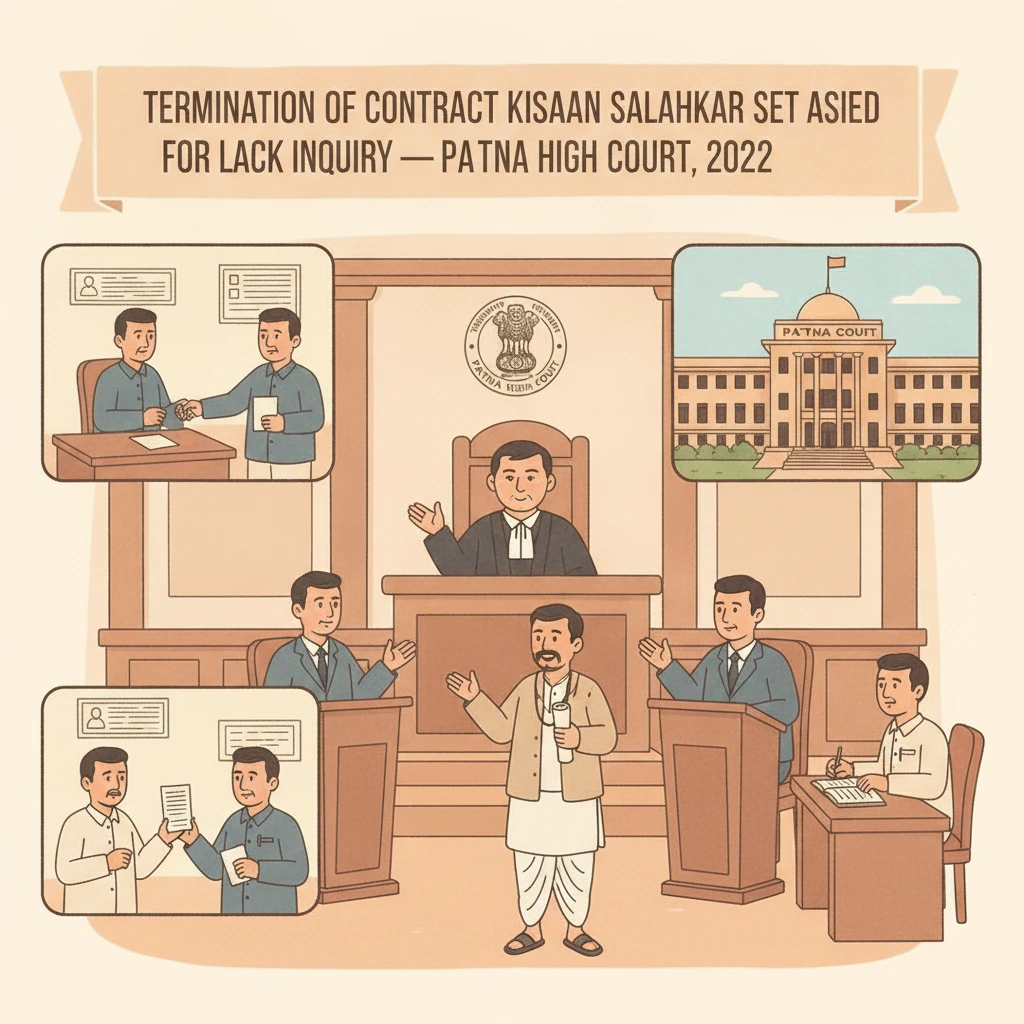
Case Background
The case arose from the engagement of the petitioner as a Kisaan Salahkar (farmer advisor) on a contract basis under the Agriculture Department in Aurangabad district, Bihar.
During his engagement, complaints were received against him. According to the judgment, these complaints, made by a large number of persons, alleged that he was in the habit of demanding and accepting illegal gratification from farmers. These complaints are collectively referred to in the record as Annexure-A.
Acting on these complaints, the District Agriculture Officer, Aurangabad, issued a notice to the petitioner on 03.10.2019, referred to in the judgment as Annexure-B. The notice called upon him to respond to the allegations.
The petitioner submitted his explanation on 09.10.2019. This explanation is mentioned in the judgment as Annexure-4 to the writ petition.
Shortly thereafter, on 17.10.2019, the District Agriculture Officer issued letter no. 24 (MU), by which the petitioner’s selection/engagement as Kisaan Salahkar was cancelled. In effect, this order terminated his services.
The petitioner preferred an appeal against the termination order before the Joint Director (Sashya), Magadh Division, Gaya. This appeal was rejected on 19.02.2020 by Memo no. 3000.
Aggrieved by both the order dated 17.10.2019 cancelling his selection and the appellate order dated 19.02.2020, the petitioner approached the Patna High Court in Civil Writ Jurisdiction Case No. 967 of 2021.
In the writ petition, he sought quashing of both orders and any other reliefs to which he might be entitled on the facts and circumstances of the case.
What the Court Examined and Decided
The matter was heard by Hon’ble Mr. Justice P. B. Bajanthri. The Court heard counsel for the petitioner and for the State respondents.
The core allegation against the petitioner was serious: that he was in the habit of demanding and accepting illegal gratification from farmers while functioning as a Kisaan Salahkar on contract basis.
The record before the Court showed three main steps taken by the authorities: receipt of multiple complaints (Annexure-A), issuance of show cause notice dated 03.10.2019 (Annexure-B), and receipt of the petitioner’s written explanation dated 09.10.2019 (Annexure-4). Based on these three documents, the District Agriculture Officer proceeded to cancel the petitioner’s selection by order dated 17.10.2019.
The Joint Director (Sashya), acting as appellate authority, thereafter rejected the appeal on 19.02.2020, effectively upholding the termination.
The petitioner’s counsel argued that the nature of the allegations was extremely serious. The charge that an officer is habitually demanding and accepting illegal gratification from farmers is clearly a stigmatic allegation and not a simple or technical ground.
It was contended that in such circumstances, the authorities could not have terminated his engagement merely on the basis of complaints and his written explanation, without holding a proper inquiry. There was no opportunity given for oral hearing or for the complainants and the petitioner to adduce evidence.
The judgment records that the official respondents proceeded to terminate the service of the petitioner only on the basis of the complaint, the notice and his explanation, “in the absence of evidence adduced by the farmers and the petitioner.”
The High Court accepted that the nature of the allegations required a higher standard of procedural fairness. The Court observed that, though the petitioner was a contract employee, where serious allegations are levelled, a domestic inquiry is warranted.
The Court emphasised that this principle applies even for temporary employees. A stigmatic order, recording serious misconduct such as habitual demand and acceptance of bribe, may create a serious hurdle for obtaining future employment, whether in government or elsewhere.
Because of this long-term impact, the authority must follow fair procedure whenever it issues an order that carries stigma. Fair procedure, in this context, includes holding a disciplinary or domestic inquiry, allowing both sides to adduce evidence, and deciding the matter on that evidence.
The Court noted that no such domestic inquiry had been held. No witnesses were examined, and no opportunity was given to the petitioner to cross-examine complainants or to present his own defence beyond the written explanation.
In the light of these facts, the Court concluded that the petitioner had made out a prima facie case. The absence of any proper inquiry rendered the termination legally unsustainable.
Accordingly, the Court set aside both the impugned orders: the termination/cancellation order dated 17.10.2019 passed by the District Agriculture Officer, Aurangabad, and the appellate order dated 19.02.2020 passed by the Joint Director (Sashya), Magadh Division, Gaya.
However, the Court did not give the petitioner a clean chit on the allegations. Instead, it struck a balance between the rights of the employee and the powers of the administration.
The High Court directed that the concerned authority could either place the petitioner under suspension or reinstate him, but in any case must initiate and complete a proper inquiry.
While issuing these directions, the Court specifically referred to two Supreme Court decisions: Managing Director, ECIL vs. B. Karunakaran, reported in (1993) 4 SCC 727, and Chairman-cum-Managing Director, Coal India Ltd. vs. Ananta Saha and Others, reported in (2011) 5 SCC 142.
By relying on these decisions, the Patna High Court underlined the settled law that when an order is stigmatic and founded on allegations of misconduct, even in cases of temporary or contractual employment, the employer must follow principles of natural justice and hold an inquiry.
The High Court directed the authorities to hold an inquiry “in the light of” the above Supreme Court judgments. This indicates that the inquiry must be fair, must follow due procedure, and must give the petitioner adequate opportunity to defend himself.
The Court further ordered that, after the inquiry is conducted and a final order is passed, the intervening period from the date of dismissal till the final order shall be treated either as a period of suspension or as period on duty, “in accordance with law.” This treatment will depend on the outcome of the disciplinary proceedings and applicable service rules or contractual terms.
Importantly, the Court imposed a time-bound schedule. It directed that the entire exercise – whether suspension or reinstatement, and conduct and completion of the inquiry – must be completed within four months from the date of receipt of the High Court’s order.
With these observations and directions, the writ petition was allowed.
Why This Judgment Matters
This decision has important practical consequences for contract and temporary workers in Bihar, especially those engaged by government departments.
The Patna High Court has made it clear that the label “contract” does not give the State a free hand to end service on serious allegations without a proper inquiry.
When an order records that a worker is habitually demanding and accepting illegal gratification, that finding can damage his reputation and close doors to future employment. Such a serious stigma cannot be imposed merely on the basis of complaints and a written reply.
For government departments, the judgment is a reminder that they must distinguish between simple termination on non-stigmatic grounds and termination based on allegations of misconduct. In the latter case, they must follow due process, even if the employee is temporary or on contract.
For contract employees facing similar accusations, this judgment shows that the Patna High Court can intervene where authorities bypass the basic requirement of a fair hearing and a proper inquiry.
Legal Issues and Answers
Issue: Can a contract Kisaan Salahkar be terminated on serious allegations of habitual demand and acceptance of illegal gratification solely on the basis of complaints, show cause notice and written explanation, without a domestic inquiry?
Answer: No. The Patna High Court held that where serious and stigmatic allegations are made, even against a contract or temporary employee, a domestic inquiry is required. The impugned termination and appellate orders were set aside for want of such inquiry.
Issue: What steps must the authorities take after the termination order is quashed on this ground?
Answer: The authorities may either place the petitioner under suspension or reinstate him and are required to hold and complete a proper inquiry, in line with Supreme Court decisions in Managing Director, ECIL vs. B. Karunakaran and Chairman-cum-Managing Director, Coal India Ltd. vs. Ananta Saha and Others, within four months.
Cases Cited by the Court
- Managing Director, ECIL vs. B. Karunakaran, (1993) 4 SCC 727.
- Chairman-cum-Managing Director, Coal India Ltd. vs. Ananta Saha and Others, (2011) 5 SCC 142.
Case Details
Case Number: Civil Writ Jurisdiction Case No. 967 of 2021
Case Title: Shailesh Kumar vs. The State of Bihar & Others
Citation: 2022 (3) PLJR 266
Court: High Court of Judicature at Patna
Coram: Hon’ble Mr. Justice P. B. Bajanthri
Date of Judgment: 12.05.2022
Advocates:
- For the petitioner: Mr. Sanjay Mandal
- For the respondents: Mr. Awanish Nandan Sinha, GP-21
Nature of the Case: Writ petition (civil) challenging termination of contractual engagement and appellate order in service matter.
Impugned Orders:
- Order contained in letter no. 24 (MU) dated 17.10.2019 issued by the District Agriculture Officer, Aurangabad, cancelling the petitioner’s selection from the post of Kisaan Salahkar.
- Appellate order contained in Memo no. 3000 dated 19.02.2020 passed by the Joint Director (Sashya), Magadh Division, Gaya.
Link to Judgment: Patna High Court Judgment in CWJC No. 967 of 2021
If you found this explanation helpful and wish to stay informed about how legal developments may affect your rights in Bihar, you may consider following Samvida Law Associates for more updates.







