

Case Background
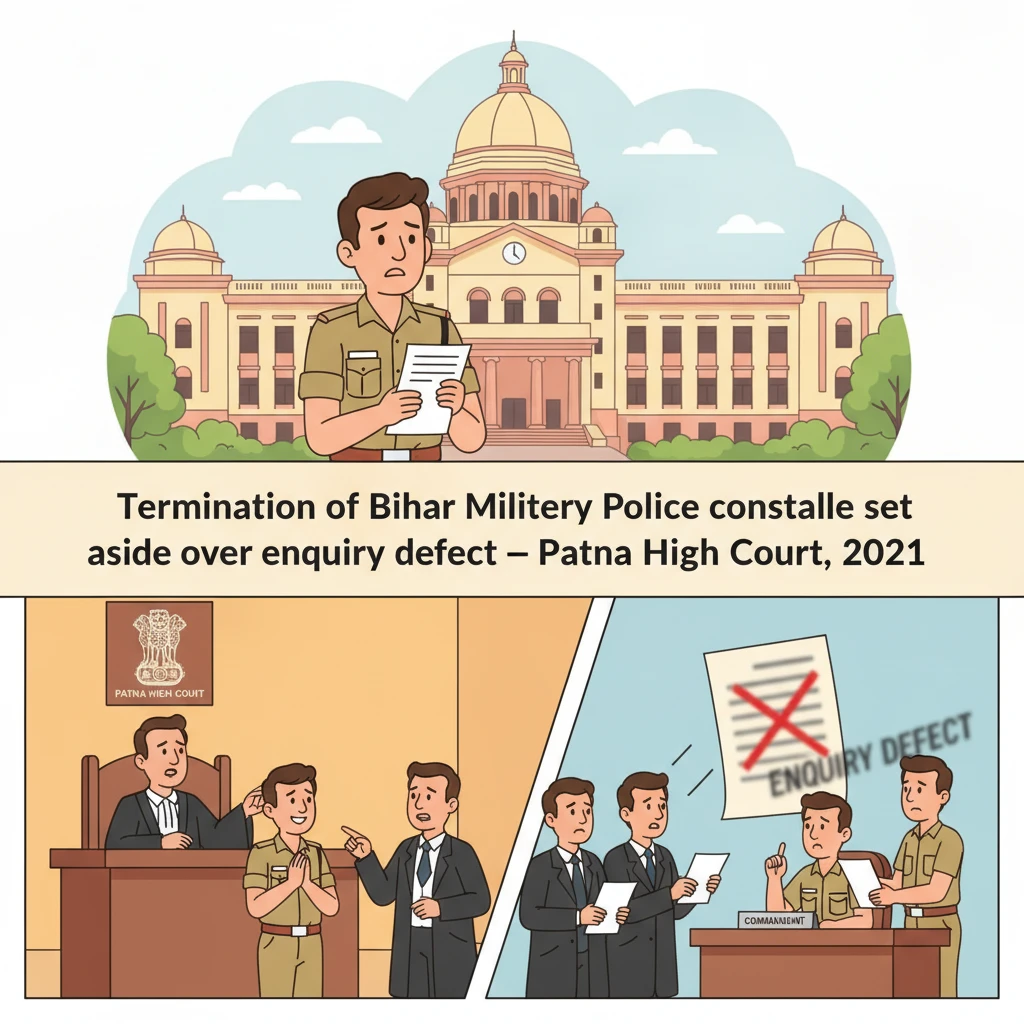
The petitioner was serving under Bihar Military Police-10, Patna. He was proceeded against in a departmental enquiry, which ultimately led to his dismissal from service.
The dismissal order was issued by the Commandant, Bihar Military Police-10, Patna-cum-Disciplinary Authority through memo no. 1367 dated 04.07.2016. Feeling aggrieved, the petitioner approached the Patna High Court under its civil writ jurisdiction.
In his writ petition, he asked the Court to quash the dismissal order. He also requested a direction for his reinstatement in service with immediate effect, along with any other relief the Court found appropriate.
On 06.12.2021, the Court passed an interim order directing the State counsel to verify the petitioner’s specific legal contentions. These contentions were raised in a rejoinder affidavit and related to alleged violation of statutory rules during the departmental enquiry.
The Court ordered that the State counsel must check the original enquiry records and obtain instructions from the disciplinary authority on whether any statutory rule had been violated. The Court also fixed a further hearing date and warned that if the disciplinary authority failed to assist the Court, he could be personally saddled with costs of Rs. 5,000/- payable to the Bihar State Legal Services Authority.
What the Court Examined and Decided
When the matter was taken up after the order dated 06.12.2021, the State respondents filed a counter statement. In that counter statement, a key fact was admitted.
The State accepted that in the disciplinary proceedings against the petitioner, no Presenting Officer had been appointed. The Presenting Officer is the person who, on behalf of the Department, is supposed to present the case, lead evidence and support the charges.
The Court noted that under Rule 17(5)(c) read with sub-rule (14) of Rule 17 of the Bihar Government Servants (Classification, Control and Appeal) Rules, 2005, a Presenting Officer has to be appointed in such enquiries. This requirement is not a mere formality; it is part of the statutory framework meant to ensure a fair process.
Because the respondents themselves admitted that no Presenting Officer was appointed, the Court treated this as a clear violation of the statutory rules governing disciplinary proceedings. The enquiry had therefore been conducted in a defective manner, not in accordance with the rules.
On this single but significant ground, the Court set aside the dismissal order dated 04.07.2016. In other words, the termination could not stand because the procedure laid down by law had not been followed.
However, the Patna High Court did not straightaway direct unconditional reinstatement with full back wages. Instead, the Court followed the law laid down by the Supreme Court for such situations, where an order of punishment is quashed on technical grounds and not on a clean finding of innocence.
The Court remanded the matter to the disciplinary authority. It directed that the authority must proceed from the “defective stage” of the enquiry. This means that the enquiry does not have to start from the very beginning of the employment, but must be resumed from the point where the legal defect occurred—in this case, from the stage where a Presenting Officer should have been appointed but was not.
The Court further ordered that the enquiry proceedings must be completed within four months from the date the disciplinary authority receives a copy of the High Court’s order. This time limit was imposed to prevent undue delay and prolonged uncertainty for the petitioner.
Another important question was: how should the intervening period between the dismissal and the final outcome of the fresh enquiry be treated in terms of pay and service benefits?
For this, the Patna High Court relied on two Supreme Court judgments. First, it referred to the decision in Managing Director, ECIL v. B. Karunakar, reported in (1993) 4 SCC 727. Second, it referred to Chairman-cum-Managing Director, Coal India Limited and others v. Ananta Saha and others, reported in (2011) 5 SCC 142, particularly paragraphs 46 to 50.
The Court reproduced paragraphs 46 to 50 of the judgment in Ananta Saha. These paragraphs summarise the Supreme Court’s settled position on what happens when a punishment order is quashed for procedural defects and a fresh enquiry is ordered.
In those paragraphs, the Supreme Court explained that:
First, when a fresh enquiry is ordered, the result of that enquiry, once completed, relates back to the date of the original termination. This means the final outcome will decide how the period in between is to be treated.
Second, in such a case, the employee is not automatically entitled to back wages, even if reinstated for the purpose of holding the fresh enquiry. The question of back wages is not automatic; it is a discretionary matter to be decided after considering all the facts and the principles of justice, equity and good conscience.
Third, the Court clarified that where punishment is quashed on technical grounds, the disciplinary authority must be allowed to conduct the enquiry afresh from the stage where the defect occurred. During this period, the employee can be reinstated and, if necessary, placed under suspension according to the applicable service rules, and would be entitled only to subsistence allowance during suspension.
Fourth, the Supreme Court emphasised that there is no rigid or mechanical rule for granting back wages. Even if the employee ultimately succeeds in getting the punishment set aside, the authority or court must consider the entire factual background.
Based on these guiding principles, the Patna High Court directed that the intervening period—from the date of dismissal till the date of the final order to be passed in the disciplinary proceedings—must be considered and decided by the disciplinary authority in the light of the Supreme Court’s decisions in ECIL v. Karunakar and Ananta Saha.
Thus, the Court left it open to the disciplinary authority, after completing the fresh enquiry, to determine whether the petitioner would be entitled to back wages or other benefits for the intervening period, and if so, to what extent.
In summary, the Court disposed of the writ petition by:
Setting aside the dismissal order dated 04.07.2016; remanding the matter to the disciplinary authority to resume the enquiry from the defective stage with due compliance of Rule 17 of the CCA Rules, 2005; directing completion of the enquiry within four months; and requiring that the treatment of the intervening period and service benefits be decided in line with the Supreme Court’s precedents.
Why This Judgment Matters
This judgment is important for government servants and disciplined forces personnel in Bihar who face departmental proceedings under the Bihar Government Servants (CCA) Rules, 2005.
The Patna High Court has made it clear that failure to appoint a Presenting Officer, when the rules require it, is not a minor mistake. It strikes at the root of a fair enquiry and can lead to the punishment order being set aside.
At the same time, the judgment also clarifies that a technical defect in procedure does not necessarily mean that the employee will get full back wages or a clean chit. The employer is given an opportunity to correct the defect and hold a fresh enquiry, and the final outcome will determine what benefits the employee receives for the intervening period.
For employees, the case shows that they can successfully challenge dismissal orders where the prescribed procedure has not been followed. For disciplinary authorities, it is a reminder to strictly follow Rule 17 of the CCA Rules, including timely appointment of a Presenting Officer, to avoid having their decisions struck down.
Legal Issues and Answers
- Issue: Whether the dismissal of the petitioner from Bihar Military Police-10 was valid when no Presenting Officer was appointed in the departmental enquiry as required by Rule 17 of the Bihar Government Servants (CCA) Rules, 2005.
Answer: No. Since the State admitted that no Presenting Officer was appointed, the enquiry was held in violation of Rule 17(5)(c) read with sub-rule (14), and the dismissal order dated 04.07.2016 was set aside. - Issue: What should be the consequence of setting aside the dismissal order passed after a procedurally defective enquiry.
Answer: The matter must be remanded to the disciplinary authority to proceed from the defective stage and complete the enquiry within four months, and the intervening period between dismissal and final order is to be dealt with in light of the Supreme Court decisions in ECIL v. Karunakar and Ananta Saha.
Cases Cited by the Court
- Managing Director, ECIL v. B. Karunakar, (1993) 4 SCC 727.
- Chairman-cum-Managing Director, Coal India Limited and others v. Ananta Saha and others, (2011) 5 SCC 142 (paragraphs 46 to 50).
- The judgment in Ananta Saha refers to other Supreme Court cases such as R. Thiruvirkolam v. Presiding Officer, Punjab Dairy Development Corpn. Ltd. v. Kala Singh, Graphite India Ltd. v. Durgapur Projects Ltd., U.P. SRTC v. Mitthu Singh, Akola Taluka Education Society v. Shivaji, and Balasaheb Desai Sahakari S.K. Ltd. v. Kashinath Ganapati Kambale, as part of the quoted extract.
Case Details
Case Number: Civil Writ Jurisdiction Case No. 15033 of 2016
Case Title: Mohd. Ali Jinnah v. The State of Bihar & Others
Coram: Hon’ble Mr. Justice P. B. Bajanthri
Citation: 2022 (1) PLJR 884
Advocates:
- For the petitioner: Mr. Niranjan Kumar, Advocate; Mr. Kumar Kishan, Advocate
- For the Central Selection Board of Constable (CSBC): Mr. Sanjay Pandey, Advocate; Mr. Binod Kr. Mishra, Advocate; Mr. Vivek Anand Amritesh, Advocate
- For the State: Mr. Prabhat Kr. Verma, AAG-3; Mr. Sanjay Kumar Ghorsarvey, AC to AAG-3
Nature of the Case: Writ petition under civil writ jurisdiction challenging an order of dismissal from service passed in departmental proceedings and seeking reinstatement.
Link to Judgment: Patna High Court judgment
If you found this explanation helpful and wish to stay informed about how legal developments may affect your rights in Bihar, you may consider following Samvida Law Associates for more updates.







