

Case Background
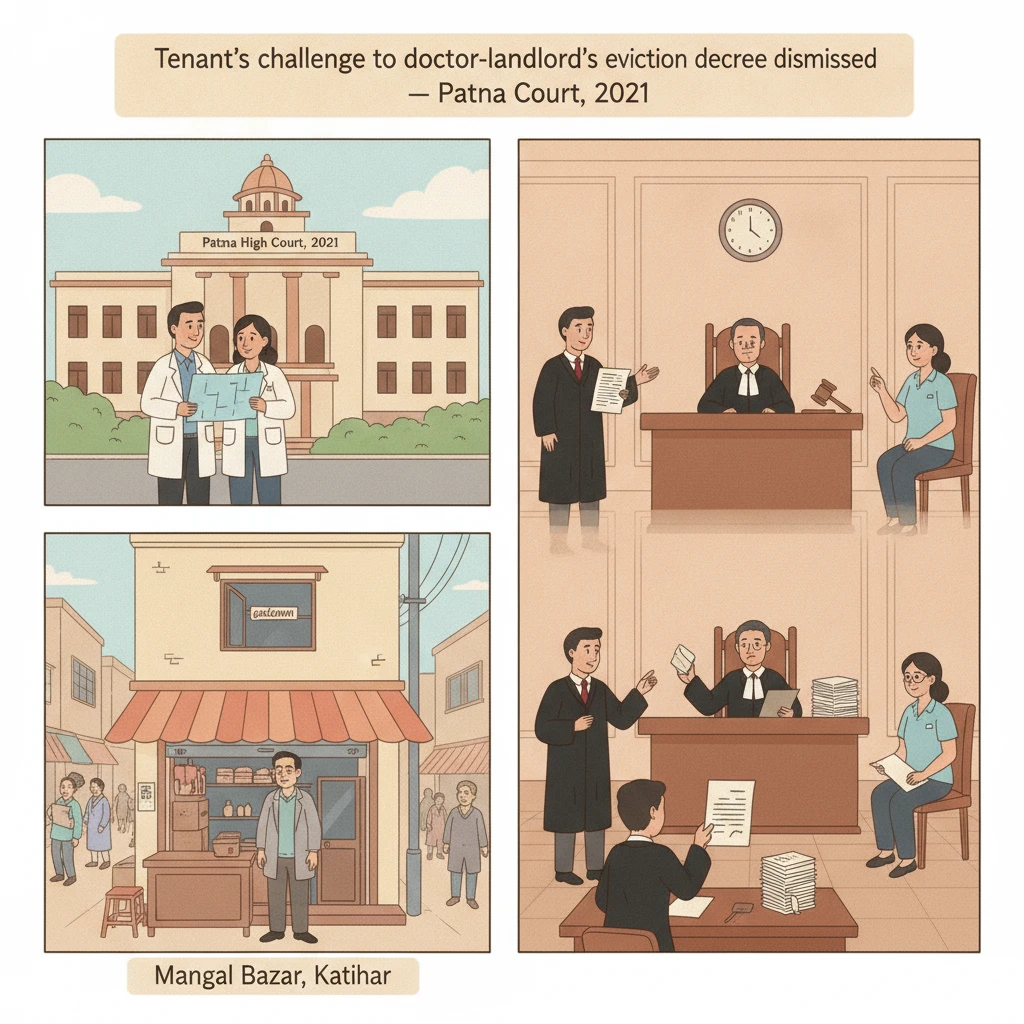
This case arose from a long-running dispute between a tenant running a shop in Mangal Bazar, Katihar, and his landlord, a medical practitioner.
The suit premises is a double-storied shop, with a total area of about 628 square feet, including 340 square feet on the ground floor. It is situated in the busy Mangal Bazar area of Katihar. The property was purchased by the original landlord through a registered sale deed dated 06.12.2005. After purchase, Jamabandi and holding were created in his name.
Later, in a family arrangement dated 11.06.2008, the suit premises was allotted to his son, who is opposite party no. 2 in the case. After this arrangement, the premises was recorded and mutated in the name of opposite party no. 2 in the records of the State Government and the Katihar Municipal Corporation.
Opposite party no. 2 and his wife are medical practitioners. They claimed that they needed the suit premises to open a medical clinic. According to them, this shop, being in the middle of town and near a hospital, was ideally located for their medical practice.
The tenant was in occupation of one shop on the ground floor and one room above it, which he used as a shop and godown. The landlord had earlier initiated proceedings before the Rent Controller (House Control Case No. 2 of 2007) for enhancement of rent, which was enhanced to Rs. 1920 per month. That rent case was still pending before the Collector, Katihar, after remand by the Commissioner, Purnea.
For eviction, the landlord filed Title (Eviction) Suit No. 1 of 2011 before the Sub-Judge-I, Katihar, under Section 11(1)(c) of the Bihar Building (Lease, Rent and Eviction) Control Act, 1982, on the ground of bona fide personal necessity. On 01.10.2018, the trial court decreed the suit in favour of the landlord.
The tenant then approached the Patna High Court by filing Civil Revision No. 172 of 2018 under Section 14(8) of the 1982 Act, challenging the eviction decree.
During the pendency of this revision, opposite party no. 1 (the original purchaser and father of opposite party no. 2) died on 31.08.2020. Applications were filed under Order 22 Rule 4 and Order 22 Rule 10A of the Code of Civil Procedure regarding substitution and expunging of his name. Since opposite party no. 2, the son and legal heir, was already on record and was the owner of the tenanted premises, the High Court held that the right to sue survived in his favour alone and there was no need to substitute other legal heirs.
What the Court Examined and Decided
The Patna High Court closely examined what the trial court had done, and what evidence had been brought by both sides.
The trial court had framed eight issues. The key issues were: whether there was a landlord–tenant relationship; whether the landlord’s need of the suit premises was bona fide and in good faith; and whether partial eviction could meet that need.
On the landlord’s side, seven witnesses were examined. Opposite party no. 2 himself deposed as P.W. 7. He stated that he is an Assistant Professor in Katihar Medical College, that he obtained his MBBS degree in 2001 and MD in 2011, and that he is entitled to do private practice.
He further stated that he was already doing private practice in different rented shops because he did not have a suitable place of his own. He said that the suit premises, being in the middle of town and near the hospital, was the best suited location for his clinic. He added that his wife is also a doctor, specialized in radiology, and that they wanted to jointly run a clinic from the suit premises.
He also stated that the premises came to him after a family partition, that his name had been duly mutated, and that he was the owner of the premises. He made it clear that he required the whole of the suit premises and that his need could not be met by a partial eviction.
The landlord produced rent receipts, rent receipts issued by the State Government, a power of attorney, panchanama, the sale deed, and original receipts as documentary evidence (marked as Exhibits 01, 01/A, 01/B, 02, 02/A, 02/B, 3, 4, 5 and 6). All prosecution witnesses supported his claim.
On the tenant’s side, nineteen witnesses were examined. The tenant himself appeared as O.P.W. 18. He described the shop as being 10 feet wide and 24 feet long, with a room of the same size above, and said that there were several other tenants occupying shops on the ground floor.
He argued that the premises was in the middle of Mangal Bazar, a crowded area with noise and pollution, and not suitable for a medical clinic. He stressed that the landlord had a large three-storied residential house at Barmasia with sufficient accommodation, and that this house was near the main road where many doctors already ran clinics. According to him, that house was better suited for a clinic.
He further contended that the landlord had other better options in Kunj Niketan Katra, which, according to him, the landlord’s family owned and contained many shops suitable for a clinic. He suggested that the landlord’s real intention was to pressurize tenants to increase rent and, after eviction, to let out the suit shop at a higher rent. He also claimed that the landlord, being an Assistant Professor and with his wife employed in a nursing home, could not legally do private practice.
The tenant produced patta records, a rent agreement, rent receipts and the application to the Rent Controller as documentary evidence (marked Exhibits A, A1, B, B1–B8 and C). Other defence witnesses echoed his stand and denied the landlord’s claimed need for the premises.
After appreciating all this evidence, the trial court concluded that there indeed existed a landlord–tenant relationship. It accepted the landlord’s evidence that he was a medical practitioner entitled to do private practice, that he already practised from rented premises due to lack of his own space, and that the suit premises, being on the main road and centrally located, was ideally suited for his clinic. The trial court found the landlord’s requirement to be bona fide and in good faith.
On partial eviction, the trial court recorded that the landlord’s pleaded and proved case was that he needed the entire premises to run the medical clinic and that his necessity could not be satisfied by evicting the tenant from only a part of it.
In revision, the tenant argued that the landlord’s need was not genuine, relying heavily on the Patna High Court decision in Shakuntala Devi v. Sajjan Kumar Bajoria, 2013 (3) PLJR 395. In that case, the Court had found that the plea of personal necessity was not bona fide where the landlord had other shops available in a market complex yet insisted on evicting a particular tenant without giving any real reason for that specific choice.
The landlord’s counsel, on the other hand, cited several decisions. These included the Supreme Court judgments in Akhileshwar Kumar v. Mustaqim, 2003 (1) PLJR 271, and Savitri Sahay v. Sachidanand Prasad, 2003 (1) PLJR 171. These decisions stress that once the landlord proves bona fide requirement, the Court should not substitute its own choice of premises for that of the landlord, especially in view of Explanation II to Section 11(1)(c) of the 1982 Act, which permits a landlord to choose among his tenanted premises.
The landlord also relied on a Patna High Court decision in Md. Ehsam Rasul v. Munni Devi, 2016 (4) PLJR 20, which in turn drew from the Constitution Bench decision in Hindustan Petroleum Corporation Ltd. v. Dilbahar Singh. These judgments underline that in rent control matters, the revisional court cannot act like a second court of first appeal. It cannot re-assess evidence afresh unless the trial court’s findings are perverse or based on no evidence.
For the issue of partial eviction, the High Court referred to its earlier judgment in Shri Vinod Kumar Gupta v. Pushpa Devi, 2005 (3) PLJR 719. There, the Court had held that after the landlord proves his bona fide need, the burden shifts to the tenant to plead and prove that his requirement can be substantially met by a partial eviction. The tenant must express readiness to accept part of the premises and to show that such partial eviction would still satisfy the landlord’s need. The plea cannot be raised casually at a later stage and is not to be decided by the court on its own.
Applying these settled principles, the Patna High Court noted that the trial court had undertaken an elaborate and careful scrutiny of the evidence before holding that the landlord’s need was genuine. It found no indication that the landlord had vacant and equally suitable alternative shops that he had ignored without reason, unlike the facts in Shakuntala Devi’s case. In the present matter, there was no pleading that other specific shops were vacant or had become vacant during the proceedings and were equally suited for the clinic.
The Court further held that it was not for the tenant to dictate that the landlord should instead use his residential house in Barmasia or some other shop in Katra for the clinic. This would go against the settled principle that the landlord is the best judge of which premises is suitable for his bona fide need.
The High Court accepted that the landlord was already running a clinic from rented premises because he did not have the suit shop available to him. This, in the Court’s view, strengthened the finding that his need was real and not a mere pretext to charge higher rent.
Since there was no material to show that the trial court had committed any legal error, overlooked vital evidence, or recorded perverse findings, the High Court held that there was no ground to interfere in revisional jurisdiction under Section 14(8) of the Act.
Accordingly, the Patna High Court dismissed Civil Revision No. 172 of 2018, thereby upholding the eviction decree in favour of the landlord.
Why This Judgment Matters
This judgment is especially important for tenants and landlords involved in eviction cases based on personal necessity in Bihar.
First, it confirms that when a landlord proves a genuine need to use the rented premises for his own occupation or profession, courts will normally respect that need. Tenants cannot insist that the landlord should shift his business or profession to another property simply because they think it is more suitable.
Second, it shows that in a civil revision under the Bihar Building (Lease, Rent and Eviction) Control Act, the Patna High Court will not re-hear the whole case or re-weigh all evidence. The Court will interfere only if the trial court’s decision is clearly unreasonable or without evidence.
Third, it clarifies that if a tenant wants the court to consider partial eviction (vacating only part of the premises), he must raise that plea in his written statement or evidence and show that such partial eviction will still satisfy the landlord’s need. Without this, the court is not required to explore partial eviction on its own.
For small shopkeepers and professionals, this judgment underlines the importance of carefully putting forward all defences at the trial stage itself. It also warns tenants that allegations of “pressure to increase rent” will not succeed unless backed by clear facts and evidence.
Legal Issues and Answers
-
Issue: Was the landlord’s need for the suit premises to run a medical clinic bona fide and in good faith under Section 11(1)(c) of the Bihar Building (Lease, Rent and Eviction) Control Act, 1982?
Answer: Yes. Both the trial court and the Patna High Court held that the landlord’s requirement was genuine, based on clear oral and documentary evidence, including the fact that he was already running a clinic from rented shops due to lack of suitable own premises. -
Issue: Could the tenant resist eviction by arguing that the landlord should use other properties (such as his residential house or other shops) or by seeking partial eviction of the premises?
Answer: No. The Court held that it is the landlord’s choice which premises to use once his bona fide need is proved, and the tenant cannot dictate alternative sites. The landlord’s evidence showed he required the entire premises, and the tenant failed to satisfactorily establish that partial eviction would meet that need. -
Issue: Did the Patna High Court have grounds, in its revisional jurisdiction under Section 14(8) of the Act, to interfere with the trial court’s eviction decree?
Answer: No. Relying on precedents like Hindustan Petroleum Corporation Ltd. v. Dilbahar Singh and Md. Ehsam Rasul v. Munni Devi, the Court held that the trial court’s findings were based on proper appreciation of evidence and were not perverse, so no interference was warranted.
Cases Cited by the Court
- Shri Vinod Kumar Gupta & Anr. v. Smt. Pushpa Devi & Anr., 2005 (3) PLJR 719
- Shakuntala Devi v. Sajjan Kumar Bajoria, 2013 (3) PLJR 395
- Akhileshwar Kumar & Ors. v. Mustaqim & Ors., 2003 (1) PLJR 271
- Savitri Sahay v. Sachidanand Prasad, 2003 (1) PLJR 171
- Md. Ehsam Rasul v. Munni Devi, 2016 (4) PLJR 20
- Hindustan Petroleum Corporation Ltd. v. Dilbahar Singh, MANU/SC/0738/2014 : 2014 (9) SCALE 657 : 2015 (1) PLJR (SC) 187
- Food Corporation of India & Ors. v. Vishun Properties & Enterprises & Ors., 1995 B.B.C.J. 711 (referred within the quoted passage)
- M/s Bata India Ltd. v. Dr. Md. Qamruzzama, MANU/BH/0328/1992 : 1993 (1) PLJR 87 (referred within the quoted passage)
Case Details
Case Number: Civil Revision No. 172 of 2018
Case Title: Dilip Kumar Agrawal v. Kamakhya Prasad & Anr.
Citation: 2022 (1) PLJR 290
Court: High Court of Judicature at Patna
Coram: Hon’ble Mr. Justice S. Kumar
Date of Judgment (Civil Revision): 17.02.2021
Advocates:
- For the Petitioner (Tenant): Mr. Bimlendu Mishra, Advocate
- For the Opposite Parties (Landlord and others): Mr. Pramod Kumar Sinha, Advocate; Mr. Gyan Prakash Ojha, Advocate; Mr. Uday Shankar Pandey, Advocate; Mr. Chetan Kumar, Advocate
Nature of the Case: Civil revision under Section 14(8) of the Bihar Building (Lease, Rent and Eviction) Control Act, 1982, challenging an eviction decree passed in a Title (Eviction) Suit based on landlord’s bona fide personal necessity.
Link to Full Judgment: Patna High Court Judgment in C.R. No. 172 of 2018
If you found this explanation helpful and wish to stay informed about
how legal developments may affect your rights in Bihar,
you may consider following Samvida Law Associates for more updates.
Meta Description: Patna High Court upholds an eviction decree in favour of a doctor-landlord, confirming bona fide need for a clinic and limiting revisional interference.
Focus Keyword: bona fide personal necessity Patna High Court
Permalink: patna-high-court-eviction-bona-fide-necessity-medical-clinic
Image Alt Text: Exterior view of Patna High Court building illustrating a landlord-tenant eviction dispute.
Image Caption: Patna High Court judgment upholding eviction for a doctor’s clinic on grounds of bona fide personal necessity.







