
Case Background
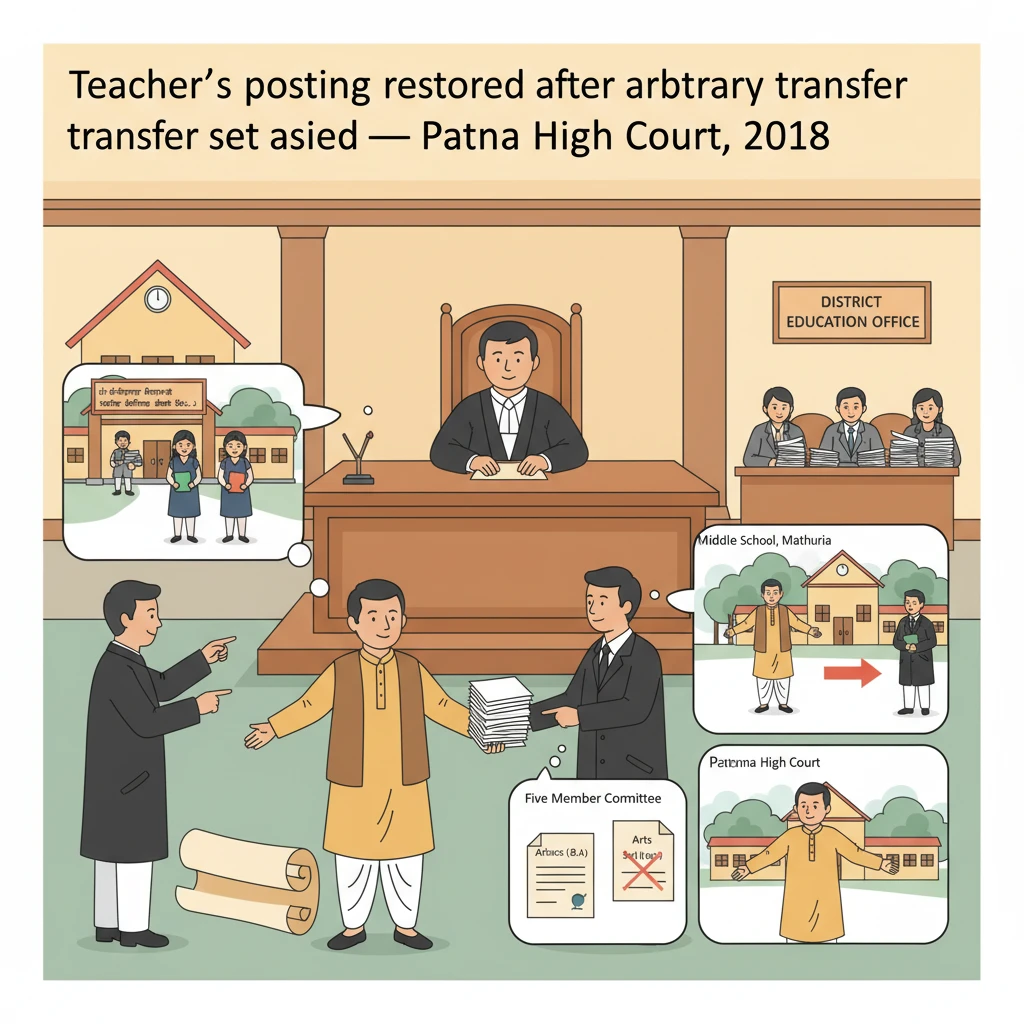
The case arose from a dispute about a single Graduate Trained Teacher post in a middle school at Mathuria, Biharsharif, in Nalanda district.
The petitioner was initially working as a Matric Trained Teacher in this Middle School, Mathuria. After he obtained the qualification required for a Graduate Trained Teacher, he was promoted along with several others by order dated 29.11.2012.
However, instead of continuing in his existing school on the Graduate Trained post, he was posted to Uttrakramik Madhya Vidyalaya, Shahabad at Katrisarai. At the same time, respondent no. 7 was posted as Trained Graduate Teacher in the petitioner’s earlier school at Mathuria.
The petitioner was aggrieved by this shifting. He approached the Patna High Court earlier in C.W.J.C. No. 705 of 2013. That writ petition was disposed of on 17.01.2014 with certain observations, noting that the issue of availability of a sanctioned Graduate Trained post in the concerned school was under consideration.
When, despite this order, the authorities did not resolve the matter and did not act on his repeated representations, the petitioner filed the present writ petition (C.W.J.C. No. 14612 of 2015). He challenged the decisions of the District Education Officer and the District Programme Officer (Establishment) relating to the identification and allotment of Graduate Trained posts in the district, particularly for Middle School, Mathuria.
What the Court Examined and Decided
The petitioner sought multiple reliefs. First, he asked for quashing Letter No. 64 dated 19.02.2014 issued by the District Education Officer, Nalanda, by which the report dated 09.09.2013 of an Internal Five Member Committee regarding verification and identification of B.A./B.Sc. Trained scale posts in middle schools was rejected.
Second, he sought quashing of a sanctioned and vacant post list (Annexure-11) prepared by respondent no. 5 (District Programme Officer, Establishment, Nalanda) for Biharsharif Nagar Nigam area, which showed the B.Sc./B.A. trained teacher posts.
Third, he requested a declaration that in Middle School, Mathuria, a B.Sc. (Science) Trained post had been sanctioned and available since 1980 and that there was no B.A. (Arts) Trained post in that school. Based on that, he claimed a right to be posted as B.Sc. Trained Teacher in that school, with all consequential promotion benefits from 29.11.2012.
He also complained that his various representations (dated 28.04.2014, 08.08.2014, 08.12.2014 and 15.06.2015) were not considered or disposed of by the authorities.
The central factual dispute was simple: whether the sole Graduate Trained post in Middle School, Mathuria, was a Science post or an Arts post.
The petitioner’s case was that:
- There was only one sanctioned Graduate Trained post in the school.
- From 1981 onwards, that post had always been filled by a Graduate Trained Science Teacher.
- Official records, including Annexure-13 and portions of the Five Member Committee’s own report, showed that this post was treated as a Science post under an official letter (Letter No. 4540 dated 30.03.1988).
- Orders of the State Information Commission in 2018 also recorded that the single post in the school was not reserved for a Graduate Arts Teacher.
On this basis, the petitioner argued that transferring him, a Graduate Trained Science Teacher, out of Middle School, Mathuria, and bringing in respondent no. 7, a Graduate Trained Arts Teacher, on that single Graduate Trained post was arbitrary, illegal, and mala fide.
The State’s counsel relied mainly on one noting in the Five Member Committee report dated 06.09.2013. That noting mentioned that the Graduate Trained Teacher post in the school was in the subject of Arts. However, apart from this, the State could not produce any document to show that the sanctioned post was ever meant for Arts.
The Court closely examined the competing materials.
First, the Court noted that there was an official document on record showing that from March 1981 up to September 2012, the single Graduate Trained post in Middle School, Mathuria, had been continuously filled by a Graduate Trained Science Teacher. There had been no objection, demur or controversy about this for over three decades.
Second, the Court referred to the minutes of the Five Member Committee itself. In those minutes, the Committee had recorded details of a letter (Letter No. 4540 dated 30.03.1988) under which a Graduate Trained Science Teacher post was shown for the school.
Third, the Court took note of the orders of the State Information Commission in 2018. Those orders clearly recorded that there was no post reserved for a Graduate Arts Teacher in Middle School, Mathuria.
Against this background, the only material supporting the State’s stand was a bare noting in the Five Member Committee report dated 06.09.2013 stating that the post was earmarked for Arts.
The Court found this noting to be internally inconsistent and unsupported. In the same report, the Committee had itself cited the official letter showing the existence of a Graduate Trained Science Teacher post. Thus, according to the Court, the very report that mentioned an Arts post simultaneously contained material that falsified that claim.
The Court held that the Committee’s bare assertion that the post was an Arts post was “absolutely without any basis, much less, any justification.” It observed that while there was a specific letter confirming a Graduate Trained Science post in the school, “there is nothing at all to show that the solitary post was of Graduate Trained Arts Teacher.”
On the role of respondent no. 7, his counsel fairly stated that he had simply joined in terms of the impugned order and did not wish to support or justify the State’s stand on merits. He left it to the State and its authorities to substantiate their claim. The Court accepted that respondent no. 7 himself was not at fault; the issue lay squarely with the decision-making of the education authorities.
After considering all the materials, the Court concluded that the impugned orders and the conduct of the authorities “cannot be sustained in law.” It held that the refusal to consider the petitioner’s case for posting in his original school was “totally unjustified, arbitrary and without any justification either on facts or in law.”
Specifically, the Court held that the transfer of the petitioner to another school and the simultaneous posting of respondent no. 7, an Arts Graduate Trained Teacher, on the sole Graduate Trained post in Middle School, Mathuria, on 29.11.2012 was “totally unsustainable.”
As a result, the Court set aside the impugned orders. It directed the education authorities to issue an order posting the petitioner back on the Graduate Trained Teacher post in the school where he had been working prior to 29.11.2012.
Regarding respondent no. 7, the Court left flexibility to the administration. It directed that respondent no. 7 “may be posted in accordance with the Rules or at the post the petitioner was posted upon his promotion, if he so desire.”
The Court fixed a clear timeframe: this exercise was to be completed within three weeks from the date the petitioner produced a copy of the judgment before respondent nos. 4 and 5 (District Education Officer and District Programme Officer, Establishment, Nalanda).
With these directions, the writ petition was allowed.
Why This Judgment Matters
This judgment is important for government school teachers and other public servants in Bihar who face transfers or postings that appear to ignore long-standing records and sanctioned posts.
The Patna High Court emphasised that authorities cannot suddenly re-label a post as belonging to a different subject or category without any supporting documentation, especially when the post has been consistently treated in a particular way for decades.
For teachers, it shows that if a post is historically and officially recognised for a particular subject, they can challenge arbitrary changes that dislodge them in favour of someone from another subject without legal basis.
For administrators, it is a reminder that internal committee notings cannot override clear official letters, past practice, and independent findings such as those of the State Information Commission.
The decision also highlights that when representations are ignored and decisions are taken without reason, the High Court can intervene under writ jurisdiction to restore the status quo and protect individual rights.
Legal Issues and Answers
- Issue: Whether the education authorities could treat the sole Graduate Trained Teacher post in Middle School, Mathuria as an Arts post and transfer the petitioner, a Science Graduate Trained Teacher, out of the school while posting respondent no. 7, an Arts Graduate Trained Teacher, in his place.
Answer: No. Based on official records, the post had always been a Graduate Trained Science Teacher post and there was no material to show it was an Arts post; the transfer and posting orders were therefore arbitrary and unsustainable. - Issue: Whether the internal Five Member Committee’s noting that the post was for Arts could justify the authorities’ action.
Answer: No. The Court held that the Committee’s noting was contradicted by its own reference to a letter establishing a Science post and by other official documents, and was thus without any factual or legal basis.
Cases Cited by the Court
- The judgment, as reproduced, does not record any cited or relied-upon case law. The Court decided the matter on the basis of documents and factual records.
Case Details
Case Number: Civil Writ Jurisdiction Case No. 14612 of 2015
Case Title: Sri Awadhesh Kumar Gupta v. The State of Bihar & Ors.
Coram: Hon’ble Mr. Justice Ahsanuddin Amanullah
Citation: 2019 (3) PLJR 562
Date of Judgment: 07.09.2018
Advocates: Names of counsel for the petitioner and for the respondents are not recorded in the extracted judgment.
Nature of the Case: Writ petition under Article 226 of the Constitution of India challenging transfer/posting and related administrative orders concerning a Graduate Trained Teacher post in a government middle school.
Link to Judgment: Click here to read the full judgment of the Patna High Court
If you found this explanation helpful and wish to stay informed about
how legal developments may affect your rights in Bihar,
you may consider following Samvida Law Associates for more updates.







