

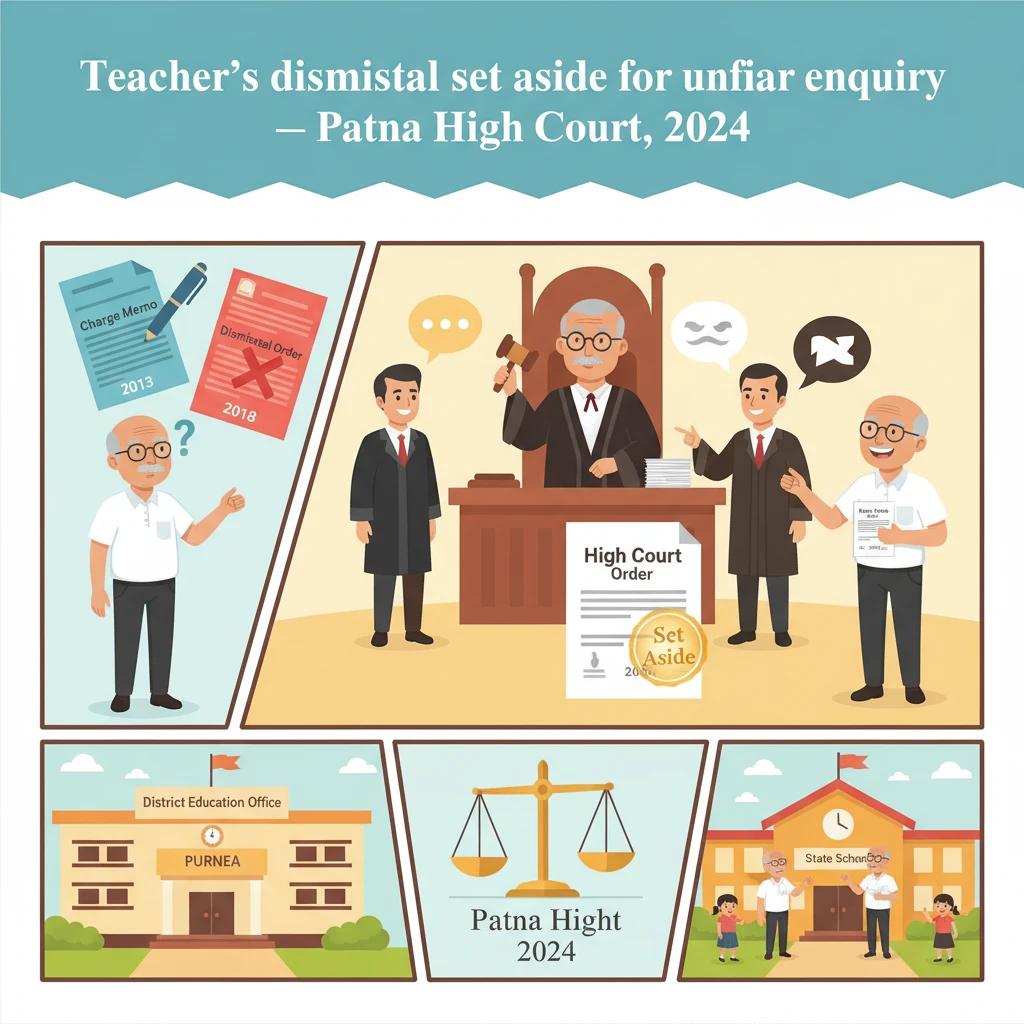
Case Background
The petitioner was appointed as an Assistant Teacher in 1988 and posted in a primary school in Kishanganj district. In 1989, he was transferred to a middle school in Purnea district, where he joined and worked to the satisfaction of the authorities. In 1990, he was given B.Sc. trained scale.
After further transfers, in 2007 he was posted to Middle School, Gulabbag, Purnea East, as Acting Headmaster. He continued to work there when, in September 2013, the District Programme Officer (Establishment), Purnea, issued a memo of charge containing six charges against him. A Programme Officer, SSA, Purnea, was appointed as Enquiry (Conducting) Officer and the Block Education Officer, Sadar Headquarters, as Presenting Officer.
The petitioner objected to the departmental proceeding. By order dated 15.11.2014, the District Education Officer, Purnea, stayed the proceeding. Later, on 12.08.2015, the District Programme Officer (Establishment) set aside this stay and directed that the enquiry be continued based on the 28.09.2013 charge memo.
The petitioner challenged the charge memo and the order dated 12.08.2015 before the Patna High Court in C.W.J.C. No.6845 of 2016. During that writ’s pendency, in September 2017 a supplementary charge memo was issued and an enquiry report was prepared on 13.02.2017. On 09.03.2018, relying on this report, the District Education Officer, Purnea, dismissed the petitioner from service.
The High Court, in C.W.J.C. No.6845 of 2016, by order dated 02.05.2018, held the earlier proceedings to be against law and suffering from procedural impropriety. It directed the authorities to start the departmental proceeding afresh from the stage of examination of witnesses and to conclude it within six months.
When that order was not followed, the petitioner filed a contempt application (M.J.C. No.2012 of 2018). During its pendency, on 11.07.2018, the District Education Officer allowed the petitioner to rejoin his school, placed him under departmental proceeding and stated that a fresh charge memo would be issued. The petitioner rejoined on 12.07.2018 and started receiving salary.
On 16.07.2018, however, the District Education Officer modified his earlier order and decided that no fresh charge memo was needed. A new Conducting Officer (District Programme Officer, Secondary Education, Purnea) and the same Presenting Officer were appointed, with a direction to complete the enquiry within two months.
Thereafter, notices were issued to the petitioner for hearings on 31.08.2018 and 14.09.2018. On 14.09.2018, statements of the petitioner, one former Headmaster and one complainant, Nita (also spelt Neeta) Kumari, were recorded. No further dates were fixed then.
On 03.10.2018, the Conducting Officer prepared an enquiry report and sent it to the District Programme Officer (Establishment). Later, complaint petitions of Nita Kumari dated 20.02.2015 and 12.06.2015 were supplied to the petitioner only on 25.10.2018. Even after submitting his report, the Conducting Officer continued to issue fresh notices and finally sent another report on 24.12.2018.
The District Programme Officer (Establishment) then directed the Conducting Officer to re-examine all documents and resubmit the report, terming the earlier report inappropriate. The Conducting Officer disagreed and suggested that, if not satisfied, another officer could be appointed for fresh enquiry.
Despite having himself doubted the enquiry report, the District Education Officer, Purnea, issued a second show cause notice on 06.02.2019 based on the same report. The petitioner went on medical leave from 28.02.2019, which was sanctioned by the Headmaster. Yet, on 02.03.2019, the District Education Officer passed an order dismissing him from service.
Later, when the petitioner tried to rejoin, he was informed about his dismissal and given a copy of the second show cause notice. He submitted his reply on 13.03.2019. He also filed an appeal on 19.03.2019 before the Regional Deputy Director of Education, Purnea Division, who rejected it on 17.05.2019.
During the present writ proceedings (C.W.J.C. No.4580 of 2020), the Director, Primary Education, dismissed the petitioner’s revision by memo dated 29.07.2020. All these orders were challenged before the Patna High Court.
What the Court Examined and Decided
The Patna High Court, through Hon’ble Mr. Justice Anjani Kumar Sharan, heard both sides. The petitioner attacked the entire departmental enquiry mainly on the ground of violation of Bihar Government Servants (Classification, Control and Appeal) Rules, 2005 (Bihar CCA Rules), particularly Rule 17.
First, the Court noted the petitioner’s argument that the original charge memo dated 25.09.2013 was said to be based on a complaint by his ex-wife, Nita Kumari. However, her complaint was supplied to the petitioner only on 25.10.2018, and the complaint itself carried the date 20.02.2015. This meant the charge memo was issued much before the complaint actually came into existence.
From this, the petitioner argued that the charge memo had been issued without any supporting material. The Court, in its final reasoning, accepted the factual position that the charge memo was framed on 25.09.2013, long before the complaint dated 20.02.2015 was filed.
Second, the petitioner argued that the enquiry violated Rule 17(12) and 17(13) of the Bihar CCA Rules. Under these rules, when the delinquent employee asks for production of documents, the Enquiry Authority must forward the request to the authority holding those documents, who must then produce them before the Enquiry Authority.
The petitioner had specifically requested on 08.09.2018 that he be supplied with the complaint of Nita Kumari so that he could defend himself on the next date. However, on 14.09.2018, without giving him a copy of the complaint, the Enquiry Officer recorded the statements of Nita Kumari and another witness. Because he did not have the complaint, the petitioner could not properly cross-examine her.
The Court took note of this and held that the enquiry was conducted in violation of Rule 17(12). The failure to provide essential documents before recording the complainant’s evidence was treated as a serious procedural defect.
The petitioner also relied on the Supreme Court judgment in Roop Singh Negi v. Punjab National Bank, (2009) 2 SCC 570, to say that departmental enquiries are quasi-judicial proceedings and that documents relied upon must be properly proved by witnesses. Although the High Court’s final reasoning paragraph mainly focuses on the Rule 17 violation and the timing of the complaint versus the charge memo, it recognised that the enquiry as held was not in line with the procedural requirements.
On the other hand, respondent no.6, in his counter affidavit, claimed that the list of charges and list of witnesses had been provided to the petitioner with the charge memo. It was also alleged that the petitioner tried to interrupt the enquiry by filing an unsigned application and by seeking time to answer the charges. The respondents asserted that the petitioner had violated Government Servant Conduct Rules by contracting a second marriage.
Despite these assertions, the Court did not accept that the enquiry was valid. It focused on the admitted procedural lapses. In paragraph 57 of the judgment, the Court clearly recorded that:
“It is admitted fact that the petitioner has not given any document and name of the witnesses and the enquiry itself was conducted in violation of Rule 17 (12) of CCA Rules…”
The Court pointed out again that the memo of charge had been framed in 2013 based on allegations from the ex-wife, but her complaint was given to the petitioner only in October 2018 and bore the date 20.02.2015. This inconsistency supported the petitioner’s stand that the charge memo was issued without proper material.
After considering all submissions and records, the Court concluded that the departmental proceedings, the dismissal order dated 02.03.2019, the appellate order dated 17.05.2019 and the revisional order dated 29.07.2020 could not stand.
In paragraph 58, the Court formally quashed:
- Dismissal order dated 02.03.2019 (memo no.748)
- Appellate order dated 17.05.2019 (memo no.205)
- Revisional order dated 29.07.2020 (memo no.664)
In paragraph 59, the Court held that the petitioner “shall be entitled to get all the consequential benefits including monetary benefits.” This means the service position prior to dismissal is to be restored and the financial loss due to dismissal is to be made good.
Finally, the writ petition (C.W.J.C. No.4580 of 2020) was allowed.
Why This Judgment Matters
This decision of the Patna High Court is important for all government employees, especially teachers and staff working under the Education Department in Bihar.
It shows that even if serious allegations are made against an employee, the department cannot ignore basic rules of fair procedure. Documents relied on in a departmental enquiry must be supplied to the employee in time, and the enquiry must follow Rule 17 of the Bihar CCA Rules.
The judgment also highlights that a charge memo cannot be based on non-existent or later-created complaints. Departmental authorities must have some real material before framing charges.
For employees facing departmental action, this case underlines that they have a right to see the complaint and other documents, and a right to cross-examine witnesses effectively. If these rights are denied, they can approach the Patna High Court, which can set aside dismissal orders and restore service with full benefits.
Legal Issues and Answers
- Issue: Whether the departmental enquiry and dismissal of the teacher were conducted in accordance with the Bihar CCA Rules, 2005, particularly Rule 17(12) and related provisions.
Answer: No. The Patna High Court held that the enquiry violated Rule 17(12) because essential complaint documents were not supplied before examination of the complainant, and the charge memo was issued much before the date of the complaint relied upon. The dismissal, appellate and revisional orders were therefore quashed, with full consequential benefits to the petitioner.
Cases Cited by the Court
- Roop Singh Negi v. Punjab National Bank, (2009) 2 SCC 570, cited by the petitioner to emphasise that departmental enquiries are quasi-judicial and that charges must be proved by proper evidence.
- Managing Director, ECIL v. B. Karunakar, 1993 (4) SCC 727, referred to in the earlier writ proceedings (C.W.J.C. No.6845 of 2016) regarding the requirement to give a copy of the enquiry report and to allow fresh proceedings from the stage of examination of witnesses.
- C.W.J.C. No.7206 of 2016 (Shankar Dayal v. The State of Bihar), cited by the petitioner as a Patna High Court precedent on similar issues of departmental enquiry, as mentioned in the judgment.
Case Details
Case Number: Civil Writ Jurisdiction Case No.4580 of 2020
Case Title: Subodh Kumar Yadav v. The State of Bihar & Others
Citation: 2024(4) PLJR 455
Coram: Hon’ble Mr. Justice Anjani Kumar Sharan
Advocates:
For the petitioner: Mr. Rajeev Kumar Singh
For the respondents: Mr. Subash Chandra Mishra (SC 16)
Nature of the Case: Writ petition (service matter – challenge to dismissal from service and consequential appellate and revisional orders)
Link to Judgment: Click here to read the full judgment of the Patna High Court
If you found this explanation helpful and wish to stay informed about
how legal developments may affect your rights in Bihar,
you may consider following Samvida Law Associates for more updates.







