
Case Background
The petitioner is a Block Teacher posted at a government school in Munger district. She was appointed as a Block Teacher in the year 2005 at Primary School, Parham, Block Jamalpur, District Munger, by Memo No. 348 dated 24.06.2005. She joined her duties on 06.07.2005.
Later, the school was upgraded as Utkramit Middle School, Parham. After she completed two years of service, the Headmaster of the school issued a letter dated 31.05.2008. By this letter, she was directed to attend the Diploma in Primary Education (DPE) programme conducted by Indira Gandhi National Open University (IGNOU).
The petitioner took admission in the DPE programme in July 2008. Her enrolment number was 086362185. She participated in a six days workshop under this programme conducted by IGNOU, and a certificate was issued in her favour for that workshop.
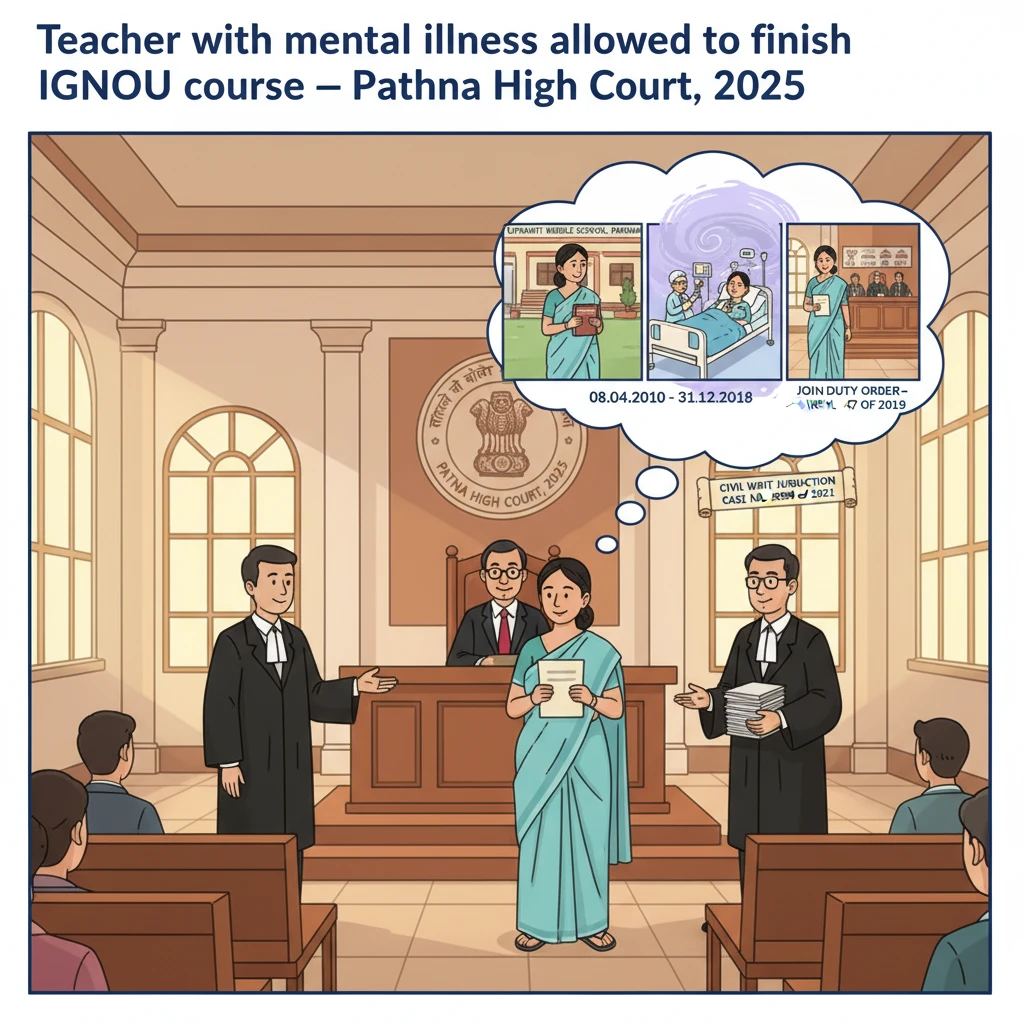
The Court notes that the petitioner completed the Diploma in Primary Education programme, but she could not appear in three specific components: theory paper ES-221, theory paper ES-222 and Practical-1. During the relevant period, she was undergoing treatment at a mental hospital from 08.04.2010 till 31.12.2018.
Because she could not take those exams, her result for those two theory papers and the practical component remained incomplete. According to the judgment, after her recovery from mental illness, even the school authorities did not allow her to join duty.
Faced with this situation, the petitioner filed Appeal No. 47 of 2019 before the District Appellate Authority on 05.03.2019. The appeal was allowed by order dated 26.09.2019, and she was permitted to resume duty in the concerned school.
Despite this relief regarding her job, her educational issue with IGNOU remained unresolved. Therefore, she approached the Patna High Court by filing Civil Writ Jurisdiction Case No. 13994 of 2021. In this writ petition, she requested directions to allow her to appear in the supplementary examination of the DPE course or, alternatively, to declare her passed on the basis of average marks.
What the Court Examined and Decided
The Patna High Court, presided over by Hon’ble Mr. Justice Purnendu Singh, heard the matter on 08.05.2025. The Court noted that the main relief sought was a writ of mandamus to direct the respondents, including IGNOU and the Union of India, to either allow the petitioner to appear in the supplementary examination of the DPE course or to treat her as passed on the basis of average marking.
The Court first recounted the petitioner’s service history and her enrolment in the IGNOU DPE programme. It accepted that she had joined the programme in July 2008 and had participated in the required workshop, for which she had received a certificate.
Critically, the Court focused on the fact that the petitioner was under treatment for mental illness at a mental hospital from 08.04.2010 till 31.12.2018. Due to this prolonged treatment, she could not appear in theory papers ES-221, ES-222 and Practical-1. As a result, her DPE result remained incomplete.
The Court further recorded that, after her recovery from mental illness, the school authorities did not initially permit her to rejoin duty. Her grievance in service was later addressed by the District Appellate Authority, which allowed her appeal and permitted her to resume work by order dated 26.09.2019 in Appeal Case No. 47 of 2019.
Turning to the legal framework, the Court treated the petitioner as a person with mental disability. It held that she was required to be dealt with under the provisions of the Rights of Persons with Disabilities Act (RPwD Act). To support this approach, the Court referred to its own earlier decision in Rabindra Nath Shukla vs. Uttar Bihar Gramin Bank & Ors. (CWJC No. 18853 of 2012), where similar issues of mental disability and adverse service action had arisen.
In that earlier case, the Court had already analysed several Supreme Court decisions concerning persons with disabilities. The present judgment extensively reproduces parts of that analysis, particularly focusing on the Supreme Court’s decision in Ravinder Kumar Dhariwal and another vs. Union of India and others, reported in (2023) 2 SCC 209.
The extract quoted from Ravinder Kumar Dhariwal explains that mental disability need not be the sole cause of alleged misconduct. Even where some residual control exists, mental disability impairs an individual’s ability to meet workplace standards compared to others. Because such persons are more likely to face disciplinary proceedings, the Supreme Court held that initiating disciplinary action against persons with mental disabilities can amount to indirect discrimination.
In that decision, the Supreme Court set aside the disciplinary proceedings and held that the employee was entitled to protection under Section 20(4) of the RPwD Act, including protection of pay, emoluments and conditions of service if reassigned to another post.
The Patna High Court also relied on Kunal Singh vs. Union of India and another, reported in (2003) 4 SCC 524. In that case, the Supreme Court clarified that the then disability law was a special enactment designed to provide equal opportunities and protection of rights to persons with disabilities. Therefore, under the doctrine of generalia specialibus non derogant, general service rules (like pension rules) could not override the specific protections in the disability statute.
The judgment in Kunal Singh, reproduced in the present case, emphasised Section 72 of the disability law, which states that the provisions of the Act are in addition to and not in derogation of other existing laws that benefit persons with disabilities. This reinforced the idea that disability protection must be given full effect.
Further, the Court noted that in Ravinder Kumar Dhariwal, the Supreme Court discussed how Section 47 of the earlier disability law (dealing with employees who acquire disability during service) protects such employees from termination, reduction in rank, or denial of promotion on the ground of disability. The Supreme Court also discussed how new statutes generally apply prospectively but may preserve accrued rights or privileges under Section 6 of the General Clauses Act.
The Patna High Court also reproduced portions of the Supreme Court’s discussion on discrimination under Section 2(h) and Section 3 of the RPwD Act. These provisions require governments to ensure that persons with disabilities are not discriminated against and can live with dignity. The definition of “discrimination” covers any distinction, exclusion or restriction on the basis of disability that impairs the equal enjoyment of rights and includes denial of reasonable accommodation.
Importantly, the Supreme Court’s observations on mental disability and stigma were highlighted. It was noted that persons with mental health issues often hide their illness due to fear of stigma, demotion, loss of job, or harassment. This leads them to avoid seeking necessary treatment and support, worsening their condition.
The Supreme Court had also connected these principles with India’s obligations under the Convention on the Rights of Persons with Disabilities (CRPD), an international human rights treaty. The discussion in that case concluded that disciplinary proceedings against a person with mental disability could amount to discrimination and needed to be set aside, especially when viewed through the lens of substantive equality under Article 15 of the Constitution and the decision in Nitisha vs. Union of India (2021) 15 SCC 125.
After reciting this legal background, the Patna High Court applied the underlying principle to the petitioner’s situation. It observed that the law is well settled that a person with disability cannot be treated on par with normal persons in such matters.
On this basis, the Court held that it had no option but to direct IGNOU to allow the petitioner to complete her course. It specifically directed IGNOU to permit her to complete the remaining components of the DPE, keeping in mind the observations made by the District Appellate Authority in its order dated 26.09.2019 in Appeal Case No. 47 of 2019.
The Court reasoned that the petitioner should not suffer in any manner, especially since she was under mental treatment from 08.04.2010 to 31.12.2018 and, due to that illness, could not appear for theory papers ES-221, ES-222 and Practical-1.
The Court then turned to the consequences for her job. It held that once the petitioner completes her course, the respondent State must not deny her the opportunity to continue with her work.
With these directions to IGNOU and the State, the Court disposed of the writ petition.
Why This Judgment Matters
This judgment is important for teachers and other employees who suffer from serious mental illness during their service and training. The Patna High Court recognised that a person who develops mental disability cannot be treated in the same way as a normal candidate regarding examinations and career conditions.
The Court did not simply say that rules must be followed strictly. Instead, it used disability rights law and Supreme Court precedents to insist that authorities like IGNOU must make reasonable adjustments so that a person is not punished for being ill.
For government teachers in Bihar and elsewhere, the decision shows that long gaps caused by mental illness, especially when certified and treated in a mental hospital, cannot be a ground to permanently block their qualification or service. It reinforces that education bodies and employers must accommodate such special circumstances.
The judgment also signals that, when a District Appellate Authority or similar body has already recognised a teacher’s right to rejoin duty after mental illness, educational institutions should align their decisions with that recognition rather than create new obstacles.
Legal Issues and Answers
- Issue: Whether a Block Teacher who, due to prolonged mental illness, could not appear in certain papers of the IGNOU Diploma in Primary Education programme, can be denied the chance to complete the course like a normal candidate.
Answer: No. The Court held that a person with disability, particularly mental disability, cannot be treated like a normal candidate. IGNOU must allow the petitioner to complete the remaining course components so she does not suffer because of her mental illness. - Issue: After such a teacher completes the pending course requirements, can the State deny her continuation in service on that basis.
Answer: No. The Court directed that once the petitioner completes her course, the respondent State must not deny her the right to continue with her work. - Issue: How should authorities treat employment and training issues involving persons with mental disabilities under the RPwD Act and related case law.
Answer: Authorities must treat such cases under the protective framework of disability law, avoid discrimination, and recognise that persons with mental disabilities are entitled to reasonable accommodation, as elaborated by the Supreme Court in decisions like Ravinder Kumar Dhariwal and Kunal Singh.
Cases Cited by the Court
- Ravinder Kumar Dhariwal and another vs. Union of India and others, (2023) 2 Supreme Court Cases 209
- Kunal Singh vs. Union of India and another, (2003) 4 Supreme Court Cases 524
- M/s Ambalal Sarabhai Enterprises Ltd. vs. M/s Amrit Lal & Co. & another, (2001) 8 SCC 397
- Nitisha vs. Union of India, (2021) 15 SCC 125
- Rabindra Nath Shukla vs. Uttar Bihar Gramin Bank & Ors., CWJC No. 18853 of 2012 (Patna High Court)
Case Details
Case Number: Civil Writ Jurisdiction Case No. 13994 of 2021
Case Title: Lalita Devi vs. The Union of India & Ors.
Citation: 2025 (2) PLJR 879
Coram: Hon’ble Mr. Justice Purnendu Singh
Advocates:
- For the petitioner: Mr. Ashutosh Kumar Verma, Advocate
- For the respondents: Mr. Kundan Kumar Singh, Advocate
Nature of the case: Civil writ petition seeking mandamus regarding IGNOU Diploma in Primary Education (DPE) supplementary examination and consequential service rights.
Court: High Court of Judicature at Patna
Date of Judgment: 08.05.2025
Link to Judgment: Patna High Court Judgment in CWJC No. 13994 of 2021
If you found this explanation helpful and wish to stay informed about
how legal developments may affect your rights in Bihar,
you may consider following Samvida Law Associates for more updates.







