
Case Background
The petitioner is an aspirant for the post of Senior Secondary School Teacher in the subject of Music in government schools in Bihar.
He completed B.A. (Prabhakar) in Vocal (Music) from Prayag Sangit Samiti, Allahabad, and a Post Graduate course in Vocal (Music) from Pracheen Kala Kendra, Chandigarh.
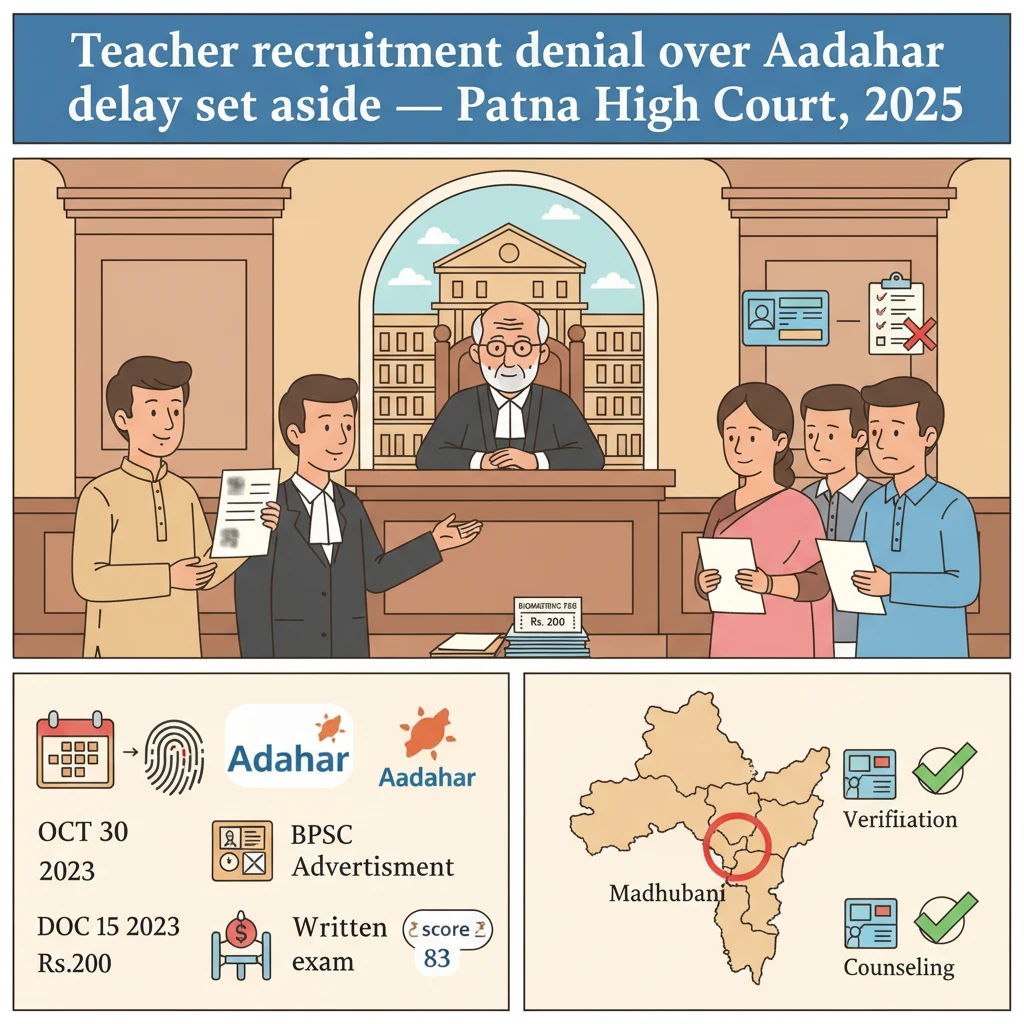
On 30.10.2023, before any recruitment notice, he applied to UIDAI, Government of India, for issuance of an Aadhaar card. The acknowledgement stated that generating the Aadhaar number could take up to 90 days.
On 04.11.2023, the Bihar Public Service Commission (BPSC) issued Advertisement No. 27 of 2023 to conduct Teacher Recruitment Examination-2 (TRE-2) for appointments in government schools across Bihar. For Senior Secondary Music Teachers, 582 posts were advertised, including 71 for Backward Class candidates.
The petitioner, being eligible in Music, applied online. As he did not yet have an Aadhaar card, he mentioned his PAN card number in the identity document column and paid an extra Rs. 200/- as Biometric fee, as permitted by the advertisement.
He was issued an admit card and appeared in the Senior Secondary examination on 15.12.2023. He scored 83 marks. In the merit list, his name appeared at serial number 303 in the unreserved category.
On 25.12.2023, BPSC allotted districts to qualified candidates, and the petitioner was placed in Madhubani district. The district counselling and document verification process started on the same day and was directed to continue until all candidates were covered.
The petitioner appeared for counselling in Madhubani on 28.12.2023 with his PAN card. His Aadhaar card had still not been issued by UIDAI. His document verification was refused solely because he did not possess Aadhaar.
He again approached the authorities on 01.01.2024 and 08.01.2024 but was still not allowed to participate in document verification. He submitted representations to the District Education Officer and other authorities, but there was no relief.
Counselling in the district continued up to 31.03.2024. By that date, the petitioner still did not have his Aadhaar card, and he was never permitted to complete counselling or verification.
Later, on 03.05.2024, his Aadhaar card was finally issued. By then, the TRE-2 process had substantially concluded. Feeling wronged, he approached the Patna High Court under Article 226 of the Constitution.
What the Court Examined and Decided
The petitioner’s core grievance was that despite being fully qualified and more meritorious than many others, he was denied counselling and appointment solely because Aadhaar was not available by the counselling date, although he had applied for Aadhaar even before the advertisement.
His counsel pointed to Clause 10, Note (1) of the advertisement. This clause said that if a candidate did not provide Aadhaar number in the online form, he or she must pay an extra Rs. 200/- for biometric verification. It further said that at the time of verification, it is “expected” that the candidate will provide Aadhaar number and the mobile number linked to Aadhaar. It also recorded that if there is any difficulty in receiving OTP on the mobile number at the time of document verification, the candidate’s eligibility “may be affected.”
On this basis, the petitioner argued that Aadhaar was not made a mandatory condition for counselling or appointment. Instead, the advertisement itself allowed an alternative method of biometric verification through another ID (like PAN) with payment of the additional fee.
He stressed that he had complied fully with this alternative mechanism. He had:
- Applied for Aadhaar on 30.10.2023, before the advertisement.
- Filled in PAN as ID in the online form.
- Paid Rs. 200/- extra for biometric verification.
- Appeared for the exam, undergone biometric verification there, and faced no objection.
Despite this, at counselling his documents were refused only for want of Aadhaar. The petitioner argued that this was illegal and contrary to the recruitment notification itself.
He further submitted that generating the Aadhaar number was not in his hands. UIDAI had indicated a 90-day period, but Aadhaar was actually issued on 03.05.2024, long after the document verification deadline of 30.01.2024. He contended that he could not be made to suffer for this delay, which was entirely beyond his control.
To support his stand that a candidate must not suffer for no fault of his own, he relied on three Supreme Court decisions:
- Narender Singh v. State of Haryana, (2022) 3 SCC 286.
- Kumari Laxmi Saroj & Ors. v. State of U.P. & Ors., Civil Appeal No. 9040 of 2022.
- Shreya Kumari Tirkey v. State of Jharkhand & Ors., SLP (Civil) No. 27139 of 2024.
The State opposed the writ petition. It argued that after declaration of the merit list, districts were allotted, and the counselling process began on 25.12.2023. The petitioner was required to appear in Madhubani with Aadhaar for biometric verification and document scrutiny.
According to the State, since the petitioner had no Aadhaar at that time, his biometric verification could not be done. Though he was allegedly granted opportunities to produce Aadhaar during the counselling period, he failed to do so. The State said that under Clause 10, Note (1), Aadhaar details and a linked mobile number were clearly expected, and difficulties in OTP could affect eligibility.
They also argued that the entire TRE-2 recruitment process had been completed and even TRE-3 was over. At this late stage, granting relief to the petitioner would disturb the concluded recruitment.
The BPSC supported the stand of the State to the extent of saying that its role ended with conducting a fair examination, publishing results, and allotting districts. It highlighted that there was no allegation of irregularity in the exam or result process.
The Court first considered the general principle that courts cannot ordinarily relax or modify recruitment instructions issued in an advertisement. It referred to State of T.N. v. G. Hemalathaa, (2020) 19 SCC 430, where the Supreme Court stressed strict adherence to terms and conditions of an advertisement.
However, the Court then closely read Clause 10, Note (1) of the advertisement. It noted that the clause did not make Aadhaar compulsory. Instead, it created an additional biometric fee route specifically for candidates who did not provide Aadhaar details in the online application.
The Court held that the language of the clause showed that providing Aadhaar number and a linked mobile number at the time of verification was only an expectation for convenience, not a hard condition whose breach automatically cancels candidature.
The Court then examined the factual timeline. The petitioner had:
- Applied for Aadhaar before the advertisement date.
- Been allowed to apply using PAN for ID.
- Paid the additional biometric fee of Rs. 200/-.
- Appeared in the exam after undergoing biometric verification.
- Scored 83 marks and placed at serial number 303 in the unreserved merit list.
- Been allotted a district.
Thus, at every stage until counselling, the authorities themselves had treated him as eligible. There was no question about his educational qualifications, identity, or merit.
The Court emphasised that the delay in issuance of Aadhaar was entirely on the part of UIDAI and beyond the petitioner’s control. It observed that the case clearly showed that the petitioner was not at fault.
Next, the Court applied the principles from the Supreme Court decisions cited by the petitioner.
In Narender Singh, a candidate could not produce a No Objection Certificate from his employer in time because the employer delayed issuing it. Although he was more meritorious than the last appointed candidate, he was denied appointment. The Supreme Court held that he could not be punished for no fault of his and directed that he be appointed.
In Kumari Laxmi Saroj & Ors., the appellants for the post of Health Worker (Female) in Uttar Pradesh had applied for registration with the U.P. Nurses and Midwife Council before the advertisement but did not receive it in time. Their candidature was rejected. The Supreme Court held that there was no fault on their part and that they could not be made to suffer due to the Council’s delay. The Court expressly stated that where there is no lapse by the candidate, he or she cannot be punished.
In Shreya Kumari Tirkey, a candidate who had cleared prelims, mains and interview was rejected for missing a medical examination date because of confusion about the schedule. The Supreme Court observed that medical examination relates only to fitness, not merit, and that candidates from marginalised communities should not be pushed out at the threshold due to procedural hurdles. The Court held that she ought to have been dealt with leniently.
The Patna High Court read these three rulings together to extract a clear principle: when a candidate has fulfilled all substantive requirements and demonstrated merit, and any lapse arises from circumstances beyond his control, he should not be denied appointment on a purely procedural ground, especially where the recruitment rules themselves permit flexibility.
Applying this reasoning, the Court held that the denial of counselling and document verification to the petitioner, solely for non-production of Aadhaar, was unjustified and contrary to the advertisement’s terms.
The Court also kept in mind the constitutional guarantees under Articles 14 and 16, which require equal opportunity in public employment and non-arbitrary treatment of candidates.
Ultimately, the Court allowed the writ petition. It directed respondent authorities, particularly the Director, Secondary Education (respondent no. 2) and the District Education Officer, Madhubani (respondent no. 4), to complete the petitioner’s document verification within eight weeks of receiving the Court’s order.
They were further directed to allot him a school against any vacant post of Senior Secondary Music Teacher.
The Court recognised that some vacancies may have been carried forward to future recruitment. It therefore ordered that if the vacant post of Senior Secondary Music Teacher has been forwarded for fresh recruitment or a subsequent advertisement, the petitioner’s appointment shall still be made against an existing vacant post.
On seniority and service benefits, the Court provided that the petitioner will be treated at par with the last appointed candidate for Senior Secondary Music Teacher under the unreserved category, but without past monetary benefits. This means he will not receive back wages for the period for which he was wrongly kept out, but his seniority and related service benefits will not suffer.
Why This Judgment Matters
This judgment is significant for teacher recruitment and similar public appointments in Bihar and beyond.
First, it clarifies that where an advertisement itself offers an alternative route for identification and biometric verification, authorities cannot later insist on Aadhaar as if it were mandatory. Candidates who follow the alternative route cannot be pushed out at the counselling stage.
Second, it reinforces the principle that candidates should not lose a hard-won government job opportunity because of delays by external agencies like UIDAI or registration councils. If the candidate has acted diligently and in time, he or she should not be punished.
Third, the judgment aligns Patna High Court practice with Supreme Court rulings in Narender Singh, Kumari Laxmi Saroj, and Shreya Kumari Tirkey, all of which protect meritorious candidates from harsh procedural rejections.
For aspirants to government posts, especially in large recruitments like TRE-2, this decision offers reassurance that courts will intervene where authorities ignore their own rules and cause injustice.
Legal Issues and Answers
- Issue: Can an otherwise successful and eligible candidate for government teacher recruitment be denied counselling and appointment solely for not having an Aadhaar card on the counselling date, when the advertisement provided an alternative biometric process?
Answer: No. The Patna High Court held that Aadhaar was not a mandatory condition under Clause 10, Note (1) of the advertisement. As the petitioner had followed the permitted alternative process, and the delay in Aadhaar issuance was beyond his control, he could not be denied counselling or appointment on this ground. - Issue: Is it permissible to grant appointment after completion of the recruitment process when non-appointment resulted from a procedural hurdle not attributable to the candidate?
Answer: Yes. Relying on Supreme Court precedents, the Court directed verification of the petitioner’s documents and his appointment against a vacant post of Senior Secondary Music Teacher, with seniority on par with the last appointed candidate but without back wages.
Cases Cited by the Court
- State of T.N. v. G. Hemalathaa, (2020) 19 SCC 430.
- Narender Singh v. State of Haryana & Ors., (2022) 3 SCC 286.
- Union of India v. Mahendra Singh, 2022 SCC OnLine SC 909.
- Cherukuri Mani v. Chief Secretary, Government of Andhra Pradesh (referred to in Mahendra Singh).
- Kumari Laxmi Saroj & Ors. v. State of U.P. & Ors., Civil Appeal No. 9040 of 2022.
- Shreya Kumari Tirkey v. State of Jharkhand & Ors., SLP (Civil) No. 27139 of 2024.
Case Details
Case Number: Civil Writ Jurisdiction Case No. 16208 of 2024
Case Title: Deo Narayan Yadav v. The State of Bihar & Ors.
Citation: 2026 (1) PLJR 60
Court: High Court of Judicature at Patna
Coram: Hon’ble Mr. Justice Harish Kumar
Date of Judgment: 25.11.2025 (uploaded on 27.11.2025)
Advocates:
- For the petitioner: Mr. Shashank Chandra, Advocate
- For the State respondents: Mr. Standing Counsel (4) and Mr. AC to SC-4
- For BPSC: Mr. Sanjay Pandey, Advocate and Mr. Nishant Kumar Jha, Advocate
Nature of the Case: Writ petition under Article 226 of the Constitution of India challenging denial of counselling and appointment in TRE-2 recruitment for Senior Secondary Music Teacher on the ground of non-production of Aadhaar card.
Link to Judgment: Click here to read the full judgment of the Patna High Court
If you found this explanation helpful and wish to stay informed about
how legal developments may affect your rights in Bihar,
you may consider following Samvida Law Associates for more updates.







