

Case Background
The writ petition was filed by the Bihar Combined Entrance Competitive Examination Board before the Patna High Court. The Board challenged an order dated 29.12.2015 passed by the Commissioner of Income Tax (Exemptions), Patna.
The challenged order related to the assessment year 2014-15. The Board had applied for approval under Section 10(23C)(vi) and (via) of the Income Tax Act, 1961. This approval, if granted, would allow its income to be exempted from income tax.
The Commissioner of Income Tax (Exemptions) rejected the Board’s claim for exemption. The reasons are not reproduced in detail in the judgment, but the High Court records that the authority had concluded that the Board was not an “educational institution” as understood in law.
Aggrieved by this rejection, the Board approached the Patna High Court through Civil Writ Jurisdiction Case No. 2106 of 2016. The petition sought quashing of the order dated 29.12.2015 and a direction to grant approval under Section 10(23C)(vi) and (via). It also asked for any other relief to which it might be entitled.
What the Court Examined and Decided
The Division Bench, comprising Hon’ble the Chief Justice and Hon’ble Mr. Justice S. Kumar, heard both sides at length. The oral judgment was delivered on 16.12.2021.
The main question before the Patna High Court was simple and focused: whether the Bihar Combined Entrance Competitive Examination Board was entitled to exemption under Section 10(23C)(vi) of the Income Tax Act, 1961.
The Court reproduced the relevant part of Section 10(23C)(vi). This provision exempts from income tax the income received on behalf of “any university or other educational institution existing solely for educational purposes and not for purposes of profit”, subject to approval by the prescribed authority.
Thus, for the petitioner to succeed, the Board had to show that it existed solely for educational purposes, not for profit, and that it was eligible to be approved under this clause.
The Court noted that the impugned order dated 29.12.2015 had rejected the Board’s claim for exemption. While the full reasoning of the Commissioner is not quoted, the High Court highlighted one key finding: the authority below had held that the Board was not an educational institution.
To support its stand, the Board, through its counsel Shri D. V. Pathy, relied on earlier judicial decisions. He referred to a decision of the Patna High Court itself in C.W.J.C. No. 20296 of 2010, Bihar State Text Book Publishing Corporation vs. Commissioner of Income Tax-I, Patna & Anr., decided on 04.09.2020.
He also mentioned an earlier decision in M.A. No.425 of 2010, Bihar State Text Book Publishing Corporation vs. The Commissioner of Income Tax-I, Patna, which had been referred to in that case. In addition, he relied upon a Delhi High Court judgment in Council for the Indian School Certificate Examinations vs. Director General of Income-tax (Exemptions), [2014] 362 ITR 436 (Del).
On the other side, counsel for the respondent, Mrs. Archana Sinha @ Archana Shahi, referred to the Supreme Court’s decision in Visvesvaraya Technological University vs. Assistant Commissioner of Income Tax, (2016) 12 SCC 258. That decision deals with tax exemption claims of educational institutions and universities.
In response, counsel for the Board further relied upon three more Supreme Court judgments: Islamic Academy of Education vs. State of Karnataka, (2003) 6 SCC 697; Assam State Text Book Production and Publication Corporation Limited vs. Commissioner of Income Tax, (2009) 17 SCC 391; and Queen’s Educational Society vs. Commissioner of Income Tax, (2015) 8 SCC 47.
These authorities, as cited by the parties, broadly concern how courts understand “educational institutions”, “charitable purposes”, and “profit motive” for income tax exemptions. However, the Patna High Court did not go into detailed discussion of these cases in the text of this judgment.
Instead, the Bench closely examined the impugned order of the Commissioner. After perusing it, the Court reached a clear conclusion: when the authority held that the petitioner was not an educational institution, it did so without having complete material before it.
The Court specifically recorded that the authority did not have full information on a crucial factual point — whether the Board was generating any profit by taking fees for conducting examinations. In other words, the authority had decided the matter on incomplete facts, especially regarding the nature of fees and whether these led to surplus profits.
This gap in material was central because, under Section 10(23C)(vi), one major requirement is that the institution must exist “solely for educational purposes and not for purposes of profit”. Determining this calls for detailed factual examination, including how fees are collected, how funds are used, and whether any surplus is used for non-educational purposes.
Recognising this weakness, the Court noted that, after some hearing, both sides agreed — were ad idem — that the matter could be sent back to the authority for fresh consideration. The idea was that both parties would be given a fresh chance to place all relevant documents and explanations on record, and then the authority would decide again strictly in accordance with law.
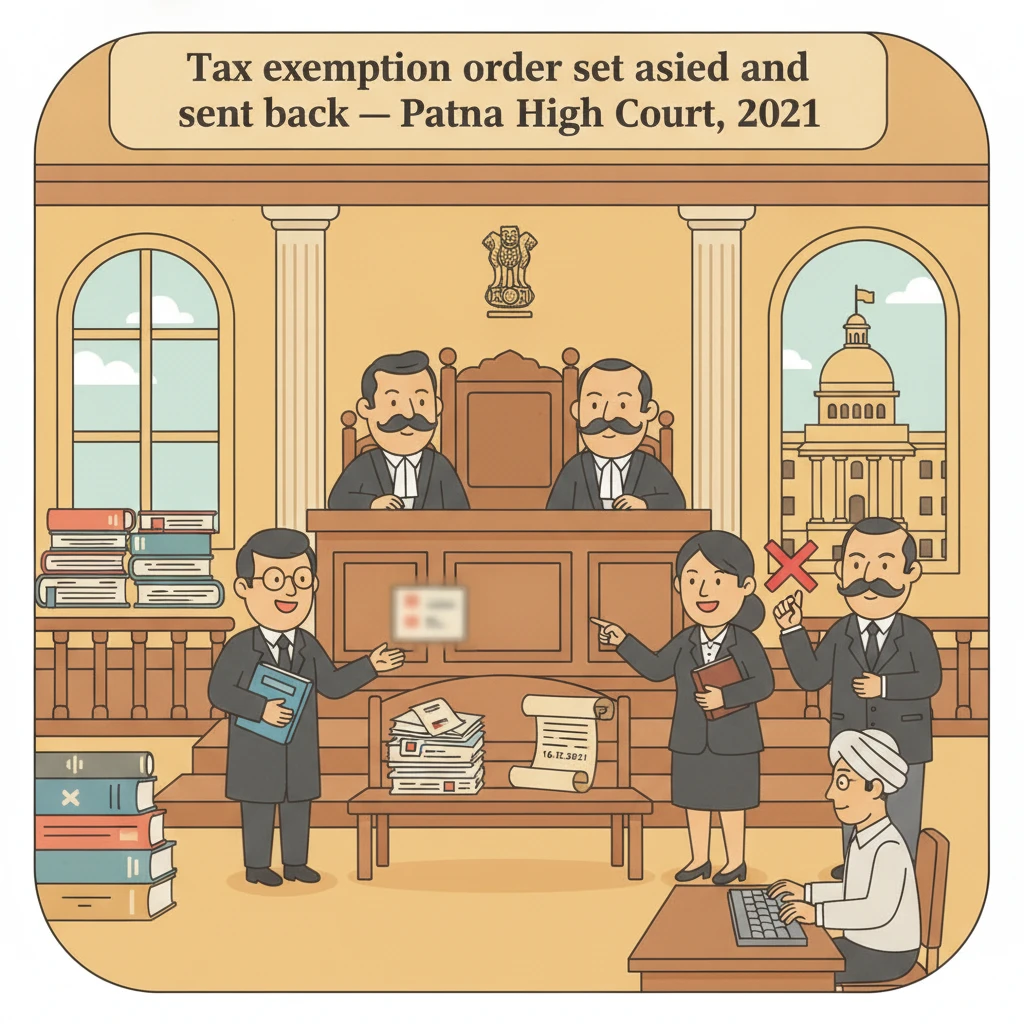
Accepting this consensus, the Patna High Court exercised its writ jurisdiction to set aside the old order and remand the matter. This means the Court did not finally declare whether the Board is or is not entitled to income tax exemption. It limited itself to correcting the procedural defect of a decision made without complete material.
The Court then laid down clear directions:
First, the impugned order dated 29.12.2015 passed by the Commissioner of Income Tax (Exemption), Patna, was quashed and set aside.
Second, the matter was remanded to the appropriate or competent authority for fresh consideration of the Board’s application for exemption.
Third, the Court directed both parties to appear before that authority on 03.01.2022. On that date, the authority is to fix a further date, giving them proper opportunity to bring additional material on record.
Fourth, the authority must give adequate opportunity of hearing to both sides, with full compliance of the principles of natural justice. It must decide the matter afresh by passing a “speaking order”, meaning an order that clearly explains reasons. Copies of this new order are to be given to both parties.
Fifth, if necessary, the proceedings before the authority can be conducted through digital mode.
Sixth, the Court reserved liberty to both parties to take such legal remedies as may be available in future, depending on the fresh order.
Seventh, the Court expressed hope and expectation that the authority would decide the matter expeditiously, preferably within the then current financial year and positively before 31st March, 2022.
Lastly, the Court made it clear that all issues were left open. This is important. It means that the High Court has not given any final finding on whether the Board is an educational institution, whether it runs for profit, or whether it qualifies for Section 10(23C)(vi) exemption. All such questions are for the authority to consider afresh, and, if necessary, for courts to examine later based on the new order.
With these directions, the writ petition was disposed of. Any interlocutory applications in the case were also treated as disposed of.
Why This Judgment Matters
This judgment matters for educational bodies, examination boards, and other organisations in Bihar which seek tax exemption as educational institutions.
First, it shows that the Patna High Court will not allow tax authorities to reject exemption claims without full facts. If an authority decides that a body is not an educational institution without properly examining whether it earns profit and how it uses its income, such an order can be set aside.
Second, the case underlines that questions under Section 10(23C)(vi) are heavily fact-based. Institutions must be prepared with complete records of their income, expenditure, and fee structure to show that they exist for education and not profit.
Third, the Court’s insistence on a speaking order and adherence to natural justice gives comfort to similar institutions. They can expect a reasoned decision after hearing, which can be challenged if still adverse.
Finally, the timeline fixed by the Court pushes for speedy resolution. Tax exemption disputes can affect large public bodies handling education and examinations. Delay can create financial uncertainty. By setting a clear outer limit for the fresh decision, the Patna High Court aimed to reduce such uncertainty.
Legal Issues and Answers
Issue: Was the rejection of the Board’s claim for income tax exemption under Section 10(23C)(vi) and (via) valid when passed without full factual material, including about profit from examination fees?
Answer: No. The Patna High Court held that the authority had decided the matter without complete material and therefore quashed the order, sending the case back for fresh consideration.
Issue: Should the High Court itself decide whether the Board qualifies as an educational institution under Section 10(23C)(vi)?
Answer: No. The Court left all substantive issues open and remitted the matter so that the competent authority could first decide after allowing both sides to place full facts and documents on record.
Cases Cited by the Court
- Bihar State Text Book Publishing Corporation vs. Commissioner of Income Tax-I, Patna & Anr., C.W.J.C. No. 20296 of 2010 (Patna High Court, judgment dated 04.09.2020).
- Bihar State Text Book Publishing Corporation vs. The Commissioner of Income Tax-I, Patna, M.A. No. 425 of 2010 (Patna High Court).
- Council for the Indian School Certificate Examinations vs. Director General of Income-Tax (Exemptions), [2014] 362 ITR 436 (Delhi High Court).
- Visvesvaraya Technological University vs. Assistant Commissioner of Income Tax, (2016) 12 SCC 258 (Supreme Court).
- Islamic Academy of Education vs. State of Karnataka, (2003) 6 SCC 697 (Supreme Court).
- Assam State Text Book Production and Publication Corporation Limited vs. Commissioner of Income Tax, (2009) 17 SCC 391 (Supreme Court).
- Queen’s Educational Society vs. Commissioner of Income Tax, (2015) 8 SCC 47 (Supreme Court).
Case Details
Case Number: Civil Writ Jurisdiction Case No. 2106 of 2016
Case Title: Bihar Combined Entrance Competitive Examination Board vs. Commissioner of Income Tax (Exemptions), Patna
Coram: Hon’ble the Chief Justice; Hon’ble Mr. Justice S. Kumar
Citation: 2022 (1) PLJR 868
Advocates: For the petitioner – Mr. D. V. Pathy, Advocate; Mrs. Manju Jha, Advocate. For the respondent – Mrs. Archana Sinha @ Archana Shahi, Advocate; Mr. Sanjeev Kumar, Advocate.
Nature of the case: Writ petition challenging rejection of approval under Section 10(23C)(vi) and (via) of the Income Tax Act, 1961.
Link to full judgment: Patna High Court Judgment in CWJC No. 2106 of 2016
If you found this explanation helpful and wish to stay informed about
how legal developments may affect your rights in Bihar,
you may consider following Samvida Law Associates for more updates.







