

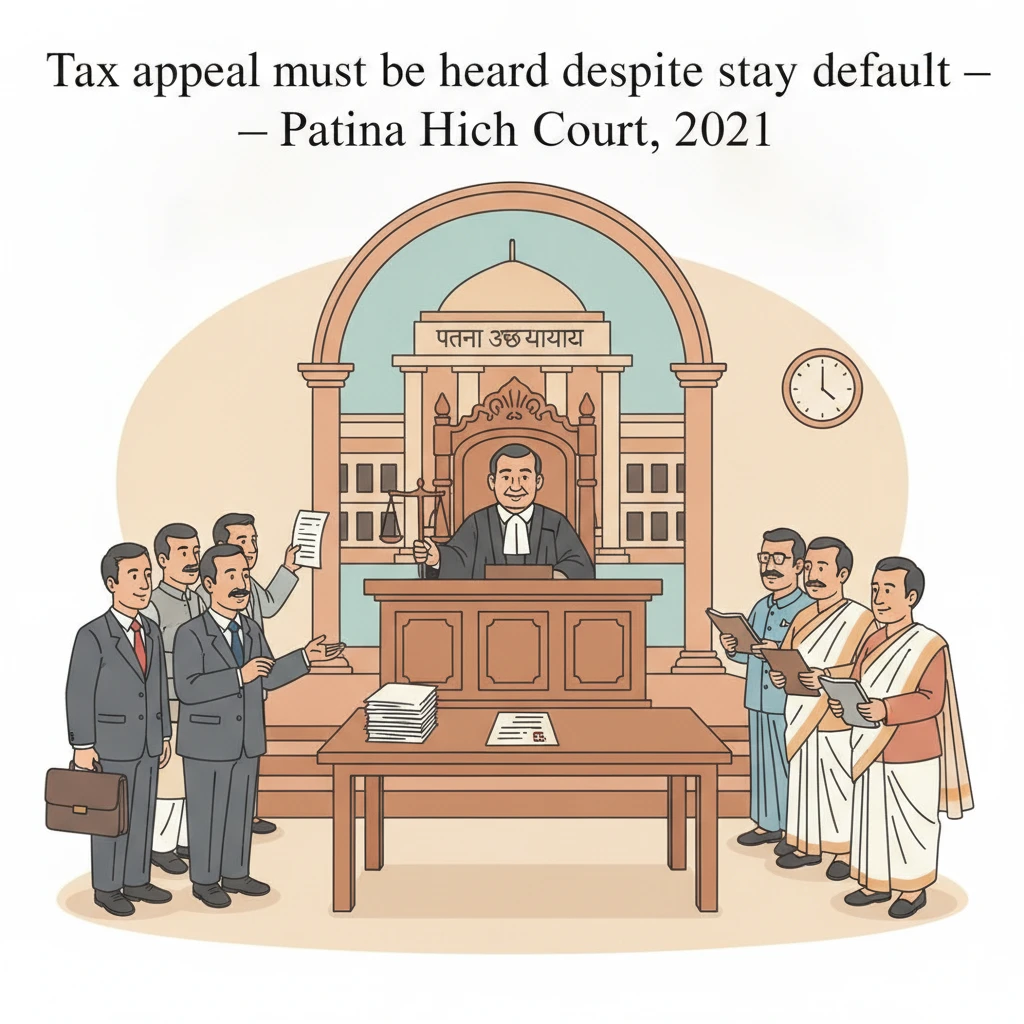
Case Background
The petitioner, a company registered under the Bihar Value Added Tax Act, 2005, was assessed to tax for the financial year 2014–2015.
The assessing authority passed an assessment order on 16 December 2020 and a consequent demand notice on 26 December 2020.
Aggrieved, the assessee filed an appeal under Section 72 of the Bihar Value Added Tax Act, 2005 before the Additional Commissioner of State Taxes (Appeals), Central Division, Patna.
As required by Section 72(2), the assessee deposited 20% of the disputed demand before the appeal was taken up. Along with the appeal, the assessee also filed a stay petition under Rule 46 of the Bihar Value Added Tax Rules, 2005 seeking stay of recovery of the remaining tax, penalty and interest.
On 22 February 2021, the appellate authority passed an order in the stay petition. While granting interim stay for the balance amount, it imposed an additional condition directing the assessee to deposit 40% of the disputed tax and 30% of the penalty and interest, i.e. Rs. 27,15,208/- towards tax and Rs. 1,35,38,175/- towards penalty and interest.
The assessee challenged this part of the order before the Patna High Court by way of a writ petition, seeking quashing of the onerous deposit condition, and a direction to the appellate authority to decide the appeal on merits within a time frame.
What the Court Examined and Decided
The Patna High Court, speaking through the Hon’ble Chief Justice, focused on a single legal question: can a tax appeal under Section 72 be heard and decided on merits if the assessee has not complied with the additional deposit condition imposed in a stay order under Rule 46 of the Bihar Value Added Tax Rules, 2005?
The State’s counsel suggested that the writ petition might have become infructuous because, after the filing of the petition, the appellate authority had started hearing the appeal.
However, counsel for the assessee requested the Court to decide the issue for future guidance, stating that there was a settled practice before the appellate authority of refusing to hear appeals until the conditions in stay orders under Rule 46 were fully complied with, even when the statutory pre-deposit under Section 72(2) was already made.
The Court therefore examined the relevant statutory provisions of the Bihar Value Added Tax Act, 2005 and the Bihar Value Added Tax Rules, 2005.
Under Section 33 of the Act, the prescribed authority can make assessment or reassessment, including on the basis of audit objections, after giving an opportunity of hearing to the dealer.
Section 72 provides for appeals to the Joint Commissioner or Deputy Commissioner. Importantly, Section 72(2) mandates that no appeal shall be admitted unless the dealer has paid 25% of the tax assessed or the full amount of admitted tax, whichever is higher. Once an appeal is filed within time, the appellate authority has powers under Section 72(4) to confirm, annul, reduce, enhance or modify the order appealed against, and must grant reasonable opportunity of hearing under Section 72(5).
Section 93(2)(zzt) authorises the State Government to make rules prescribing the form and manner of filing an appeal under Section 72. In exercise of that power, the Bihar Value Added Tax Rules, 2005 have been framed.
Rule 45 (not fully reproduced in the judgment) deals with the memorandum of appeal or application for revision. Rule 46 deals with disposal of appeal or revision and, specifically, with stay petitions.
Under Rule 46(1)–(3), an appeal can be rejected if it does not comply with Rule 45 requirements or on other reasonable grounds, but the appellate authority must ordinarily, within thirty days of presentation of the appeal, either admit or reject it after examining the impugned order and the record.
Rule 46(4) lays down the scheme for stay petitions. An appellant seeking stay of recovery of disputed tax, penalty or interest must file a stay petition along with the memorandum of appeal, setting out details of the disputed amounts and reasons. If such a petition is filed and the appeal has been entertained, the appellate or revisional authority must dispose of the stay petition within one month, after giving a reasonable opportunity of hearing.
The appellate authority may stay realisation of the disputed amount, in whole or in part, on such terms and conditions as it deems fit. If the stay is made subject to payment of an amount or furnishing of security, the appellant must comply by the date specified in the order. If the appellant fails to pay the amount required under the stay order by the due date, the order staying recovery stands automatically vacated.
The Court underlined that these provisions clearly create two distinct tracks:
First, admission and hearing of the appeal itself, governed by Section 72 and Rule 46(3), depends only on fulfilment of the statutory pre-deposit requirement of 20% (as noted by the Court, though Section 72(2) uses 25%) or admitted tax, whichever is higher.
Second, grant of interim protection from recovery of the disputed demand, governed by Rule 46(4), is discretionary and can be conditioned on further deposit or security. Non-compliance with such additional conditions only leads to automatic vacation of the stay.
The Court specifically noted that there is no embargo either under Section 72 of the Act or under Rules 45 and 46 preventing the appellate authority from hearing the appeal on merits once the mandatory pre-deposit has been complied with.
The Court held that non-compliance with conditions imposed in a stay order under Rule 46 is at the risk of the assessee. Such default enables the revenue to proceed with recovery of the impugned demand under Section 39 of the Act, which is an independent provision not subordinated to Section 72 or to Rules 45 and 46.
However, this default does not restrict or take away the appellate authority’s power and duty to hear and decide the appeal on merits.
The Court also pointed out that if an assessee fails to comply with the stay order, Rule 46 itself provides for automatic vacation of the stay. This default mechanism is clear and self-executing, and does not justify refusing to hear the appeal.
Further, the Court noted that the Rules cast a specific obligation on the appellate authority to either admit or reject the appeal within 30 days of its presentation. In the present case, no such step was taken within that time. This indicated a broader administrative practice of keeping appeals pending and tying them to compliance with stay conditions, which the Court found contrary to the statutory scheme.
On the facts, the Court recorded that the assessee had challenged the assessment and demand orders dated 16 December 2020 and 26 December 2020, deposited 20% of the disputed demand, and filed a stay petition. The appellate authority’s order dated 22 February 2021 itself acknowledged compliance with the pre-deposit condition.
The assessee admittedly did not comply with the further deposit of 40% tax and 30% penalty and interest ordered as a condition for stay. Instead, it requested the appellate authority to hear the appeal on merits. When the authority did not accede and declined to proceed without such payment, the assessee approached the High Court on 26 March 2021. Only after the writ petition was filed did the appellate authority start hearing the appeal.
In this backdrop, the Court accepted the assessee’s contention that the prevailing practice of not hearing appeals until stay conditions were satisfied was unwarranted in law.
To support its interpretation, the Court referred to the Supreme Court decision in Shyam Kishore and Others v. Municipal Corporation of Delhi and Another, (1993) 1 SCC 22. The relevant passages extracted show that the Supreme Court favoured an interpretation which avoids making the right of appeal illusory, and recognised the appellate authority’s power to manage appeals and payment of disputed tax in a manner that mitigates hardship, without insisting on rigid conditions that might raise constitutional concerns.
Applying this approach, the Patna High Court concluded that the statutory design in the Bihar Value Added Tax Act, 2005 and Rules permits the appeal to be processed independently of compliance with additional stay conditions, and that such an interpretation advances fairness and reduces harassment.
Finally, the Court disposed of the writ petition by issuing broad directions for future conduct of appeals under Section 72:
First, in all cases, the appellate authority under Section 72 must, ordinarily within 30 days of presentation of the appeal as stipulated by Rule 46(3), either admit or reject the appeal.
Second, this duty to admit or reject is to be performed without insisting on compliance with any order passed under Rule 46(4) regarding stay, especially because the Rule itself provides that stay orders are automatically vacated on non-compliance.
Third, the Court saw no justification for keeping appeals pending for years. It directed that all appeals must in any event be decided within six months from the date of presentation.
Fourth, the Court observed that timely disposal of appeals would contribute to economic growth in Bihar and build confidence among litigants. It directed the Principal Secretary-cum-Commissioner, Department of State Taxes, Government of Bihar, to take all steps to ensure that the order is implemented in letter and spirit.
On this basis, the writ petition and any interlocutory applications were disposed of.
Why This Judgment Matters
This judgment is significant for dealers and businesses registered under the Bihar Value Added Tax Act, 2005 who face high tax, penalty and interest demands.
Earlier, many appellants were effectively forced to pay large extra sums beyond the statutory 20% pre-deposit because appellate authorities refused to hear appeals until stay conditions were fully complied with. This made the right of appeal very difficult to exercise for those without sufficient funds.
The Patna High Court has now made it clear that once the statutory pre-deposit is made, the appeal must proceed on merits. Non-payment of additional amounts ordered in a stay petition only allows the department to recover tax; it does not allow authorities to sit on the appeal.
The Court has also set outer time limits: 30 days to admit or reject appeals, and six months to decide them. If followed, this can significantly reduce delay and uncertainty in tax disputes and avoid harassment of assessees.
For lawyers and taxpayers alike, this judgment reinforces that statutory appeal rights cannot be made illusory by administrative practices that add extra hurdles not found in the law.
Legal Issues and Answers
- Issue: Can a tax appellate authority under Section 72 of the Bihar Value Added Tax Act, 2005 refuse to hear an appeal on merits until the assessee complies with additional deposit conditions imposed in a stay order under Rule 46 of the Bihar Value Added Tax Rules, 2005?
Answer: No. Once the assessee has complied with the statutory pre-deposit requirement under Section 72(2), the appellate authority must admit and hear the appeal on merits. Non-compliance with conditions in a stay order only results in vacation of the stay and permits recovery; it does not bar hearing of the appeal. - Issue: What are the time limits for dealing with appeals under Section 72?
Answer: Under Rule 46(3), the appellate authority must ordinarily admit or reject an appeal within 30 days of its presentation. Further, all appeals should be decided within six months from the date of presentation. - Issue: What is the consequence of non-compliance with a conditional stay order passed under Rule 46(4)?
Answer: The stay order automatically stands vacated after expiry of the time allowed for payment or furnishing security, and the revenue may proceed with recovery under Section 39. However, this does not affect the continuation or hearing of the appeal.
Cases Cited by the Court
- Shyam Kishore and Others v. Municipal Corporation of Delhi and Another, (1993) 1 SCC 22.
Case Details
Case Number: Civil Writ Jurisdiction Case No. 8562 of 2021
Case Title: McNally Bharat Engineering Co. Ltd v. The State of Bihar & Others
Coram: Hon’ble the Chief Justice; Hon’ble Mr. Justice S. Kumar
Date of Judgment: 06-12-2021
Citation: 2022(1) PLJR 232
Advocates for the Petitioner: Mr. Gautam Kumar Kejriwal, Advocate; Mr. Atal Bhiari Pandey, Advocate; Mr. Alok Kumar Jha, Advocate; Mr. Harshit Gupta, Advocate
Advocate for the Respondents: Mr. Vikash Kumar, Standing Counsel-11
Nature of the Case: Writ petition challenging conditions imposed in an interim stay order in a statutory tax appeal and seeking directions for hearing and disposal of the appeal.
Link to the Judgment: Patna High Court Judgment
If you found this explanation helpful and wish to stay informed about how legal developments may affect your rights in Bihar, you may consider following Samvida Law Associates for more updates.







