

Case Background
The criminal case started with a tragic incident involving a young married woman, Shilpi Devi. She had married Satya Prakash Tiwari in 2013 as per Hindu customs.
According to the prosecution, within a month of marriage she was allegedly abused and assaulted by her husband and his family members for dowry. She is said to have informed her parents about this.
It was further alleged that her in-laws tried to burn her by pouring kerosene oil. Later, around Makar Sankranti in January 2015, they allegedly tried to kill her by giving her poison. She was admitted to Sadar Hospital, Chapra, and when this news came in the newspaper, her parents took her back to their house.
The prosecution story continues that during the marriage of her brother-in-law, she was taken back to her matrimonial home, and after the marriage, her husband brought her again to her parents’ house as she was pregnant. On 06.08.2015, around 2:00 p.m., at her parents’ house, her husband allegedly entered the room where she was sleeping with her bhabhi, Renu Devi, and fired at her when she objected to his attempt to take away jewellery.
The bullet allegedly hit Shilpi Devi’s right wrist and stomach. When Renu Devi tried to snatch the pistol, she was also shot in her left hand. In the struggle that followed, one shot reportedly hit the husband’s left hand.
On the basis of Shilpi Devi’s statement recorded in injured condition, Manjhi P.S. Case No.164 of 2015 was registered under Sections 341, 323, 307, 326, 498-A and 504/34 IPC. During treatment, Shilpi Devi died. The Investigating Officer then moved to add Section 302 IPC to the FIR.
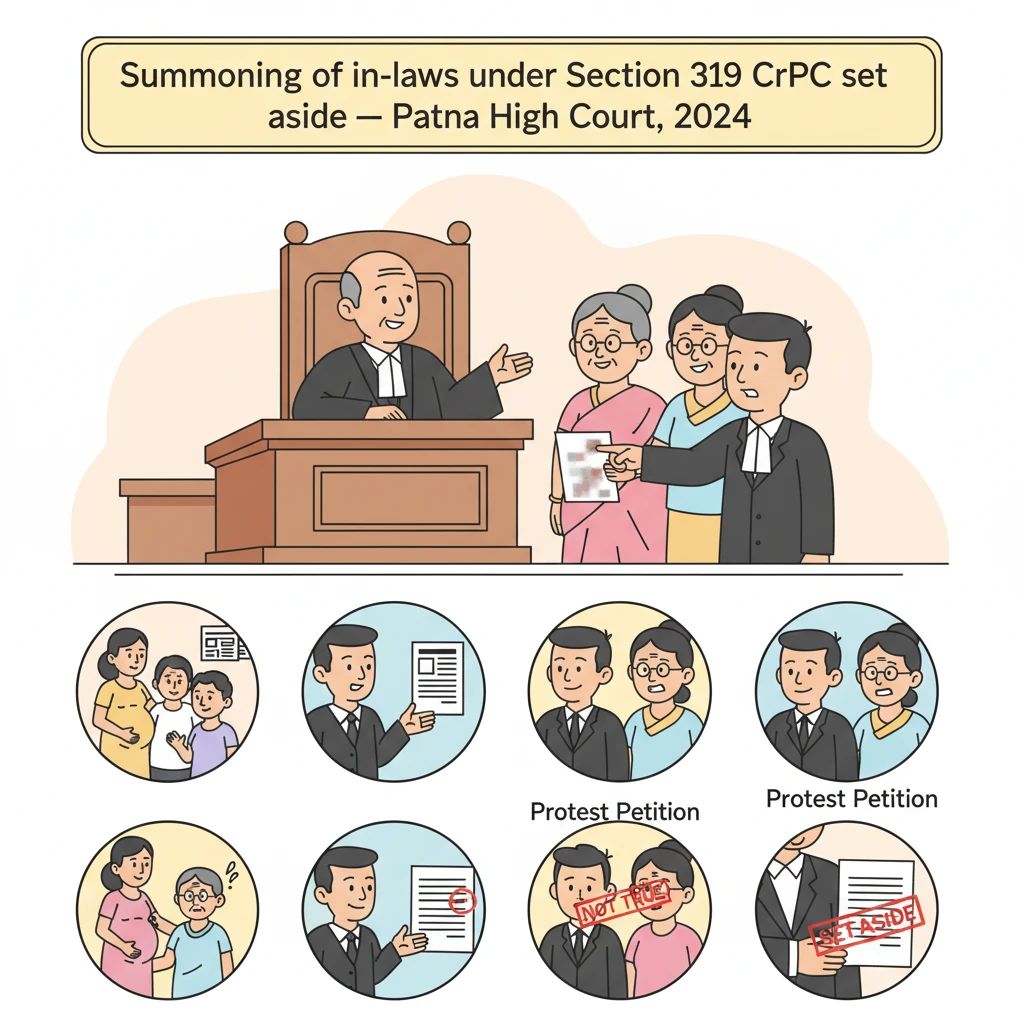
After investigation, on 29.10.2015, police submitted charge-sheet under Sections 307 and 302 IPC and Section 27 of the Arms Act only against the husband, Satya Prakash Tiwari. Investigation against the other family members continued. Later, final form dated 12.06.2016 was submitted holding the case “not true” under Sections 307 and 302 IPC against petitioner nos.2 to 4. The Magistrate accepted this and took cognizance only against the husband on 13.06.2016.
Renu Devi, the injured bhabhi, then filed a protest petition, treated as Complaint Case No.2733 of 2016. On 24.07.2019, the Additional Chief Judicial Magistrate, V, Saran at Chapra dismissed the complaint, holding that there was no specific material or overt act against any accused other than the husband.
Renu Devi challenged this dismissal in Criminal Revision No.199 of 2019 before the District & Sessions Judge, Saran at Chapra, but the revision also failed.
Meanwhile, on 29.05.2018, the Public Prosecutor moved an application under Section 319 CrPC before the Additional District & Sessions Judge VII, Saran at Chapra, seeking to summon the in-laws (including petitioner nos.2 to 4) as additional accused. By order dated 15.11.2022 in Sessions Trial No.467 of 2016, the trial court allowed the application and issued summons to the petitioners for offences under Sections 323, 307, 498-A and 504/34 IPC.
The petitioners then approached the Patna High Court under Criminal Miscellaneous No.25033 of 2023, challenging the summoning order. During the hearing, the application was withdrawn as regards petitioner no.1, and the case continued only for petitioner nos.2 to 4.
What the Court Examined and Decided
The Patna High Court, through Hon’ble Mr. Justice Sandeep Kumar, heard counsel for the petitioners, the State, and counsel for the father of the deceased.
The core question before the Court was: did the trial court properly exercise its power under Section 319 CrPC to summon the in-laws, after they had earlier been exonerated by the police and after a protest complaint and revision had both failed?
Counsel for the petitioners highlighted their personal circumstances. Petitioner no.2 was stated to be a constable in Bihar Military Police, posted in the Special Task Force at Aurangabad, and on duty there on 14.01.2015 and 15.01.2015, around the time of the alleged poisoning on Makar Sankranti. Petitioner no.3 was also a constable in Bihar Police and was similarly on duty on those dates.
They argued that the main allegations related to the shooting incident of 06.08.2015 at the parental house (naihar) of the deceased, where only the husband was present. The direct accusations for firing were only against him. Other allegations, such as torture for dowry and an attempt to poison her on 15.01.2015, had already been considered by the investigating agency. After this evaluation, the petitioners were not sent up for trial, and the final form exonerating them was accepted by the Magistrate.
Further, the protest-cum-complaint and the criminal revision filed by Renu Devi did not succeed. According to the petitioners’ counsel, no new material emerged during the trial beyond what had already been examined earlier. Yet, the trial court summoned the petitioners solely on the basis of Section 319 CrPC.
The petitioners contended that the trial court had mainly relied on the FIR version and on Exhibits 3 and 4, which were medical documents showing that the doctor at Sadar Hospital, Chapra, had found traces of poison in the food. However, there was no discussion in the impugned order as to what in the trial evidence, especially the depositions of witnesses, specifically pointed to the petitioners’ criminal involvement.
They emphasized that Section 319 CrPC is a discretionary, extraordinary power. It must be used sparingly, only when strong and clear evidence appears during trial that a person, not earlier arraigned, seems to have committed the offence and can be tried along with the existing accused. Summons should not be issued merely on suspicion or because a person was named in the FIR.
In support, the petitioners relied on three Supreme Court decisions: Hardeep Singh v. State of Punjab (2014) 3 SCC 92, Brijendra Singh & Others v. State of Rajasthan (2017) 7 SCC 706, and Michael Machado & Others v. CBI (2000) 3 SCC 262. These cases stress that power under Section 319 CrPC requires strong and cogent evidence from trial and must not be exercised casually.
On the other hand, counsel for the father of the deceased supported the trial court’s order. He argued that Shilpi Devi, while pregnant and undergoing treatment, had made a statement on the basis of which the FIR was lodged. Witnesses Chandan Kumar Mishra (PW-1), Vinay Kumar Mishra (PW-2), Hridyanand Mishra (PW-3), Manju Devi (PW-4) and Renu Devi (PW-5) were said to have fully supported the prosecution case in court.
He further pointed out that PW-6 Lalan Ji Pandey had exhibited the informatory petition filed by the deceased and that Exhibits 3 and 4, relating to the doctor at Sadar Hospital, Chapra, recorded traces of poison in the food. According to him, this showed that all the in-laws tortured the deceased and, with common intention, tried to kill her by both kerosene and poison.
He submitted that the Investigating Officer, in collusion with the accused persons, had wrongly filed the final form exonerating the petitioners. The Public Prosecutor’s application under Section 319 CrPC was therefore justified, and the trial court rightly summoned the petitioners, having found sufficient material on record that they were involved in offences under Sections 323, 307, 498-A, 504/34 IPC.
The High Court then examined the legal position on Section 319 CrPC, quoting extensively from the Supreme Court judgment in Michael Machado & Others v. CBI. That decision explains that for invoking Section 319 CrPC, the court must have “reasonable satisfaction” from evidence already collected at trial that another person has committed an offence and can be tried along with the existing accused.
The Court noted that it is not enough if the court merely entertains some doubt. The power is discretionary and must be used only to achieve criminal justice. There is no duty on the court to proceed against every person connected by some evidence. The Supreme Court also warned that adding a new accused requires restarting proceedings against that person from the beginning, re-summoning and re-examining witnesses, and the trial court must carefully consider whether the likely benefit justifies such delay.
The High Court also referred to Brijendra Singh & Others v. State of Rajasthan and summarized the principles from Hardeep Singh. These decisions hold that the “evidence” for Section 319 CrPC means material brought before the court during trial. Material gathered by the Investigating Officer can be used only for corroboration, not as standalone evidence. The power is extraordinary, to be used sparingly, and requires a higher degree of satisfaction than at the stage of framing charge. Only where strong and cogent evidence appears should a person be added as an accused.
Applying these principles, the Patna High Court observed that the petitioners were not charge-sheeted after investigation and that the final form exonerating them was accepted by the Magistrate. Petitioners 2 and 3 are government servants posted elsewhere at the time of the alleged poisoning incident, and petitioner no.4 is a woman, with the main occurrence of firing having taken place at the parental house where only the husband was present and himself injured.
The Court held that merely because petitioner nos.2 to 4 were named in the FIR, and despite the police finding the case false against them, they could not be summoned on the mere basis of witness statements without strong, specific trial evidence of their complicity.
The High Court concluded that this was not a fit case for exercising power under Section 319 CrPC, which must be used sparingly and with caution. It found the impugned order of the trial court unsustainable.
Accordingly, the High Court allowed the criminal miscellaneous application and quashed the order dated 15.11.2022 of the Additional District & Sessions Judge VII, Saran at Chapra in Sessions Trial No.467 of 2016, insofar as it summoned petitioner nos.2 to 4 to face trial in connection with Manjhi P.S. Case No.164 of 2015.
Why This Judgment Matters
This judgment matters because it clearly explains when a court can, and more importantly cannot, add new accused persons under Section 319 CrPC during an ongoing trial.
For families of both victims and accused, the decision shows that being named in an FIR is not by itself enough to be forced to stand trial, especially when after full police investigation and even complaint proceedings, no specific role is found.
The Patna High Court stresses that additional accused can be summoned only on the basis of strong and clear evidence that comes during trial, not on suspicion or general allegations of harassment. It also reminds trial courts to consider the burden of restarting proceedings and to avoid casual use of this extraordinary power.
Practically, this protects individuals from being dragged into long criminal trials without sufficient trial-level evidence, even in sensitive cases like alleged dowry harassment and murder. At the same time, the trial against the main accused, here the husband, continues unaffected.
Legal Issues and Answers
- Issue: Can in-laws who were named in the FIR but not charge-sheeted, and against whom the final form has been accepted and a protest complaint and revision failed, still be summoned under Section 319 CrPC based mainly on earlier allegations and general witness statements?
Answer: No. The Patna High Court held that without strong and cogent trial evidence showing their specific involvement, and where police and courts have earlier found no material against them, they cannot be summoned under Section 319 CrPC merely because they were named in the FIR. - Issue: What level of satisfaction and type of material is required for a court to exercise power under Section 319 CrPC?
Answer: The Court held, following Supreme Court precedents, that Section 319 CrPC is an extraordinary, discretionary power to be used sparingly. It can be used only on the basis of evidence led during trial, requiring stronger and more cogent material than at the stage of framing charge and giving the court reasonable satisfaction that the person appears to have committed the offence and can be tried with the existing accused.
Cases Cited by the Court
- Hardeep Singh v. State of Punjab, (2014) 3 SCC 92
- Brijendra Singh & Others v. State of Rajasthan, (2017) 7 SCC 706
- Michael Machado & Others v. Central Bureau of Investigation, (2000) 3 SCC 262
- Municipal Corporation of Delhi v. Ram Kishan Rohtagi, (1983) 1 SCC 1 (quoted within Michael Machado)
- Y. Saraba Reddy v. Puthur Rami Reddy, (2007) 4 SCC 773 (relied upon by counsel for the father of the deceased as recorded in the judgment)
Case Details
Case Number: Criminal Miscellaneous No.25033 of 2023 (arising out of Manjhi P.S. Case No.164 of 2015; Sessions Trial No.467 of 2016)
Case Title: Nagendra Tiwary & Others v. The State of Bihar
Coram: Hon’ble Mr. Justice Sandeep Kumar
Citation: 2024(4) PLJR 870
Advocates:
- For the Petitioners: Mr. Awadhesh Kumar, Advocate; Mr. Shashikant Amar, Advocate; Mr. Manish, Advocate
- For the State (Opposite Party): Mr. Ram Bilash Roy Raman, APP; Mr. Shashi Bhushan Singh, Advocate
- Counsel also appeared for the father of the deceased (name not specified in the judgment text)
Nature of the Case: Criminal miscellaneous petition challenging an order of the Sessions Court summoning additional accused under Section 319 of the Code of Criminal Procedure in a case involving offences under Sections 323, 307, 498-A, 504/34, 302 IPC and Section 27 of the Arms Act.
Link to Judgment: Patna High Court Judgment – CRIMINAL MISCELLANEOUS No.25033 of 2023
If you found this explanation helpful and wish to stay informed about
how legal developments may affect your rights in Bihar,
you may consider following Samvida Law Associates for more updates.







