

Case Background
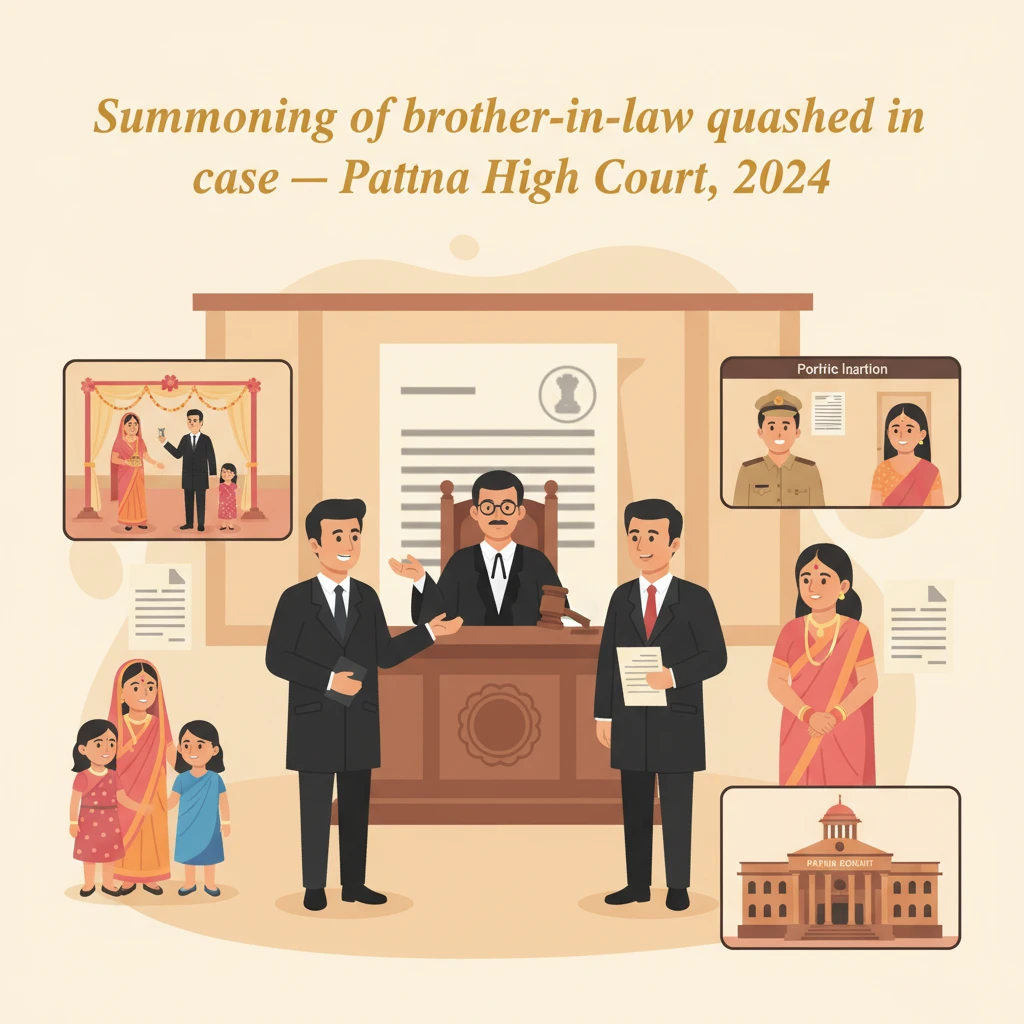
The case arose from a matrimonial dispute in Bhojpur district. The complainant’s marriage with her husband was solemnised on 13.03.2008 as per Hindu rites and rituals.
According to the complaint, soon after marriage, the complainant was subjected to demands for dowry by all accused persons. On non-fulfilment of these demands, she alleged that she was tortured and assaulted in various ways and was finally ousted from her matrimonial home.
The complaint further stated that she was blessed with two girl children. Despite this, her husband allegedly solemnised another marriage with one Sujita Devi, daughter of Jagdish Pandit. On 30.01.2013, she was allegedly thrown out of her matrimonial house after being forced to sign blank papers.
On these allegations, she filed Complaint Case No. 2644 of 2014 in the court at Ara, Bhojpur. The complaint named her husband and in-laws, including the present petitioner, who is her brother-in-law.
During the enquiry in the complaint case, the Magistrate recorded the solemn affirmation of the complainant. Statements of three witnesses, namely Suresh Chandra Singh, Mukesh Kumar and Manju Devi, were also recorded.
On the basis of these statements, the Judicial Magistrate 1st Class, Bhojpur at Ara, by order dated 21.08.2015, took cognizance of offences under Sections 498A, 494, 379/34 of the Indian Penal Code and issued summons to the petitioner and other accused persons to face trial.
The petitioner challenged this order in Criminal Revision No. 178 of 2018 before the learned A.D.J.-3rd, Bhojpur at Ara. On 14.01.2020, the Revisional Court dismissed the revision, finding no infirmity in the Magistrate’s order.
Aggrieved, the petitioner approached the Patna High Court by filing Criminal Miscellaneous No. 26166 of 2021 under Section 482 of the Code of Criminal Procedure, seeking quashing of both the Magistrate’s and the Revisional Court’s orders.
What the Court Examined and Decided
Justice Harish Kumar of the Patna High Court heard the matter. Notice had been validly served on the complainant (opposite party no. 2), but no one appeared on her behalf. The Court heard learned counsel for the petitioner and the learned Additional Public Prosecutor for the State.
The petitioner’s counsel first highlighted his relationship and occupation. The petitioner is the complainant’s brother-in-law and has been serving as a Constable in the Air Force. At the time of hearing, he was posted at Air Force Station, Kanheri Hills. A certificate issued by the Wing Officer of the said Air Force Station was produced through a supplementary affidavit.
The defence then pointed out that, before the present complaint case was filed, the complainant had already lodged a police case. Mahila P.S. Case No. 16 of 2013 was registered on 25.02.2013 under Sections 498A/34 of the Indian Penal Code and Sections 3/4 of the Dowry Prohibition Act, with exactly identical allegations.
In that FIR, after investigation, Final Report No. 11 of 2013 dated 31.03.2013 was submitted. In the final report, the present petitioner and two others were not sent up for trial. A copy of this final report was placed on record as Annexure-2(i).
The petitioner’s counsel drew the Court’s attention to the complaint petition and the solemn affirmation. He argued that, from the complainant’s own statement, all specific allegations of assault, torture and second marriage were directed against the husband. There was no clear, individual allegation describing any overt act by the brother-in-law.
It was also highlighted that, in the complaint petition, the petitioner’s name in the “accused” column appeared to have been added later with a different pen, indicating that he might have been roped in subsequently.
The petitioner further relied on the Revisional Court’s own observation that he was a brother-in-law serving in the Air Force. Despite recognising this, the Revisional Court still upheld the summoning order by treating the alleged cruelty as a “continuing offence” and holding that there was no bar on filing a second case even after a final report in the first case.
The State’s counsel defended the orders of the Magistrate and the Revisional Court. He argued that cruelty and torture on account of dowry demand is a continuing offence. Therefore, even if at one point the involvement of a person was not found, a fresh complaint could be lodged later, and if material existed, the Magistrate could summon such person to face trial.
The State also submitted that, at the stage of issuing process in a complaint case, the Magistrate is not required to consider the defence version or weigh the evidence as if deciding conviction. He is required only to see if the complaint and supporting statements disclose a prima facie case.
After hearing both sides, the High Court carefully examined the complaint petition, the solemn affirmation and the other materials on record. The Court noted that, except for a general or omnibus allegation that “all in-laws” demanded dowry and tortured the complainant, there was no specific act attributed to the petitioner.
The Court also observed that the complaint itself showed the petitioner’s name had been added later in the list of accused, written with a different pen. The solemn affirmation made clear that the entire narrative of cruelty, torture and second marriage revolved around the husband.
Given these facts, the High Court considered it appropriate to revisit the principles laid down by the Supreme Court regarding misuse of Section 498A IPC and indiscriminate roping in of all family members in matrimonial disputes.
The Court referred to the decision in Preeti Gupta & Anr v State of Jharkhand & Anr, (2010) 7 SCC 667. In that judgment, the Supreme Court observed that many complaints under Section 498A are filed on or with the advice of lawyers, and that members of the Bar must treat such complaints as human problems and encourage amicable settlements where possible.
The Supreme Court had further warned that complainants often do not visualise the serious consequences of such complaints, which can cause immense harassment and pain not only to the accused but also to the complainant herself and their families. The Court emphasised that accusations against close relations living in other cities, who rarely visit the matrimonial home, must be scrutinised with great care and circumspection.
The Patna High Court then referred to the recent Supreme Court judgment in Kahkashan Kausar @ Sonam v The State of Bihar, (2022) 6 SCC 599. In that case, an earlier complaint had led to summons only against the husband, while later a second complaint with similar omnibus allegations was filed against the husband and in-laws.
The Supreme Court, after surveying earlier decisions including Rajesh Sharma & Ors v State of U.P. & Anr, Arnesh Kumar v The State of Bihar & Anr, Preeti Gupta & Anr v The State of Jharkhand & Anr, Geeta Mehrotra & Anr v State of U.P. & Anr and K. Subba Rao v The State of Telangana, reiterated its concern over misuse of Section 498A IPC.
The key passages from Kahkashan Kausar, quoted by the Patna High Court, state that general, omnibus allegations against relatives of the husband, without specific material, can amount to abuse of process. Courts have been warned not to proceed against in-laws where no clear prima facie case is made out.
At the same time, the Patna High Court acknowledged the settled law that, at the stage of taking cognizance or issuing summons, the Magistrate primarily looks for a prima facie case and need not assess the ultimate truth of the allegations. However, in matrimonial and family disputes, the Magistrate must still ensure that some specific role or allegation is attributed to each person sought to be prosecuted, because there is a clear tendency to rope in all family members to put pressure on the husband.
Applying these principles, the Court held that there were no specific allegations against the petitioner, who is a brother-in-law serving in the Air Force for a long time. In such circumstances, allowing the prosecution to continue against him would amount to abuse of the process of the Court.
The Court observed that although the High Court’s power under Section 482 CrPC has to be exercised carefully, it is justified in intervening where allegations appear to be made with an oblique motive merely to settle scores. Permitting such prosecution would result in injustice rather than promote justice.
Accordingly, the Patna High Court found merit in the quashing application. It quashed the order dated 14.01.2020 passed by the A.D.J.-3rd, Bhojpur at Ara in Criminal Revision No. 178 of 2018, as well as the order dated 21.08.2015 passed by the Judicial Magistrate 1st Class, Bhojpur at Ara in Complaint Case No. 2644 of 2014, so far as they related to the petitioner.
The quashing application was allowed, and the petitioner stood relieved from facing trial in this complaint case.
Why This Judgment Matters
This judgment is significant for families caught in dowry and cruelty disputes, especially in Bihar. It shows that the Patna High Court will closely examine whether there are specific allegations against each accused, rather than blindly allowing all in-laws to face criminal trial.
For brothers, sisters and other relatives of the husband, the ruling underlines that they cannot be dragged into a 498A case only on the basis of general statements that “all in-laws” demanded dowry or tortured the complainant.
At the same time, the decision does not dilute protection for genuine victims of cruelty. The Court accepts that cruelty and dowry harassment are serious and continuing offences. But where a person is living away, with no clear role described, the Court can use its inherent powers to stop misuse of criminal law.
For lawyers, Magistrates and litigants, the judgment reinforces Supreme Court guidance in cases like Preeti Gupta and Kahkashan Kausar. It stresses careful scrutiny at the initial stage in matrimonial complaints, so that the criminal process is not turned into a tool of pressure or vengeance.
Legal Issues and Answers
- Issue: Can the brother-in-law of a complainant be compelled to face trial under Sections 498A, 494, 379/34 IPC on the basis of general, omnibus allegations without any specific act attributed to him?
Answer: No. The Patna High Court held that in absence of specific allegations or a clear role, particularly where the relative is serving away from the matrimonial home, continuation of proceedings would be an abuse of process and is liable to be quashed under Section 482 CrPC. - Issue: Does the fact that dowry cruelty is a continuing offence prevent filing of a second case or quashing of proceedings against some accused where they were earlier not sent up for trial?
Answer: The Court accepted that cruelty can be a continuing offence and a second case is not automatically barred, but clarified that even then, courts must see whether there is sufficient material and specific allegations against each accused. In their absence, proceedings against such accused can still be quashed.
Cases Cited by the Court
- Preeti Gupta & Anr v State of Jharkhand & Anr, (2010) 7 SCC 667
- Kahkashan Kausar @ Sonam v The State of Bihar, (2022) 6 SCC 599
- Rajesh Sharma & Ors v State of U.P. & Anr (referred)
- Arnesh Kumar v The State of Bihar & Anr (referred)
- Geeta Mehrotra & Anr v State of U.P. & Anr (referred)
- K. Subba Rao v The State of Telangana (referred)
Case Details
Case Number: Criminal Miscellaneous No. 26166 of 2021; arising out of Complaint Case No. 2644 of 2014, P.S. Ara Nawada, District Bhojpur
Case Title: Ajay Anand v The State of Bihar & Anr
Citation: 2024 (4) PLJR 13
Coram: Hon’ble Mr. Justice Harish Kumar
Date of Judgment: 23.08.2024
Advocates: Mr. Manoj Kumar for the petitioner; learned Additional Public Prosecutor for the State; no appearance for opposite party no. 2 despite service
Nature of the Case: Petition under Section 482 CrPC seeking quashing of summoning and revisional orders in a complaint case alleging offences under Sections 498A, 494, 379/34 IPC
Link to Judgment: Patna High Court Judgment
If you found this explanation helpful and wish to stay informed about
how legal developments may affect your rights in Bihar,
you may consider following Samvida Law Associates for more updates.







