

Case Background
This case arises out of a long-running dispute involving Magadh University and certain teaching and non-teaching employees seeking absorption in the University and related service and monetary benefits.
The employees had earlier approached the Patna High Court in CWJC No. 17670 of 2017. By a judgment dated 17.07.2018, a learned Single Judge issued directions to Magadh University regarding examination of their claims. In paragraph 43 of that judgment, the Court made it clear that once the University took a favourable decision, it would calculate the entitlement of such employees and then request the State Government for additional funds so that monetary benefits could be paid.
Thereafter, the matter reached the Division Bench in Letters Patent Appeal (L.P.A.) No. 1556 of 2018 and connected cases. An order was passed in those appeals on 26.09.2022. The State of Bihar, through its Principal Secretaries of Higher Education and Finance Departments, later felt that its financial interests might be affected by implementation of the Single Judge’s order as affirmed or dealt with in the L.P.A.
Instead of waiting for any concrete demand or decision by the University, the State chose to file Civil Review No. 54 of 2023 before the Patna High Court. Through this civil review, the State sought recall of the Division Bench order dated 26.09.2022 passed in L.P.A. No. 1556 of 2018 and connected matters.
The review petition thus placed before the Division Bench the question whether there was any error in the L.P.A. order warranting its recall, and whether the State had any present cause of action to seek such review.
What the Court Examined and Decided
The Division Bench of the Patna High Court, comprising Hon’ble Mr. Justice P. B. Bajanthri and Hon’ble Mr. Justice Rajiv Roy, heard Civil Review No. 54 of 2023. The oral judgment was delivered on 13.03.2024 by Hon’ble Mr. Justice P. B. Bajanthri.
On behalf of the State (the review petitioners), learned counsel argued that the implementation of the Single Judge’s directions would ultimately affect the State’s rights. The concern raised was that if Magadh University granted absorption and monetary benefits to the employees, the financial burden would fall upon the State Government.
In support of this apprehension, counsel for the State specifically pointed to paragraph 43 of the Single Judge’s judgment dated 17.07.2018 in CWJC No. 17670 of 2017. That paragraph was reproduced in the review judgment. It recorded that after the University took a favourable decision on employees’ claims and worked out their entitlement, it would request the State Government for additional funds so that monetary benefits might be extended to the petitioners.
The Division Bench closely examined this paragraph and the scope of the earlier orders. The Court emphasized that the direction in paragraph 43 was clearly addressed to the University, not to the State. The University was first required to make its own decision on whether the concerned employees were entitled to absorption in service, and, depending on that decision, to compute their service benefits.
Only after this exercise by the University would any question arise of the State being requested to provide additional funds. Thus, the Court highlighted that the State’s role and responsibility were conditional and had not yet started.
The Bench observed that the State, as appellant and now review petitioner, had “no cause of action” to file the L.P.A. itself, because there was no specific direction against the State in the Single Judge’s order. The instructions contained in the judgment were addressed to Magadh University. The University alone was required to determine whether the respondents were entitled to absorption and to fix their service conditions and monetary benefits.
The Court underlined that the University was expected to examine service conditions of the absorbees with reference to applicable policy decisions and any relevant judicial pronouncements. This examination would include the date of absorption and the individual service particulars of each respondent.
Only after the University completed this exercise and, if it chose to grant relief to any respondent, would the question of financial implications arise. At that later stage, the State would have to provide funds as requested. There could also be a process of resolving financial issues between the State and the University once the University made a positive decision on absorption.
Because this entire chain of events had not yet taken place, the Court concluded that the State’s present objections were at the level of speculation. The apprehension that the State’s rights would be affected in future was seen as premature. There was no present, concrete grievance or adverse order directly against the State.
In this backdrop, the Division Bench turned to the law governing review petitions in civil cases. It noted that for entertaining a civil review petition, the scope of Order XLVII Rule 1 of the Code of Civil Procedure, 1908, had to be strictly applied.
The Court referred to the judgment of the Hon’ble Supreme Court in Sanjan Kumar Agarwal vs. State Tax Officer (1) & Anr., reported in 2023 SCC OnLine SC 1406. In that decision, the Supreme Court had laid down eight principles governing when a civil review petition can be entertained. Though the Patna High Court did not set out each principle in detail, it clearly stated that those tests apply to review petitions like the present one.
Applying these principles, the Division Bench assessed whether the State’s civil review disclosed any valid ground. Review can normally be entertained only in limited situations, such as discovery of new and important matter that could not be produced earlier, or some mistake or error apparent on the face of the record, or any other sufficient reason. It is not meant to allow a party to reargue the case or raise speculative fears about future consequences.
The Court held that the civil review petition did not make out any such ground. There was no error apparent in the L.P.A. order of 26.09.2022. The State’s argument that its rights might be affected later was found to be based on assumption rather than any existing order or action. Since the University had not yet taken a decision on absorption or raised any demand, the State’s challenge was premature.
The Bench reiterated that the L.P.A. itself was not maintainable by the State as there was no direct or specific direction against it. Consequently, there was no basis to recall the L.P.A. order through review.
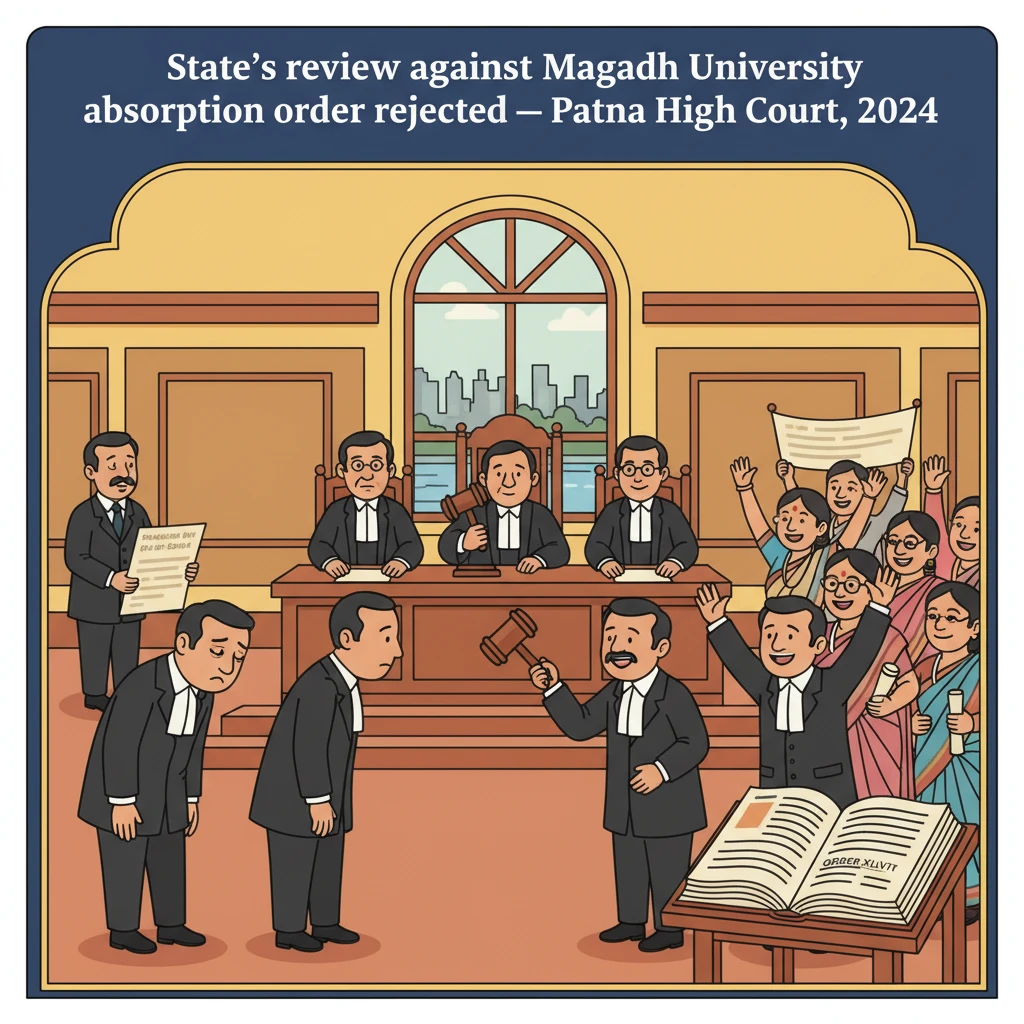
Having reached these findings, the Division Bench concluded that there was no justification for interfering with or recalling the earlier appellate order. The review petition therefore failed on both legal and factual grounds.
In the final paragraph of the judgment, the Court declared that the present civil review petition stands dismissed. With this, the order dated 26.09.2022 passed in L.P.A. No. 1556 of 2018 and connected cases remains undisturbed, and the directions primarily addressed to Magadh University continue to operate.
Why This Judgment Matters
This judgment is important for employees and public authorities alike because it clarifies when the State Government can and cannot rush to court in service and funding disputes involving universities.
For teaching and non-teaching staff of universities, the decision confirms that when a court directs a university to examine their absorption or service benefits, the State cannot immediately block that process merely by citing future financial burden. The University must first examine their cases, and only after that stage is completed can funding issues be taken up.
For the State and other government departments, the judgment is a reminder that review petitions are not a tool to challenge hypothetical or future consequences. Courts will insist on a clear, direct injury or error on the record before entertaining such challenges, in line with Order XLVII Rule 1 CPC and Supreme Court guidance.
The ruling also reinforces that the Patna High Court will strictly apply the limited scope of review jurisdiction. This protects finality of judgments and prevents repeated litigation on the same issue, especially when there is no present cause of action.
Legal Issues and Answers
- Issue: Did the State of Bihar have a valid cause of action to seek review and recall of the Division Bench order in L.P.A. No. 1556 of 2018, on the ground that its financial rights might be affected by implementation of the Single Judge’s directions?
Answer: No. The Court held that there was no specific direction against the State, the University alone was directed to act, and the State’s role would arise only after the University’s decision. The State’s apprehensions were speculative and premature, so no ground for review was made out. - Issue: Were the requirements of Order XLVII Rule 1 CPC, as explained by the Supreme Court in Sanjan Kumar Agarwal vs. State Tax Officer (1) & Anr., satisfied so as to justify entertaining the civil review petition?
Answer: No. The Court found that the review petition did not disclose any error apparent on the face of the record, discovery of new material, or other sufficient reason. Hence, the civil review could not be entertained and was dismissed.
Cases Cited by the Court
- Sanjan Kumar Agarwal vs. State Tax Officer (1) & Anr., 2023 SCC OnLine SC 1406
Case Details
Case Number: Civil Review No. 54 of 2023 in Letters Patent Appeal No. 1556 of 2018
Case Title: The State of Bihar & Ors. vs. Magadh University & Ors.
Coram: Hon’ble Mr. Justice P. B. Bajanthri and Hon’ble Mr. Justice Rajiv Roy
Citation: 2024 (2) PLJR 809
Advocates:
- For the petitioners (State of Bihar): Mr. Sarvesh Kumar Singh, AAG
- For the respondents (University side): Mr. Sanjay Kumar Giri, Sr. Advocate; Mr. S.K. Giri, Advocate
- For the private respondents (employees): Mr. Saroj Kumar, Advocate
Nature of the case: Civil review petition seeking recall of an order passed in Letters Patent Appeal.
Link to judgment: Click here to view the official judgment of the Patna High Court
If you found this explanation helpful and wish to stay informed about
how legal developments may affect your rights in Bihar,
you may consider following Samvida Law Associates for more updates.







