

Case Background
The petitioner’s land was acquired by the Road Transport and National Highways Department in Land Acquisition Case No. 01 of 2017-18. An award for compensation was passed on 10.06.2019.
After the award, the compensation was deposited in the petitioner’s bank account. The land had been notified for acquisition through the Extraordinary Gazette of India dated 10.09.2018. The compensation was paid between 18.12.2020 and 22.12.2020 after verification of the petitioner’s ownership documents.
According to the petitioner, he had inherited the land and was in peaceful possession. He relied on documents such as Khatiyan, Malguzari Receipts, Land Acquisition Certificate, Land Possession Certificate, and revenue receipts. He stated that there was no dispute about his ownership during the land acquisition proceedings.
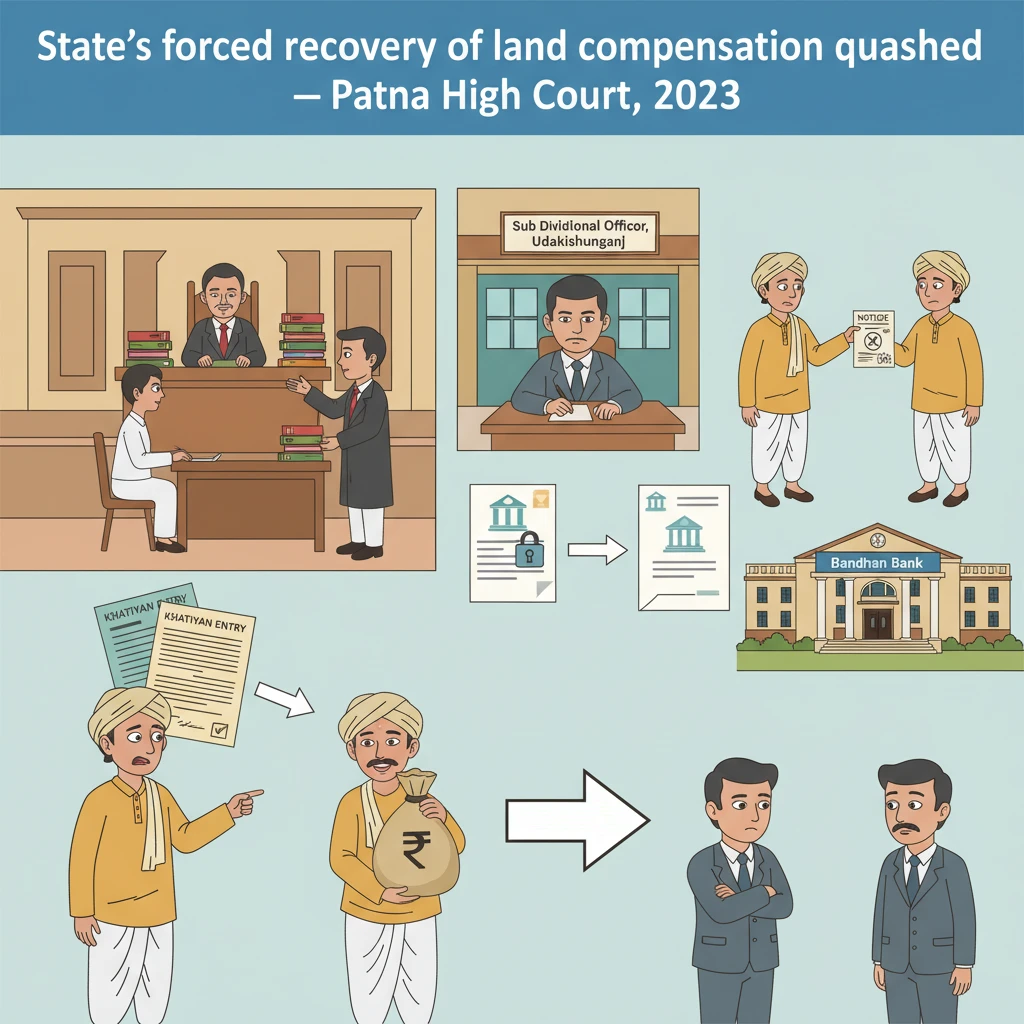
However, in April 2021, the situation changed suddenly. On 12.04.2021, the Sub Divisional Officer, Udakishunganj (respondent no. 3) issued a letter to the petitioner directing him to refund the compensation amount. The reason given was that the same land had already been acquired earlier by the Water Resources Department.
The very next day, on 13.04.2021, respondent no. 3 wrote to the Branch Manager of Bandhan Bank, Purnea (respondent no. 4) asking the bank to stop withdrawal from the petitioner’s account, on the ground that compensation had been wrongly paid.
On 16.04.2021, the Sub Divisional Officer again wrote to Bandhan Bank, this time requesting the bank to withdraw the compensation amount along with interest from the petitioner’s account and credit it into the account of the Additional District Land Acquisition Officer, Udakishunganj (respondent no. 5).
The petitioner replied to the notice, contesting the claim that the land already belonged to the Water Resources Department. However, his reply was not considered, reportedly on the ground that it was filed without a Vakalatnama of an advocate.
On 20.04.2021, Bandhan Bank informed the petitioner that his account had been put under restriction. The petitioner sent a notice to the bank questioning the freezing of his account.
Despite this, on 24.05.2021, the compensation amount lying in the petitioner’s account was transferred to the account of the Additional District Land Acquisition Officer, Udakishunganj. This led the petitioner to approach the Patna High Court under its civil writ jurisdiction.
What the Court Examined and Decided
The Patna High Court, through Hon’ble Mr. Justice Sandeep Kumar, examined both the petitioner’s version and the State’s defence, as well as the conduct of the bank.
The petitioner argued that he was the lawful owner and recorded tenant of the land. He stressed that his documents had already been checked during the land acquisition process under Section 15-A of the Land Acquisition Act. Based on official entries in Khatiyan, Malguzari Receipts, Land Acquisition Certificate and other materials collected in the confidential enquiry, compensation had been granted to him.
He contended that if the land had actually been acquired by the Water Resources Department in the past, this would have been reflected in records like Jamabandi Register II and Khatiyan. His ownership documents, including title deed, revenue receipts and Land Possession Certificate, showed that he was still treated as the owner.
The petitioner also pointed out that the Water Resources Department never took possession of the land and did not file any objection under Section 3-C of the National Highways Act when the land was acquired for the highway and compensation was determined under Section 3-G. According to him, this showed that the earlier acquisition claim was not substantiated.
On the other side, the State filed a counter affidavit. It stated that as per the cadastral survey, the land was initially recorded as Gair Majarua Aam Land. Later, in the revisional survey, it was recorded in the name of the petitioner’s father. When questioned, the petitioner allegedly could not explain how the land came to be recorded in his father’s name.
The State further claimed that the land had been acquired by the Water Resources Department between 1973 and 1978 and that compensation had already been paid to the then owner. However, it admitted that the Water Resources Department did not take steps for mutation of the land in its favour. The State alleged that the petitioner obtained the award by suppressing these facts and was therefore not entitled to relief.
The Court first noted some key, undisputed facts. The land was notified for acquisition through the Extraordinary Gazette of India dated 10.09.2018. The petitioner was paid compensation between 18.12.2020 and 22.12.2020 after “all proper verification” regarding ownership.
The Sub Divisional Officer’s letter dated 12.04.2021 asked the petitioner to return the compensation amount, directing him to deposit it by 27.04.2021. Crucially, the Court observed that this letter was issued without initiating any formal proceeding against the petitioner and without giving him a proper opportunity of hearing.
The Court found that the order for recovery was passed without notice and without disclosing detailed grounds. The Sub Divisional Officer then coerced Bandhan Bank to freeze the petitioner’s account and, by the letter dated 16.04.2021, forced the bank to transfer the money back to the State, again without giving any notice to either the petitioner or the bank.
The Court took note that the petitioner had written on 19.04.2021 to the Sub Divisional Officer in response to the notice. In that letter, he gave details of the facts and his ownership documents. These were the same documents the Sub Divisional Officer had earlier verified before releasing compensation to the petitioner. They included Khatiyan, Land Possession Certificate and revenue receipts. Only after examining such documents had the compensation been released.
The Court also recorded that the petitioner had questioned the freezing of his account and the restriction on operating it, stated to be on the orders of the Sub Divisional Officer “without any authority”.
Despite this, a large sum of Rs. 1,28,23,328/- lying in the petitioner’s account in Bandhan Bank was withdrawn and transferred to the account of the Additional District Land Acquisition Officer, Udakishunganj. The Court noted that the bank acted “illegally without any legal order” and did so under pressure from the Sub Divisional Officer.
The Court emphasised that the petitioner was the recorded tenant. He could not be denied compensation on the mere statement of the Sub Divisional Officer, without legal proof that the land did not belong to him. The counter affidavit of the bank itself showed that it acted only because of pressure from the Sub Divisional Officer, acting on behalf of the State Government.
From these facts, the Court drew a clear conclusion. The money had been “lawfully credited” in the petitioner’s bank account after proper verification of his documents. It was then “illegally recovered” from his account without initiating any lawful proceeding for recovery.
The Court held that at the very minimum, the Sub Divisional Officer ought to have started a proper proceeding, issued notice to the petitioner, and passed an order only after hearing him. Such a procedure is available under the law and should have been followed before any recovery from the petitioner.
Because this basic process was ignored, the entire action of recovery from the petitioner’s bank account was declared “illegal and not authorized by law” and therefore unsustainable.
The Court went further and used strong language. It held that the forced withdrawal of money from the petitioner’s account “tantamounts to extortion by the State without following the due process of law”. It also noted that the petitioner had already given an undertaking on affidavit at the time of disbursal of the compensation. In such a situation, there was no justification for directly proceeding to recovery without first starting a legal proceeding.
In the result, the writ petition was allowed. The Patna High Court directed respondent nos. 2 and 3 (the District Magistrate/Collector and the Sub Divisional Officer) to refund the amount to the petitioner’s bank account within fifteen days from the date of receipt or communication of the order.
At the same time, the Court did not close the door on the State. It clarified that after transferring the amount back to the petitioner’s account, the State and its authorities would be free to initiate a proper proceeding for recovery of any amount said to have been wrongly disbursed, in accordance with law.
Why This Judgment Matters
This decision of the Patna High Court is significant for landowners whose land is acquired for public projects and who receive compensation through banks.
First, it makes it clear that once compensation is released after proper verification, the government cannot simply ask the bank to take the money back on its own. Recovery must follow a legal process, with notice and hearing to the person concerned.
Second, the Court has sent a strong message that pressuring banks to freeze or withdraw citizens’ money without lawful authority will not be tolerated. Such actions were described as amounting to “extortion” when done without due process.
Third, even when the State claims that compensation was wrongly paid, it must prove this through proper proceedings. Recorded tenants and persons whose names appear in official land records cannot be deprived of compensation merely on the unsupported statements of officials.
For ordinary landowners in Bihar and elsewhere, this judgment assures that government officials must follow the law, and that courts will intervene when powers are misused to take back compensation already credited to their accounts.
Legal Issues and Answers
- Issue: Can the State, through the Sub Divisional Officer, direct a bank to freeze and withdraw land acquisition compensation from a landowner’s account without initiating any legal proceeding or giving the landowner a hearing?
Answer: No. The Patna High Court held that recovery without initiating proceedings, issuing notice, and hearing the landowner is illegal, unauthorised by law, and amounts to extortion. - Issue: What relief is appropriate when compensation is taken back from a landowner’s bank account in this unlawful manner?
Answer: The Court directed the authorities to refund the full amount to the landowner’s bank account within fifteen days, while granting the State liberty to start proper legal recovery proceedings thereafter, if so advised.
Cases Cited by the Court
- No earlier judicial precedents or case citations are mentioned or relied upon in the text of this judgment.
Case Details
Case Number: Civil Writ Jurisdiction Case No. 13845 of 2021
Case Title: Rajeev Ranjan v. The State of Bihar & Others
Coram: Hon’ble Mr. Justice Sandeep Kumar
Citation: 2024 (1) PLJR 893
Advocates:
- For the petitioner: Mr. Rajesh Ranjan, Advocate; Mr. Prem Kumar, Advocate
- For the State of Bihar: Mr. Rishi Raj Sinha, S.C.-19; Mr. Saurabh Kumar, A.C. to S.C.-19
- For Bandhan Bank: Mr. Dayanand Singh, Advocate
Date of Judgment: 15.09.2023
Nature of the Case: Writ petition under civil writ jurisdiction challenging freezing of bank account and recovery of land acquisition compensation.
Link to Judgment: Click here to read the full Patna High Court judgment
If you found this explanation helpful and wish to stay informed about how legal developments may affect your rights in Bihar, you may consider following Samvida Law Associates for more updates.







