

Case Background
The dispute concerns a large piece of land bearing Khesra/Plot No. 1702, under Khata No. 113, in village Tetari, P.S. Dandari, District Begusarai, measuring 40.34 acres.
According to the petitioners, this land was originally recorded in the khatiyan as “Gairmazarua Khas” land of the ex-zamindar under old Tauzi No. 629. In 1912, a descendant of the ex-zamindar, Bibi Aisha, allegedly transferred her interest in the relevant tauzis, including this plot, to one Bhadri Hazari through a registered sale deed. Bhadri Hazari came into possession.
The petitioners stated that in 1944 Bhadri Hazari settled different portions of this land in favour of various persons. Jamabandis were opened, and rent was regularly paid to the State. Over the years, by registered sale deeds and relinquishment (Ladavi) deeds, portions were transferred to successors and further transferees, including the present petitioners or their predecessors. They claimed continuous cultivating possession and regular rent payment.
The petitioners also pointed out that in 1954–55, a portion of Khesra No. 1702 had been acquired for construction of the Gandak River Bandh and compensation paid to recorded raiyats, and that in 2019, part of the land was acquired under the Petroleum and Minerals Pipelines Act by GAIL (India) Ltd., again treating it as raiyati land.
In 2019, under the State’s “Jal Jeevan Hariyali Abhiyan”, the Chief Engineer (Planning, Monitoring and Underground), Minor Water Resources Department, issued Tender No. 6/2019-20 for ground water recharge/irrigation schemes across Bihar. This tender included “Tetari Moin” at Serial No. 170 in Dandari Block.
In March 2020, about 70 years after jamabandi creation, the Circle Officer, Dandari, issued a notice dated 04.03.2020 to the heirs and descendants of several persons, including ancestors of the petitioners. The notice stated that Khesra No. 1702 was recorded as “Gairmazarua Khas Man” and identified as sairat land, and proposed cancellation of jamabandis in favour of transferees from Bhadri Hazari and their successors.
The petitioners and others filed objections, asserting that the land was private raiyati land, not a river, nala, pond, or road, and not recorded as sairat in the sairat register. Despite this, the authorities went ahead.
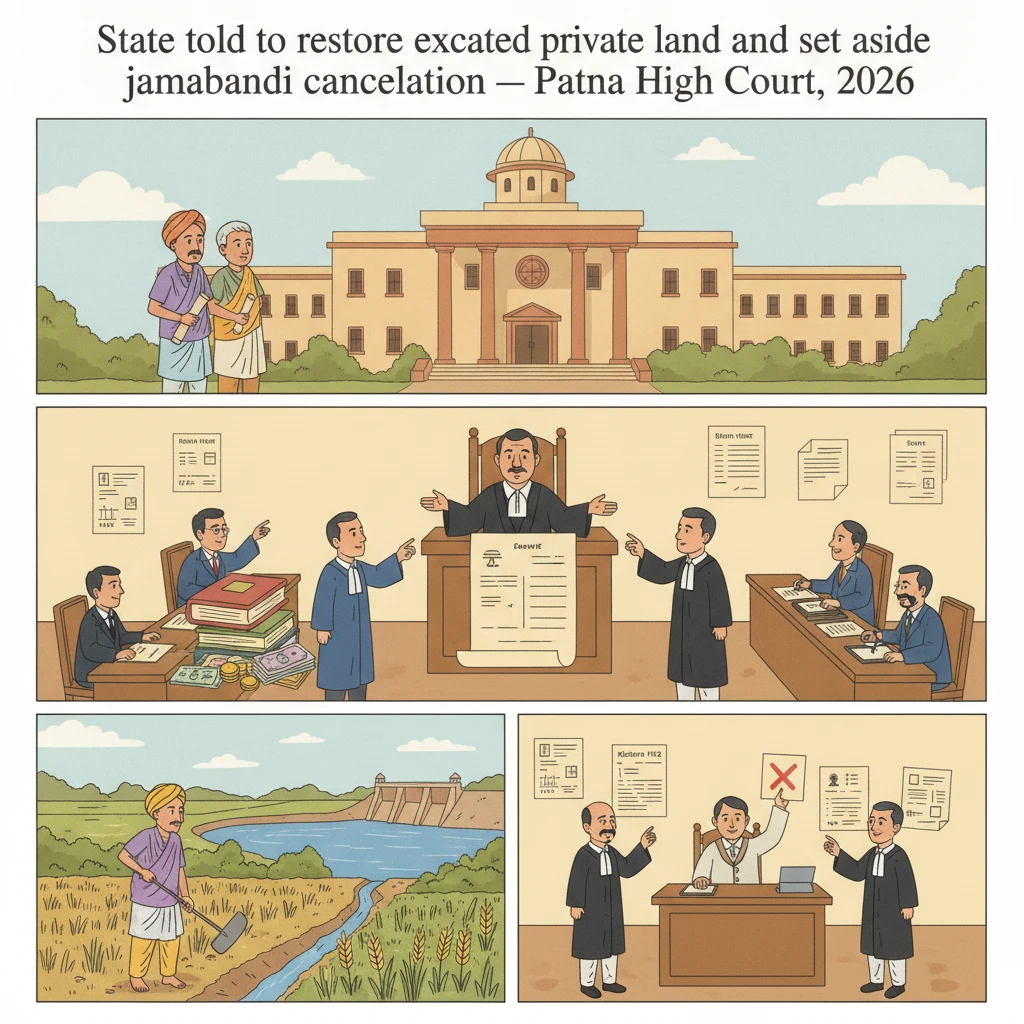
Under Jal Jeevan Hariyali Abhiyan, the State excavated more than 20 acres of the disputed land for water conservation, ignoring the objections. Later, during pendency of the writ petition, the State also constructed a culvert on the land and planned to sink a tube-well to fill the excavated portion with water, changing the topography and making it un-arable.
While the writ petition was still pending, the Additional Collector, Begusarai, passed an order dated 10.01.2026 in Jamabandi Cancellation Case No. 44/2021-22 (offline) / Case No. 55/2022-23 (online), cancelling different jamabandis relating to Khesra No. 1702. The petitioners challenged this order by filing I.A. No. 1 of 2026 in the same writ proceeding.
What the Court Examined and Decided
The petitioners approached the Patna High Court under Article 226 of the Constitution. They sought directions to the State to pay the cost of refilling earth in the excavated portions of their land, compensation for damage to land and crops, and a direction that their agricultural land should not be treated as sairat or settled for fisheries or other purposes.
After the Additional Collector’s order came on record, they also sought quashing of the jamabandi cancellation.
The petitioners’ counsel argued that Khesra No. 1702 is cultivable land where both Kharif and Rabi crops are grown. They emphasized that jamabandis had existed for several decades in the names of transferees from Bhadri Hazari and that rent had been regularly paid. They stressed that prior acquisitions for Gandak Bandh and GAIL pipeline recognized the raiyati nature of the land, which would not have been done if it was State-owned jalkar or sairat.
On the tender and sairat claim, the petitioners pointed to the State’s own documents. Annexure-A to the counter affidavit of respondents 2–5 showed “Tetari Moin” listed as a jalkar at Serial No. 12, with area 5.83 acres, under Khata No. 113 but Khesra No. 761, not 1702. The total disputed land in this case is 40.34 acres under Khesra No. 1702.
The petitioners argued that “Tetari Moin” in Khesra No. 761 is a different parcel of land. They said the State was wrongly equating that jalkar with their private raiyati land, and that such land of over 40 acres could not realistically be settled for Rs. 26,000 per year as shown in the jalkar settlement records.
They also relied on a report of the Karamchari (Annexure-6) given to the Circle Officer, Dandari. This report recorded that although Khesra No. 1702 was entered in the khatiyan as “Moin”, it had never been settled as such. During inspection, persons holding jalkar settlements claimed to fish from this land, but the petitioners explained that these fishermen were allowed to fish after paying compensation because the land remained waterlogged for four to five months a year, and was used for cultivation once the water dried.
On the other side, the State, through counter affidavits, asserted that Khesra No. 1702 is recorded as “Gairmazarua Khas” land of the ex-zamindar and had vested in the State after abolition of zamindari since the ex-landlord did not file any return in any individual’s name. The Circle Officer, Ballia, had allegedly been settling the land for fishery purposes, supported by entries in the sairat register.
The State argued that rent receipts (jamabandis) taken by the petitioners and others were illegal. They said tenders had been repeatedly issued by Animal Husbandry and Fisheries Departments for jalkar settlement over this land. They also contended that the petitioners had not clearly shown what exact area was transferred by Bhadri Hazari and how jamabandi was created.
The State further submitted that the writ petition was not maintainable as the petitioners had not first given a representation or demand to the proper authority seeking enforcement of their right. They also raised the objection of alternative remedy, saying the petitioners had already filed an appeal against jamabandi cancellation, which was pending, and that disputed questions of fact required a civil suit.
The State relied on decisions including Juman Lal Dewangan v. State of Chhattisgarh and a Supreme Court order in Vinod Gandhi v. District Collector, Madurai, to support the approach that State land, especially water bodies, should be protected, and that writ courts should not intervene where alternative remedies exist.
The Court, after hearing both sides and examining the documents, identified the core question: whether the petitioners’ land was being lawfully treated by the State as sairat/jalkar, or whether it was in fact private raiyati land wrongfully taken over.
The Court closely looked at the jalkar list produced by the State. It noted that “Tetari Moin” was shown under Khata No. 113 but Khesra No. 761, area 5.83 acres. By contrast, the petitioners’ land is Khesra No. 1702 measuring 40.34 acres. The Court observed that only during pendency of the case did the State “discover” that Khesra No. 761 had supposedly been wrongly written instead of Khesra No. 1702.
The Court found this explanation unconvincing, especially because such a large area could not reasonably have been settled for a meagre amount (Rs. 20 in 1973–74 and Rs. 26,000 in 2021), and because the jalkar list itself mentioned an area of around 5 acres. These discrepancies raised doubt about the State’s stand.
From the Karamchari’s report (Annexure-6), the Court found that Khesra No. 1702 was recorded as “Moin” but had never been settled as such. The report also reflected the practical position: the land was seasonally inundated but was used for agriculture after the water receded, with fishermen being allowed access only on payment of compensation to raiyats.
The Court examined the khatiyan entry of Khesra No. 1702 as “gairmajarua khas” with the name of “Chaudhary Babu Nurool Hoda and other”. It noted that such entry can denote raiyati land owned by an individual. The Court accepted that, over time, even if originally recorded as “Moin”, the nature of the land could have changed and it became cultivable, and that the land was transferred by the ex-zamindar and then by subsequent purchasers to the petitioners and others.
The Court held that the petitioners’ contention that the land was not a jalkar “in the true sense” was reasonable. It pointed out that cancellation of longstanding jamabandis by a revenue authority on the ground of “wrong creation” is not permissible in law, especially when it would effectively nullify registered sale deeds and earlier settlements by the ex-zamindar.
The Court relied on the Patna High Court judgment in Maya Devi & Ors. v. State of Bihar & Ors., (2014) 3 PLJR 584. That decision held that if the State wants land over which people have been residing or holding jamabandi for long periods, it must pay due compensation under the land acquisition law, or if it wants to cancel jamabandi, it must move a civil court for a declaration that the settlement is illegal. Until such declaration, people cannot be evicted or denied compensation.
On the objection of alternative remedy, the Court referred to the Supreme Court’s recent judgment in Rikhab Chand Jain v. Union of India & Ors., 2025 SCC OnLine 2510. It reiterated that existence of an alternative statutory remedy does not oust writ jurisdiction, especially where there is lack of jurisdiction or violation of principles like natural justice.
The Court noted that the writ petition had been pending for more than five years, during which it had been actively seized of the matter and had called for counter affidavits and supplementary affidavits. Despite this, the Additional Collector passed the order dated 10.01.2026 cancelling jamabandis. The Court held that this amounted to overreaching judicial propriety and attempting to influence the outcome of the pending writ case.
For this proposition, the Court cited the Full Bench decision in The King v. Parmanand & Others, AIR 1949 Patna 222, which affirmed that when a matter is pending before a court, no executive authority should take action that disturbs the free course of justice or prejudges the merits.
In view of all these factors, the Court declared the order dated 10.01.2026 passed by the Additional Collector in the jamabandi cancellation case to be illegal, truculent, and an overreach of authority. The order was set aside, and I.A. No. 1 of 2026 was allowed.
On the main relief, the Court held that the State had illegally treated the petitioners’ private agricultural land as sairat/jalkar and excavated it. The Court directed the State to replace the earth excavated from the petitioners’ land, and to ensure that any boundary constructed from that excavated soil is dismantled and the earth refilled onto the petitioners’ land.
However, the Court also clarified that if the State is aggrieved by creation of jamabandi in favour of the petitioners, it remains open to the State to institute a civil suit before a competent court for setting aside the sale deeds and earlier settlements. Until then, the petitioners’ jamabandi stands and their land cannot be treated as State-owned sairat.
With these directions and findings, the writ application was allowed.
Why This Judgment Matters
This judgment is important for farmers and landholders whose lands are near ponds, low-lying areas, or seasonal water bodies in Bihar.
First, the Patna High Court has clearly said that even if land is shown as “Moin” or low-lying in old records, it does not automatically become government jalkar or sairat. Longstanding private possession, jamabandi, rent payment, and even past land acquisition recognising raiyati status are strong indicators of private ownership.
Second, revenue officers cannot simply cancel old jamabandis on their own. If the State believes jamabandi was wrongly created, it must go to a civil court and prove its title. Until then, people cannot be treated as encroachers or denied compensation.
Third, when a case is already pending before the High Court, executive authorities must not pass orders on the very same issue in a way that prejudges the dispute. Doing so is treated as overreach and such orders can be struck down.
Finally, for villagers affected by schemes like Jal Jeevan Hariyali Abhiyan, this judgment reinforces that development works cannot ignore private rights. If the State needs private land for public schemes, it must follow proper legal process, including acquisition and compensation, and cannot just dig up fields by calling them sairat lands.
Legal Issues and Answers
-
Issue: Can the State treat Khesra No. 1702 as sairat/jalkar land and cancel longstanding jamabandi through revenue proceedings while the High Court is seized of the dispute?
Answer: No. On the record, Khesra No. 1702 could not be reliably connected with the jalkar “Tetari Moin”. Longstanding jamabandi in favour of private raiyats cannot be set aside by revenue authorities in this manner, especially during pendency of a writ. The cancellation order dated 10.01.2026 was held illegal and set aside. -
Issue: Is the writ petition barred because of alternative remedy or absence of prior representation to the authorities?
Answer: No. The High Court held that existence of alternative statutory remedy does not oust writ jurisdiction, particularly where jurisdictional errors and overreach by authorities are alleged. Given the long pendency of the writ and conduct of authorities, relegating the petitioners to other remedies was not appropriate. -
Issue: What relief is appropriate where the State has excavated private agricultural land under a public scheme on the assumption it is State sairat land?
Answer: The Court directed the State to replace the excavated earth and refill any boundaries constructed from that soil onto the petitioners’ land, thereby restoring it. If the State disputes title, it must approach a competent civil court to challenge the sale deeds and jamabandi.
Cases Cited by the Court
- Maya Devi & Ors. v. The State of Bihar & Ors., (2014) 3 PLJR 584 – relied on to hold that longstanding jamabandi cannot be cancelled by revenue authorities and that the State must either acquire the land with compensation or approach a civil court for declaration of title.
- Rikhab Chand Jain v. Union of India & Ors., 2025 SCC OnLine 2510 – cited on the principle that availability of an alternative statutory remedy does not bar the High Court from entertaining a writ petition, especially where jurisdictional issues are raised.
- The King v. Parmanand & Others, AIR 1949 Patna 222 (Full Bench) – relied upon for the principle that when a matter is pending before a court, executive authorities must not take steps that disturb the free course of justice or prejudge the merits.
- Vinod Gandhi v. District Collector, Madurai & Ors. – order of the Supreme Court referred to by the State regarding State land and water bodies, though ultimately the High Court did not accept the State’s application of this precedent to the petitioners’ land.
- Juman Lal Dewangan v. State of Chhattisgarh, WP(S) No. 599 of 2017 – cited by the State on the requirement of a demand before seeking mandamus.
Case Details
Case Number: Civil Writ Jurisdiction Case No. 228 of 2021
Case Title: Shyam Kishore Sharma @ Shyam Kishore Hazari & Anr. v. The State of Bihar & Ors.
Citation: 2026 (3) PLJR 563
Coram: Hon’ble Mr. Justice Sourendra Pandey
Date of Judgment: 14-05-2026
Advocates:
- For the Petitioners: Mr. Vaidehi Raman Prasad Singh, Advocate; Mr. Uday Kumar, Advocate
- For the Respondents/State: Mr. Nadim Seraj, GP-5; Mr. Nalin Vilochan Tiwary, AC to GA-9
Nature of the Case: Writ petition under Article 226 of the Constitution of India challenging excavation of alleged private agricultural land under a State water scheme, claiming compensation and restoration, and later challenging cancellation of jamabandi by revenue authority.
Link to the Judgment: View full judgment on Patna High Court website
If you found this explanation helpful and wish to stay informed about how legal developments may affect your rights in Bihar, you may consider following Samvida Law Associates for more updates.







