

Case Background
The petition was filed by teaching and non-teaching employees of Dwarka Nath College, Jatti Chak, Masaurhi, in the district of Patna. The college was affiliated to Magadh University, Bodhgaya, and recognized by the University Grants Commission. Later, after reorganization, the college came under Patliputra University through a Government notification.
The dispute relates to whether this college should be treated as a constituent college of the University, with all financial and service benefits that come with that status. According to the petitioners, the State Government had decided in the late 1980s to give this status, but the formal notification was never issued.
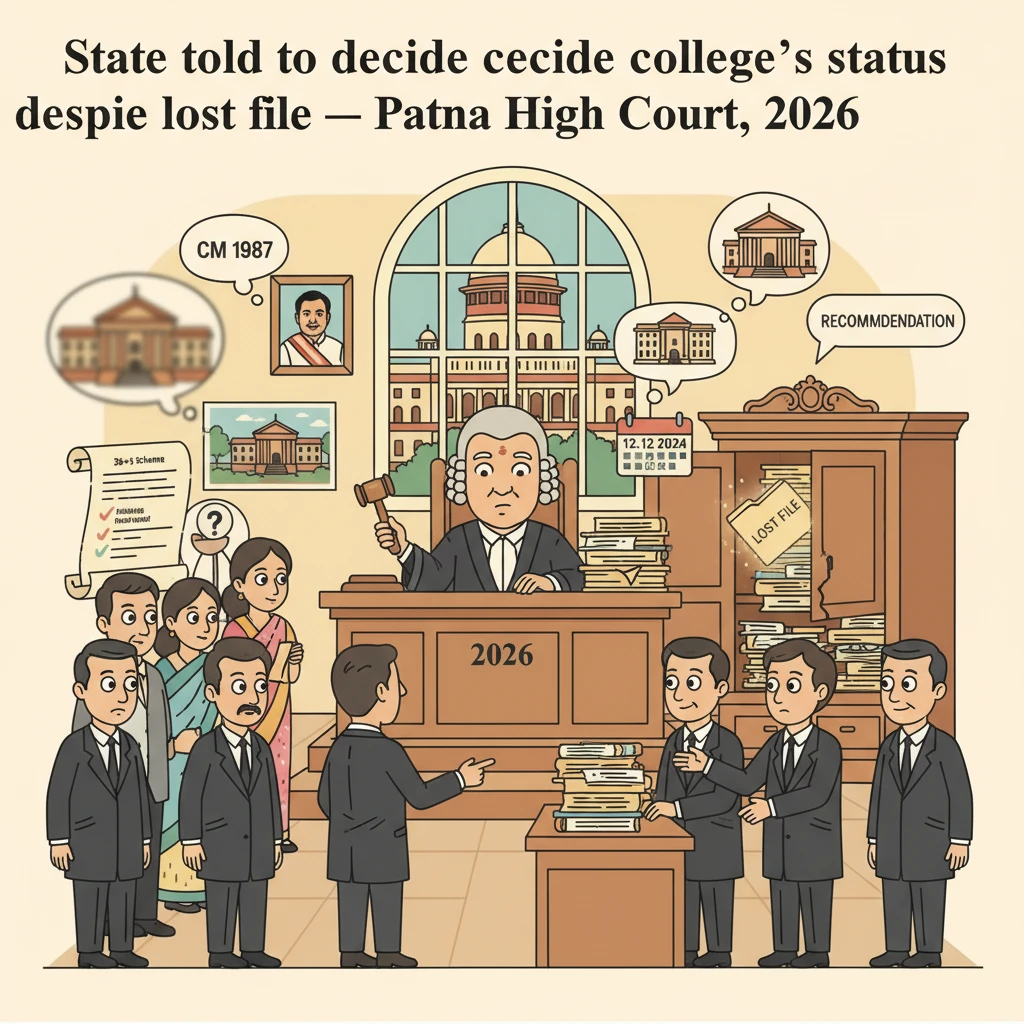
In 1986–87, the State Government decided to convert 36 affiliated colleges into constituent colleges under different universities. Along with these, five more colleges, including Dwarka Nath College, were taken up under a scheme known as the IVth Phase Constituent Colleges (36+5 scheme). Out of these five, four colleges were actually notified as constituent colleges. Only this college was left out because, as later claimed by the State, its original file went missing.
Over the years, the issue kept surfacing in the Bihar Legislature. In 2006, when the matter was raised in the Legislative Council, the Aswashan Committee (Education Department) stated that the recommendation to declare the college as a constituent college had been made, but the matter was still pending before the State Government.
The matter again reached the Chief Minister, who sought the opinion of the Advocate General, Bihar. The Advocate General reportedly gave an opinion in favour of granting constituent status to the college. The Department of Human Resources Development and the Department of Education also considered the case positively and gave approval to proceed. The file was then placed before the Finance Department, and financial details for supporting the college as a constituent unit were worked out.
Despite these steps, the matter never reached the Cabinet for a final decision. When the issue was again raised in the Assembly in 2013, the then Education Minister acknowledged that recommendations had been made, that the matter was pending before the Cabinet, and that the college should take its case to the Justice S.C. Agrawal Commission in terms of directions of the Supreme Court in S.L.P. No. 12591 of 2010.
Separately, the Principal of the same college filed C.W.J.C. No. 12106 of 2018 before the Patna High Court. In that case, he sought either declaration of the college as a constituent unit of Patliputra University or recognition as a deficit grant college entitled to State benefits, along with arrears for staff. On 12.12.2024, a learned Single Judge disposed of that petition without entering into the merits and directed that a detailed representation be made to the Principal Secretary, Department of Education.
What the Court Examined and Decided
Justice Harish Kumar heard arguments from the petitioners, the State of Bihar, and Patliputra University.
The petitioners’ counsel relied on various official notes and proceedings to show that the college had fulfilled all conditions for constituent status back in 1987 itself. According to them, the Chief Minister at that time had accepted that this college and the four other colleges, along with the 36 already identified, met all criteria. Orders were passed accordingly, but the notification for this particular college could not be issued because the original file became “traceless” in the department.
The petitioners highlighted that, unlike the other four similarly placed colleges which received constituent status in 1987, only their college was left out because of the missing file. They argued that litigation before the Supreme Court regarding appointments in other IVth phase colleges had nothing to do with their college and could not justify the delay.
They also pointed out that the college had been granted affiliation by the State Government on 06.12.1982, based on the university’s recommendation, i.e., before the State’s policy called “Vit Rahit Siksha Niti” came into force on 09.12.1988.
On the other side, the State, through respondents 2 and 3, filed a counter affidavit. Its primary objection was that the writ petition should be dismissed on the ground of delay and laches, because the events complained of dated back to the 1980s.
The State admitted that by letter no. 202 dated 19.08.1986, 36 affiliated colleges were notified as constituent colleges. It also admitted that the then Chief Minister later announced that four more colleges would be made constituent colleges and notifications were issued in 1987. It stated that the question of validity of appointments of teaching and non-teaching employees in these IVth phase colleges went to the Supreme Court in Civil Appeal No. 6098 of 1997 [(2005) 9 SCC 129].
Pursuant to that case, the Supreme Court constituted the Justice S.C. Agrawal Commission to examine the validity of those appointments. The Commission submitted a detailed report. Some aggrieved persons then challenged aspects of that process in S.L.P. No. 12591 of 2010, leading to the appointment of the Justice S.B. Sinha Commission, which also submitted its report. Several contempt petitions and further proceedings followed, and yet another set of persons whose claims were rejected by the S.B. Sinha Commission again approached the Supreme Court.
The State argued that with these litigations still pending and with almost 37 years having passed, it was not viable to take a decision now to declare the college a constituent unit, especially while the issue of absorption of validly appointed employees of 40 colleges remained under consideration before the Supreme Court.
The State further submitted that it could not clearly explain why a final decision was never taken in relation to this college because all original files of colleges had been seized by the Vigilance Department. It argued that until a formal order was issued, the Chief Minister’s announcement could not be treated as binding.
The State also stated that, under a later resolution contained in Memo No. 1846 dated 21.11.2008, it had abolished the non-aided education policy and had decided to provide grants to affiliated colleges on a performance basis, depending on students’ results. Dwarka Nath College was already receiving performance-based grants under this policy.
Patliputra University’s counsel informed the Court that the University came into existence on 18.03.2018. Only afterwards did the college fall under its jurisdiction as an affiliated college. Since the writ petition had been filed earlier, Patliputra University had asked Magadh University for the relevant records, but these had not yet been received. The University argued that declaration of a college as a constituent college is ultimately a policy matter dependent on the discretion of the State Government and concerned department.
Having heard all sides, the Court first addressed the State’s objection on delay. It examined the materials and noted that the issue of constituent status had remained alive within the Government system. The matter had been raised in the Assembly at least up to 2013. On that occasion, the Education Minister had accepted that a recommendation granting constituent status to this college already existed and that the matter was pending before the Cabinet.
The Court observed that the writ petition itself was filed in 2013 while the question was still under consideration. Additionally, in 2018 the Principal of the college approached the Court in a separate writ, which was disposed of only in December 2024 with directions to the Principal Secretary, Education. In these circumstances, the Court held that the petitioners’ claim could not be treated as stale or barred by delay.
The central legal question framed by the Court was: can a person be deprived of his right solely because the original file is lost in the department?
On the facts, the Court noted that:
- The college was granted affiliation on 06.12.1982, before “Vit Rahit Siksha Niti” took effect on 09.12.1988.
- The college had qualified in all respects along with four other colleges for constituent status in 1987.
- Notifications were issued in favour of those four colleges, but not for this college, only because its record had been lost.
The Court acknowledged the settled principle that internal notings on a government file do not, by themselves, constitute a binding legal order. For this, it relied on the Supreme Court’s decision in State of Bihar & Ors. v. Kripalu Shanker, AIR 1987 SC 1554.
However, the Court stressed that the notings in this case clearly showed that the State Government had consistently intended to declare the college a constituent college. The missing file had prevented issuance of the formal notification. In such a situation, the department was duty-bound to reconstruct the file and continue the decision-making process instead of allowing the matter to remain in limbo.
The Court stated that loss of a file does not automatically mean loss of the underlying legal right. Citizens or employees should not be made to suffer because of administrative lapses, especially when fault lies with the State. The Court further held that the State cannot treat people differently when distributing “largess and bounty” and cited the Supreme Court judgment in Ramana Dayaram Shetty v. International Airport Authority of India and Ors., 1979 AIR 1628, to underline that state action must be non-arbitrary and even-handed.
In this light, the Court concluded that the State Government is bound to take a final decision on granting constituent status to the college. It emphasized that discrimination in any form is impermissible and that, as a welfare State governed by the rule of law, the Government must act uniformly, particularly when other similarly placed colleges were granted constituent status decades ago.
Accordingly, the Court issued a direction to the Additional Chief Secretary, Education Department, Government of Bihar. He must call for the relevant records of the college. If records require reconstruction, that exercise must be undertaken. After examining the material and satisfying himself regarding the petitioners’ claim, the Additional Chief Secretary must place the matter before the State Government for a final decision in accordance with law, keeping in mind that the petitioners’ case rests on parity with the four other colleges that were granted constituent status.
The Court expected that this entire exercise would be completed within three months from the date the order is received or produced before the authorities. With these directions, the writ petition was disposed of.
Why This Judgment Matters
This judgment is significant for teachers and non-teaching staff of private or affiliated colleges in Bihar who have been waiting for constituent status or government recognition. It clarifies that the State cannot indefinitely delay a decision just because a file is lost or because of internal administrative problems.
The Patna High Court has made it clear that loss of records in a department does not destroy the rights of individuals. If earlier steps and recommendations show that the State intended to confer a benefit, the Government must reconstruct the record and complete the process.
The judgment also reinforces that similarly placed institutions cannot be treated unequally. When four colleges in the same batch have already been made constituent, the fifth college cannot be ignored without a legal reason.
For ordinary employees, this means that long-standing claims do not automatically become “time-barred” if the Government itself has kept the matter pending. When the State’s own records and statements show that the issue is alive, the Court can still step in and direct the Government to take a final call.
Legal Issues and Answers
- Issue: Can the State Government deny or indefinitely postpone a decision on granting constituent college status only because the original departmental file is lost, and then oppose a writ petition on the ground of delay?
Answer: No. The Patna High Court held that loss of the file does not extinguish underlying legal rights, and where the matter has remained under active government consideration and recommendations exist, there is no delay. The department must reconstruct the record and the State is bound to take a final decision. - Issue: Can the State treat one college differently from other similarly situated colleges that were granted constituent status under the same scheme?
Answer: No. The Court held that discrimination is not permissible. As a welfare State governed by rule of law, the Government must act uniformly and cannot deny parity without valid legal justification.
Cases Cited by the Court
- State of Bihar & Ors. v. Kripalu Shanker, AIR 1987 SC 1554 – cited on the point that internal file notings do not by themselves constitute an effective legal order.
- Ramana Dayaram Shetty v. International Airport Authority of India and Ors., 1979 AIR 1628 – cited to emphasize that the State cannot act arbitrarily and must treat similarly situated persons equally when distributing benefits.
- Bijoy Bahadur Sharma v. The State of Bihar & Ors., 2008 (4) PLJR 547 – relied upon by the State to argue that petitions must be filed within a reasonable time; the Court distinguished this in light of continuous consideration of the petitioners’ claim.
- Civil Appeal No. 6098 of 1997, (2005) 9 SCC 129 – referred to in the State’s counter affidavit regarding validity of appointments in IVth phase constituent colleges and the Justice S.C. Agrawal Commission.
- S.L.P. No. 12591 of 2010 – referred to for the constitution of Justice S.B. Sinha Commission in relation to the same broader controversy.
Case Details
Case Number: Civil Writ Jurisdiction Case No. 14227 of 2013
Case Title: Jai Prakash Singh and another v. The State of Bihar and others
Court: High Court of Judicature at Patna
Coram: Hon’ble Mr. Justice Harish Kumar
Date of Judgment: 09.02.2026
Citation: 2026 (2) PLJR 457
Nature of the Case: Civil writ petition seeking direction to declare Dwarka Nath College, Jatti Chak, Masaurhi, as a constituent college of the concerned University (earlier Magadh University, now Patliputra University) and related reliefs for teaching and non-teaching employees.
Advocates:
- For the Petitioners: Mr. Chakrapani, Advocate; Mr. Dipak Kumar, Advocate
- For the State of Bihar: Mr. Sunil Kumar Mandal, SC-3; Mr. Bipin Kumar, AC to SC-3
- For Patliputra University: Mr. Rana Vikram Singh, Advocate; Ms. Rasika Jha, Advocate
Link to Judgment: Patna High Court Judgment in CWJC No. 14227 of 2013
If you found this explanation helpful and wish to stay informed about how legal developments may affect your rights in Bihar, you may consider following Samvida Law Associates for more updates.







