
Case Background
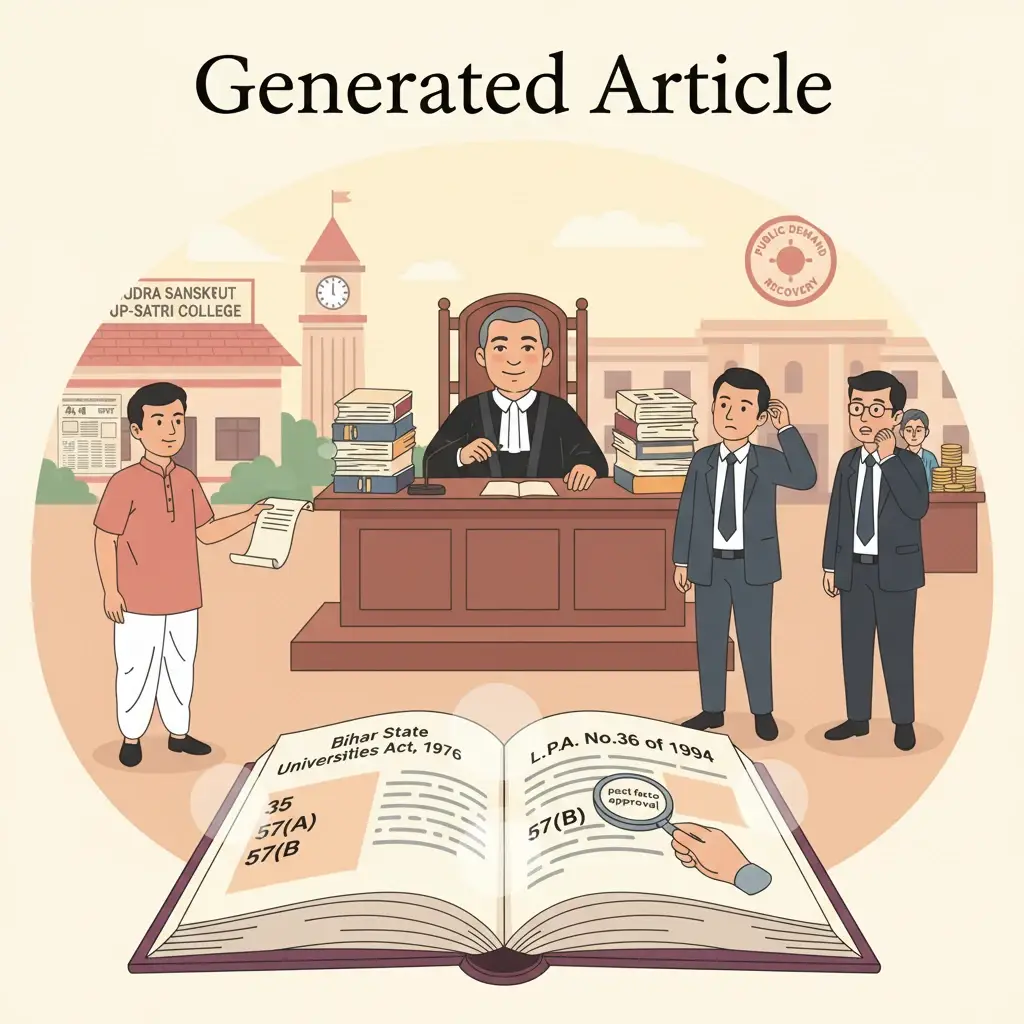
This case arose from a dispute over the appointment of a Graduate Teacher in Rudra Sanskrit UP-Sastri College, Hullash, Supaul, a permanently affiliated and full deficit grant Sanskrit college under Kameshwar Singh Darbhanga Sanskrit University.
By a resolution dated 18.10.1976 issued by authorities under the Education Department of the State Government, ten teaching posts and four non-teaching posts were sanctioned for non-government Sanskrit educational institutions in Bihar. These sanctioned teaching posts included one Principal and various lecturers in Sanskrit subjects, as well as posts for teachers in English, Hindi, Sanskrit and a modern science subject. Four non-teaching posts (clerk, typist, peon and night guard) were also sanctioned.
The College is a permanently affiliated college of the University and enjoys full deficit grant status. This means the State Government provides funds to the College for payment of salaries to teaching and non-teaching employees, subject to the Bihar State Universities Act, 1976 and the statutes framed under it.
On 26.09.2012, the College published an advertisement in the daily newspaper “Aaj” inviting applications for various teaching posts, including two posts of Graduate Teacher. The petitioner, being eligible, applied for the post of Graduate Teacher.
A Selection Committee scrutinised the applications and conducted interviews on 26.10.2012. The petitioner appeared in the interview. The Selection Committee found him suitable and recommended his name for appointment to the post of Graduate Teacher by a recommendation dated 26.10.2012.
On 29.10.2012, the Governing Body of the College, by letter No.139/12, informed the petitioner that he had been appointed as Graduate Teacher, based on the recommendation of the Interview Board and the Governing Body’s decision dated 28.10.2012. The petitioner was asked to join within 15 days. He submitted his joining on 05.11.2012, which was accepted.
On 22.01.2017, the College sent the petitioner’s appointment to the University for approval. After considering the proposal, the University, by Memo No.653 dated 19.04.2018, granted concurrence to the petitioner’s appointment along with other teachers.
Despite this, the petitioner’s salary was not released. He approached the Patna High Court in C.W.J.C. No.18977 of 2019 seeking approval of his appointment and payment of salary. By order dated 16.09.2019, the Court directed the State to take an appropriate decision regarding allotment of funds to the University for payment of the petitioner’s salary within 60 days of receiving the order.
Instead of releasing funds, the Director, Higher Education, Education Department, Bihar, Patna, passed the impugned order contained in Memo No.914 dated 21.04.2022. By this order, the State rejected the University’s proposal for concurrence to the petitioner’s appointment on the ground that Section 35(2) of the Bihar State Universities Act, 1976 had not been followed, as no prior permission of the State Government had been obtained before the appointment. The University was also directed to take steps to terminate the petitioner’s services.
Following this direction, the University cancelled its approval of the petitioner’s appointment and, by letter No.529/22 dated 16.06.2022, asked the College’s Governing Body to comply with the Education Department’s order. The petitioner then filed the present writ petition challenging Memo No.914 dated 21.04.2022 and the consequential actions.
What the Court Examined and Decided
The petitioner sought quashing of the Education Department’s Memo No.914 dated 21.04.2022, and all consequential letters, and a declaration that the State’s order was arbitrary, unreasonable and violative of natural justice. He also sought a direction to allow him to continue in service and a declaration that his appointment as Graduate Teacher was valid and made after following due process.
The core controversy before the Patna High Court was whether prior approval of the State Government under Section 35(2) of the Bihar State Universities Act, 1976 was mandatory for the petitioner’s appointment to a sanctioned post in an affiliated, full deficit grant college, and whether the State could, on that ground alone, reject the appointment and direct termination.
The petitioner’s counsel argued that his appointment was made strictly in accordance with Section 57(A) and statutes framed under Section 57(B) of the Bihar State Universities Act. The post was advertised, applications were invited, interviews were held by a duly constituted Selection Committee, and the Governing Body resolved to appoint him. The University subsequently approved his appointment by Memo No.653 dated 19.04.2018.
The petitioner contended that Section 35(2) applies only where appointments are made against posts that are not duly sanctioned. In this case, the posts were already sanctioned by the 18.10.1976 resolution and fell within the staffing pattern. Therefore, prior approval from the State Government was not required. It was further submitted that the impugned order violated Articles 14, 16 and 21 of the Constitution of India.
The petitioner placed strong reliance on the Full Bench judgment of the Patna High Court in L.P.A. No.36 of 1994, Braj Kishore Singh and others vs. State of Bihar and others. The relevant extracts from paragraphs 9, 21, 22 and 25 of that judgment were cited to show:
- Section 35(1) requires prior State approval for creation of posts involving financial liability.
- Section 35(2) bars appointments without prior State approval, but this has to be read in a workable manner.
- Appointments made against sanctioned posts within the staffing pattern by college/university authorities should not automatically be treated as illegal for want of prior approval.
- The requirement of “prior approval” can be read down to include “post facto” approval to avoid absurd and unworkable results.
- The main object of Section 35 is to prevent illegal, unsanctioned and financially burdensome appointments, not to invalidate bona fide appointments against sanctioned posts made after proper selection.
The Full Bench had held that once posts are deemed to be sanctioned as per approved staffing pattern, appointments can be made against those posts without fresh approval for the post itself. While ordinarily prior approval for appointments should be taken, in exceptional cases appointments may be made subject to post facto State approval, and such appointments would have legal effect once approved.
On the other hand, the State’s counter affidavit emphasised the text of Section 35 of the Bihar State Universities Act, 1976. It stated that:
- Section 35(1)(i) mandates that no teaching or non-teaching post involving financial liability shall be created without prior State Government approval.
- Section 35(2) provides that no college, other than those specified in clauses (a) and (b) of Section 35(1), shall appoint any person on any post without the prior approval of the State Government.
- Section 35(3) declares that any appointment or promotion made contrary to the Act or statutes, or in an irregular or unauthorised manner, shall be invalid and liable to termination. Expenditure on such appointments can be recovered as a public demand from the officer responsible.
The State submitted that in a meeting held on 28.06.2021 with the University, it was found that no prior State approval was obtained for the petitioner’s appointment. Therefore, the University’s proposal was rejected by Memo No.914 dated 21.04.2022. It was argued that the appointment was contrary to Section 35(2), the writ petition had no merit, and was liable to be dismissed.
The University (Respondent Nos.4 and 5) in its counter affidavit confirmed the factual sequence: the advertisement dated 26.09.2012, the interview and recommendation by the Selection Committee, the Governing Body’s resolution dated 28.10.2012, and the petitioner’s appointment as Graduate Teacher. It further stated that in the meeting of the Approval, Seniority and Pay Fixation Committee of the University held on 24.03.2018, the petitioner’s appointment was considered and approval was granted subject to certain conditions. However, after the Education Department’s Memo No.914 dated 21.04.2022, the University cancelled its earlier approval and asked the College to comply with the State’s direction.
The Patna High Court examined these rival contentions in light of the Full Bench decision in Braj Kishore Singh. The Court noted that, according to the Full Bench:
- Approval of the staffing pattern by the Bihar Inter University Board means that non-teaching Class III and IV posts are deemed created with prior State approval; by analogy, sanctioned posts within the staffing pattern can be filled without separate prior approval for creation of posts.
- Appointments against such sanctioned posts cannot be branded illegal solely due to absence of prior State approval.
- The State may examine eligibility and suitability even post-appointment, but appointments made by college/university authorities only attain final legal sanctity after State approval, which can be post facto.
Applying this legal position, the Court held that where the post is already sanctioned, there is no requirement to obtain prior State approval for making an appointment. The petitioner’s appointment was to a sanctioned post, duly advertised, and made after a proper interview process. The University had granted concurrence by Memo No.653 dated 19.04.2018 (Annexure-P/6), making it clear that the petitioner’s service was regular on a sanctioned post.
The Court further observed that the petitioner, presently a regular employee on a sanctioned post, would be entitled to participate in a domestic enquiry if any allegations were made against him. The Court referred to the settled position that even temporary employees are entitled to a domestic enquiry before termination when allegations are levelled. In this case, the petitioner’s service was interfered with purely on the ground of lack of prior approval, without any such enquiry.
In paragraph 21 of the judgment, the Court explicitly recorded that, in view of the Full Bench decision, there is no requirement to take prior approval of the State Government when the post is already sanctioned and the appointment is otherwise legal. The ground adopted by the Director, Higher Education in Memo No.914 dated 21.04.2022 was thus held to be misconceived.
Consequently, in paragraph 23, the Court set aside Memo No.914 dated 21.04.2022 (Annexure-P/8). In paragraph 24, the Court directed the University and the State to regularise the petitioner’s service and release funds to pay all consequential benefits to the petitioner within three months from the date of receipt or production of a copy of the order. With these directions, the writ petition was disposed of.
Why This Judgment Matters
This judgment is significant for teachers and staff of affiliated colleges in Bihar, especially those in full deficit grant institutions, who face threats to their appointments because of alleged non-compliance with prior approval requirements.
The Patna High Court reaffirmed that where posts are already sanctioned under an approved staffing pattern, the State cannot nullify a valid selection and appointment process simply on the ground that prior approval was not obtained. The Court relied on the Full Bench ruling in Braj Kishore Singh to clarify that the requirement of prior approval under Section 35(2) of the Bihar State Universities Act, 1976 must be read pragmatically.
The judgment protects teachers appointed through a transparent selection process against arbitrary cancellation by the Education Department on purely technical grounds. It also reiterates that if the State or University has issues with an employee’s conduct or eligibility, the proper route is domestic enquiry, not unilateral termination based on administrative objections alone.
Practically, the ruling ensures that teachers like the petitioner, working on sanctioned posts in affiliated colleges, can rely on university approval and proper selection as strong protection against abrupt loss of livelihood caused by later State-level objections on approval formalities.
Legal Issues and Answers
- Issue: Can the State Government refuse concurrence to a teacher’s appointment in an affiliated, full deficit grant college on the ground that prior State approval under Section 35(2) of the Bihar State Universities Act, 1976 was not obtained, even when the appointment is to a sanctioned post?
Answer: No. The Patna High Court held, relying on the Full Bench decision in Braj Kishore Singh, that when the post is already sanctioned, prior State approval is not required for appointment. The requirement of prior approval must be read down, and appointments made against sanctioned posts after proper selection cannot be invalidated solely on that ground. - Issue: Was the Education Department’s Memo No.914 dated 21.04.2022, rejecting the petitioner’s appointment and directing termination, legally sustainable?
Answer: No. The Court set aside Memo No.914 dated 21.04.2022, holding that the ground of non-compliance with Section 35(2) was misconceived where the petitioner had been validly appointed to a sanctioned post after due advertisement, interview and university concurrence. - Issue: What relief was the petitioner entitled to after quashing of the impugned order?
Answer: The Court directed the University and the State to regularise the petitioner’s service and to release funds and pay all consequential benefits to him within three months from the date of receipt or production of the Court’s order.
Cases Cited by the Court
- Full Bench judgment in L.P.A. No.36 of 1994, Braj Kishore Singh and others vs. State of Bihar and others (Patna High Court), extensively relied upon regarding interpretation of Section 35 of the Bihar State Universities Act, 1976.
- A prior judgment of the Patna High Court dated 01.11.2018 in C.W.J.C. No.10397 of 2014 was referred to by the petitioner’s counsel as dealing with similar issues under Section 35, though detailed reliance by the Court in this case is not separately recorded.
- The judgment also notes that the Apex Court has repeatedly held that even temporary employees are entitled to domestic enquiry before termination when allegations are made against them, but specific case citations are not mentioned in the text.
Case Details
Case Number: Civil Writ Jurisdiction Case No.2022 of 2024
Case Title: Sanjeev Kumar Ishwar vs. The State of Bihar & Ors.
Court: High Court of Judicature at Patna
Coram: Hon’ble Mr. Justice Anjani Kumar Sharan
Date of Judgment: 02.04.2025
Citation: 2025 (2) PLJR 780
Advocates:
- For the Petitioner: Mr. Satyam Shivam Sundaram, Advocate
- For the Respondents (State): Mrs. Anuradha Singh, SC 21
Respondents:
- The State of Bihar through the Additional Chief Secretary, Education Department, Government of Bihar, Patna
- The Additional Chief Secretary, Education Department, Government of Bihar, Patna
- The Director, Higher Education, Government of Bihar, Patna
- The Registrar, Kameshwar Singh Darbhanga Sanskrit University, Darbhanga
- The Vice-Chancellor, Kameshwar Singh Darbhanga Sanskrit University, Darbhanga
Nature of the Case: Writ petition (civil) under Article 226 of the Constitution of India challenging rejection of concurrence to appointment and consequential directions for termination.
Impugned Order: Memo No.914 dated 21.04.2022 issued by the Director, Higher Education, Education Department, Bihar, Patna.
Prior Related Proceedings: C.W.J.C. No.18977 of 2019 before the Patna High Court, disposed of on 16.09.2019 with a direction to the State to decide on allotment of funds for payment of salary.
Link to Full Judgment: https://patnahighcourt.gov.in/viewjudgment/MTUjMjAyMiMyMDI0IzEjTg==-odXZSDYDnps=
If you found this explanation helpful and wish to stay informed about
how legal developments may affect your rights in Bihar,
you may consider following Samvida Law Associates for more updates.







