

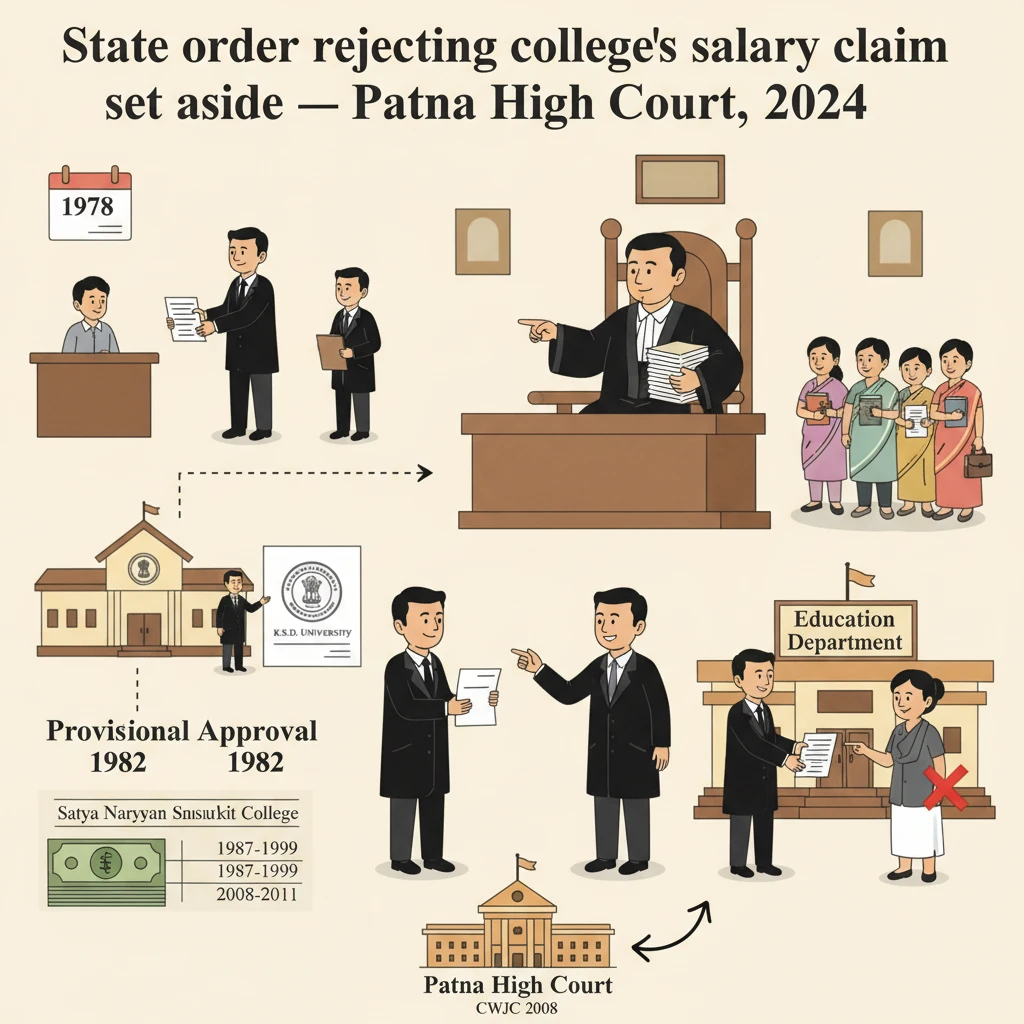
The Court cancelled the State’s order that had refused to recognise his service.
It directed the authorities to regularise his service and give all benefits from his initial appointment in 1978.
The authorities have three months to comply, failing which they can be held responsible.
Case Background
The case arose from the service of a clerk appointed in Satya Narayan Sanskrit College, Chhatauni, an affiliated unit of Kameshwar Singh Darbhanga Sanskrit University.
The petitioner was appointed by the Governing Body of the College on the post of Second Clerk on 05.10.1978. He joined on 15.10.1978 by submitting his joining to the Principal of the College.
On the request of the Governing Body, the University provisionally approved the appointment of the petitioner along with others through letter no.190/82 dated 16.07.1982, issued by the Registrar. Later, by letter no.1084/88 dated 08.02.1988, the University decided to make ad hoc payment to the petitioner and others from September 1987 till further orders.
Salary was actually paid by the University from September 1987 to 1999 and then again from March 2008 to 2011. In between and thereafter, payments were irregular or stopped, leading to repeated litigation.
Similarly situated employees and the Karamchari Mahasangh of the University had earlier approached the Patna High Court in a batch of writ petitions, the leading one being CWJC No.9222 of 1991, reported in 2003 (3) PLJR 749. By order dated 25.06.2003, the Court directed the University to send details of all concerned employees to the State Government, which was to scrutinise them within four months.
Acting on those directions, the State decided to regularise the services of 33 persons, including one Assistant Librarian of the same college appointed on 01.04.1981, i.e., later than the present petitioner. The petitioner’s case, however, was not regularised.
The petitioner then filed CWJC No.13922 of 2008 seeking arrears and current salary. On 20.09.2010, the High Court directed the authorities to consider and decide his claim. In consequence, the University issued an office order on 25.02.2011 to start payment of salary from March 2008 to him and similarly situated persons. Salary was again stopped in 2011, following which the College wrote to the State Government and submitted budget proposals for salary.
Still aggrieved, the petitioner again approached the High Court in CWJC No.15442 of 2014, seeking approval of his service. On 27.09.2018, the Court directed the State authorities to consider his case in light of the Full Bench judgment in Braj Kishore Singh, reported in 1997 (1) PLJR 509, within two months.
Eventually, the Education Department, Government of Bihar, passed memo no.1449 dated 07.09.2020 rejecting the petitioner’s claim. This memo became the immediate cause for the present writ petition, CWJC No.4619 of 2021, filed before the Patna High Court.
What the Court Examined and Decided
The petitioner challenged memo no.1449 dated 07.09.2020, by which the State refused approval of his service and payment of salary on the ground that his appointment was illegal. He also sought a declaration that his 1978 appointment as clerk was lawful, along with arrears and current salary and all consequential benefits.
Arguing on his behalf, counsel submitted that his appointment was made by the Governing Body of the College on 05.10.1978 and that he joined on 15.10.1978. The University itself had granted provisional approval to his appointment through letter no.190/82 dated 16.07.1982 and had arranged ad hoc salary payment from September 1987 as per letter no.1084/88 dated 08.02.1988.
Counsel emphasised that salary had been paid for long periods, which showed that the University and State had accepted his work. He pointed out that, in follow-up to the earlier batch of writ petitions (leading case CWJC No.9222 of 1991, reported in 2003 (3) PLJR 749), the State had regularised 33 employees, including one Assistant Librarian of the same college, appointed in 1981, later than the petitioner.
The petitioner relied heavily on the Full Bench judgment in Braj Kishore Singh, 1997 (1) PLJR 509, and the State’s own resolution of the Human Resources Development Department contained in memo no.989 dated 10.05.1991. According to this resolution, the benefit of regularisation was to be given to persons appointed before 10.05.1986 against available vacancies, keeping in view the reservation roster. Those who could not be adjusted immediately for want of vacancies were to be continued so they could be adjusted in future. Services of those appointed after 10.05.1986 were to be terminated.
The petitioner argued that he clearly fell in the pre‑10.05.1986 category and his appointment was against posts approved under the staffing pattern fixed by the Bihar Inter University Board, Patna and approved by the State Government on 19.01.1980. Under this staffing pattern, for colleges having up to 400 students, four posts of clerks, one typist, one instructor and one librarian were approved. Thus, his appointment as a second clerk was within the sanctioned staffing pattern.
He also relied on the Full Bench finding that appointments made against posts within the staffing pattern did not require prior sanction of the State Government; instead, post-facto approval could suffice.
The State, through its counsel, defended memo no.1449 dated 07.09.2020. It argued that the petitioner was appointed against a second clerk post which was not sanctioned and that his appointment was made without any advertisement. According to the State, this violated Section 35(2) and Section 10(6) of the Bihar State Universities Act, 1976.
The State explained that Section 35 mandates prior approval of the State Government for creating teaching or non-teaching posts and for appointments in colleges (other than specified exceptions). Section 10(6) empowers the Vice-Chancellor to make appointments only within the sanctioned grades, scales and strength of ministerial staff.
On this basis, the State contended that the appointment was illegal ab initio, as it was against an unsanctioned post and without prior State approval. It further argued that, under the Full Bench judgment in Ram Sewak Yadav v. State of Bihar, 2013 (1) PLJR 964, read with the Supreme Court judgment in Secretary, State of Karnataka v. Uma Devi, 2006 (4) SCC 1, illegal appointments made without open competitive selection could not be regularised. It pointed out that the petitioner’s appointment was not preceded by advertisement and was not made through a competitive process.
The University, in its counter affidavit, confirmed that this was the petitioner’s third writ petition and recounted the earlier orders of 2010 and 2018. It admitted that the petitioner was appointed by the Governing Body on the second clerk post, which it described as unsanctioned. It also referred to its own letter no.190/82 dated 16.07.1982 providing provisional approval subject to sanction of the post by the Government and receipt of grant, showing that the appointment was conditional.
After hearing all parties, the Patna High Court considered the Full Bench judgment in Braj Kishore Singh. In paragraph 9 of that judgment, the Full Bench had analysed Section 35 of the Bihar State Universities Act and held that, while prior approval of the State is required for creation of posts and appointments, this provision must be read realistically.
The Full Bench reasoned that a college cannot function without teachers and necessary staff. If strict prior approval is insisted upon in every case, Section 35 may become unworkable and lead to absurd results. Therefore, the requirement of “prior approval” has to be read down to allow for “post-facto approval” by the State Government in appropriate cases. Appointments made by university/college authorities against posts within the staffing pattern should not be treated as final until State approval, but they can be given legal effect and sanctity once such approval is granted upon scrutiny of qualifications and recruitment process.
In the present case, the Patna High Court noted several important features: the petitioner’s appointment dated back to 1978; he had been provisionally approved by the University; he had been paid salary from public funds for many years; and he had continued in service for about 44 years until his superannuation on 22.02.2022. The Court also noted that the State itself had earlier framed a policy in memo no.989 dated 10.05.1991 to regularise those appointed before 10.05.1986 against available vacancies.
Applying the principles from Braj Kishore Singh, the Court effectively treated the petitioner’s appointment as one made within the staffing pattern where post-facto approval by the State could be granted. It did not accept the State’s stand that the sanctioned strength was limited to “10+2+2” as claimed and found that this was contrary to the facts and law considered in the Full Bench decision and to the staffing pattern fixed by the Bihar Inter University Board and approved on 19.01.1980.
The Court did not rely on the illegal-appointment line of cases to deny relief. Instead, it focused on the special context of university and college appointments under Section 35, the long duration of service, the earlier directions of the High Court, and the State’s own regularisation policy for pre‑1986 appointees.
In the result, the Patna High Court set aside memo no.1449 dated 07.09.2020 issued by the Education Department, Government of Bihar. It directed the “concerned authority” to regularise the petitioner’s service. Since he had already retired on 22.02.2022 after 44 years of service, the Court further directed that all consequential benefits be given to him from the date of his initial appointment, i.e., 05.10.1978.
The authorities were instructed to comply with this order within three months from the date of receiving a copy of the judgment. The Court made it clear that the authorities would be held responsible for non-compliance within the stipulated period. With these directions, the writ application was allowed.
Why This Judgment Matters
This judgment of the Patna High Court is important for non-teaching staff of affiliated colleges who were appointed decades ago and whose services have not yet been regularised.
The Court has reminded the State that long-serving employees appointed within the staffing pattern, especially before 10.05.1986, cannot be casually labelled as illegal appointees and denied benefits when the State itself had framed a policy for their regularisation.
By setting aside the rejection memo and granting regularisation with benefits from the initial appointment date, the judgment provides a clear path for similarly placed employees to claim their dues, especially where the University and State have taken work from them for many years.
The decision also shows that earlier Full Bench judgments like Braj Kishore Singh continue to guide how Section 35 of the Bihar State Universities Act should be applied, particularly in relation to prior versus post-facto State approval of college appointments.
Legal Issues and Answers
- Issue: Whether the petitioner’s appointment as a clerk in 1978, made by the Governing Body without prior State approval, could be treated as illegal so as to deny approval, regularisation and salary benefits.
Answer: No. Relying on the Full Bench in Braj Kishore Singh and the staffing pattern approved by the State, the Court held that the State’s rejection memo was unsustainable and directed regularisation with all consequential benefits from 05.10.1978. - Issue: Whether Section 35 of the Bihar State Universities Act requires strict prior approval of the State Government in every appointment, even where posts fall within an approved staffing pattern.
Answer: No in absolute terms. Following the Full Bench, the Court treated the requirement of prior approval as capable of being fulfilled by post-facto approval in appropriate cases so that the provision remains workable and does not lead to absurd results.
Cases Cited by the Court
- CWJC No.9222 of 1991, reported in 2003 (3) PLJR 749 (leading case in earlier batch concerning similarly situated employees).
- Full Bench judgment in Braj Kishore Singh & Ors. v. State of Bihar & Ors., 1997 (1) PLJR 509.
- Full Bench judgment in Ram Sewak Yadav v. State of Bihar, 2013 (1) PLJR 964 (cited by the State to argue against regularisation).
- Secretary, State of Karnataka v. Uma Devi, 2006 (4) SCC 1 (referred to in Ram Sewak Yadav on limits of regularisation).
Case Details
Case Number: Civil Writ Jurisdiction Case No. 4619 of 2021
Case Title: Vishnudeo Prasad Singh v. The State of Bihar & Ors.
Citation: 2024 (4) PLJR 134
Court: High Court of Judicature at Patna
Coram: Hon’ble Mr. Justice Anjani Kumar Sharan
Date of Judgment: 29.08.2024
Advocates:
- For the Petitioner: Mr. Satyam Shivam Sundaram
- For the State: Mr. Prabhakar Jha, GP 27; Mr. Umesh Narayan Dubey, AC to GP 27
- For the University: Mr. Deepak Kumar
Nature of the Case: Writ petition under civil writ jurisdiction challenging State Government memo refusing approval and salary; seeking regularisation and consequential benefits.
Link to Judgment: Click here to read the full Patna High Court judgment
If you found this explanation helpful and wish to stay informed about
how legal developments may affect your rights in Bihar,
you may consider following Samvida Law Associates for more updates.







