

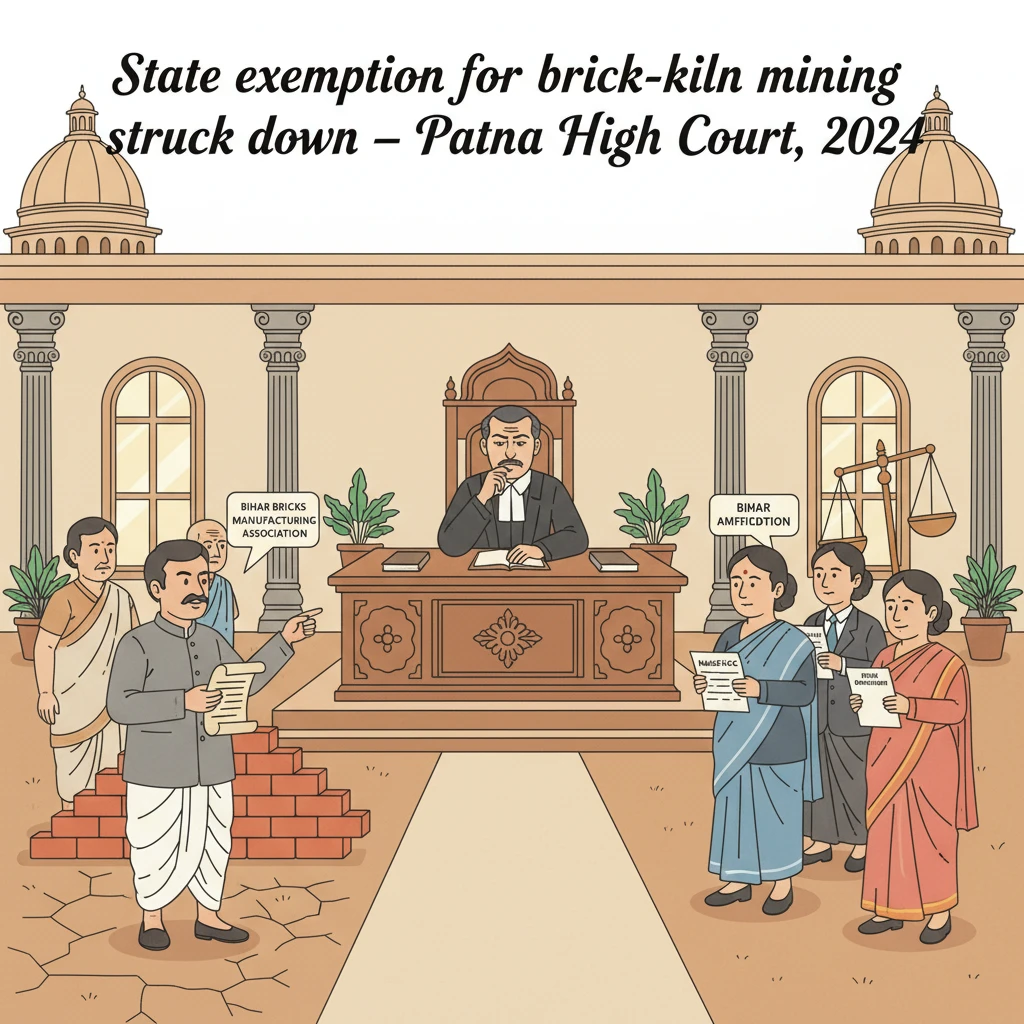
Case Background
The case arose from a public interest litigation filed by a resident of Patna challenging a State Government notification (Annexure-2). That notification had amended Rule 38(3) of the Bihar Minerals (Concession, Prevention of Illegal Mining, Transportation & Storage) Rules, 2019.
Through this amendment, quarrying of clay for brick-kilns was treated as a “non-mining activity” for the purpose of environmental clearance. It also said that environmental clearance would be required only if the depth of the quarry exceeded one and a half metres from the adjoining ground level.
The petitioner argued that this change would allow large numbers of brick-kilns to operate without proper environmental scrutiny or mining permissions. The challenge was not only to the State notification but also to a central notification dated 28.03.2020 issued by the Ministry of Environment, Forest and Climate Change (MoEF&CC).
That central notification had introduced Appendix-IX to the Environmental Impact Assessment (EIA) Notification, 2006, listing activities that did not require prior environmental clearance. Clause 13 of this Appendix allowed State Governments, under their own legislation or rules, to declare certain activities as “non-mining” and thereby outside prior environmental clearance.
The petitioner contended that Bihar had used this Clause 13 to declare brick-kiln clay quarrying as non-mining, and that both the central delegation and the State notification were legally unsustainable and harmful to the environment.
What the Court Examined and Decided
The Patna High Court, speaking through the Hon’ble Chief Justice with Hon’ble Mr. Justice Harish Kumar agreeing, first noted the petitioner’s core grievance: by treating brick-kiln quarrying as a non-mining activity and tying environmental clearance only to depth beyond one and a half metres, the State had created a broad exemption from established environmental safeguards.
Counsel for the petitioner drew attention to the MoEF&CC notification dated 28.03.2020. Appendix-IX to that notification listed various activities which would not require prior environmental clearance. At Sl. No. 13, it allowed States to declare certain activities as non-mining under their own legislation or rules.
The petitioner argued that this went beyond the power granted to the Central Government under the Environment (Protection) Act, 1986, and amounted to excessive delegation, because the Central Government in turn allowed States to exempt activities from environmental clearance without clear guidelines.
It was further argued that even if Clause 13 were valid, the activities declared by the State must be of the same nature as those at Sl. Nos. 1 to 12 of Appendix-IX. Those clauses focused on preserving traditional occupations and crafts, or on activities necessary for public welfare and protection against disasters. Brick manufacturing, according to the petitioner, did not fall in that category.
The petitioner also relied on a document (Annexure-P/4) that spoke about preserving top soil to maintain soil fertility. The concern was that widespread brick-kilns, allowed to dig clay without proper control, would destroy top soil and defeat the objective of soil preservation.
On the other side, counsel for the Bihar State Pollution Control Board pointed out that even if brick-kilns were exempt from environmental clearance, they still needed consent to establish and consent to operate from the Board under the Air (Prevention and Control of Pollution) Act, 1981. This was presented as a safeguard against pollution.
The learned Government Advocate for the State drew attention to the evolution of central policy. Earlier, Clause 13 required approval from the Central Government before a State could declare an activity as one not requiring prior environmental clearance. The later notification (Annexure-4) had removed this requirement, which, according to the State, reflected the Central Government’s intention to give States flexibility to promote development activities while still avoiding serious environmental damage.
The Court then turned to the Mines and Minerals (Development and Regulation) Act, 1957 (MMDR Act). Section 4 of the MMDR Act says that no person may undertake reconnaissance, prospecting or mining operations except under a reconnaissance permit, prospecting licence or mining lease. Section 15 gives State Governments the power to make rules for minor minerals, including quarry leases and other concessions.
The Court highlighted that, originally, Section 14 of the MMDR Act excluded Sections 4 to 13 for minor minerals. But from 10.02.1987, by amendment, only Sections 5 to 13 were excluded. Section 4 was made applicable even to minor minerals. This meant that even for minor minerals such as clay, mining could not be carried out without an appropriate permit or lease.
The Court examined how the Mines Act, 1952 and the MMDR Act work together. It held that they are complementary and do not exclude each other. Any activity involving underground excavation, including open cast working, falls within the definition of “mine” under the Mines Act, which has no separate definition under the MMDR Act.
To support this, the Court referred to earlier Supreme Court decisions. In Bhagwan Dass v. State of Uttar Pradesh & Others, the Supreme Court held that minerals need not be subterranean and that “winning” a mineral simply means extracting it, whether or not the activity is hazardous.
In Sri Tarkeshwar Sio Thakur Jiu v. Dar Dass Dey & Co. and Others, the Supreme Court clarified that “any excavation” for obtaining minerals, whether an open cast cavity or an underground tunnel, falls within the definition of “mine”, and that mining operations can occur on the surface or beneath the earth.
The Court also referred to Joint Director of Mines Safety v. M/s. Tandur and Nayandgi Stone Quarries (P) Ltd., where the Supreme Court explained that the Mines Act is primarily for the safety of workmen, while the MMDR Act is for development and regulation of mines under Union control.
On the scope of State legislative power over minerals, the Court relied on Monnet Ispat & Energy Ltd. v. Union of India, where the Supreme Court analysed Entry 54 of List I and Entry 23 of List II in the Constitution. It held that once Parliament declares that regulation of mines and mineral development should be under Union control (as done in Section 2 of the MMDR Act), the States lose legislative competence to that extent. State legislation cannot trespass into the field occupied by the central law.
Using this reasoning, the Patna High Court held that Section 4 of the MMDR Act, which prohibits mining without a permit, applies to minor minerals and cannot be overridden by State rules framed under Section 15. Therefore, the State cannot exempt any mining activity involving minor minerals from the need for a permit, licence or lease.
The Court then examined the purpose of the Environment (Protection) Act, 1986 and the Environmental (Protection) Rules, 1986. Section 3 empowers the Central Government to take measures to protect and improve the environment, and clause (5) of sub-section (2) allows it to prescribe areas where certain industries or processes shall not be carried out or shall be subject to safeguards.
Rule 5 deals with prohibition and restriction on location of industries and operations. It allows the Central Government, in public interest, to dispense with the requirement of prior notice before issuing certain measures.
The Court noted that the 28.03.2020 notification was issued under Section 3 and Rule 5. It aligned the EIA Notification, 2006 with amendments in the MMDR Act, including new Section 8B, which allowed a successful bidder of an expiring mining lease to be deemed to have the approvals and clearances of the previous lessee for two years.
The notification also responded to representations seeking waiver of prior environmental clearance for certain activities such as burrowing ordinary earth for roads, manual extraction of lime shells and shrines within inter tidal zones by traditional communities.
The Court emphasised that the Environment Act is meant to prevent, control and reduce pollution. While the Central Government can restrict industries, it also has the power to exempt some restrictive measures for activities that do not significantly harm the environment or where there are compelling public reasons, such as protection of traditional communities, disaster prevention or essential development like roads and pipelines.
Looking at Appendix-IX, the Court observed that Clauses 1, 2, 8 and 9 protect traditional communities such as potters, earthen tile makers, Banjaras and Oads, including those working in inter tidal zones. Clauses 3, 4, 5, 7 and 12 aim to protect farmlands from floods, allow customary extractions for community work, and enable dredging, desilting and plugging breaches in water bodies, all of which help prevent disasters.
Clause 6 covers burrowing ordinary earth for linear projects such as roads and pipelines. Clause 10 relates to irrigation or drinking water projects, and Clause 11 allows digging of building foundations without prior environmental clearance.
Against this background, Clause 13, which allowed States to declare other activities as non-mining, was seen as problematic. The Court pointed out that earlier versions required concurrence of the MoEF&CC before such exemptions, but this safeguard had been removed, effectively giving States a free hand to exempt mining activities.
The Court held that this amounted to a further delegation of power. Parliament had delegated certain powers to the Central Government under the Environment Act and MMDR Act. The Central Government could not, in turn, delegate to State Governments a power that the statutes themselves had not granted to the States. This would violate the principle “delegatus non potest delegare” — a delegate cannot further delegate.
The Court also applied the principle of ejusdem generis. It held that any “other activity” to be exempted under Clause 13 of Appendix-IX must be similar in nature to the activities listed in Clauses 1 to 12: traditional livelihoods, disaster management, essential public utilities and basic necessities such as water and irrigation.
Brick manufacturing did not fall into any of these categories. It was not a traditional livelihood of marginalised groups protected in the same way as those communities referred to in the notification, nor was it a disaster-prevention or essential public utility activity. Moreover, brick-kiln clay extraction directly affected top soil and environmental quality.
Therefore, the Court concluded that neither the MMDR Act nor the Environment (Protection) Act gave the State power to exempt brick-kiln clay quarrying from mining and environmental clearance requirements. The Central Government’s attempt, through Clause 13 of Appendix-IX, to allow States such power was itself invalid.
On this reasoning, the Court set aside the State’s Annexure-2 notification that had amended Rule 38(3) of the Bihar Minerals (Concession, Prevention of Illegal Mining, Transportation & Storage) Rules, 2019. It also struck down Clause 13 of Appendix-IX to the EIA Notification, 2006, to the extent it delegated power to the States to exempt activities from environmental clearance by declaring them non-mining.
The writ petition was allowed. The practical effect is that brick-kiln operations involving clay extraction in Bihar must now comply with the full rigour of the MMDR Act and the EIA framework, including obtaining necessary mining permits and, where applicable, environmental clearance.
Why This Judgment Matters
This judgment has major impact on brick-kiln owners, landowners, and nearby residents in Bihar. By striking down the State’s exemption, it closes a route by which brick-kilns could avoid mining permits and environmental scrutiny.
For communities living around brick-kilns, it means there is a clear legal requirement that any clay excavation for bricks must follow mining rules. This supports protection of top soil, farmland and local environment, and ensures that authorities cannot lightly reclassify such activity as non-mining.
For State authorities, the decision is a reminder that their powers are limited by central laws such as the MMDR Act and Environment (Protection) Act. They cannot bypass these frameworks by simply declaring mining-related activities as something else.
The ruling also clarifies that the Central Government, when using its powers under environmental law, cannot hand over to States a blanket authority to remove activities from the environmental clearance regime unless the statute clearly allows such delegation.
Legal Issues and Answers
- Issue: Could the State of Bihar validly declare clay quarrying for brick-kilns as a non-mining activity, exempt from environmental clearance and mining permit requirements?
Answer: No. The Court held that under Section 4 of the MMDR Act, mining of even minor minerals requires a permit, licence or lease, and State rules under Section 15 cannot exempt such activity from this requirement. - Issue: Was Clause 13 of Appendix-IX to the EIA Notification, 2006, which allowed States to declare activities as non-mining, legally sustainable?
Answer: No. The Court held that this clause amounted to impermissible further delegation (“delegatus non potest delegare”) and that any exempted “other activity” must be similar to those at Clauses 1–12, which brick manufacturing is not. Clause 13 was struck down to the extent it delegated such power to States. - Issue: Did brick-kiln clay extraction fall within the category of exempt activities listed in Appendix-IX of the 28.03.2020 notification?
Answer: No. Applying the principle of ejusdem generis, the Court found brick manufacturing is not akin to traditional livelihood protection, disaster management measures, or essential public utilities listed in Clauses 1–12 and therefore cannot be exempted under Clause 13.
Cases Cited by the Court
- Bhagwan Dass v. State of Uttar Pradesh & Others; (1976) 3 SCC 784
- Sri Tarkeshwar Sio Thakur Jiu v. Dar Dass Dey & Co. and Others; (1979) 3 SCC 106
- Joint Director of Mines Safety v. M/s. Tandur and Nayandgi Stone Quarries (P) Ltd.; (1987) 3 SCC 208
- Monnet Ispat & Energy Ltd. v. Union of India; (2012) 11 SCC 1
Case Details
Case Number: Civil Writ Jurisdiction Case No. 11181 of 2021
Case Title: Abhay Kumar v. The Union of India & Others
Citation: 2024 (2) PLJR 314
Court: High Court of Judicature at Patna
Coram: Hon’ble the Chief Justice K. Vinod Chandran and Hon’ble Mr. Justice Harish Kumar
Date of Judgment: 07-03-2024
Nature of the Case: Public Interest Litigation under civil writ jurisdiction challenging State and central notifications regarding environmental clearance and mining treatment for brick-kiln clay quarrying.
Advocates for the Petitioner: Mr. Abhinav Srivastava, Advocate; Mr. Raushan, Advocate; Mr. Pushkar Bhardwaj, Advocate; Mr. Atul Prakash, Advocate
Advocates for the Union of India: Dr. K. N. Singh, ASG; Mr. Kumar Priya Ranjan, CGC; Mr. Sandeep Kumar, Advocate; Mr. Vibhuti Kumar, Advocate
Advocates for the State of Bihar: Mr. Gyan Prakash Ojha, GA-7; Mr. Ajit Kumar, AC to GA-7
Advocates for SEIAA: Mr. Kumar Ravish, Advocate; Ms. Siddhi Aashna, Advocate
Advocates for Mines Department: Mr. Naresh Dixit, Spl. P.P.; Mr. Sumit Shekhar Pandey, Advocate; Ms. Kalpana, Advocate
Advocate for Bihar State Pollution Control Board: Mr. Abhimanyu Singh, Advocate
Advocate for Respondent No. 7 (Bihar Bricks Manufacturing Association): Mr. Manoj Kumar, Advocate
Link to Judgment: Click here to view the official Patna High Court judgment
If you found this explanation helpful and wish to stay informed about
how legal developments may affect your rights in Bihar,
you may consider following Samvida Law Associates for more updates.







