
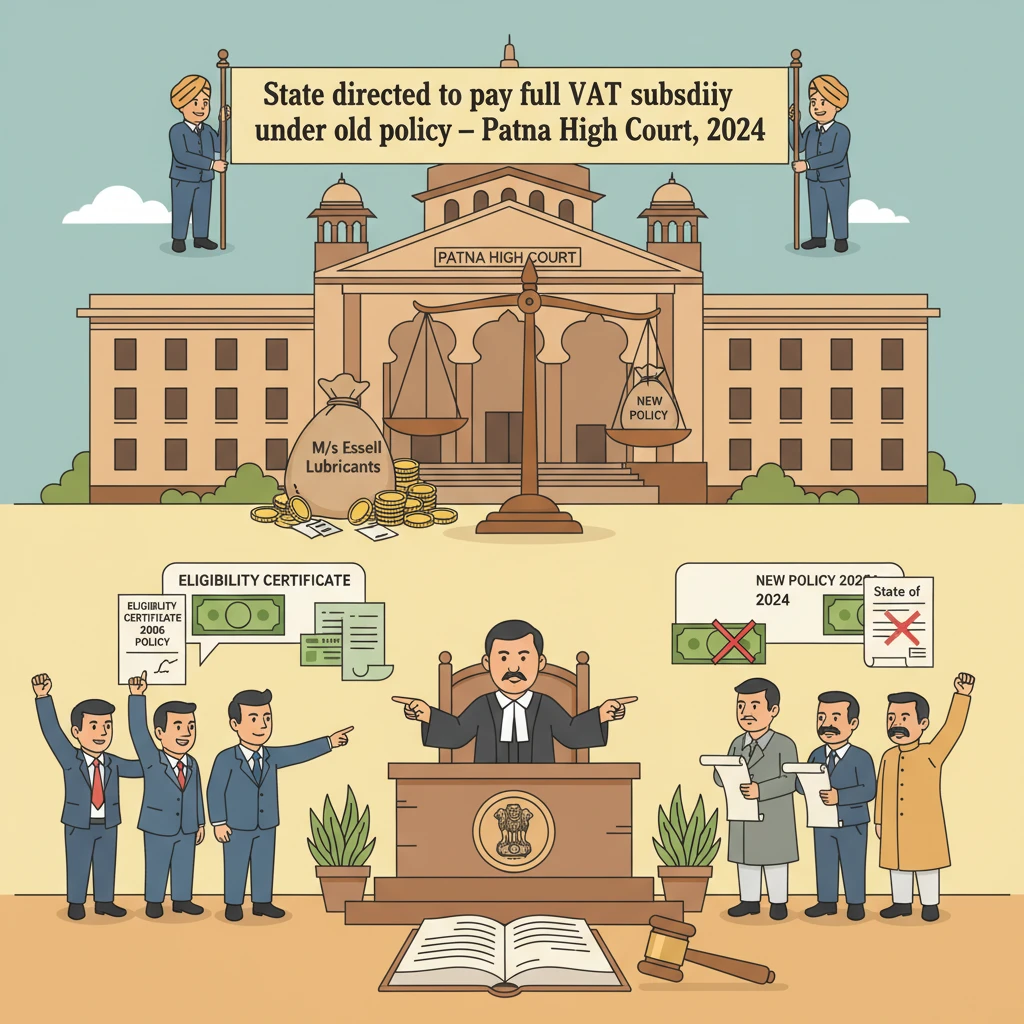
Case Background
This case arose from a dispute between an industrial unit and the State of Bihar over tax incentives promised under the Bihar Industrial Incentive Policy, 2006 (referred to as the 2006 Policy).
The petitioner, M/s Essell Lubricants and Chemicals Private Limited, established a manufacturing unit of refined petroleum products in Aurangabad, Bihar. The unit commenced commercial production on 01.07.2008.
Under the 2006 Policy, new industrial units which started production within five years from 01.04.2006 were promised reimbursement of 80% of the admitted Value Added Tax (VAT) paid to the State Government, for a period of ten years, subject to certain limits.
On the strength of this promise, the petitioner set up its unit and applied under the 2006 Policy. By letter no. 546 dated 31.07.2010, the General Manager, District Industries Centre, Aurangabad, issued an eligibility certificate. This certificate confirmed that the petitioner was eligible to receive 80% VAT reimbursement under the 2006 Policy.
For the financial years 2010-11 and 2011-12, the authorities accepted the petitioner’s claim and paid reimbursement at 80% of the admitted VAT amount.
However, for the financial years 2012-13, 2013-14 and 2014-15, the petitioner claimed reimbursement totalling Rs. 26,94,442/-, but received only Rs. 9,14,606/-. A balance of Rs. 17,79,836/- remained unpaid despite the petitioner approaching the Commercial Tax Department by representation.
In this situation, the petitioner filed the present writ application, seeking a direction for payment of Rs. 17.79 lakhs (approx.) towards VAT reimbursement for 2012-13 to 2014-15 under the 2006 Policy. Through I.A. No. 1 of 2022, the petitioner also challenged letter no. 649 dated 27.08.2021, by which the District Industries Centre communicated that the petitioner did not have approval of the District Level Single Window Clearance Committee / State Investment Promotion Board.
What the Court Examined and Decided
Justice Anil Kumar Sinha of the Patna High Court heard the matter and examined both the 2006 Industrial Policy and the later 2011 Industrial Policy, along with the facts of how the petitioner’s unit was set up and treated by the State authorities.
The petitioner’s counsel argued that:
- The 2006 Policy clearly promised 80% VAT reimbursement for new units that commenced production within five years from 01.04.2006.
- The petitioner’s unit started commercial production on 01.07.2008, well within this time frame, and was fully covered by the 2006 Policy.
- The State authorities themselves issued an eligibility certificate (Annexure 1) confirming eligibility for 80% VAT reimbursement.
- On that basis, the State had actually paid 80% VAT reimbursement for the financial years 2010-11 and 2011-12.
- Only later, in a supplementary counter affidavit dated 01.09.2021, the State for the first time claimed that the petitioner lacked approval from the District Level Single Window Clearance Committee / State Investment Promotion Board.
- The State also took the stand that because a new Industrial Policy, 2011, had come into effect, the petitioner was entitled only to 25% VAT reimbursement, and not 80%.
The petitioner’s side emphasized that it had set up its industrial unit and invested significant capital on the strength of the promise in the 2006 Policy. Having altered its position based on that promise, it could not now be denied the promised benefit.
The State’s counsel, on the other hand, argued that:
- The Industrial Policy, 2011 had replaced the earlier 2006 Policy.
- Under Clause 3(iii) of the 2011 Policy, “presently working” industrial units were entitled only to 25% reimbursement of admitted VAT/entry tax, and the petitioner had already been paid at this 25% rate for 2012-13, 2013-14 and 2014-15.
- The petitioner had not obtained approval from the State Investment Promotion Board or the District Committee.
- The department had not yet internally resolved the fate of units without this approval.
- The 2006 Policy had completed its tenure and closed; now the 2011 Policy, and later the 2016 Policy, were in force.
The key legal question before the Court was whether the State could deny 80% VAT reimbursement promised under the 2006 Policy by relying on the later 2011 Policy and on the alleged lack of Single Window clearance.
The Court first examined the text of the policies:
Under the 2006 Policy:
- Clause 2(vi) dealt with subsidy/incentive on VAT for small, medium and large industries.
- New units were to get a passbook in which VAT paid under the Bihar VAT Act would be entered and verified by the Commercial Tax Department.
- The Director, Industries, was authorized to pay the incentive amount after verification.
- New units would get 80% reimbursement of admitted VAT paid into the Government account, for a period of ten years.
- The maximum subsidy was 300% of the capital invested.
Under the 2011 Policy:
- Clause 3(b) similarly stated that new units would be entitled to 80% VAT reimbursement against admitted VAT for ten years, subject to a ceiling of 300% of capital invested.
- However, Clause 3(iii), under the heading “reimbursement of VAT/entry-tax for the unit in operation”, said that “presently working industrial units” would get only 25% reimbursement of VAT/entry tax deposited in the Government account against admitted VAT.
The State relied on Clause 3(iii) of the 2011 Policy to argue that the petitioner, being a presently working unit, was entitled only to 25% reimbursement.
The Court then examined binding Supreme Court decisions on promissory estoppel and industrial incentives:
- In Pournami Oil Mills and Others vs. State of Kerala and Another, 1986 Supp SCC 728, the Supreme Court held that new industries set up in response to a Government concession could invoke promissory estoppel and insist that the State honour its promise of tax exemption for the promised period.
- In Motilal Padampat Sugar Mills Co. Ltd. vs. State of UP and Others, (1979) 2 SCC 409, the Supreme Court ruled that where the Government makes a promise intending it to be acted upon, and the promisee alters his position based on that promise, the Government is bound by it, even in the absence of traditional contractual formalities under Article 299 of the Constitution.
The Patna High Court also relied on its own earlier decision in M/s Gangotri Iron & Steel Co. Ltd. vs. State of Bihar & Others, 2021(3) PLJR 73, which had considered the same 2006 Policy. In that case, the Court held that once the State had made a clear and unequivocal promise of subsidy/incentive, and the industrial unit had acted on that promise and altered its position, the State was bound to honour it on the principle of promissory estoppel.
The judgment further referred to Supreme Court decisions including Kasinka Trading and Rom Industries vs. State of Jammu & Kashmir, (2005) 7 SCC 348, noting that where a right to exemption or benefit has already accrued for a fixed period and conditions are fulfilled, withdrawal of exemption during that period cannot take away the accrued right, unless overriding public interest is clearly shown.
Applying these principles, the Court held that:
- Under the 2006 Policy, the State made an “unequivocal promise” to new units commencing production within five years from 01.04.2006 that they would receive 80% VAT reimbursement for ten years.
- The petitioner’s unit commenced production on 01.07.2008, well within the stipulated period.
- The State issued an eligibility certificate under the 2006 Policy confirming eligibility for 80% VAT reimbursement.
- The petitioner altered its position and invested substantial amounts based on this promise and policy.
- The State actually reimbursed 80% VAT for two financial years (2010-11 and 2011-12), thereby acting upon and confirming the policy promise.
- Subsequently, the State could not turn around and reduce the benefit to 25% for later years merely because of the 2011 Policy.
As to the objection about lack of approval from the District Level Single Window Clearance Committee / State Investment Promotion Board, the Court was clear and firm. It noted that the same State authorities had already granted the eligibility certificate and reimbursed 80% VAT for earlier years. In this background, the plea that the unit lacked Single Window clearance was termed “preposterous” and “not acceptable”.
The Court described the decision in letter no. 649 dated 27.08.2021 as “arbitrary and whimsical” and lacking application of mind, because the State had itself treated the petitioner as eligible and had already partly given the promised benefit.
The Court specifically held that the State, having made a promise under the 2006 Policy to extend incentive benefits for ten years, and the petitioner having fulfilled the criteria and acted on that promise, could not deny those benefits on the principles of promissory estoppel and legitimate expectation.
Accordingly, the Court:
- Quashed letter no. 649 dated 27.08.2021.
- Directed the respondent authorities to reimburse 80% of the VAT amount paid by the petitioner for the period 2012-13, 2013-14 and 2014-15, after adjusting any amount already paid.
- Ordered that the amount so calculated must be paid within two months from the date of receipt or production of a copy of the order.
Why This Judgment Matters
This judgment is significant for industrial units in Bihar that set up operations on the strength of earlier industrial policies.
The Patna High Court has clearly held that once the State promises a certain level of tax benefit for a fixed period, and an industry starts its unit and invests money relying on that promise, the State cannot later cut down the benefit by changing the policy mid-way, unless there is a strong public interest reason, which must be clearly shown.
The decision also shows that the State cannot take contradictory stands—first issuing eligibility certificates and paying benefits, and later denying those very benefits by citing technical objections like absence of Single Window clearance.
For industrial investors, this judgment reinforces that:
- Written policy promises and eligibility certificates from the government have legal value.
- If an industry follows the policy, starts production in time and fulfils the conditions, it can demand the promised incentives.
- If benefits are wrongly reduced or stopped, courts can step in and direct payment.
For the State, the judgment is a reminder that policy assurances given to attract investment must be honoured fairly, to maintain trust and predictability in government schemes.
Legal Issues and Answers
- Issue: Can the State of Bihar reduce VAT reimbursement from 80% to 25% for a new industrial unit that commenced production within the time limit of the 2006 Policy, by relying on the later 2011 Industrial Policy?
Answer: No. The Court held that the State is bound by its clear promise under the 2006 Policy to grant 80% VAT reimbursement for ten years, and cannot curtail this accrued benefit by invoking the 2011 Policy. - Issue: Can the State deny VAT reimbursement on the ground that the unit did not have approval from the District Level Single Window Clearance Committee / State Investment Promotion Board, after having issued an eligibility certificate and paid 80% reimbursement for earlier years?
Answer: No. The Court found this plea to be preposterous and not acceptable. The earlier eligibility certificate and payments bound the State, and the letter denying benefit on this ground was quashed as arbitrary. - Issue: Does the doctrine of promissory estoppel and legitimate expectation apply against the State in matters of industrial incentives?
Answer: Yes. Relying on Supreme Court and Patna High Court precedents, the Court held that where an industry sets up a unit and alters its position based on a clear policy promise, the State is bound by that promise, unless overriding public interest is established.
Cases Cited by the Court
- Pournami Oil Mills and Others vs. State of Kerala and Another, 1986 Supp SCC 728.
- Motilal Padampat Sugar Mills Co. Ltd. vs. State of UP and Others, (1979) 2 SCC 409.
- M/s Gangotri Iron & Steel Co. Ltd. vs. State of Bihar & Others, 2021(3) PLJR 73.
- Kasinka Trading (referred to for principle of promissory estoppel and withdrawal of exemption).
- Rom Industries vs. State of Jammu & Kashmir, (2005) 7 SCC 348.
Case Details
Case Number: Civil Writ Jurisdiction Case No. 10038 of 2020
Case Title: M/s Essell Lubricants and Chemicals Private Limited vs. The State of Bihar & Others
Coram: Hon’ble Mr. Justice Anil Kumar Sinha
Citation: 2025(3) PLJR 3
Advocates:
For the petitioner: Mr. Brisketu Sharan Pandey
For the respondents (State): Mr. Lalit Kishore, Advocate General
Nature of the Case: Writ petition under Article 226 of the Constitution of India, seeking direction for payment of VAT reimbursement under the Bihar Industrial Incentive Policy, 2006, and challenge to a departmental letter denying such benefit.
Date of Judgment: 22.03.2024 (oral judgment; CAV date 26.02.2024)
Judgment Link: https://patnahighcourt.gov.in/viewjudgment/MTUjMTAwMzgjMjAyMCMxI04=-UlkqO3SpJtk=
If you found this explanation helpful and wish to stay informed about
how legal developments may affect your rights in Bihar,
you may consider following Samvida Law Associates for more updates.







